Covenant headroom is the distance between a borrower's covenant result and the limit in its credit agreement, usually stated as a percentage of the limit: a leverage ratio of 2.72x against a 3.50x maximum has 22.3% headroom, and a coverage ratio of 1.31x against a 1.25x minimum has 4.8%. It matters because a pass tells a lender almost nothing about next quarter, while a cushion of a few percent, or one that has shrunk for three quarters running, says a breach is close. Botminds' Covenant Monitoring re-tests every covenant in a loan book from the borrowers' own statements and shows each one as a gauge of headroom, so a relationship manager sees which borrowers are a quarter away from a limit while there is still time to talk.
The examples on this page come from a fictional sample bank as it runs through the solution: Tamarack Commerce Bank, with 214 borrowers and 612 financial covenants. The research figures come from regulators and peer-reviewed studies, linked where they appear.
Why a breach matters more than a ratio
14pts
rise in the chance of a capital expenditure restriction after a covenant violation
23bp
rise in the interest spread on the same loan after a violation
32%
of private credit agreements studied already restrict capital expenditures
What is covenant headroom? The ratio, and the EBITDA behind it
Headroom has a simple formula and a less simple meaning. For a maximum covenant, such as leverage, it is the limit minus the result, divided by the limit. For a minimum covenant, such as fixed charge coverage or debt service coverage, it is the result minus the limit, divided by the limit. A dollar covenant, such as minimum liquidity or a capital expenditure cap, works the same way in dollars.
The percentage is the number most reports print, and on a leverage covenant it is also the honest one. Total debt divided by EBITDA can rise to the limit if EBITDA falls by the headroom percentage and debt stays put, so 22.3% headroom means EBITDA can fall 22.3%. On a coverage covenant the same arithmetic does not hold, because the numerator is EBITDA less deductions, such as unfinanced capital expenditures, cash taxes and distributions. A fall in EBITDA lands entirely on the smaller number.
One sample borrower's four covenants: headroom in percent, and what it means in money
Total leverage
Limit≤ 3.50x
Result2.72x certified
Headroom22.3%
What the cushion isEBITDA can fall 22.3% before the limit, if debt stays where it is
Fixed charge coverage
Limit≥ 1.25x
Result1.31x certified
Headroom4.8%
What the cushion is$362,500 of EBITDA, or 3.3%, if the deductions stay where they are
Minimum liquidity
Limit≥ $5.0M
Result$6.31M certified
Headroom26.2%
What the cushion is$1.31 million of cash and availability
Capital expenditures, fiscal year
Limit≤ $6.0M
Result$4.18M to date
Headroom30.3%
What the cushion is$1.82 million left to spend in the fourth quarter
The coverage line is the one to read twice. The borrower certified 4.8% headroom, which sounds like a narrow but real cushion. In EBITDA dollars it was 3.3%, about $362,500 on a business earning $11 million a year: one soft month, or one add-back the agreement does not allow. On this borrower it turned out to be the second. Re-tested under the agreement as amended, coverage was 1.23x, below the limit, and the EBITDA add-back behind the difference is worked through line by line elsewhere.
The capital expenditure line misleads in a different way. A fiscal-year cap tested against spending to date always shows plenty of headroom early in the year. The useful question is how much is left for the rest of the year, and whether the borrower's plan fits inside it.
How to calculate covenant headroom: the formula, worked on one coverage test
To calculate covenant headroom, find the result the covenant needs, compare it with the borrower's result, and express the gap both against the limit and against EBITDA. The steps below use the sample borrower's certified third quarter, so every figure can be checked against the agreement's own arithmetic.
Covenant headroom calculation on a fixed charge coverage covenant, step by step
| Step | Calculation | Result |
|---|---|---|
| 1. Fixed charges for the trailing four quarters | Scheduled principal $3,780,000 + cash interest $2,250,000 | $6,030,000 |
| 2. The numerator the 1.25x minimum requires | 1.25 × $6,030,000 | $7,537,500 |
| 3. The numerator the borrower certified | Consolidated EBITDA $11,130,000 − unfinanced capex $2,140,000 − cash taxes $690,000 − distributions $400,000 | $7,900,000 |
| 4. Ratio and ratio headroom | $7,900,000 ÷ $6,030,000 = 1.31x; (1.31 − 1.25) ÷ 1.25 | 4.8% |
| 5. EBITDA cushion in dollars | $7,900,000 − $7,537,500 | $362,500 |
| 6. EBITDA cushion as a share of EBITDA | $362,500 ÷ $11,130,000 | 3.3% |
The same method gives the formula for each covenant type. For a maximum (leverage, senior leverage, capital expenditures): headroom = (limit − result) ÷ limit. For a minimum (fixed charge coverage, debt service coverage, interest coverage, liquidity, net worth): headroom = (result − limit) ÷ limit. A negative result is a breach, and its size matters too: a debt service coverage of 1.12x against a 1.20x minimum is 6.7% short, which tells the relationship manager how large a cure or an amendment would have to be.
Two details trip up hand calculations. Unless the agreement says how to round, compare ratios unrounded: a certificate that shows 1.25x can hide a 1.246x that fails. And the result must use the agreement's definitions, not the borrower's reported EBITDA: if an add-back is capped or a lease is counted as debt, headroom computed from the income statement is headroom for a covenant the bank never wrote.
Why a covenant breach costs more than the spread
A breach is not a pricing event; it hands the lender control. "The breach of a financial covenant means that the borrower is in technical default on the loan," the FDIC working paper by Nini, Smith and Sufi explains, "and that the lender has the right to demand immediate repayment of the entire loan" (FDIC CFR 2007-01). Lenders rarely demand repayment. They use the moment to renegotiate, and the terms that change most are the ones that limit what the borrower can do.
The same study measured it. After a violation, the chance that the loan carries a capital expenditure restriction rises by 14 percentage points, a 44% increase at the mean, while the interest spread rises by about 23 basis points. The lender's price for a breach is paid mostly in control, not in margin, and what happens if a borrower breaches a loan covenant follows the rest of the sequence, from the notice to the renegotiation.
That is why headroom is the relationship manager's number. A borrower with 5% headroom is one quarter from a conversation in which the bank, not the borrower, sets the agenda. A relationship manager who raises it while the borrower is still compliant can talk about the plan, the forecast and whether the structure still fits. One who learns of it from a breach notice is talking about a waiver fee.
Where a whole book sits: headroom across 612 covenants
Across a book, headroom shows where the next quarter's breaches will come from, if they come at all. At the sample bank, almost seven in ten tested covenants sit with more than a quarter of their limit to spare. The ones that matter are the thin band between zero and 10%, and the late certificates that have not been tested at all.
Most covenants have room; fourteen do not, and 79 are untested
The untested bar is the uncomfortable one. Seventy-nine covenants belong to borrowers whose certificates were late, and a late certificate is not neutral: a borrower whose quarter went badly has the most reason to be slow. A report that shows last quarter's headroom for those borrowers, in the same colour as everyone else's, is reporting a guess. The covenant status report in the solution keeps them in a band of their own.
The book as a wall of gauges, tightest first
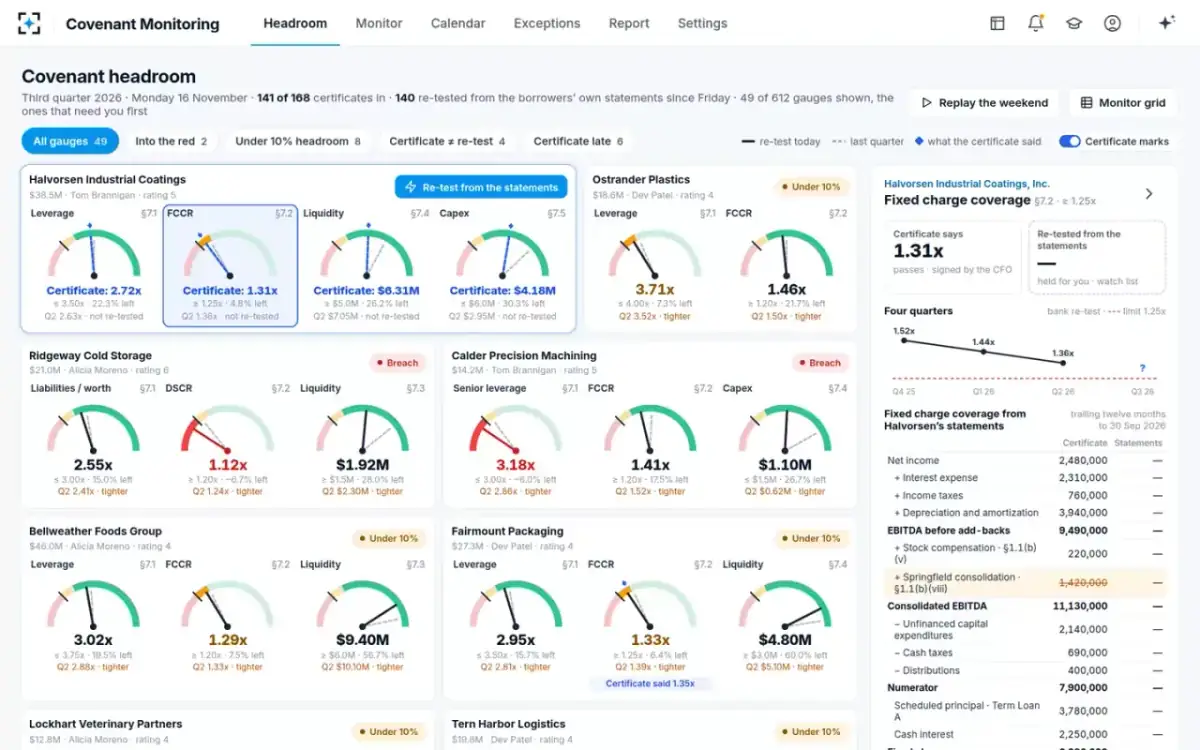
Trend beats level: three quarters of falling headroom
A level tells you where a borrower is; a trend tells you where it is going. A borrower at 7% headroom that has been at 7% for two years is a different credit from one that was at 22% a year ago. Covenant Monitoring flags both: any covenant under 10% of its limit, and any borrower whose headroom has fallen three quarters running, whatever the level.
One borrower's coverage headroom, quarter by quarter
The trend rule caught this borrower before the level rule did. In the second quarter its coverage headroom was still 8.8%, inside the 10% band but no worse than several others, and its rating moved from 4 to 5, the watch list, on 14 August after the chief credit officer approved it. The third quarter's certificate claimed a recovery, to 1.31x. The bank's re-test showed the fall had continued. A borrower on the watch list is re-tested with an analyst present, which is why the recalculation waited for one rather than running over the weekend.
What is covenant headroom erosion? Step-downs, expiring add-backs and the quarter that drops out
Headroom erosion is a cushion that shrinks even when the borrower's business does not get worse, and it has three common causes. Each is written in the agreement or the arithmetic, so each can be seen coming a year ahead.
The first is the step-down. Many agreements tighten a limit on a schedule, so a borrower whose ratio holds perfectly still loses headroom at every step. Take a leverage ratio steady at 3.40x under a maximum that steps from 4.00x to 3.75x to 3.50x: headroom falls from 15.0% to 9.3% to 2.9% without a single dollar of EBITDA lost.
A step-down covenant erodes headroom while the borrower stands still
The second is the add-back that expires. Where an agreement allows a pro forma adjustment, such as expected savings from an acquisition, only for a set number of quarters, the covenant EBITDA falls when the window closes even if reported EBITDA does not. The third is the strong quarter rolling out of the trailing twelve months: a borrower with one exceptional quarter a year ago loses that quarter's contribution on the anniversary. A headroom report should therefore compare each result with the limit in force on that test date, read from the agreement and every amendment, not with the limit at closing, and should show the next two test dates' limits alongside.
Setting the tight-headroom line: 5%, 10% or 25%?
There is no regulatory figure for tight headroom; it is a matter of credit policy. The OCC's 2026 examiner job aid describes what well-set covenants do instead: conservative covenants "allow the bank to renegotiate loan terms to reflect emerging weaknesses in a timely manner before credit deterioration", while liberal ones "may permit significant deterioration in borrower performance or collateral position before a covenant violation or an event of default is triggered" (OCC, Lending and Loan Portfolio Risk Management). A threshold is the monitoring half of the same idea: it should fire while there is still time to renegotiate.
How the OCC grades financial covenants, and what each grade means for headroom
The examiner job aid: "Financial covenants are strong, well established, and within acceptable parameters to manage risks." They let the bank renegotiate "in a timely manner before credit deterioration."
For the headroom report: Headroom is narrow enough to move when performance moves. A 10% band catches most deterioration a quarter early.
The examiner job aid: "Adequate and generally well established but may lead to heightened risk exposure." Renegotiation comes "before significant credit deterioration."
For the headroom report: Trend matters more than level: a fall of several quarters is often the first signal.
The examiner job aid: "Inadequate, inappropriately established, or nonexistent," permitting "significant deterioration … before a covenant violation or an event of default is triggered."
For the headroom report: Headroom stays wide while the credit weakens. A pass says little; the spread and the borrower's own trend say more.
The Federal Reserve's manual adds the other side of the trade. Covenants "should not be written so restrictively that the borrower is constantly in default over trivial issues; however, violations should be dealt with immediately to give credibility to the agreement" (CBEM §2080.1). A tight-headroom threshold set too wide floods the relationship managers with borrowers who are fine; set too narrow, it fires the same week as the breach. In the solution the threshold is a setting, from 5% to 25%, with the trend rule from two to four quarters, both versioned and on the audit trail.
What the relationship manager does in each band
A band is only useful if it comes with an action. The table below is one way a bank can write the response into its procedures; the bands are the sample bank's, and the actions are ours, offered as a starting point.
Headroom bands, and the call each one prompts
| Band | What it usually means | What the relationship manager does |
|---|---|---|
| Over 25% | Performance far from the limit; little to learn from the covenant this quarter. | Nothing beyond the normal relationship. Watch the trend at the annual review. |
| 10–25% | A cushion that one bad quarter would use up on a coverage covenant. | Look at the trend. Two quarters of decline is a reason to ask for the borrower's forecast. |
| Under 10% | A quarter away from the limit. | Call the CFO before the next test date. Ask for the forecast and the plan, and how the next certificate will be calculated. |
| Falling three quarters | Deterioration, whatever the level. | Treat as under 10%. Raise a rating review with credit if the forecast does not turn. |
| Breach, confirmed | A technical default; the bank's rights are open. | Send the reservation-of-rights letter, discuss a cure, and take any waiver request to the chief credit officer with a recommendation. |
| Untested, certificate late | Unknown, and more likely bad than good. | Chase the certificate. The covenant shows last quarter's figure until it arrives, and should not be read as a pass. |
The breach row is where the relationship manager's response stops being optional. Accepting late performance without reserving the bank's rights risks a waiver by conduct, which is why the solution drafts a reservation-of-rights letter for every confirmed breach. What a waiver is, and why the examiner still counts it, follows a breach from there.
The monitor: every borrower's headroom, filtered to the ones under 10%
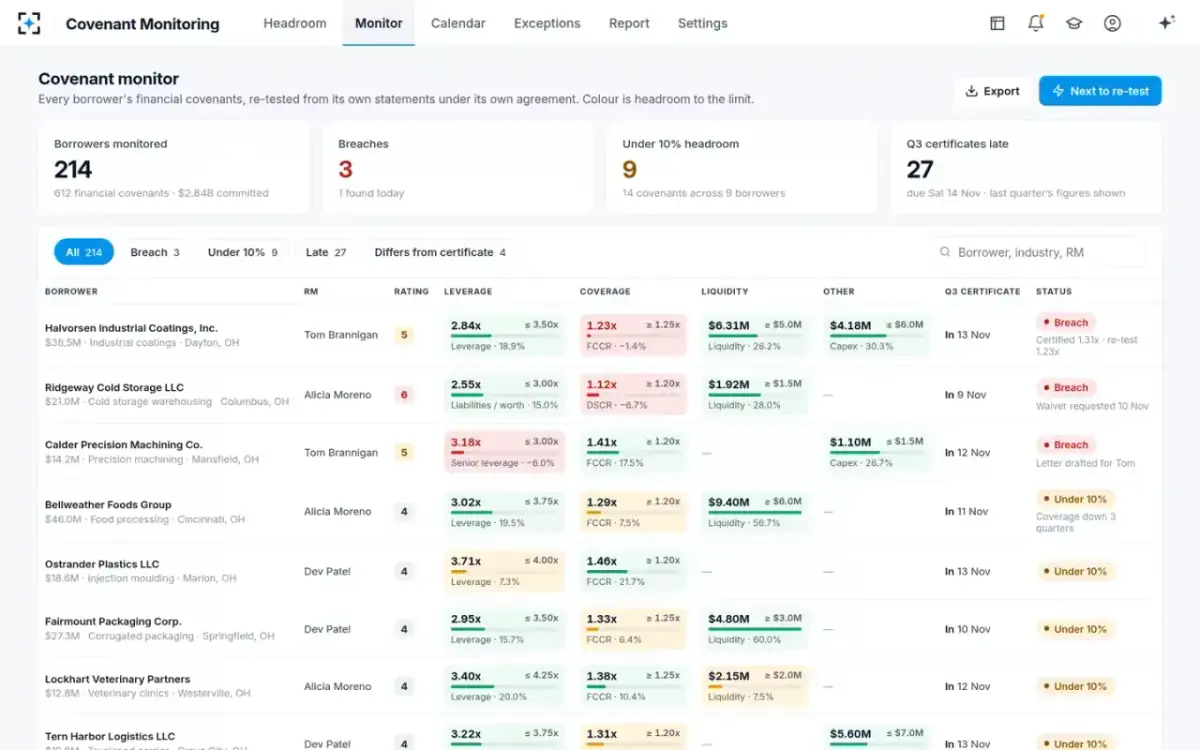
Headroom is also the reason breaches are less rare than most relationship managers assume; how often borrowers breach loan covenants sets out the research. To see the gauges, the trend rule and the letters together, start from Covenant Monitoring.
Questions people ask
What is a good covenant headroom?
There is no standard figure. Covenants are usually set at closing with a cushion against the projections the credit was approved on, and how much cushion is part of the negotiation. For monitoring, the useful questions are whether headroom is under the bank's tight threshold, commonly somewhere between 5% and 25%, and whether it has been falling.
Should headroom be measured on the ratio or on EBITDA?
Both. The ratio percentage is what the agreement tests. The EBITDA cushion, how many dollars of earnings the borrower can lose before the limit, is what a relationship manager can discuss with a CFO. On leverage the two are the same percentage; on coverage covenants the EBITDA cushion is smaller.
Is covenant headroom the same as covenant cushion?
In practice, yes: lenders use headroom, cushion and room interchangeably for the distance between a result and its limit. Some reserve cushion for the gap set at closing between the covenant and the borrower's projections, and headroom for the gap at each test date. What matters more is saying which unit is meant, percent of the limit or dollars of EBITDA, because on a coverage covenant the two differ.
How is headroom calculated on a debt service coverage covenant?
The same way as on any minimum: the result less the minimum, divided by the minimum. A debt service coverage of 1.32x against 1.20x has 10% headroom; at 1.12x it is 6.7% short, a breach. Because debt service is largely fixed, a fall in cash flow lands on the ratio almost in full, so a debt service coverage covenant can move from comfortable to breached in one weak year.
What is an equity cure, and does it restore headroom?
An equity cure lets the owners inject cash that counts toward the covenant for the period that failed. In the sample agreement it must be made within 15 business days, may be used twice, and not in consecutive quarters. It fixes one test; it does not change the trend that produced the breach.