AI covenant extraction is the use of a language-model agent to read a credit agreement and every amendment and return the covenants a bank must test: each financial covenant with its limit, step-downs and test period, the defined terms it rests on, cure rights, reporting deadlines and events of default, each cited to its section and page. It matters because covenant testing is only as good as this step. The ratio is simple arithmetic; deciding which definitions and limits apply this quarter takes the whole agreement, and amendments rewrite it by reference. Botminds' Covenant Monitoring gives that reading to one agent, the agreement reader, which builds the covenant register the other agents test from. This page follows it through one borrower, then sets out what to look for in any AI covenant extraction tool and how to test it before relying on it.
The agreement reader, from documents to register
It reads
Credit Agreement of 18 March 2024 · 142 pages
First Amendment of 9 December 2025 · 11 pages
in date order, the latest amendment winning
It hands over a register of
- 4 financial covenants, each with its section, limit and test frequency
- the definitions they rest on, as amended, with page numbers
- the equity cure: 15 business days, 2 uses
- reporting deadlines: 45 days quarterly, 120 days audited
- insurance and other covenants, and the events of default
Can AI extract covenants from a credit agreement? What it should return
Yes, the reading itself is well within what current language models do, provided the output is constrained: cited, amendment-aware and forbidden to fill gaps. The harder question is what the extraction must return for a covenant test to rely on it, because a list of covenant names and numbers is not enough to test anything.
A usable extraction returns five things. The covenants, each with its limit and any step-down schedule by test date. The definitions behind them, built from their cross-references, so "Consolidated EBITDA" arrives with its add-back clauses, caps and windows rather than as a heading. The amendment history, applied in date order with the superseded text still cited. The cure rights and their limits. And the reporting obligations, which become the calendar a certificate is chased against. Without the second and third, the tester re-uses the borrower's reading of the agreement, which is the error the test exists to catch.
Why the ratio is easy and the agreement is hard
Dividing one number by another takes no skill; deciding which numbers to divide takes the whole agreement. In the sample agreement, "Consolidated EBITDA" is built from "Consolidated Net Income" and "Consolidated Interest Expense", both defined elsewhere in section 1.1, with eight add-back clauses, a dollar cap on one, a date window on another and, since the First Amendment, a percentage cap. Fixed charge coverage then subtracts unfinanced capital expenditures, cash taxes and distributions, each with a definition of its own. A test that gets any of these wrong gets the covenant wrong.
Amendments make it harder, and they are frequent. Michael Roberts found that the typical bank loan "is renegotiated five times, or every nine months", with "pricing, maturity, amount, and covenants" all modified along the way (NBER working paper 20484). An amendment rarely restates the agreement; it changes it by reference, adding a clause here and replacing a number there, and the reader has to rebuild each definition from the pieces. A covenant workbook built at closing and never rebuilt carries the closing definitions forever.
The examiners' question is about exactly this. The OCC's Commercial Loans procedures ask about "Use of loan agreements and financial/collateral covenants, including monitoring and enforcement" and "Systems for monitoring compliance with loan covenants" (OCC, Commercial Loans). A system that monitors the wrong definition monitors nothing.
What the agreement reader does, step by step
The agent's job is narrow and its limits are explicit. It reads; it does not test, collect, judge or decide. Three rules govern everything it produces: it never invents a threshold or a definition that is not in the documents, the latest amendment always wins, and every term it extracts cites its section and page.
Inside the agreement reader
Agent
Agreement reader · readReads the credit agreement and every amendment it is given, in date order.
Agent
Agreement reader · defineBuilds each defined term from its parts, following its cross-references.
Never: Never fills a gap with a definition that is not in the documents.
Agent
Agreement reader · amendApplies each amendment to the text it changes, so the latest version wins, and keeps both versions cited.
Never: Never drops the earlier text from the citation trail.
Agent
Agreement reader · extractLists every covenant with its limit, step-downs, test period and frequency, cure rights and reporting deadlines.
Never: Never states a limit without its section and page.
Agent
Covenant tester and certificate collectorUse the register: the tester for the definitions and limits, the collector for the reporting calendar.
A person decides
Credit administration analystOpens any term against its page, and confirms each test result before it goes anywhere.
What should a covenant register contain? One sample borrower's, from 153 pages
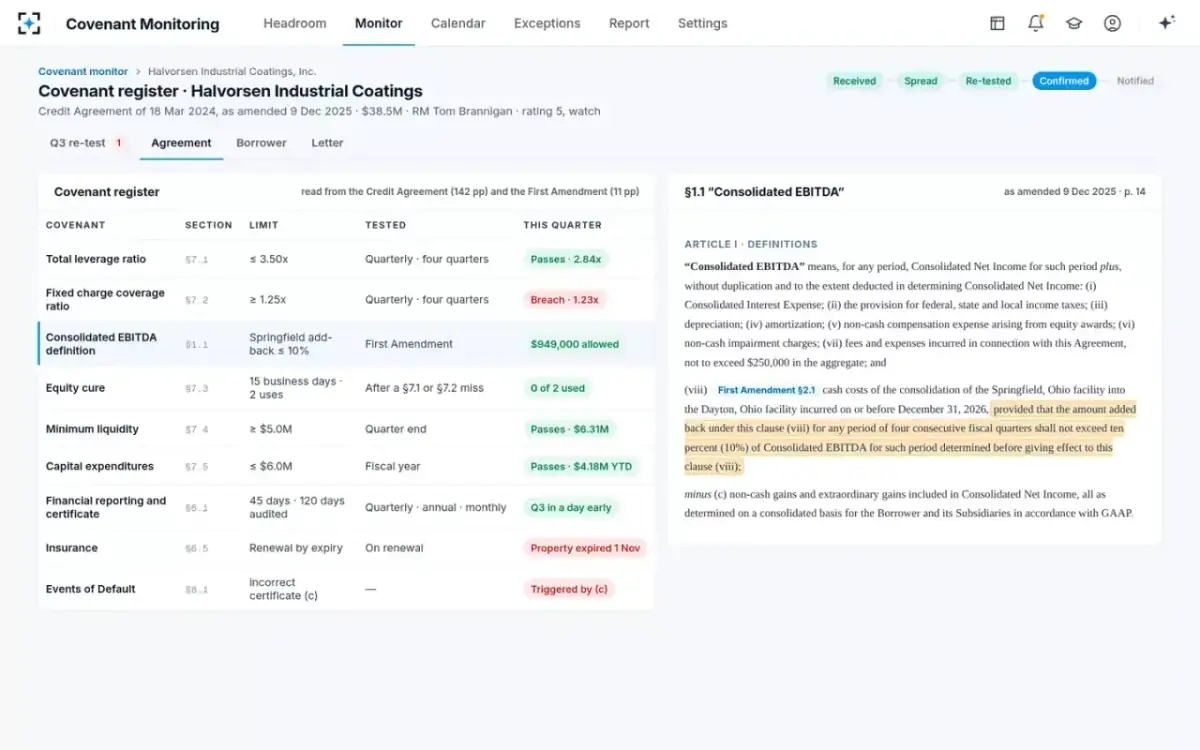
The output is a covenant register: one row per obligation, each with its section, its limit and how it is tested. For Halvorsen Industrial Coatings, a $38.5 million borrower of the fictional Tamarack Commerce Bank, the agent produced the register below from 153 pages.
The covenant register the agent read from 153 pages
| Obligation | Section | Limit or term | How it is tested |
|---|---|---|---|
| Total leverage ratio | §7.1 | at most 3.50x | Quarterly, four quarters trailing |
| Fixed charge coverage ratio | §7.2 | at least 1.25x | Quarterly, four quarters trailing |
| Consolidated EBITDA, Springfield add-back | §1.1, as amended | capped at 10% by the First Amendment | Inside both ratios |
| Equity cure | §7.3 | within 15 business days; 2 uses | After a §7.1 or §7.2 failure |
| Minimum liquidity | §7.4 | at least $5.0 million | At quarter end |
| Capital expenditures | §7.5 | at most $6.0 million | Fiscal year |
| Financial reporting and certificate | §6.1 | 45 days after each quarter; audited statements in 120 days | Quarterly, annual and monthly |
| Insurance | §6.5 | renewal evidence by expiry | On renewal |
| Events of default | §8.1 | including an incorrect certificate, clause (c) | On any breach |
Three rows are not financial covenants, and they matter as much as the four that are. The reporting row is what the certificate collector builds the calendar from, so a 45-day deadline in the agreement becomes a reminder ten days earlier. The equity cure row is what the letter drafter cites when it tells a borrower what it can do. The events-of-default row is what made an incorrect certificate a default of its own on this borrower, as the certificate that said 1.31x shows.
The register, with the amended clause open on its page
By hand and with the agent: the same step, compared
The comparison that matters is not speed alone; it is what happens when an amendment is signed. By hand, the definitions live in whatever workbook the analyst built at closing, and an amendment changes the bank's test only if someone remembers to rebuild it. With the agent, the register is rebuilt from the documents each time, and every term points to the page it came from.
Finding the definitions: by hand and with the agreement reader
By hand: A workbook built at closing, sometimes with a summary sheet.
With the agreement reader: A register rebuilt from the agreement and every amendment.
By hand: Someone has to notice, read it and change the workbook.
With the agreement reader: The amendment is read in date order; the latest text wins and both are cited.
By hand: Search the PDF for the definition, then for each cross-reference.
With the agreement reader: Open the cited section and page from the register.
By hand: Copied by hand into a tickler or calendar.
With the agreement reader: Taken from the same register into the reporting calendar.
By hand: About two days a quarter across the book, our estimate for finding definitions.
With the agreement reader: 21 seconds for 153 pages on the sample borrower.
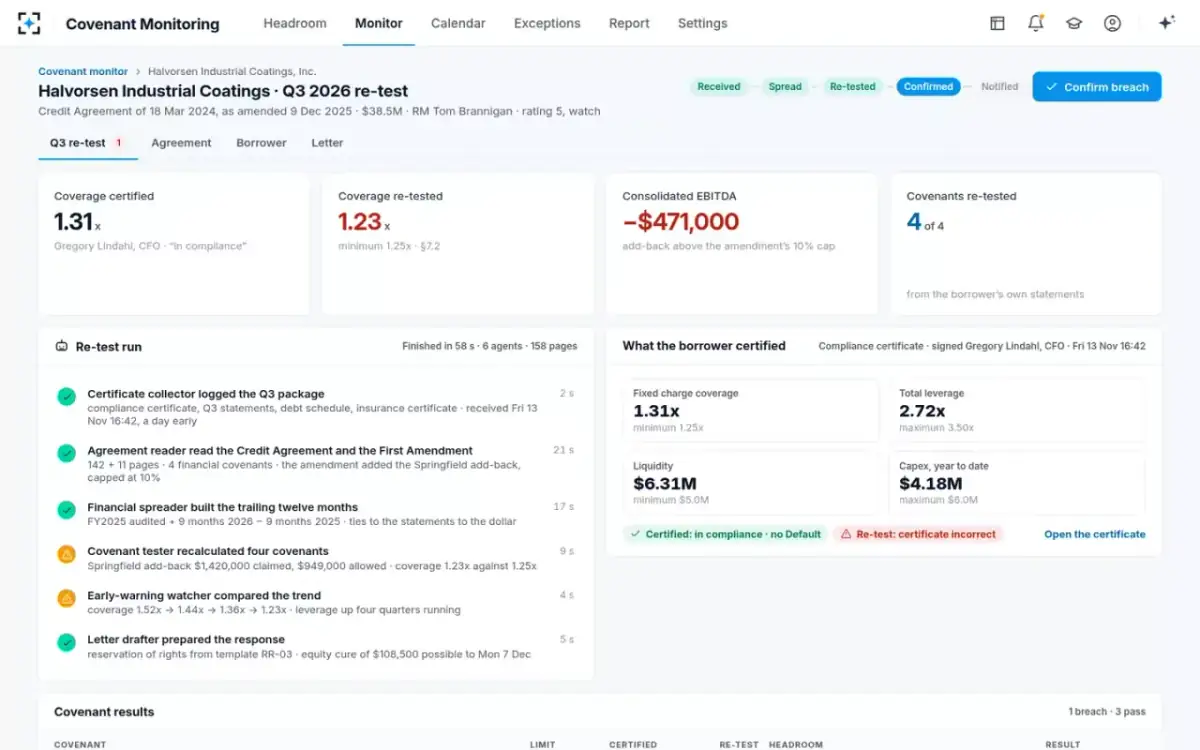
Where the 58 seconds of one re-test went
Reading takes the largest share of the run because it is the largest share of the work. That is also where an agent can go wrong in ways a calculation cannot, so it is where a bank should test hardest.
The re-test run, each agent's step with what it found
How accurate is AI at reading credit agreements? Where it fails, and what limits it
An agent that reads documents can fail in three ways that matter for covenants. It can misread a term, for example taking a cap from the wrong base or missing a cross-reference. It can apply amendments in the wrong order, or miss that a later document changed an earlier one. And it can fill a gap: where the documents are silent, produce a plausible threshold that is not there. The third is the most dangerous, because the result looks complete.
The solution's limits address each one. Citing section and page for every term makes a misreading checkable in seconds rather than findable only by rereading the agreement. Reading in date order with the latest amendment winning, and keeping both versions cited, makes the order explicit. The rule that it never invents a threshold or definition means a gap in the documents stays a gap in the register. That points to the other half of the control: the agent can only read what the bank gives it. An amendment sitting in a relationship manager's email is invisible to it, which is why the documents a bank brings to start matter as much as the agent.
Federal guidance does not yet settle how such an agent is governed. The April 2026 interagency model risk guidance says "Generative AI and agentic AI models are novel and rapidly evolving. As such, they are not within the scope of this guidance" (OCC Bulletin 2026-13). The OCC's Spring 2026 Semiannual Risk Perspective describes bank use of such tools as "generally limited to specific use cases with guardrails and human-in-the-loop accountability" (OCC, Spring 2026), and the interagency third-party guidance still holds that "the use of third parties does not diminish or remove banking organizations' responsibilities" (Federal Register, June 2023). In practice that means the bank tests the agent, keeps a person confirming every result, and owns the outcome.
What to look for in AI covenant extraction software
Look for evidence, not accuracy claims: a citation for every term, a visible amendment trail, a rule against inventing terms, and a person who confirms results before they reach a borrower or a committee. Many tools are now sold as AI covenant extraction, and the differences that matter only show on a bank's own amended agreements.
Buying AI covenant extraction: what to require, and how to check it in a pilot
| Requirement | Why it matters | How to check it | In Covenant Monitoring |
|---|---|---|---|
| Section and page cited for every term | A misread term becomes checkable in seconds instead of findable only by rereading 140 pages. | Open twenty citations at random; each must show the exact text. | Every register row opens on its clause and page. |
| Amendments applied in date order | Most errors in certificates and workbooks are amendment errors. | Give it an agreement with two amendments that change the same definition. | Latest amendment wins; earlier text stays cited. |
| Definitions built from cross-references | Covenants rest on defined terms several layers deep. | Check that each add-back cap and window appears under the covenant it affects. | The register carries the definition as amended, with caps. |
| No gap-filling | A plausible invented threshold looks complete and is wrong. | Withhold a document and see whether the missing term stays missing. | A gap in the documents stays a gap in the register. |
| A person confirms before anything leaves | The bank, not the vendor, answers for the result. | Find who can release a breach or a letter without a person. | Only the analyst confirms; letters need the relationship manager's signature. |
| Your documents stay under your oversight | Third-party use does not move responsibility off the bank. | Ask where documents are processed and retained, and who can see them. | A matter for each bank's third-party review. |
Speed is the least useful thing to compare. Every tool reads faster than a person; what differs is whether the bank can see why each term says what it says, and whether the register changes when an amendment does. A pilot on agreements the bank already knows well answers both in a few days.
How to test AI covenant extraction before relying on it
The test is straightforward because the right answers already exist: the bank's own agreements, read by its own people. The checklist below is how we would test any agreement-reading agent before relying on it.
Before relying on an agreement-reading agent
- Choose agreements with amendments
A clean agreement proves little. Pick ones with two or more amendments, a step-down and a cure right.
- Compare its register with your covenant check sheets
Every limit, test period and deadline. Where they differ, open the cited page and decide who is right; sometimes it is the check sheet that is out of date.
- Plant a change
Give it an amendment that tightens a cap or moves a deadline, and check the register changes, with both versions cited.
- Take a document away
Withhold an amendment and see what it does. It should not reconstruct terms it cannot see.
- Open every citation on a sample
A term that does not match its cited page is a failure, even if the number happens to be right.
- Re-test past certificates with it
Run it over quarters you have already tested, and read every disagreement.
The last item is the strongest evidence a bank can get, because it uses quarters whose outcomes are known. Re-testing eight quarters of certificates explains how to run it and how to read the disagreements. The other five agents, and the people who confirm what they find, are shown on Covenant Monitoring.
Questions people ask
How long does AI covenant extraction take?
Seconds per agreement for the reading; the time that matters is the person's check. On the sample borrower the agreement reader read 153 pages in 21 seconds. By hand, finding definitions across the sample bank's book took about two days a quarter in our estimate, mostly spent rebuilding amended terms.
What is the difference between a covenant register and a covenant check sheet?
A check sheet is a one-page summary of each covenant and its results, which the Federal Reserve expects in a credit file. A register goes further: every obligation in the agreement, with the definitions behind each covenant as amended and a citation for each term. The check sheet tells you the limit; the register tells you why it is the limit.
Can AI covenant extraction replace legal review of an amendment?
No. Counsel negotiates and drafts the amendment; extraction reads what was executed and applies it to the covenant test. A register that cites the clause it relied on makes it easy for counsel or credit to confirm that the bank is testing what the parties signed.
What happens when the agent cannot read a term?
It should say so. In Covenant Monitoring a term the documents do not settle stays blank in the register for the analyst to resolve, rather than being filled with a typical value. A blank is a visible gap; a guessed threshold is an invisible error.
Is AI covenant extraction a model under model risk guidance?
The April 2026 interagency guidance excludes simple arithmetic and deterministic rule-based processes from its definition of a model, and places generative and agentic AI outside its scope for now. Banks therefore govern such agents through their own risk management and third-party oversight, with people confirming results.