A covenant compliance certificate is the statement a borrower's chief financial officer signs each quarter, showing the calculation of every financial covenant in the credit agreement and certifying that no default exists. It is usually due 45 days after quarter end, and when that date passes without it the bank has no current test of any financial covenant on that loan. Late certificates rarely look urgent: the borrower is paying, the relationship manager has heard nothing alarming, and dozens of other certificates are waiting to be keyed. That is how a missed deadline becomes an examiner's stale-statement exception months later. Botminds' Covenant Monitoring treats a late certificate as an exception the day after it is due, chases it on a schedule the bank sets, and leaves every extension to a person.
Take a fictional sample bank as it runs through the solution. Tamarack Commerce Bank has 168 quarterly certificates due on Saturday 14 November 2026. One of them belongs to Mill Race Brewing Co., a $6.2 million borrower whose relationship manager is Dev Patel. Its second-quarter certificate arrived more than a week late. Its third-quarter certificate has not arrived at all.
The late list on Monday 16 November
27of 168
quarterly certificates missing two days after the due date
2of 4
scheduled reminders already sent to each late borrower
79
financial covenants untested because their certificate is late
1
borrower late for the second quarter running: Mill Race Brewing
What is a covenant compliance certificate?
A covenant compliance certificate is the borrower's own answer to the covenant test: a signed document, delivered with the period's financial statements, that calculates each financial covenant under the agreement's definitions and states whether the borrower complies. The credit agreement prescribes its form, usually as an exhibit, and its delivery date, usually in the reporting covenant beside the statements it accompanies.
Regulators treat the certificate as a core control rather than paperwork. The OCC's 2026 examiner job aid grades a bank's reporting requirements as conservative when it has "regularly required borrower certificates of compliance, financial statements, borrowing base certificates", and as liberal when certificates are "infrequent" (OCC, Lending and Loan Portfolio Risk Management). The older Commercial Loans procedures add the harder question: whether the bank has "practices to determine the ongoing accuracy and reliability of borrower certifications" (OCC, Commercial Loans). A certificate that arrives is half the control; a certificate that is checked is the other half.
What is in a financial covenant compliance certificate?
A financial covenant compliance certificate has four parts: who certifies, for which period, the calculation of each covenant, and a statement about defaults. The calculation is the part that matters, because it is where the borrower applies the agreement's definitions, and most disagreements between a certificate and a bank's own test start there.
Inside a covenant compliance certificate: the parts, and what a reviewer checks in each
| Part | What it says | What the bank checks |
|---|---|---|
| Certification | A named officer, usually the CFO, certifies on the borrower's behalf. | The signer is an officer the agreement names as a responsible officer, and the date is on or before the due date. |
| Period and statements | The test date and the statements the figures come from: interim for the quarter, audited at year end. | The statements attached are the ones the certificate used, for the right period, and tie to the general ledger totals. |
| Covenant calculations | Each financial covenant computed under the agreement's defined terms, with a supporting schedule: EBITDA and its add-backs, debt, fixed charges. | Every line traces to the statements, every add-back is permitted and within its cap, and the limit used is the one in force on the test date. |
| Compliance and no-default statement | That the borrower complies with each covenant, and that no default or event of default exists, or a description of any that does. | The statement matches the bank's own re-test. A wrong certification can itself be an event of default. |
Take a watch-list borrower in the sample book, Halvorsen Industrial Coatings. Its CFO signed the third-quarter certificate at 16:42 on Friday 13 November, the last business day before the deadline, certifying fixed charge coverage of 1.31x, total leverage of 2.72x, liquidity of $6.31 million and capital expenditures of $4.18 million to date, "in compliance · no Default". The bank's re-test from the same statements found coverage of 1.23x, below the 1.25x minimum, because one add-back exceeded its cap. How the certificate reached 1.31x walks through the lines. The case on this page is the other way a certificate fails the bank: by not arriving.
When is a compliance certificate due? Day 45, and what a late one stops
A quarterly compliance certificate is usually due 45 days after quarter end, and the annual one with the audited statements, often 120 days after year end; the agreement's reporting covenant sets both. A missing certificate stops the test, not just the paperwork. Without the borrower's interim statements and its own calculation, the bank cannot recalculate leverage, coverage or liquidity, so every financial covenant on the loan carries last quarter's result. For Mill Race that means the newest statements the bank has tested end on 30 June. On the due date they are already 137 days old.
The 45-day window is familiar for a reason: it is the SEC's deadline for quarterly reports from public companies that are not accelerated filers, and every agreement in the sample book, public borrower or not, uses the same window. With the audit arriving only once a year, that makes the quarterly certificate the bank's main signal for most of the year, and the Federal Reserve's manual explains why the right to it matters: "With proper use of loan covenants, a bank can protect its right to receive additional or more frequent information if a borrower's financial condition deteriorates" (CBEM §2010.1).
Mill Race Brewing's third quarter, counted from the day it ended
- Borrower closes its booksDays 0–35
- Reminders35–45
- Late45–50
- A person decidesDays 50–90
- Up to the due date92 → 137 days
- After the due date137 → 182 days
Day by day: from the first reminder to the exception
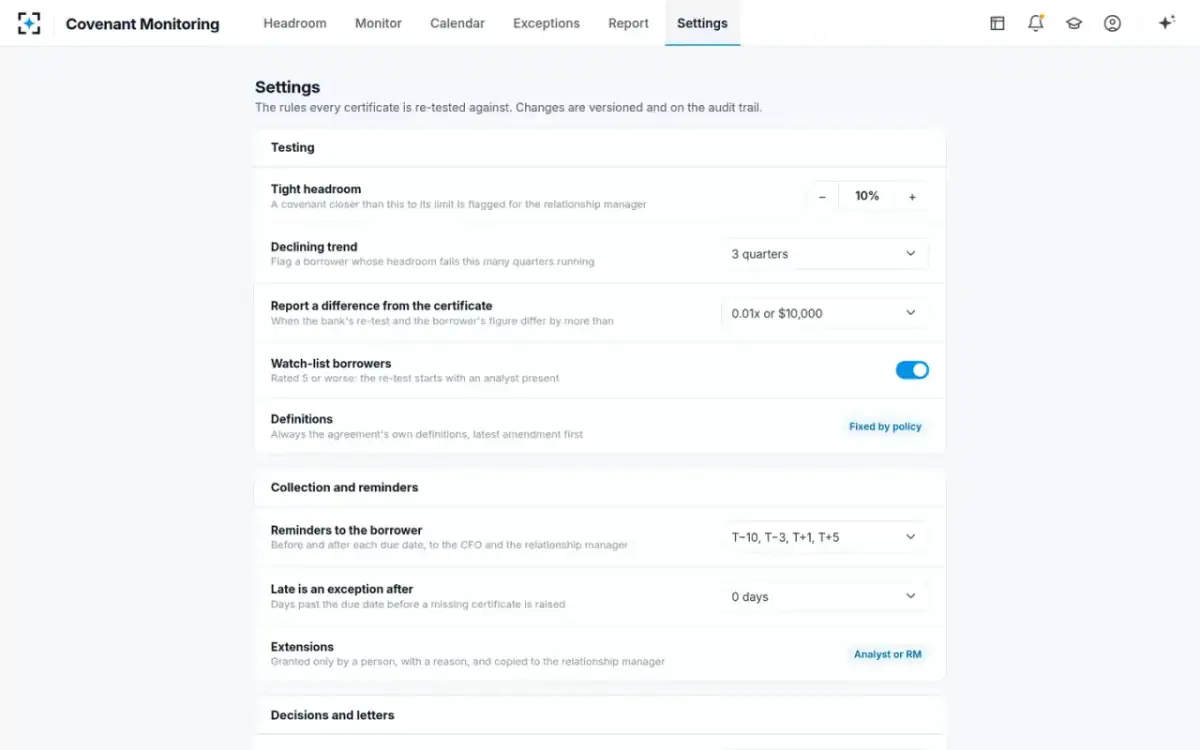
The first four steps happen on a schedule, and none of them needs judgment. The certificate collector keeps the calendar, sends the request ten days out and a reminder three days out, logs what arrives, and opens an exception the day after the due date for anything that has not. The reminders go to the borrower's chief financial officer with the relationship manager copied, because a borrower answers the person who owns the relationship faster than it answers a back office.
Mill Race Brewing, day by day
Wed 4 NovDay 35 · T−10
—
The certificate collector requests the third-quarter package from the CFO, Dev Patel copied.
127 days
Wed 11 NovDay 42 · T−3
No reply.
Second reminder. Most of the book is arriving: 21 certificates come in the next day, 38 the day after.
134 days
Sat 14 NovDay 45 · due
Nothing received.
Due date passes with 141 of 168 certificates in.
137 days
Sun 15 NovDay 46
—
Exception opened: "Q3 certificate late, second quarter running", §6.1(c), owner Dev Patel, stage Found.
138 days
Mon 16 NovDay 47 · T+1
—
Day-after reminder to the CFO, the relationship manager copied; flagged to him as a repeat.
139 days
Thu 19 NovDay 50 · T+5
—
Last scheduled reminder. The credit committee's report counts 27 late certificates.
142 days
If nothing arrivesDay 50 onward
An answer, a date, or silence.
No agent acts further. An extension, with a reason, or an escalation is the analyst's or the relationship manager's call.
—
Tue 29 DecDay 90
If still missing: the fourth quarter closes in two days.
The newest statements the bank has tested on this borrower are six months old.
182 days
The exception on day 46 is the step most banks skip. By hand, a late certificate usually lives as a highlighted row in a spreadsheet, or as a note in the analyst's head, until it is either received or forgotten. The OCC's 2026 booklet treats "stale financial statements, tax returns, or borrowing base certificates" as credit administration exceptions, and it has a phrase for the ones a bank does not log: "unidentified exceptions are often the result of errors, miscalculations, breakdowns in the pre- or post-closing review process, or system failures" (OCC, Lending and Loan Portfolio Risk Management). A large number of them, it adds, "could be indicative of less than satisfactory exception processes".
A late certificate is not a pending item. It is an exception the bank either logs on day 46 or explains to an examiner later.
The late list, with what each borrower said
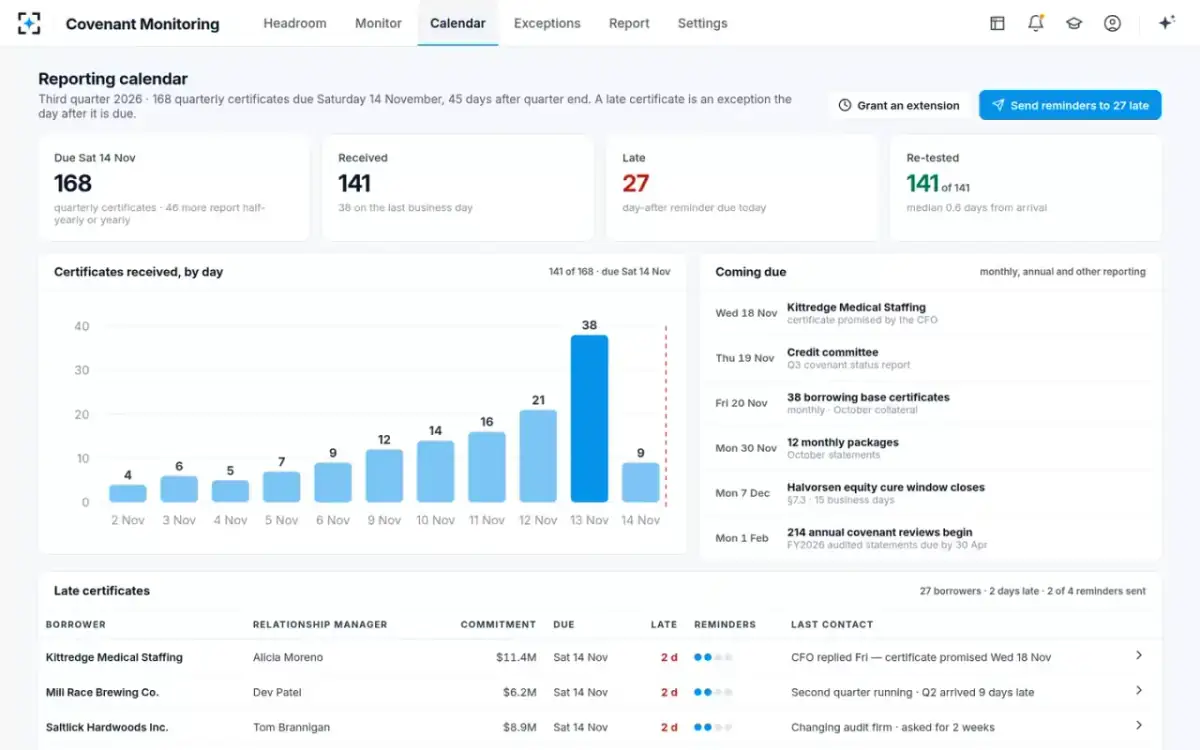
Three late borrowers, three different next steps
A late list is not one problem; each row needs its own answer, and the answer depends on what the borrower said. On the sample bank's list that Monday, three borrowers show the range.
Kittredge Medical Staffing's CFO replied on Friday and promised the certificate for Wednesday 18 November. That needs nothing but a date in the calendar and a test when it arrives. Saltlick Hardwoods is changing audit firms and has asked for two weeks. That is a request for an extension, and the solution will not grant it: it goes to the analyst or the relationship manager, who records a reason, and the relationship manager is copied either way. Mill Race Brewing has said nothing, and is late for the second quarter running. That one is flagged to Dev Patel as a repeat, because a pattern of lateness is information about the borrower, not only about its accounts team.
Who does what when a certificate is late
Agent
Certificate collectorSends the request at T−10 and a reminder at T−3, to the CFO with the relationship manager copied.
Never: Never changes a due date.
Agent
Certificate collectorLogs each arrival; the day after the due date, opens a late-certificate exception with the clause and an owner.
Never: Never lets a late certificate wait unlogged.
Agent
Certificate collectorSends the T+1 and T+5 reminders and records each reply and promised date.
Never: Never grants an extension.
A person decides
Analyst or relationship managerGrants an extension with a reason, or escalates a borrower who has gone silent or is late again.
Agent
Covenant testerRe-tests every covenant from the statements the day the package arrives.
Never: Never declares a breach.
A person decides
Credit administration analystConfirms the result; any breach goes to the relationship manager and the chief credit officer.
What happens if a compliance certificate is late? Day 50 to day 90
After the last scheduled reminder, the decisions are human ones, and the risk is that nobody makes them. A borrower that has gone quiet needs a call from its relationship manager, not a fifth email. A borrower that is late a second time may need its reporting covenant enforced, which in most agreements means the bank's legal rights under the reporting clause and its events of default, read from that borrower's own agreement. Neither step should be left to whoever next opens the file.
If nothing arrives, day 90 is a useful line to draw. On Tuesday 29 December the fourth quarter has two days left. The newest statements the bank has tested on Mill Race end on 30 June and are 182 days old, so the bank will go into its year-end allowance and rating work on six-month-old numbers. How old is too old is a matter for each bank's credit policy; the OCC names stale statements as an exception without fixing a number. A bank that counts from the due date will know exactly how stale each borrower is. A bank that keeps the late list in a spreadsheet will usually find out at the annual review, when the analyst asks for the year-end package and discovers the third quarter never came.
The examiner's question is simple and on the OCC's procedure list: "Does the bank have a system to monitor the timely submission of commercial borrower and guarantor financial statements and other items required in the bank's loan agreements?" (OCC, examination procedures). A dated exception, opened on day 46 with an owner and every reminder and reply beside it, is that system's evidence.
What day 46 changes for the rest of the book
Logging late certificates on time also changes what the bank reports about everyone else. In the sample bank's third quarter, 79 of its 612 financial covenants belonged to borrowers whose certificates were late. A covenant status report that shows those borrowers' second-quarter headroom alongside everyone else's third-quarter re-test overstates how much the bank knows. Covenant Monitoring keeps them in a band of their own, "not tested, certificate late", so the committee on Thursday 19 November saw 27 borrowers it could not yet vouch for.
The certificates that did arrive were re-tested quickly, with a median of 0.6 days from arrival to tested in the sample bank's third quarter, against 19 days by hand a year earlier. That gap is the reason chasing becomes most of the analyst's remaining work once the agents take the keying, as the covenant monitoring analyst's seat describes. It is also why the time from certificate to test belongs among the five numbers a covenant programme should report.
The reminder schedule and the extension rule, as settings
What to check on every late certificate
Most of this can be done by hand with a disciplined calendar. The solution runs it on every borrower; a team without it can start with the list below.
A late-certificate routine for a covenant desk
- Put every reporting date in one calendar
Quarterly, annual, monthly borrowing base and any one-off deliveries, read from each agreement and its amendments, not from memory.
- Ask before the date, not after
A request ten days out and a reminder three days out catch the borrowers who simply forgot.
- Open the exception the day after the due date
With the clause, the owner and the date. A late certificate is an exception whether or not it arrives tomorrow.
- Copy the relationship manager on every reminder
The borrower answers the person who owns the relationship.
- Treat a second late quarter as news about the borrower
Flag repeats to the relationship manager and the credit officer, not only to the borrower's accounts team.
- Let only a person grant an extension, with a reason
Changing audit firm is a reason; silence is not.
- Report untested covenants as untested
Never carry last quarter's headroom forward as if it were this quarter's.
A late certificate is one exception among several a covenant desk carries; breaches, waivers and certificate differences sit in the same queue, and a waived breach is still an exception follows the most misunderstood of them. To see the whole sample book, start from Covenant Monitoring.
Questions people ask
Who signs a covenant compliance certificate?
A financial officer of the borrower, usually the chief financial officer, as the agreement's "responsible officer". The signature makes the figures the borrower's representation to the bank, which is why many agreements treat a materially incorrect certificate as an event of default in its own right. In the sample agreement that is section 8.1(c).
Is failure to deliver financial statements an event of default?
It breaches the reporting covenant, and most agreements make that an event of default, sometimes only after a notice or a grace period. What the bank may do then is set by its own agreement. In practice banks chase first and enforce later, but the exception should be logged from the day after the due date either way.
Can a bank give a borrower more time to deliver financial statements?
Yes, if its policy allows, but it should be a decision by a named person with a reason, communicated to the borrower and noted in the file. An extension that happens by silence looks to an examiner like an exception nobody identified.
Is a late certificate a covenant breach or an administrative exception?
Both, in different senses. Under the agreement it is a breach of the reporting covenant. In the OCC's exception categories, "stale financial statements" are a credit administration exception, distinct from financial exceptions such as a covenant ratio breach.
What is the difference between a compliance certificate and a borrowing base certificate?
A compliance certificate tests the covenants, usually quarterly, from the income statement and balance sheet. A borrowing base certificate sets how much an asset-based revolver may lend, usually monthly, from eligible receivables and inventory after the agreement's advance rates. A borrower with an asset-based line often owes both, on different calendars, which is why the sample bank had 38 borrowing base certificates due the Friday after its quarterly deadline.