A covenant monitoring analyst, usually titled a credit administration or portfolio monitoring analyst, owns the part of a commercial loan that comes after closing: the reporting calendar, the compliance certificates and financial statements borrowers owe each quarter, the recalculation of each financial covenant, and the exception list that goes to the credit committee and the examiners. The work is hard because it peaks all at once. Quarterly certificates tend to fall due on the same day, 45 days after quarter end, and each one has to be tested under that borrower's own agreement. Botminds' Covenant Monitoring exists for this seat: six agents collect the certificates, spread the statements and re-test every covenant, and the analyst confirms what they find.
The seat rarely appears on an organisation chart drawn for the board. Relationship managers own the borrower, the chief credit officer owns the decisions and loan review owns the second look. Yet whether a breach is found this quarter or at the annual review is usually decided here, on a Monday in the week after the deadline. Take a fictional sample bank, Tamarack Commerce Bank, as it runs through the solution, with its analyst Priya Raman, who covers 71 covenant borrowers.
One quarter's deadline on the covenant desk of a sample bank
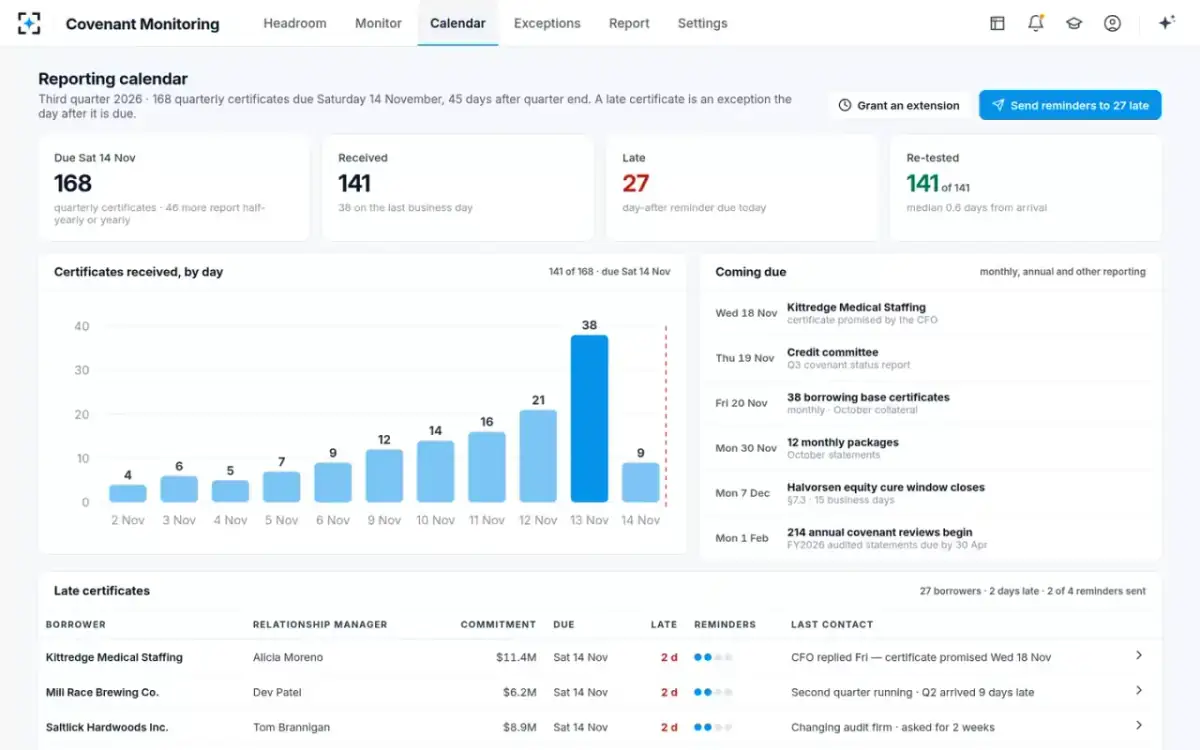
168
quarterly compliance certificates due on one day, Saturday 14 November
38
arrived on the last business day before the deadline
27
still missing two days after the due date
19days
median from certificate to tested, by hand, a year earlier
What does a covenant monitoring analyst do?
The analyst makes sure every covenant in the loan book is tested on time, on the right numbers, under the right definitions, and that every miss is logged. That breaks into five jobs, and only the fifth is visible outside credit administration.
First, the calendar. Each credit agreement sets what the borrower must deliver and when: a quarterly compliance certificate with interim statements, usually 45 days after quarter end; audited annual statements, often 120 days after year end; monthly borrowing base certificates for revolvers secured by receivables and inventory. The analyst keeps that calendar for every borrower and sends the requests. Second, the chase: reminders before the date, calls after it, and a decision on every request for more time. Third, the spread: the borrower's statements keyed into the bank's template, with a trailing twelve months built from the last audited year and the year to date. Fourth, the test: each covenant recalculated under the agreement's definitions, compared with what the borrower certified, and headroom worked out. Fifth, the report: breaches, late certificates and tight covenants, for the relationship managers, the chief credit officer and the committee.
The first four jobs are the ones that consume the quarter, and they are also the ones nobody sees until something goes wrong. A certificate accepted at face value, a late package nobody logged, an amendment that changed a definition and never reached the workbook: each is a failure of the seat, and each surfaces months later as a surprise at annual review.
What do examiners expect from covenant monitoring?
Examiners expect a working calendar, a real test of each certificate and a report of every exception, and they describe the work in more detail than most org charts do. The OCC's 2026 booklet, Lending and Loan Portfolio Risk Management, describes credit administration as "often the operations arm of the lending function" and places covenant testing squarely inside it. The Federal Reserve's Commercial Bank Examination Manual expects covenant check sheets in the credit file and a tickler to chase what is missing. Read together, they amount to a job description.
What examiners expect from the covenant seat, in their own words
OCC, Lending and Loan Portfolio Risk Management (2026)
Credit administration includes "monitoring the status of required periodic borrower financial statements and loan covenant testing."
On the deskThe calendar and the test, every quarter
OCC, examination request list
"Commercial loan credit administration reports, such as financial statement tracking, covenant tracking, and the status of annual reviews."
On the deskThe report the examiner asks for first
OCC, examination procedures
"Does the bank have a system to monitor the timely submission of commercial borrower and guarantor financial statements and other items required in the bank's loan agreements?"
On the deskThe late list
OCC, Commercial Loans booklet
"Practices to determine the ongoing accuracy and reliability of borrower certifications" and "Systems for monitoring compliance with loan covenants."
On the deskWhether the certificate is re-tested or accepted
Federal Reserve, Commercial Bank Examination Manual §2010.1
Credit files hold "loan agreements, and loan covenant check sheets", with "a file documentation tickler system".
On the deskThe check sheet and the tickler
Two of those passages carry more weight than they appear to. The request list matters because a covenant tracking report is among the first things an examiner reads, and a report assembled by hand from each relationship team's spreadsheet is the one most likely to disagree with the credit files. The Commercial Loans passage matters because it asks about the "accuracy and reliability of borrower certifications". That is a question about whether anyone checks the borrower's arithmetic, not whether the certificate arrived.
One deadline, 168 certificates: the analyst's peak week
The covenant desk does not work at an even pace. Certificates cluster on the deadline, because borrowers' finance teams close their quarters on much the same timetable and most agreements in a book share one deadline. Forty-five days is a familiar number: it is the SEC's deadline for a quarterly report from public companies that are not accelerated filers, and every agreement in the sample book uses the same 45 days. On the sample bank's third quarter, 141 of 168 certificates arrived between 2 and 14 November, and more than a quarter of those came on the Friday before the Saturday deadline.
Certificates arrive in a wave, and the wave breaks on the deadline
By hand, that shape is the problem. Each certificate needs its statements keyed, its trailing twelve months built and its covenants recalculated, and the analyst cannot start most of them until the week the deadline passes. Meanwhile the 27 missing certificates need chasing, the relationship managers want to know which of their borrowers turned, and the committee meets on Thursday. Something gives. Usually it is the recalculation: the analyst checks that the certificate arrived, reads the ratio the borrower's chief financial officer signed, and moves on.
The reporting calendar the analyst starts the week from
Where a quarter of covenant testing goes, by hand and with agents
Most of the analyst's quarter is spent on work that is not judgment. In our estimate for one quarter's certificate cycle at the sample bank, about 19 working days go into the cycle by hand, and nearly two-thirds of them are chasing and re-keying. Finding the right definitions in an agreement and its amendments takes two days on its own, because they are spread across a 142-page credit agreement and whatever has been signed since.
Where a quarter's covenant-testing days go
By hand · about 19 days
- Chasing certificates · 26%
- Re-keying and finding definitions · 43%
- Recalculating and checking · 21%
- Letters and report · 10%
With the agents · about 3 days
- Chasing certificates · 65%
- Re-keying and finding definitions · 9%
- Recalculating and checking · 10%
- Letters and report · 16%
The two bars tell different stories. By hand, recalculation is a fifth of the time and the first thing squeezed. With the agents, chasing becomes most of what is left, because a borrower who has not sent its package still has to be asked by someone it answers to. The difference is not that the analyst works faster. The keying and the hunt through the agreement stop being the analyst's job, and the time left over goes to the borrowers whose numbers turned.
The call only this seat makes: accept the certificate, or re-test it
The analyst's most consequential decision is whether to trust the borrower's certified ratio. A compliance certificate is the borrower's own calculation, signed by its chief financial officer, under its own reading of the agreement's definitions. Whether an add-back is allowed, whether it is capped, whether an amendment changed it: each is a matter of the agreement's exact words, and each can turn a breach into "in compliance".
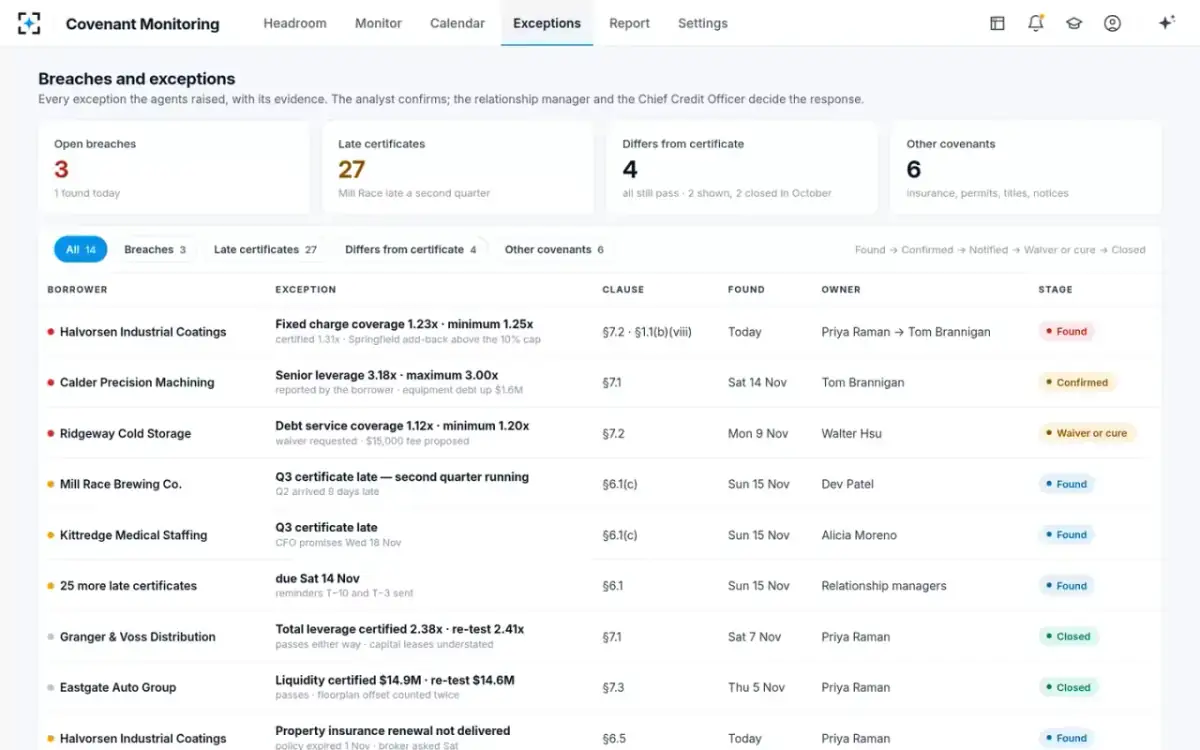
In the sample book, Halvorsen Industrial Coatings, a $38.5 million borrower, certified fixed charge coverage of 1.31x against a 1.25x minimum. Re-tested from its statements under the agreement as amended, coverage was 1.23x. The difference was a single add-back that the First Amendment capped and the certificate took in full. By hand, with 71 borrowers due the same week, it is easy to see how 1.31x gets accepted. The arithmetic is set out line by line in the certificate that says 1.31x when the agreement says 1.23x.
The certificate is not the test. It is the borrower's answer to a test the bank wrote, and only the bank's own recalculation shows whether the answer is right.
The Federal Reserve's manual explains why this matters to the bank as much as to the examiner. "With proper use of loan covenants," it says, "a bank can protect its right to receive additional or more frequent information if a borrower's financial condition deteriorates" (CBEM §2010.1). That right is only worth something if somebody notices the deterioration. A late certificate nobody logged and a ratio nobody re-checked both mean the bank has a right it never uses.
What the seat waits on, and what waits on the seat
The covenant analyst sits in the middle of a chain, which is why delay here spreads. Upstream, the seat waits on borrowers' finance teams, on relationship managers who own the contact, and on the legal team that keeps the executed amendments. Downstream, the relationship manager waits for a confirmed breach before calling the borrower, the chief credit officer waits for the proposal before deciding a waiver or a rating, and the committee waits for the status report.
One seat in the middle: what the covenant analyst waits on, and who waits on it
The seat waits on
- The borrower's CFO for the certificate, interim statements and, yearly, the audit
- The relationship manager to press a borrower that has gone quiet
- Legal or loan operations for every executed amendment, consent and waiver
- Collateral staff for borrowing base certificates and field exams
Covenant analyst
calendar · chase · spread · test · exceptions
Waiting on the seat
- The relationship manager, to call the borrower and send a reservation-of-rights letter
- The chief credit officer, to decide a waiver, an amendment or a rating change
- The credit committee, for the covenant status report
- Loan review and examiners, for covenant tracking and the exception list
The chain also explains the 19-day median. Each certificate waits in the analyst's queue for its turn to be keyed, and each confirmed result then waits for the next person. At the sample bank by hand, a certificate that arrived on 13 November could be tested in early December, after the committee had met on a status report built from the previous quarter.
The seat with agents: what moves, and what stays with the analyst
With the solution, the analyst stops being the place work waits and becomes the place it is confirmed. Six agents take the mechanical part: one reads each agreement and amendment into a covenant register, one keeps the calendar and sends reminders, one spreads the statements, one recalculates each covenant, one trends headroom, and one drafts letters from approved templates. What none of them does is decide. The covenant tester proposes a breach; only the analyst confirms it, with a signature that states what it means: "I re-checked the calculation".
Covenant Monitoring and the four people who handle a breach
Today
Spends the two weeks after every due date re-keying certificates into workbooks, then accepts most certified ratios for lack of time.
With agents
Starts the week from a book already re-tested from the borrowers' statements, and works the borrowers whose numbers turned.
Still theirs: confirming every result and granting extensions
Today
Assembles the exception report for the committee and the examiners from each team's spreadsheets.
With agents
Exports a report built from the tests, with every figure linked to the calculation behind it.
Still theirs: the report and the policy settings
Today
Hears that a borrower's numbers turned at the annual review, when the CFO has moved on.
With agents
Gets a drafted letter with the clause, the figure and the cure, the day the analyst confirms.
Still theirs: the call to the borrower and the signature
Today
Decides waivers and ratings from summaries he cannot trace to the agreement.
With agents
Sees the clause, the number and the cure behind each proposal before deciding.
Still theirs: waivers, amendments and ratings of 6 or worse
The analyst also keeps the decisions that involve a judgment about a borrower's good faith. The certificate collector never grants an extension; a borrower changing audit firms that asks for two weeks gets an answer from the analyst or the relationship manager, with a reason, copied to the relationship manager. The day-to-day consequences of that rule, from the first reminder to the stale-statement exception, are followed in one late compliance certificate, day 45 to day 90.
Every exception in one queue, each with its clause and owner
Covenant analyst salary, titles and how banks staff the seat
Federal statistics do not count covenant analysts separately; the nearest category, credit analysts, had 64,390 jobs nationally and a median annual wage of $83,510 in May 2025, a category that also includes consumer credit analysts. Banks give the seat different names, from credit administration analyst to portfolio monitoring analyst, covenant compliance analyst or loan administration officer, and smaller banks often fold it into a credit analyst's job.
The nearest federal category: credit analysts, May 2025
64,390
credit analysts employed nationally
$83,510
median annual wage
$100,850
mean annual wage
Staffing ratios are a matter for each bank. The sample bank's analyst covers 71 covenant borrowers; whether that is light or heavy depends on how many covenants each carries, how many report monthly and how many sit on the watch list. What every bank can measure is the outcome: how long certificates wait to be tested, and how many breaches are found before the annual review rather than at it. The five numbers a covenant programme should report sets out how to measure both. For how the seat reads a book by headroom rather than pass or fail, see how close to the limit is too close, and for the whole system the analyst works in, start from Covenant Monitoring.
Questions people ask
Is covenant monitoring done by the relationship manager or by credit administration?
Most banks separate them. The relationship manager owns the borrower and the conversation; credit administration owns the calendar, the test and the exception report, which keeps the measurement independent of the person whose book it is. The OCC places covenant testing inside credit administration, which it calls "often the operations arm of the lending function".
What is a loan covenant check sheet?
A one-page summary in the credit file of each covenant, its limit, how often it is tested and the result each period. The Federal Reserve's examination manual lists covenant check sheets among the documents a credit file should hold, along with a tickler system that prompts staff to obtain updated borrower information.
What is a tickler file in commercial lending?
A diary of what each borrower owes the bank and when: certificates, statements, insurance renewals, borrowing base reports. It used to be a card box; today it is a reporting calendar. Its purpose is the same, so that a missing document is noticed on the day it is due rather than when someone next opens the file.
How often are loan covenants tested?
Financial covenants in bank loans are usually maintenance tests, checked every quarter on the trailing twelve months whether or not the borrower does anything. Lian and Ma's study of corporate borrowing found that covenants in loans "generally monitor compliance on a quarterly basis", while those in bonds are tested only when the borrower takes an action such as issuing debt (NBER, 2018). Borrowing base certificates on asset-based revolvers often come monthly.
What skills does a covenant monitoring analyst need?
Three, mainly: reading financial statements well enough to rebuild a trailing twelve months from an audit and interims, reading a credit agreement's definitions closely enough to see what an amendment changed, and the persistence to chase a finance team that has gone quiet. The arithmetic is the easy part. The judgment is knowing which certified figure to doubt, and when a late package says more about the borrower than the numbers would.
Does a covenant analyst need to log a certificate that is only a few days late?
Yes, if the bank wants its tracking to match its files. The OCC's management-information list for commercial lending names "Credit administration exceptions" and the status of reviews "coming due and late" as items management should see (OCC, 2026). A late certificate that is not logged leaves the exception report shorter than the truth, which is the gap an examiner's file sample tends to find.