Financial covenant testing is the bank's recalculation of each financial covenant in a loan, such as leverage, fixed charge coverage or minimum liquidity, at each test date, from the borrower's statements and under the credit agreement's own definitions, compared with the limit in force and with what the borrower certified. The most reliable way to know whether that testing is accurate is a back-test: take the compliance certificates the bank accepted over the past eight quarters, re-test each covenant under the agreement as it stood at the time, and compare three numbers, what the borrower certified, what the bank recorded and what the re-test finds. Every disagreement then has to be explained. Botminds' Covenant Monitoring re-tests every covenant from source each quarter, and the same run over closed quarters is how a bank can judge it on its own files.
The method matters because covenant testing has no external answer key. There is no published error rate for compliance certificates and no regulator benchmark for how often a bank's recalculation should differ from its borrowers'. The only truth available is the bank's own files, read carefully.
What one quarter of re-tests found on a sample book
What is financial covenant testing, and how do banks do it?
Banks test financial covenants by rebuilding the borrower's calculation from source rather than reading the borrower's answer. The test has six steps, and the first four are where the hours and the errors are.
- Receive the package. The compliance certificate and the interim or audited statements behind it, against the deadline in the reporting covenant.
- Spread the statements. Key them into the bank's template and build the trailing twelve months, usually the last audited year plus the year to date less the same period a year earlier.
- Apply the definitions in force. EBITDA, debt, fixed charges and liquidity as the agreement defines them on that test date, with every amendment applied.
- Recalculate each covenant. Unrounded, against the limit in force, including any step-down.
- Compare and measure. Against the certificate, line by line, and against the limit as headroom.
- Record and escalate. Log every breach and every difference above the bank's threshold, with an owner.
The OCC's examination procedures ask whether a bank has "systems for monitoring compliance with loan covenants" and "practices to determine the ongoing accuracy and reliability of borrower certifications" (OCC, Commercial Loans). Steps three to five are what the second phrase means in practice. A bank that stops at step one, filing the certificate and copying its ratios, is monitoring receipt, not compliance.
How often are financial covenants tested?
Most financial covenants in bank loans are tested quarterly on a trailing four-quarter basis, but each covenant carries its own frequency and measurement basis in the agreement, and testing has to follow each one. The sample agreement used on this page shows the usual mix.
How often each kind of financial covenant is tested, in one sample agreement
| Covenant | Limit | Tested | Measured on |
|---|---|---|---|
| Total leverage | at most 3.50x | Quarterly | Debt at quarter end over trailing four quarters of Consolidated EBITDA |
| Fixed charge coverage | at least 1.25x | Quarterly | Trailing four quarters, as defined, over fixed charges |
| Minimum liquidity | at least $5.0 million | Quarterly | Cash and availability at quarter end |
| Capital expenditures | at most $6.0 million | Annually, tracked during the year | Fiscal-year spending |
Frequency is where testing quietly fails. A fiscal-year capital expenditure cap that is checked only at year end gives no warning in the third quarter, when the borrower has $1.82 million of its $6.0 million left; a quarterly liquidity minimum tested only when the annual review comes round is not being tested at all.
How do you check covenant calculations are accurate? Re-test quarters you have closed
A live quarter cannot tell you whether a covenant test is accurate, because you do not yet know the right answer. A closed quarter can. The bank has the certificate, the statements, the agreement and amendments as they stood, its own recorded result and, for older quarters, what happened next: whether the borrower breached later, was downgraded, or was waived. That is a gold set built from work the bank's own people already signed.
The OCC suggests the same kind of look back. Its 2026 booklet lists, among items in a postmortem review of problem loans, "Reviewing the borrower's financial condition at the time of loan approval and over time" and "Assessing the effectiveness of the loan and covenant structure" (OCC, Lending and Loan Portfolio Risk Management). A back-test applies that discipline to every borrower, not only the ones that went bad.
How many quarters should a covenant back-test cover? Eight, and why
Eight quarters covers two annual cycles, so the test includes the hard cases a single quarter misses. Year-end certificates are tested against audited statements that may restate the interims. Amendments are likely to land in the window, so the test checks that the bank applied each one from the right quarter, and step-downs come due. And borrowers that later breached or were downgraded have had time to show it, which tells you which past passes were wrong.
Eight quarters also gives a usable count. With 100 borrowers that is roughly 800 certificates. If the re-test and the bank's recorded result disagree on none of them, the "rule of three" puts the 95% upper bound on the disagreement rate at about 3 in 800, or 0.4%. One quarter of 141 certificates with no disagreement bounds the rate only at about 2.1%. The size of the gold set decides how much a clean result proves.
How much a clean back-test proves, by the number of certificates
2.1%
upper bound on the disagreement rate after 141 certificates with none found
0.4%
after 800 certificates with none found, about eight quarters of 100 borrowers
3in n
the rule of three: zero events in n trials bounds the rate at about 3 ÷ n, at 95%
How to build the replay, step by step
The replay is a pipeline, and most of the effort is in the first step: assembling, for each quarter, the documents exactly as the bank had them. A missing amendment in the replay produces a false disagreement, and a missing certificate produces none at all.
Re-testing eight closed quarters
A person decides
Credit administrationAssembles each borrower's agreement and every amendment in force at each test date, the certificates, the statements and the bank's own recorded results.
Agent
Agreement readerReads each agreement as amended at each test date into a covenant register, citing section and page.
Never: Never invents a definition the documents do not contain.
Agent
Financial spreaderSpreads each quarter's statements and builds the trailing twelve months, tied to the statements to the dollar.
Never: Never alters a reported figure.
Agent
Covenant testerRecalculates every covenant and lists every difference from the certificate and from the bank's recorded result.
Never: Never declares a breach.
A person decides
Credit administration analystReads each disagreement against the cited pages and assigns a verdict.
A person decides
Credit administration managerReports the counts by verdict, and decides what the bank will rely on.
Three numbers per covenant, per quarter: what to compare
| Compare | What it tells you | Watch for |
|---|---|---|
| Certificate against re-test | Whether the borrower applied the agreement correctly. | Add-backs above a cap, debt left out, items counted twice. |
| Bank's recorded result against re-test | Whether the bank's own test was right at the time. | Results copied from the certificate; workbooks with closing-date definitions. |
| Pass or fail under each | Whether any difference changed the outcome. | Certified passes that re-test as breaches, and the reverse. |
| Headroom under each | Whether the bank's picture of risk was right, even where the outcome was not. | Borrowers shown at 15% headroom that were really under 10%. |
| Test date against the agreement in force | Whether the right version was tested. | Amendments and step-downs applied a quarter early or late. |
Reading a disagreement: four verdicts
A disagreement is not an error until someone has read it. Some show the new test is wrong; some show the old process was. The point of the replay is to sort them, because each verdict calls for a different response and a different count.
Four verdicts on a disagreement, and what each one means
The certificate was wrong, and the bank accepted it
A breach or a difference the bank missed at the time. The OCC calls these unidentified exceptions.
What to doCount it. Check whether it still matters today, and whether the borrower's certificates share the error.
The bank's own test was wrong too
The bank's workbook carried an old definition or a keying error, so it agreed with the certificate.
What to doCount it separately: it measures the old process, not the borrower.
The re-test was wrong
The agent misread a term, or a document it needed was missing from what it was given.
What to doCount it as an agent error, by cause. A missing amendment is an intake fix; a misreading is a finding on the agent.
The agreement can be read both ways
Two careful readers would differ. Neither calculation is plainly wrong.
What to doSend to credit and counsel, record the bank's reading, and apply it from then on.
The first two verdicts are findings about the bank, and they should be expected. The OCC's 2026 booklet observes that unidentified exceptions "are often the result of errors, miscalculations, breakdowns in the pre- or post-closing review process, or system failures", and that a large volume of them "could be indicative of less than satisfactory exception processes" (OCC). A back-test that finds some is doing its job. The OCC's older Commercial Loans procedures ask about "the ongoing accuracy and reliability of borrower certifications" (OCC, Commercial Loans); a back-test is the most direct answer a bank can give.
The third verdict is the one that measures the agent, and it should be broken down by cause. A missing document is an intake problem, fixed by making sure every executed amendment reaches the system. A misread term is a finding on the agent itself, and the cited section and page make it quick to confirm.
Why do certified covenant figures differ from the bank's calculation?
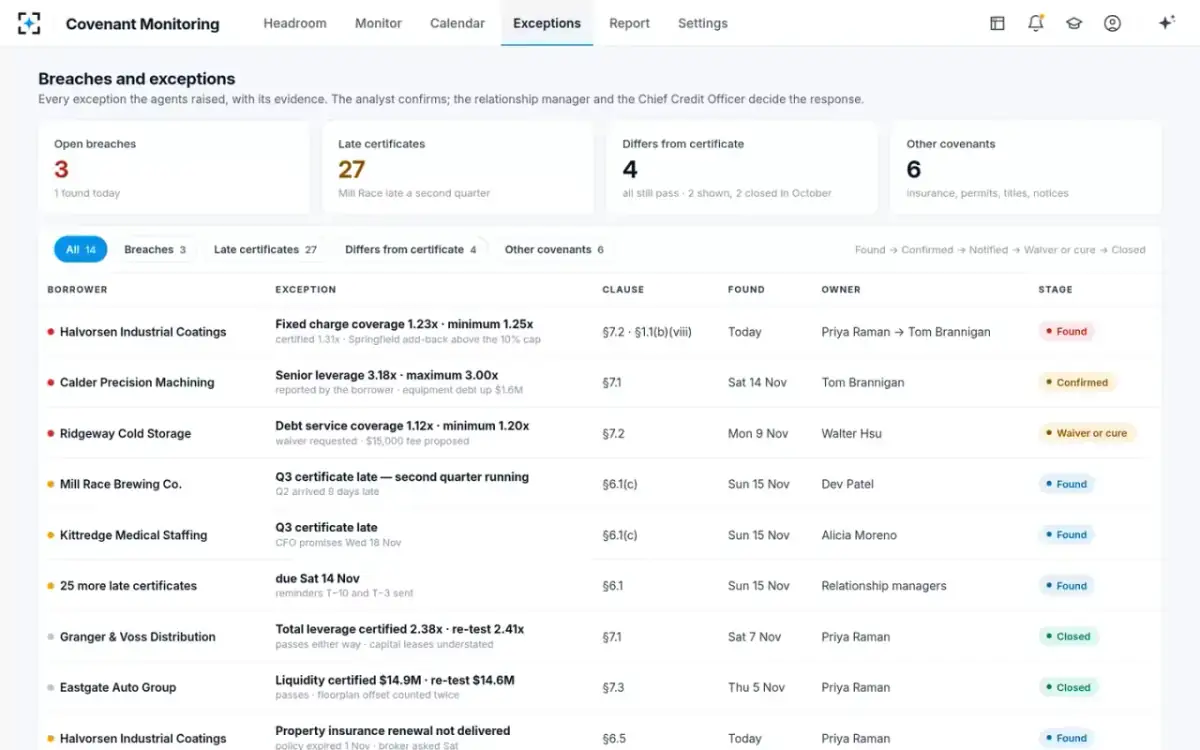
Take a fictional sample bank as it runs through the solution. In Tamarack Commerce Bank's third quarter of 2026, three borrowers show the range of differences a re-test turns up. Halvorsen Industrial Coatings certified fixed charge coverage of 1.31x and re-tested at 1.23x, a breach, because the certificate took an add-back above the cap an amendment had set. Granger & Voss Distribution certified leverage of 2.38x and re-tested at 2.41x, a pass either way, because its capital leases were understated. Eastgate Auto Group certified $14.9 million of liquidity and re-tested at $14.6 million, also a pass, because a floorplan offset was counted twice.
Certified against re-tested, with the run that produced it
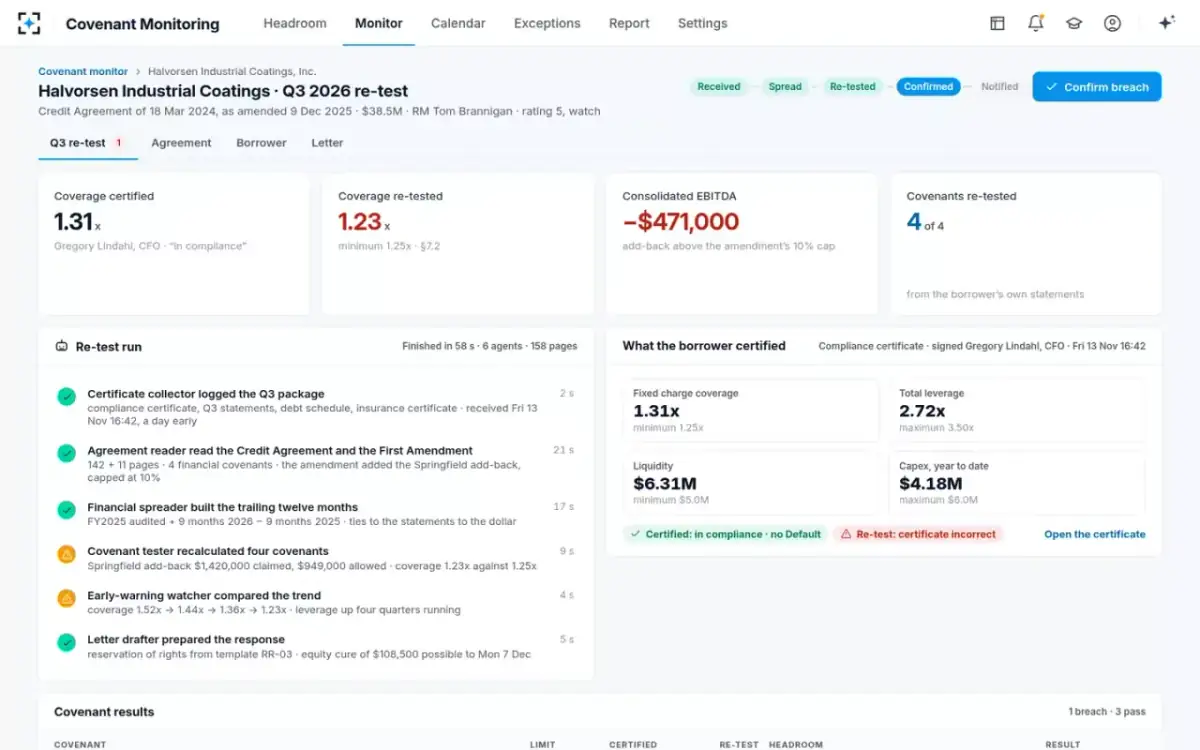
Each of those three would get a different verdict in a back-test of past quarters. If the bank had accepted Halvorsen's 1.31x in an earlier quarter, that is a missed breach, verdict one. If the bank's workbook had also carried the uncapped add-back, that is verdict two, and the more important finding, because every other borrower with an amended definition is now in question. Granger & Voss and Eastgate are differences that did not change an outcome; they still say the borrower and the bank calculate differently, and next quarter that may matter.
Differences that passed are kept, not dropped
Building the gold set: what to gather before you start
The quality of the back-test is set before any re-test runs. The checklist is what we would gather for eight quarters, and the order in which we would gather it.
Building a back-test from your own closed quarters
- Pick the borrowers with care
Include every borrower that breached, was waived or was downgraded in the period, then add a random sample of the rest. A test of easy borrowers proves little.
- Gather the agreement as it stood at each test date
The original and every amendment, in order, with execution dates. A missing amendment creates a false disagreement.
- Keep the certificate and the statements together
The certificate the borrower signed, and the interim or audited statements delivered with it.
- Record what the bank decided at the time
The bank's own result for each covenant, from the workbook or check sheet, and any waiver or letter.
- Set the difference threshold before you look
For example 0.01x or $10,000. Deciding it after seeing the results invites arguments about every case.
- Have someone other than the builder adjudicate
The analyst who built the old workbook should not be the only judge of whether it was right.
- Report the four verdicts separately
Missed by the bank, wrong in the bank's test, wrong in the re-test, and ambiguous.
The back-test also gives a baseline for the numbers a covenant programme should report going forward, such as the share of covenants re-tested from source and the breaches found before annual review; the five numbers a credit committee should see defines them. For the documents the replay needs, see what a bank brings to start, and for the agent whose reading is most worth testing, the agent that reads the agreement first. To run the replay on a sample of your own agreements and certificates, start from Covenant Monitoring.
Questions people ask
How accurate is covenant monitoring software?
There is no published benchmark, and a vendor's figure on someone else's loans says little about yours. The useful number is the one you measure: the share of covenants where a re-test of your own closed quarters agrees with a careful human reading, with every disagreement explained.
Who performs financial covenant testing at a bank?
Usually credit administration, not the relationship manager, so the measurement is independent of the person whose book it is. The work sits with an analyst who keeps the reporting calendar, spreads the statements and recalculates each covenant; the covenant monitoring analyst describes the seat.
Is a bank's covenant testing the same as an auditor's covenant compliance testing?
No. A borrower's auditor checks covenant compliance to decide how the borrower's debt is classified and disclosed in its own financial statements. A bank tests covenants to manage its credit, under its own reading of the agreement, every quarter. The auditor's work is useful evidence at year end, but it does not replace the lender's test.
Should covenant ratios be tested rounded or unrounded?
As the agreement says; where it is silent, unrounded is the safer reading. A certificate that shows 1.25x can hide 1.246x against a 1.25x minimum, and a re-test that rounds before comparing will miss it.
What if the re-test finds a breach we missed in a past quarter?
Treat it as an unidentified exception: record it, check whether it still matters today, and look for the cause, which is often an amendment the bank's own test did not pick up. Then check every other borrower with an amended definition.