A covenant waiver is the lender's written agreement not to exercise its rights over a specific breach, usually for a specific test date, often in exchange for a fee or tighter terms. It ends the default between bank and borrower. It does not end the exception. The OCC's 2026 examiner booklet lists "covenant breaches (even if waived)" among the financial exceptions examiners expect a bank to identify and track, and the Federal Reserve treats a "ready willingness to waive violations of key covenants" as a sign of weak credit risk management. A waiver therefore needs its own approver, its own reason and its own register. Botminds' Covenant Monitoring keeps every confirmed breach in one queue from found to closed, and leaves the waiver decision with the chief credit officer.
Among the financial exceptions that occur during the life of a loan: "Covenant breaches (even if waived)".
OCC, Lending and Loan Portfolio Risk Management, version 1.0 (June 2026), table of exception types
What "even if waived" means for a bank
It means a waived breach stays in the bank's exception reporting. The OCC's 2026 Lending and Loan Portfolio Risk Management booklet sorts exceptions into underwriting, financial and credit administration types, and puts covenant breaches, waived or not, in the financial column beside "DSCR below policy at the time of annual review". Among the reports it expects management to see are "Covenant breaches and waivers", listed together. Among its examples of structural weaknesses in a loan is "Nonexistent, weak, or waived covenants".
The booklet is balanced about what that implies. "Examiners should not criticize a loan solely because it has an exception," it says, and an exception "does not automatically represent excessive risk-taking." But "a consistent pattern of these exceptions can reflect a critical lack of internal controls or other risk management concerns." A single waiver, granted for a reason and recorded, is ordinary credit management. A loan waived every other quarter, or a book where waivers are granted faster than they are counted, is what examiners are looking for.
The practical consequence is about where waivers live. In many banks a waiver is a letter in the credit file and an email to the covenant analyst, who then marks the covenant as compliant in the spreadsheet. The breach disappears from monitoring the day it is waived, which is exactly the day the OCC says it should still be counted.
Why examiners worry about easy waivers
Waivers are not suspect in themselves; lenders are expected to use judgment. Research on bank lines of credit describes covenants as giving the lender options, and notes that "all of these terms involve discretion: a lender can roll-over the loan, not mark the collateral to market at high frequency, and waive a covenant violation" (Chodorow-Reich, Darmouni, Luck and Plosser, NBER). The concern is a waiver that buys nothing.
The Federal Reserve's examination manual names it. Among the signs of "undue reliance on continued favorable economic conditions" is a "ready willingness to waive violations of key covenants, release collateral, or guarantee requirements, or even to restructure loan agreements, without corresponding concessions on the part of the borrower". Its stated danger is "the possibility of delay in properly identifying problem loans" (CBEM §2010.1). Elsewhere it puts the other half plainly: covenant "violations should be dealt with immediately to give credibility to the agreement" (CBEM §2080.1).
What "corresponding concessions" look like is no mystery. When public borrowers violate covenants, lenders usually renegotiate, and the terms that change most are the ones that limit what the borrower can do, such as capital expenditure restrictions, rather than the price; what happens after a loan covenant breach sets out the research. A waiver that asks for nothing gives up the moment of leverage the covenant was written to create.
Covenant waiver vs forbearance, amendment or reservation of rights
A breach has several possible answers, and they are often confused. They differ in what they change, for how long, and what the bank gives up. The table below sets them side by side in plain terms; the exact effect of each is a matter for the bank's own documents and counsel.
Four responses to a confirmed breach, and what each leaves on the file
| Response | What it does | When it fits | What the file needs |
|---|---|---|---|
| Reservation of rights | Tells the borrower the bank knows of the default and has not given up any remedy. Decides nothing yet. | Immediately, on every confirmed breach, while the bank decides. | The letter, the clause and the figures, and who signed it. |
| Waiver | Gives up the bank's rights over a specific breach, usually for one test date. | A one-off miss with a credible reason, often with a fee or conditions. | The approver, the reason, the concession, the period covered and the count of earlier waivers. |
| Amendment | Changes the covenant for the future: a reset level, a new definition, a new step-down. | When the original level no longer fits the business and will be missed again. | The executed amendment, read into the covenant register before the next test. |
| Forbearance | The bank agrees not to enforce for a period while the default continues, usually with milestones. | A workout, while the borrower refinances, sells assets or raises equity. | The milestones and dates, monitored like covenants of their own. |
| Equity cure | The borrower fixes the test itself, where the agreement allows, by contributing cash. | When the agreement grants a cure right and the owners will use it. | The amount, the date and the count of cures used. |
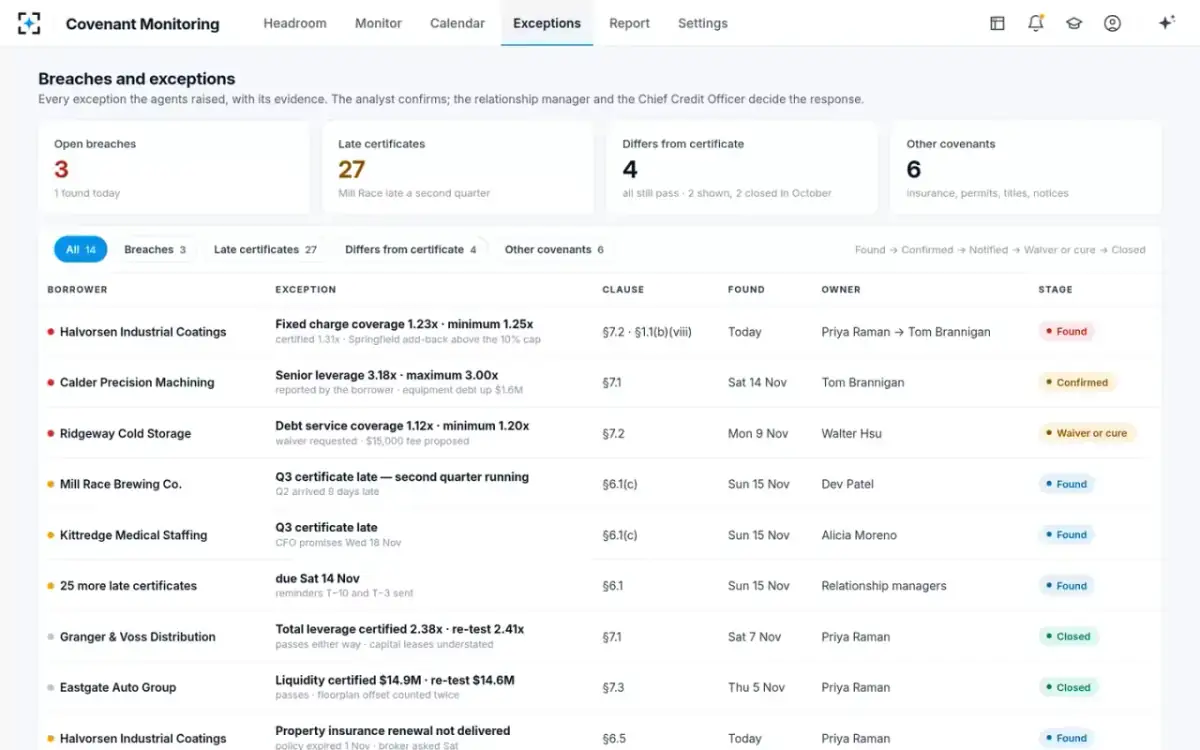
The sample bank's own breaches show three of these at once. Take a fictional sample book as it runs through the solution: Tamarack Commerce Bank had three open breaches in the third quarter of 2026. Halvorsen Industrial Coatings' recalculated fixed charge coverage breach got a reservation-of-rights letter and an equity cure figure, $108,500 by 7 December. Calder Precision Machining's senior leverage breach was confirmed and a letter drafted for its relationship manager. Ridgeway Cold Storage's debt service coverage breach came with a waiver request, which is with the chief credit officer.
Can a lender waive a covenant by conduct? The risk of silence
The most dangerous response is none. A bank that knows of a breach and goes on lending, accepting payments and saying nothing may later find it has waived the breach by its conduct. The Federal Reserve's manual addresses this directly for asset-based lending, where the stakes are highest: if a covenant is waived, "the waiver should be formally communicated to the borrower in writing. The lender should avoid both not taking action for a period of time and not issuing a written waiver for a covenant violation. In either case, if a covenant violation is subsequently used as a reason to cancel an asset-based loan, the lender is more vulnerable to lender liability" (CBEM §2160.1).
That is why the sample bank's policy, as set in the solution, sends a reservation-of-rights letter on every confirmed breach. The letter drafter fills the bank's legal-approved template with the clause, the figures and any cure, and the relationship manager signs it. The letter's own words do the protecting: no delay or forbearance, and no acceptance of payment, is a waiver of any event of default. The waiver decision can then take the time it needs.
Three breaches, three stages, one queue
What is a covenant waiver letter, and what should it say?
A covenant waiver letter is the written agreement, signed by the lender and usually countersigned by the borrower, that gives up the lender's rights over a named breach on stated terms. Its job is to be narrow: to excuse exactly one failure, for one period, on conditions the bank can check, and to say plainly that nothing else is excused.
The clauses of a covenant waiver letter, and what each protects
| Clause | What it says | Why the bank wants it |
|---|---|---|
| The breach waived | The covenant by section, the test date, and the figure that failed. | A waiver that names no test date can be read as covering the next one. |
| Conditions to effectiveness | The fee paid, documents delivered, any equity or collateral provided, before the waiver takes effect. | Nothing is given up until the concession is in hand. |
| No other waiver | The waiver is limited to its terms and is not a waiver of any other default, present or future. | Stops a one-off decision becoming a precedent the borrower can rely on. |
| No course of dealing | Past or future waivers do not oblige the bank to grant another. | Answers the argument that repeated waivers changed the agreement by conduct. |
| Reaffirmation | The borrower and guarantors confirm the loan documents and guarantees remain in force. | Keeps guarantors bound through the change. |
| Ongoing terms | Any added reporting, a margin step-up or a tighter limit for the next tests. | Turns the concession into something the covenant desk can monitor. |
The writing is itself a protection, as the Federal Reserve's guidance on silence below makes clear. A waiver agreed by phone and recorded only in an email to the covenant analyst satisfies neither the borrower's lawyer nor the examiner.
How much is a covenant waiver fee?
There is no published market rate for a bank covenant waiver fee; it is set by each bank's policy and negotiated case by case, and it often arrives with other terms rather than alone. The research on violations suggests why: lenders take most of their price in control. After a violation, Nini, Smith and Sufi found the chance of a capital expenditure restriction rose by 14 percentage points while the interest spread rose by about 23 basis points (FDIC CFR 2007-01). A fee is the visible part of a waiver's price; the covenants that tighten with it are often the larger part.
Fees take three common shapes: a flat amount, a share of the commitment, or a step-up in the margin until the borrower is back in compliance. Whatever the shape, policy should set a floor, so that a waiver is never free by default, and should require the recommending officer to explain a fee below it. The sample bank sets its floor at $5,000, and its one open request came with a proposed $15,000 fee that the chief credit officer had yet to approve.
What a waiver register should hold
A waiver register is a list of every covenant waiver the bank has granted or refused, with enough on each line to answer an examiner's three questions: who decided, why, and what the bank got. The OCC expects banks to track exceptions "in a thorough and timely manner" and to analyse them; for waivers, that means the fields below. The sample values are Ridgeway Cold Storage's request as it stood on Monday 16 November, with its decision still open.
One line of a waiver register, with the fields an examiner will ask about
Borrower and covenant
Ridgeway Cold Storage · debt service coverage, §7.2
On file
The breach, as confirmed
1.12x against a 1.20x minimum, found Monday 9 November
On file
Request
Waiver requested by the borrower, 10 November
On file
Period covered
One test date only, or stated otherwise
At the decision
Reason the bank accepts
Written by the recommending officer
At the decision
Concessions and conditions
Fee proposed: $15,000 (policy minimum $5,000); any reporting, collateral or pricing terms
At the decision
Decided by
Walter Hsu, chief credit officer, for a borrower rated 6
On file
Earlier waivers on this loan
Count and dates, so a pattern is visible
At the decision
Rating and accrual
Reviewed with the decision
At the decision
Two fields do most of the work. "Earlier waivers on this loan" turns a series of reasonable one-off decisions into a visible pattern, which is the thing the OCC says can signal "a critical lack of internal controls". "Concessions and conditions" answers the Federal Reserve's question directly: did the bank get anything for the waiver? The sample bank's settings put a floor under the answer, a minimum waiver fee of $5,000, and send every waiver, amendment and any rating change to 6 or worse to the chief credit officer. A bank can choose its credit committee instead; either way the setting is versioned and on the audit trail.
A breach from found to closed, and who owns each step
Agent
Covenant testerRecalculates the covenant from the statements and proposes a breach, with every line it used.
Never: Never declares a breach.
A person decides
Credit administration analystRe-checks the calculation and confirms the breach. Stage: Confirmed.
Agent
Letter drafterDrafts the reservation-of-rights letter from the approved template, citing the clause, the figures and any cure.
Never: Never sends without a signature.
A person decides
Relationship managerSigns and sends the letter. Stage: Notified. Brings any waiver request with a recommendation.
A person decides
Chief credit officerDecides the waiver, amendment or rating change, with the reason and conditions. Stage: Waiver or cure.
A person decides
Credit administration analystCloses the exception when the cure is made or the decision is executed, and the waiver stays on the list.
Writing the covenant waiver policy
A bank does not need software to fix its waiver practice; it needs a policy that treats a waiver as a credit decision and a register that keeps it countable. The checklist is the minimum we would expect to see.
What a covenant waiver policy should say
- Every confirmed breach gets a reservation-of-rights letter
Sent promptly, from an approved template, so the bank decides on its own timetable without waiving by silence.
- Who may grant a waiver, by size and rating
Name the authority. Waivers on weaker credits go higher, not to the relationship manager who owns the borrower.
- A written reason and a stated concession
A fee, tighter reporting, collateral or pricing. Where none is taken, say why.
- One breach, one period
A waiver covers a stated test date. A level that will be missed again needs an amendment, not repeated waivers.
- Count earlier waivers on the same loan
Show the count on every new request, and set a number that triggers a rating and structure review.
- Keep waived breaches in exception reporting
The OCC counts them "even if waived"; the report to the committee should too.
- Read the waiver into the next test
A waiver does not change the covenant; the next quarter is tested at the original level unless an amendment says otherwise.
The last item is where waivers and amendments meet the covenant register. The agent that reads the agreement first shows how amendments, but not waivers, change the test. For how a breach is found in the first place when the certificate says otherwise, see the certificate that said 1.31x, and for the wider pattern of breaches across lenders, how often borrowers breach loan covenants. The whole queue, from found to closed, is shown on Covenant Monitoring.
Questions people ask
Does a covenant waiver have to be reported to examiners?
There is no separate filing, but waived breaches belong in the exception reporting examiners review. The OCC lists covenant breaches as financial exceptions "even if waived", and names "covenant breaches and waivers" among the reports examiners consider.
Is a waiver the same as an amendment?
No. A waiver excuses a specific breach, usually for one test date, and leaves the covenant as it was. An amendment changes the agreement for the future, such as resetting a ratio or adding a definition, and has to be read into every later test.
Who should approve a covenant waiver?
Someone other than the relationship manager who owns the borrower, at a level set by the size of the loan and its rating. The sample bank sends waivers, amendments and any borrower rated 6 or worse to its chief credit officer. Independence matters because the Federal Reserve names a "ready willingness to waive violations of key covenants" as a warning sign in its own right.
How many covenant waivers is too many?
No regulation sets a number, but the OCC warns that "a consistent pattern of these exceptions can reflect a critical lack of internal controls". A practical rule is that a second waiver of the same covenant within a year should trigger a review of the rating and the structure, because a level that keeps being missed needs an amendment, not another waiver.
Can a bank waive a late compliance certificate?
Yes: a missed reporting deadline is a breach of a covenant like any other, and banks often answer it with an extension rather than a formal waiver. Either way it should be a named person's decision with a reason. A covenant compliance certificate followed from day 45 to day 90 shows how that decision is recorded.