EBITDA add-backs are the adjustments a credit agreement allows a borrower to make when it turns net income into "Consolidated EBITDA" for its covenants: non-cash compensation, one-off fees, restructuring costs and the like, each defined by the agreement's words, and often capped by amount, by period or as a share of EBITDA. Because leverage and coverage covenants divide by or start from that EBITDA, the definition decides whether a borrower passes. A compliance certificate is the borrower's own calculation under its own reading of those words. Botminds' Covenant Monitoring recalculates every covenant from the borrower's statements under the agreement as amended, and puts the two calculations side by side.
Take a certificate from a fictional sample book as it runs through the solution. Halvorsen Industrial Coatings, a $38.5 million borrower of the sample Tamarack Commerce Bank, delivered its third-quarter 2026 certificate on Friday 13 November, a day early. Its chief financial officer certified fixed charge coverage of 1.31x against a 1.25x minimum, "in compliance", with no default.
One certificate, two answers
1.31x
fixed charge coverage the borrower certified, against a 1.25x minimum
1.23x
the same covenant re-tested from the statements under the agreement as amended
$471,000
of one add-back above the cap the First Amendment set
58s
for six agents to re-test the borrower, reading 158 pages
How is covenant EBITDA calculated? From the definition, not the income statement
Covenant EBITDA is whatever the agreement's definition says it is. Most corporate loans are written on cash flow: Lian and Ma estimate that 80% of US nonfinancial corporate debt by value rests "predominantly on cash flows from firms' operations", with covenants that cap debt or debt payments at a multiple of trailing twelve-month EBITDA (Lian and Ma, NBER, 2018; Quarterly Journal of Economics, 2021). The definition in each agreement then adjusts that EBITDA. Theirs is a study of public borrowers, but the mechanics are the same in a middle-market agreement.
The sample agreement's definition is typical in shape. "Consolidated EBITDA" starts from consolidated net income and adds back, to the extent deducted, interest, income taxes, depreciation and amortization, non-cash compensation from equity awards, non-cash impairment charges, fees and expenses of the agreement itself "not to exceed $250,000 in the aggregate", and, in clause (viii), added by the First Amendment of 9 December 2025, the cash costs of consolidating the borrower's Springfield, Ohio plant into its Dayton plant, incurred on or before 31 December 2026. It then subtracts non-cash and extraordinary gains. Three limits sit in those clauses: a dollar cap on the fees, a date window on the Springfield costs, and a percentage cap that the same amendment put on them.
Accounting choices sit inside the definition too. Lian and Ma note that agreements can compute EBITDA under accounting rules frozen at closing ("fixed GAAP") or under current rules ("floating GAAP"), and that "Reviews of sample contracts show that 'floating GAAP' is common". A change in accounting can therefore move a covenant without any change in the business, and the agreement says whether it should.
What are EBITDA add-backs? Four kinds, and how agreements limit each
EBITDA add-backs fall into four families, and each carries its own risk of overstating covenant EBITDA. The first two describe costs that really happened but are not expected to recur or do not use cash; the last two describe earnings that have not happened yet, which is why agreements limit them hardest.
The four kinds of covenant EBITDA add-backs, and what a reviewer verifies
| Kind | Typical examples | How agreements usually limit it | What to verify each quarter |
|---|---|---|---|
| Non-cash charges | Stock compensation, impairments, unrealised losses | Often uncapped, but only "to the extent deducted" and non-cash in the period | The charge is in the statements, and no cash payment for it falls in the test period |
| Non-recurring costs | Restructuring, severance, plant consolidation, litigation, deal fees | A dollar ceiling, a share of EBITDA, a date by which the cost must be incurred, or all three | The cost fits the clause's words, sits inside its cap and window, and is not recurring every year |
| Pro forma acquisitions and disposals | Trailing earnings of a business bought mid-period | Usually allowed if supported by the target's own statements | The acquired business's figures tie to its statements and cover only the months before closing |
| Run-rate savings and synergies | Cost savings the borrower projects from an action taken or expected | A cap as a share of EBITDA and a deadline for the savings to be realised | The action happened, the savings have not also reached actual results, and the window has not closed |
Run-rate savings are the hardest to test, because the borrower is adding back money it expects to save, not money it spent. A reviewer can check that the action happened and that the cap and the window hold, but not that the savings will arrive. That is why the cap, not the borrower's projection, is what the covenant test can rely on, and why an add-back that outlives its window is a common source of certificate errors.
One certificate, line by line: where 1.23x became 1.31x
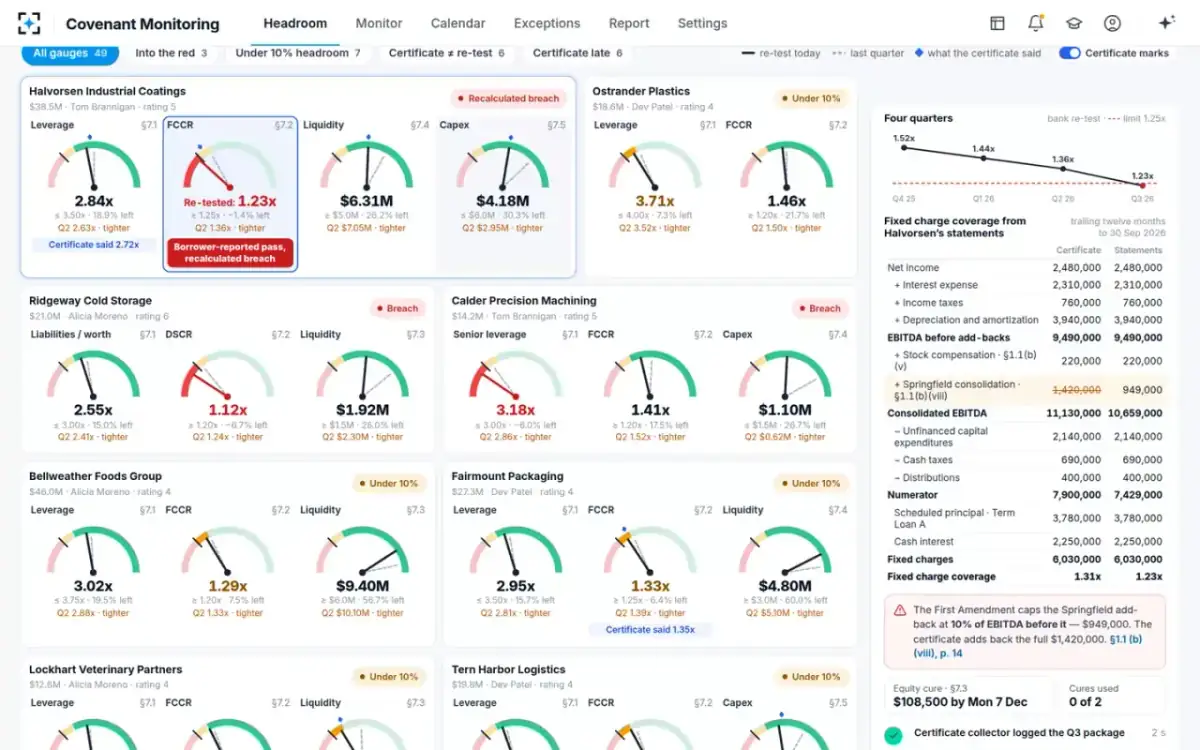
Both calculations agree on almost every line. They start from the same statements, the same $9,490,000 of EBITDA before add-backs and the same $220,000 of stock compensation. They deduct the same unfinanced capital expenditures, cash taxes and distributions, and divide by the same $6,030,000 of fixed charges. The difference is one add-back.
Fixed charge coverage, four quarters to 30 September 2026: the certificate against the re-test
Certified by the borrower: $9,490,000
Re-tested by the bank: $9,490,000, tied to the statements
Certified by the borrower: $220,000
Re-tested by the bank: $220,000
Certified by the borrower: $1,420,000, the full cost
Re-tested by the bank: $949,000, the First Amendment's 10% cap
Certified by the borrower: $11,130,000
Re-tested by the bank: $10,659,000
Certified by the borrower: $3,230,000
Re-tested by the bank: $3,230,000
Certified by the borrower: $7,900,000
Re-tested by the bank: $7,429,000
Certified by the borrower: $6,030,000
Re-tested by the bank: $6,030,000
Certified by the borrower: 1.31x · "in compliance"
Re-tested by the bank: 1.23x · below the minimum
The First Amendment allowed the Springfield add-back but capped it at ten percent of Consolidated EBITDA, as the amendment defines the base, which for this period the solution calculates at $949,000. The certificate added back the full $1,420,000. Without the $471,000 above the cap, Consolidated EBITDA is $10,659,000, the numerator is $7,429,000, and coverage is 1.23x. Leverage moves too, from the certified 2.72x to 2.84x on the re-test, but stays inside its 3.50x maximum.
Nothing in the certificate is false in the sense of a made-up number. Every figure ties to the statements. The certificate took the add-back the First Amendment created and left out the limit the same amendment put on it. That is the usual shape of a certificate error: not invention, but a looser reading of the words.
The recalculated breach, with the cap and the cure beside it
Why the bank, not the borrower, has to do the arithmetic
Examiners have asked this question for decades. The OCC's Commercial Loans procedures, in use since 1998, tell examiners to assess "Practices to determine the ongoing accuracy and reliability of borrower certifications that serve as justification for advancing funds" (OCC, Commercial Loans). A bank that accepts a certified ratio without recalculating it has no such practice. It has the borrower's word.
"Practices to determine the ongoing accuracy and reliability of borrower certifications that serve as justification for advancing funds."
OCC, Commercial Loans, examination procedures
The 2026 OCC booklet adds two reasons. Among its examples of structural weaknesses in a loan are "Nonexistent, weak, or waived covenants" and "Inadequate financial analysis", and it attributes unidentified exceptions to "errors, miscalculations, breakdowns in the pre- or post-closing review process, or system failures" (OCC, Lending and Loan Portfolio Risk Management). A covenant that the bank never tests against the agreement's words is, in effect, a weak covenant, whatever its level. A miscalculated certificate that nobody catches is an unidentified exception.
There is also a plain incentive reason. The borrower prepares the certificate, and the borrower is the party that bears the consequences of a breach: a renegotiation, a fee, a capital expenditure limit. That does not make the borrower dishonest; it makes the borrower's reading of an ambiguous clause predictably generous. The bank's recalculation is the independent check.
Seven places a definition changes the answer
The Springfield cap is one example of a family. The places to look are few and predictable, and a re-test should check each of them every quarter. The checklist below is ours; the examples in it are from the sample book.
Where a certified covenant and a re-test usually part company
- A cap on an add-back
A percentage of EBITDA, a dollar ceiling, or an aggregate limit across several clauses. The sample agreement has all three: 10% on Springfield, $250,000 on deal fees.
- A time window on an add-back
Restructuring or integration costs allowed only if incurred before a date. After the date, the same cost is an ordinary expense.
- An amendment applied to the wrong periods
A new add-back used for quarters before it existed, or an old uncapped clause used after an amendment capped it.
- A deduction left out of the numerator
Fixed charge coverage subtracts unfinanced capital expenditures, cash taxes and distributions. Financed and unfinanced capex are easy to swap.
- Debt the borrower did not count
Capital leases, earn-outs and letters of credit, if the definition of debt includes them. In the sample book, one borrower certified leverage of 2.38x; with its capital leases, the re-test was 2.41x.
- An item counted twice
An offset netted in two places. Another sample borrower certified $14.9 million of liquidity; with a floorplan offset counted once, it was $14.6 million.
- The wrong trailing twelve months
Built from the wrong quarters, or from an unaudited year when the audit has since restated it. The spread should tie to the statements to the dollar.
The last three examples matter as much as the first. A difference that leaves a covenant passing still means the bank and the borrower are calculating differently, and next quarter that difference may sit on the wrong side of the limit. The solution reports any difference above 0.01x or $10,000, a setting a bank can change, whether or not the covenant passes.
How to review a covenant compliance certificate in six steps
To review a covenant compliance certificate, rebuild it: tie the inputs to the statements, read the definitions as amended, recompute each covenant against the limit in force, and record every difference. A review that only checks the arithmetic on the certificate's own lines checks the borrower's adding, not the borrower's reading of the agreement.
- Tie the starting figures to the statements. Net income, interest, taxes, depreciation and amortization should match the interim or audited statements delivered with the certificate, for the same trailing four quarters.
- Read the definitions as they stand on the test date. Start from the credit agreement and apply every amendment in date order; the latest wins. A workbook built at closing is out of date the day the first amendment is signed.
- Test each add-back against its clause. Is it the kind of item the clause names, inside its cap, inside its window, and actually deducted from earnings in the period?
- Rebuild the denominator and the deductions. Debt as defined, including leases or letters of credit if the definition counts them; fixed charges as defined; unfinanced, not total, capital expenditures.
- Compare with the limit in force. Step-downs change the limit by test date; an equity cure, if used, changes the numerator for that one period only.
- Record every difference, pass or fail. A difference that still passes is the next quarter's breach in waiting, and a documented re-test is the evidence of the "accuracy and reliability" practice examiners look for.
In the sample book, step three is where the error sat and step two is why it was missed by hand: the cap lived in an eleven-page amendment, not in the 142-page agreement the original workbook was built from.
Is an incorrect compliance certificate an event of default? What the re-test triggered
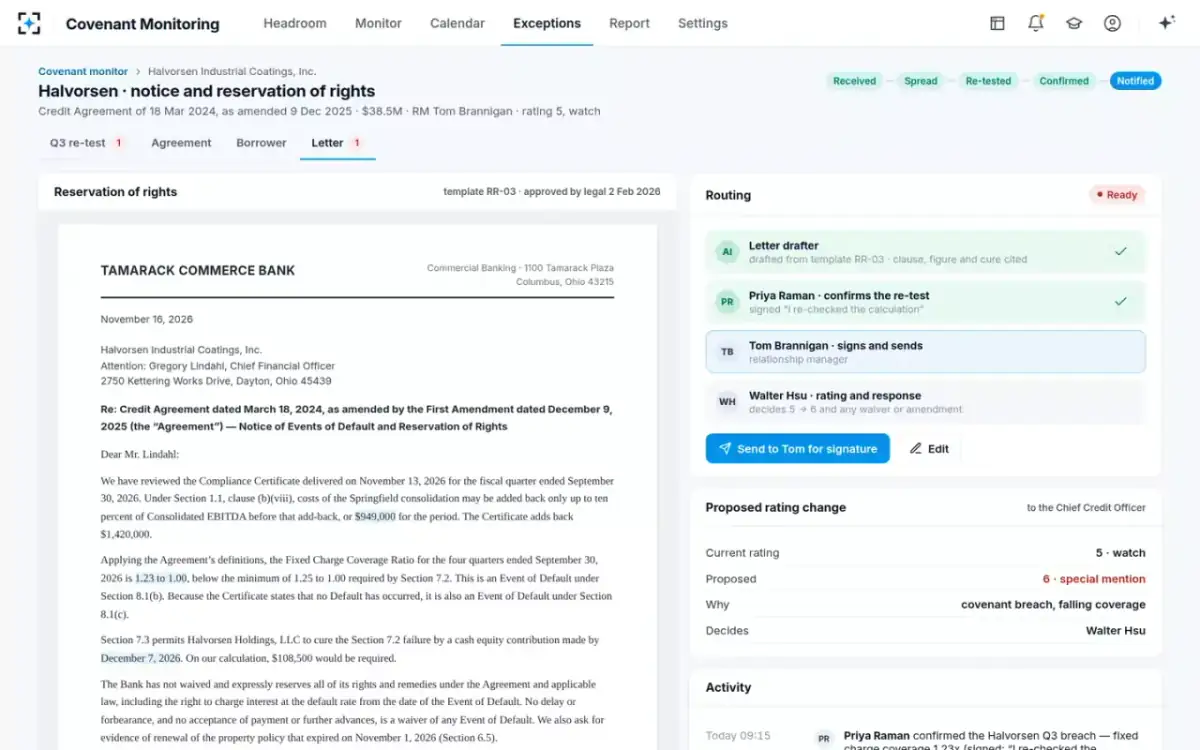
On the sample agreement, the re-test opened two events of default, not one. The fixed charge coverage failure is an event of default under section 8.1(b). And because the certificate stated that no default had occurred, the incorrect certificate is a separate event of default under section 8.1(c). The second matters even if the borrower cures the first, because it concerns the reliability of what the borrower tells the bank.
The agreement also gives the borrower a way back. Section 7.3 allows an equity cure: the parent may contribute cash within 15 business days of the due date, counted toward the covenant for the failed period, with two uses in all and not in consecutive quarters.
The equity cure, worked out
Minimum fixed charge coverage
1.25x
§7.2
Fixed charges, four quarters
$6,030,000
scheduled principal $3,780,000 + cash interest $2,250,000
Numerator the minimum needs
$7,537,500
1.25 × $6,030,000
Numerator on the re-test
$7,429,000
from the statements, cap applied
Cash equity that cures the test
$108,500
by Monday 7 December 2026: 15 business days from the 14 November due date, Thanksgiving excluded
The covenant tester proposes the breach; it does not declare it. The credit administration analyst re-checks the calculation and confirms, the relationship manager signs the letter, and the chief credit officer decides any rating change or waiver. The letter itself is drafted from the bank's approved template, with the clause, the figures and the cure.
The reservation-of-rights letter, drafted from the re-test
Reading the amendment, every time
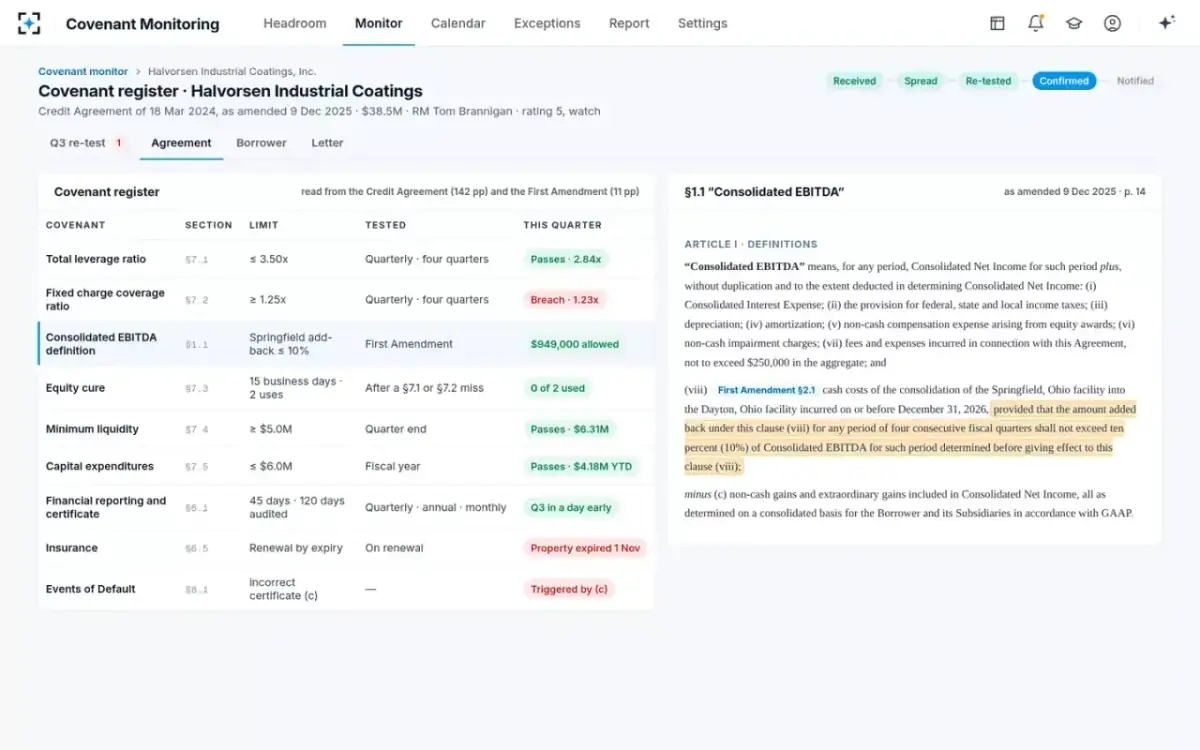
The Springfield error is an amendment error, and amendments are where by-hand testing is weakest. A covenant workbook built at closing carries the closing definitions. Unless someone rebuilds it when an amendment is signed, the bank's own test can repeat the borrower's mistake. In Covenant Monitoring the agreement reader reads the credit agreement and every amendment in date order into a covenant register, lets the latest amendment win, and cites the section and page for each term. How that agent works, and what it is not allowed to do, is set out in the agent that reads the agreement first.
The covenant register, with the amended definition open beside it
Re-testing every certificate this way also gives a bank a way to measure how often its borrowers' certificates disagree with its own arithmetic. Re-testing eight quarters of past certificates sets out how to do that on files the bank has already accepted. And for how the same borrower looked on a headroom gauge before the re-test, see how close to the limit is too close. The full re-test is shown on Covenant Monitoring.
Questions people ask
What is the difference between adjusted EBITDA and covenant EBITDA?
Adjusted EBITDA is management's own figure, used in investor materials and board packs, with whatever adjustments management chooses. Covenant EBITDA is a defined term in the credit agreement, with the add-backs, caps and windows the lender agreed to. The two often start from the same adjustments, but only the covenant figure binds the borrower, and a certificate that uses the management figure has used the wrong number.
What is the fixed charge coverage ratio formula in a covenant?
Usually EBITDA less unfinanced capital expenditures, cash taxes and distributions, divided by fixed charges, meaning scheduled principal plus cash interest, all over the trailing four quarters. The exact formula is the agreement's own: each term is a defined word, and the definitions differ from one agreement to the next.
How much of covenant EBITDA can come from add-backs?
No regulation sets a limit; the agreement's caps do. On the sample certificate the add-backs came to $1,640,000, about 15% of the certified Consolidated EBITDA; after the cap they were $1,169,000, about 11% of the re-tested figure. A share that rises quarter after quarter is worth a question even when every item is permitted.
Can a borrower add back costs for periods before an amendment allowed them?
Only if the amendment says so. Its effective date and any wording on which test periods it covers decide whether a new add-back reaches back into the trailing four quarters. The same applies in reverse: once an amendment caps an add-back, a certificate that keeps using the uncapped clause is using a definition that no longer exists.
Do add-backs affect the leverage covenant as well as coverage?
Yes, wherever the agreement uses the same defined EBITDA, and most do. On the sample borrower the capped add-back moved total leverage from the certified 2.72x to 2.84x on the re-test, still inside its 3.50x maximum. Because leverage divides by EBITDA while coverage starts from it, the same add-back moves the two by different amounts.