Covenant monitoring software is the system a bank uses to keep every loan's covenants under test after closing: it holds the covenants and definitions from each credit agreement and amendment, chases the compliance certificates and statements borrowers owe, recalculates each financial covenant, tracks headroom, and routes breaches, late certificates and waivers to the people who decide. The difference between products that matters most is whether they test or only track: whether they recalculate each covenant from the borrower's statements, or record the ratio the borrower certified. The way to tell is to measure what the software finds, and when. Five numbers do it: how long a certificate waits before it is tested, how many covenants are recalculated from source, whether late certificates are logged on the day, whether breaches are found in the quarter they happen, and whether waivers are recorded in full. Botminds' Covenant Monitoring is built to move all five, and a fictional sample bank, Tamarack Commerce Bank, shows them below as it runs through the solution.
Five covenant monitoring KPIs, with a sample scorecard
1
Days from certificate to tested
median of (date tested − date received), every certificate in the quarter
A breach is only useful to the bank once someone knows of it.
0.6 days
19 days by hand a year earlier
2
Covenants re-tested from source
covenants recalculated from the statements ÷ covenants due
The OCC asks about "the ongoing accuracy and reliability of borrower certifications".
Target 100%
Not measured by hand
3
Late certificates logged on day one
late certificates logged as exceptions within one business day ÷ late certificates
Stale statements are an exception whether or not anyone logs them.
27 of 27
27 late of 168 due
4
Breaches found in the quarter they occur
breaches confirmed at the quarterly test ÷ all breaches later found for that quarter
A breach found at the annual review arrives three quarters late.
Target 100%
Measured by a back-test
5
Waivers recorded in full
waivers with approver, reason, concession and period ÷ waivers granted
A waiver is a credit decision; without its approver, reason and price on file, it cannot be reviewed.
Target 100%
1 waiver request open
What should covenant monitoring software do? Tracking is not testing
Covenant monitoring software should do five jobs: read the agreement and amendments into a register, keep the reporting calendar and chase what is late, spread the statements, recalculate every covenant from them, and run the exceptions to a decision. Many tools sold as covenant software do only the first two, which makes them a better tickler, not a better test.
Covenant monitoring software that tracks, and software that tests
Tracks status: Keyed in at closing from a summary sheet; amendments re-keyed if someone remembers.
Tests from source: Read from the agreement and every amendment, latest first, each term cited to its page.
Tracks status: The ratio the borrower certified, typed into a field.
Tests from source: Recalculated from the statements under the definitions in force, and compared with the certificate line by line.
Tracks status: A due date that turns red.
Tests from source: Reminders before and after the date, and an exception with a clause and an owner the day after.
Tracks status: Pass or fail.
Tests from source: Distance to the limit in ratio and in EBITDA, with the trend over several quarters.
Tracks status: A status note.
Tests from source: Stages from found to closed, each with an owner; waivers with approver, reason and price.
Tracks status: That certificates arrived.
Tests from source: That covenants were tested, and that the borrower's figures were right or wrong.
The left column is not useless; a reliable calendar is the first thing examiners ask about. But only the right column answers the OCC's question about "practices to determine the ongoing accuracy and reliability of borrower certifications" (OCC, Commercial Loans). At the sample bank, one certified pass, a fixed charge coverage of 1.31x, re-tested at 1.23x, below its 1.25x minimum. Tracking software would have shown it green.
How to choose covenant monitoring software: what to ask a vendor
Choose on evidence from your own files, not on a feature list: ask each vendor to re-test a set of your closed quarters, and judge the answers to a short list of questions. The questions below separate testing from tracking, and people-in-control from automation that decides.
Questions to ask before buying covenant monitoring software
- Does it recalculate, or record what was certified?
Ask to see one covenant rebuilt from the statements, with every line traced to its source and to the clause that defines it.
- What happens when an amendment is signed?
The register should change on the next run, with the old and new text both cited. A re-key by your staff is a tracking tool.
- Who confirms a breach, and who sends a letter?
A person should confirm every breach and sign every letter. Ask what, if anything, can reach a borrower without one.
- Can it run on our closed quarters before we sign?
A pilot on eight past quarters, with every disagreement explained, is the only accuracy figure that applies to your book.
- What can the examiner see?
A covenant tracking report built from the tests, each figure linked to its calculation, and a trail of every setting change.
- Which thresholds are ours to set?
Tight headroom, trend length, difference tolerance, reminder schedule, who may extend and who approves a waiver should all be bank policy, versioned.
- What stays our responsibility?
All of it, under the interagency guidance on third-party relationships. Ask where documents are processed and kept.
The pilot answers most of the others. Financial covenant testing on eight closed quarters shows how to build it and how to read every disagreement, and covenant tracking software setup lists the documents it needs.
Covenant monitoring software vs spreadsheets: why status reports miss breaches
A spreadsheet can hold the status of every covenant, but it cannot show whether any of them was tested. Covenant reporting has grown up around the examiner's request list, and the request list asks for status. The OCC's 2026 booklet asks banks for "commercial loan credit administration reports, such as financial statement tracking, covenant tracking, and the status of annual reviews" (OCC, Lending and Loan Portfolio Risk Management). A status report answers "where are we?" A programme also needs to answer "are we finding what we should, in time to act?", and that needs different numbers.
The difference shows when something goes wrong. A status report that says three open breaches and nine borrowers under 10% headroom looks the same whether the bank recalculated every covenant or accepted every certified ratio. Only the five KPIs separate the two. They are also what the OCC's own questions point at: the accuracy of borrower certifications, the timely submission of statements, the identification of exceptions and the handling of waivers.
KPI 1: days from certificate to tested
This is the median number of days between a certificate arriving and its covenants being recalculated, for every certificate in the quarter. It is the single best measure of whether the covenant desk keeps up with the wave of certificates that arrives on the deadline. At the fictional sample bank, it was 19 days by hand in the third quarter of 2025 and 0.6 days with the solution a year later.
Where the quarter's days go, by activity: by hand and with the agents
The bars show why the median falls so far. By hand, a certificate waits for re-keying and for the analyst to find the definitions before anyone recalculates it. With the agents, those steps take minutes, so the test runs when the package arrives. What remains is chasing, which is human work: a borrower answers its relationship manager, not a system.
KPI 2: covenants re-tested from source
This is the share of covenants due in the quarter that the bank recalculated from the borrower's statements under the agreement's definitions, rather than taking the certified figure. It is the KPI most banks cannot report, because by hand the answer depends on how busy the week was. The solution's design target is 100%.
It is the direct answer to the OCC's long-standing examination question about "Practices to determine the ongoing accuracy and reliability of borrower certifications" (OCC, Commercial Loans). At the sample bank, a certified fixed charge coverage of 1.31x re-tested at 1.23x, a breach, because the certificate took an add-back above a cap the latest amendment set. A programme that does not re-test cannot find that; the arithmetic is set out line by line.
KPI 3: late certificates logged on day one
This is the share of late certificates logged as exceptions within one business day of the due date, with an owner. It turns the OCC's procedure question, "Does the bank have a system to monitor the timely submission of commercial borrower and guarantor financial statements", into a number. At the sample bank, all 27 late certificates were logged the day after the due date, one of them for the second quarter running.
The rate of late certificates itself, 27 of 168 at the sample bank, is worth reporting beside it, but it is a measure of the borrowers, not of the programme. What the bank controls is how fast it knows. One late certificate, followed from day 45 to day 90, shows what that is worth.
KPI 4: breaches found in the quarter they occur
This is the share of breaches confirmed at the quarterly test for the period in which they occurred, out of all breaches later found for that period, whether at the annual review, by loan review or by an examiner. It measures what the covenant programme exists for. A breach found three quarters late is a breach the bank could not use: renegotiations after a violation are where lenders win terms that restrict the borrower, as what happens after a loan covenant breach sets out, and that leverage is worth most when it comes early.
The denominator is the hard part, because it needs breaches the bank did not find at the time. A back-test of past quarters supplies it, and re-testing eight quarters of certificates explains how. The target is 100%; the honest starting value is whatever the back-test shows.
KPI 5: waivers recorded in full
This is the share of covenant waivers granted with four things on file: who approved, why, what the bank received in return, and which period the waiver covers. A waived breach stays in the examiner's count of exceptions, and a waiver granted without a concession is one of the Federal Reserve's named warning signs (CBEM §2010.1), so a waiver missing any of the four is the kind an examiner asks about. At the sample bank the one open request, with a $15,000 fee proposed, sits with the chief credit officer; why a waived breach still counts covers the policy.
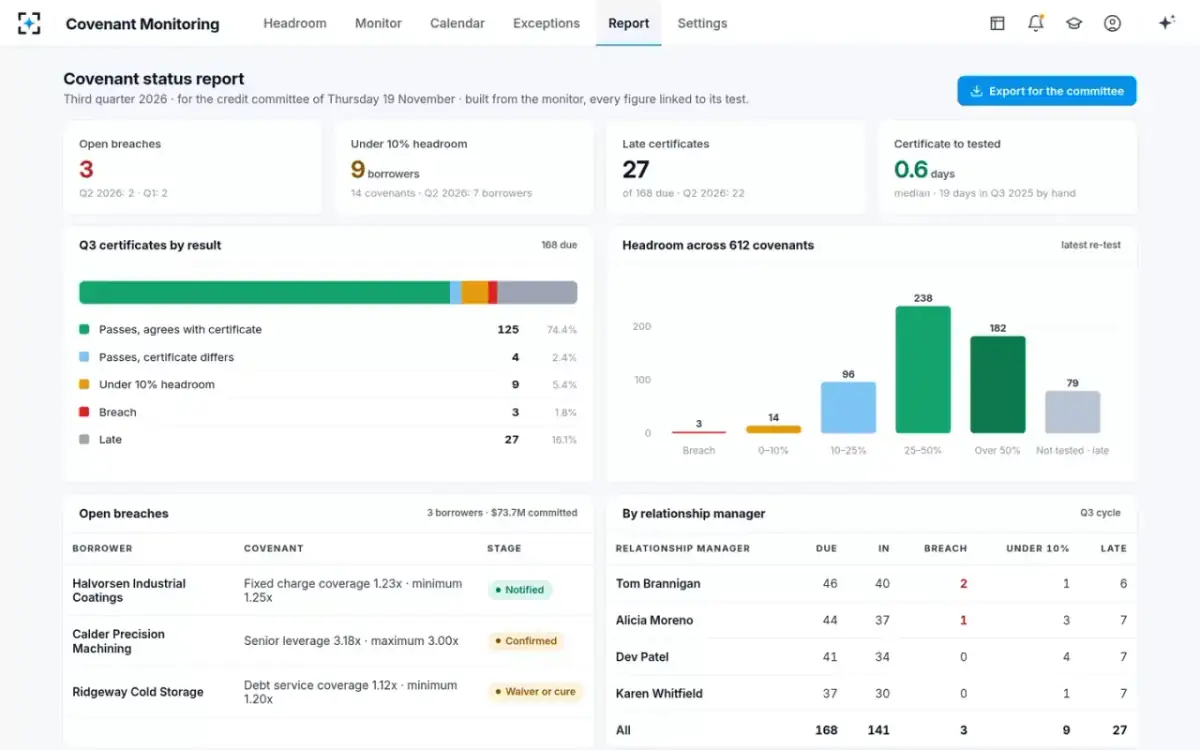
The committee report the KPIs feed
What is the ROI of covenant monitoring software? Pricing it on these numbers
The return on covenant monitoring comes from three places, and only one of them is staff time. We found no independent, published figure for the hours or costs of covenant testing, so every term below is priced from the bank's own inputs; the sample figures are our estimates for the fictional bank.
The return on a covenant programme, as a sum
Desk time released
days saved per quarter × 4 × loaded daily cost
Sample bank, our estimate: about 16 working days a quarter. At the BLS mean wage for credit analysts, $100,850 a year, before benefits.
Priced by credit administration
Breaches found earlier
breaches moved from annual review to quarter × value of acting a quarter or more sooner
Fees, tighter terms, an earlier rating change or a cure. KPI 4 gives the count; the value per breach is the bank's own judgment.
Priced by the chief credit officer
Findings avoided
exam findings on covenant tracking, stale statements or waivers × cost of remediation
KPIs 3 and 5 measure the exposure. Cost is the bank's own experience of a matter requiring attention.
Priced by credit risk and compliance
Cost of the programme
subscription + setup + people's time confirming results
The analyst still confirms every result and decides every extension; that time stays in the cost.
Priced by finance
The first term is the easiest to count and the least important. At the sample bank our estimate of the days saved is about 16 a quarter, which at roughly $390 a working day of a credit analyst's mean wage comes to about $25,000 a year before benefits. That pays for little on its own. The second term is where the money is, and KPI 4 is the measure of it: every breach found in the quarter it happens rather than at the annual review gives the bank a renegotiation it would otherwise have lost. The third term is insurance; its value depends on the bank's exam history.
The sample bank's quarter at a glance
3
open breaches, one of them a certified pass that the re-test turned into a breach
9
borrowers, 14 covenants, under 10% headroom, up from 7 borrowers
27of 168
certificates late, every one logged the day after the due date
0.6days
median from certificate to tested, against 19 by hand
Starting the scorecard
A bank can compute four of the five KPIs from its own files today, imperfectly, and the fifth after one back-test. The order below is the one we would use.
Five steps to a covenant scorecard
- Date-stamp arrival and test
Record when each certificate arrived and when its covenants were recalculated. KPI 1 follows.
- Mark how each covenant was tested
Recalculated from the statements, or accepted from the certificate. KPI 2 follows, and is usually lower than expected.
- Log late certificates on the day after the due date
With the clause and an owner. KPI 3 follows.
- Run one back-test
Re-test a sample of past quarters to find breaches the bank missed at the time. It gives KPI 4 its denominator and its baseline.
- Add four fields to every waiver
Approver, reason, concession, period. KPI 5 follows.
The documents the programme needs to produce these numbers, from every amendment to past certificates, are listed in what a bank brings to start. To see the scorecard built from a sample book, start from Covenant Monitoring.
Questions people ask
What are the most important covenant monitoring KPIs?
Days from certificate to tested and the share of breaches found in the quarter they occur. The first measures whether the desk keeps up; the second measures whether the programme finds what it exists to find. The others explain why either number moves.
How much does covenant monitoring software cost?
No public price list covers the category; quotes usually depend on the number of borrowers or covenants and on setup. The cost to compare is the total: subscription, setup, and the time your people still spend confirming results. Set it against the return terms above, priced from your own back-test.
What is the difference between covenant monitoring and covenant tracking software?
The words are used loosely, but tracking usually means the calendar and status of each covenant and certificate, while monitoring adds the recalculation, headroom and trend that show whether the borrower really complies. A product that only tracks will report a certified pass as a pass.
How soon does covenant monitoring software show results?
The first quarter after setup gives three of the five KPIs: days to tested, the share re-tested from source and late certificates logged on the day. Breaches found in the quarter need a baseline, which a back-test of past quarters supplies before go-live.
Is the number of open breaches a good KPI?
It is a useful status figure, not a performance measure. A rise can mean borrowers are weakening or that the bank has started finding breaches it used to miss. Read it beside KPIs 2 and 4.