If a borrower breaches a loan covenant, it is in technical default even if every payment is on time: the lender gains the right to refuse new advances, charge default interest and, in the end, demand repayment of the whole loan. What usually happens instead is a renegotiation. The lender reserves its rights in writing, the borrower may cure the breach if the agreement allows it, and the two sides agree a waiver or an amendment, generally with a fee, tighter terms or new limits on what the borrower may spend. Breaches are not rare: "in any given year, between 10 percent and 20 percent of firms report being in violation of a financial covenant in a credit agreement" (Nini, Smith and Sufi, Review of Financial Studies, 2012). For a bank, finding them promptly is the whole value of the covenant, and Botminds' Covenant Monitoring re-tests every covenant from the borrowers' own statements each quarter so the breach is found in the quarter it happens, not at the annual review.
Breaches are common; losses are not
10–20%
of US public nonfinancial firms report a covenant violation in a given year, 1996–2008
75%+
of covenant violations lead to a renegotiation of the loan
9months
between renegotiations of the typical bank loan
0.96%
of C&I loans at insured banks were noncurrent at 30 June 2026
What happens if you breach a loan covenant? The sequence, step by step
A breach sets off a sequence that the credit agreement mostly scripts: the test fails, the default is recognised, the lender reserves its rights, the borrower gets any cure the agreement gives it, and the parties settle on a waiver, an amendment or, rarely, enforcement. The order matters to both sides, because each step either preserves the lender's rights or quietly gives them away.
From a failed covenant test to new terms: what happens after a breach
Agent
The test failsThe quarter's ratio, recalculated under the agreement's definitions, is on the wrong side of its limit. Sometimes the borrower reports it; sometimes only the lender's re-test finds it, which in Covenant Monitoring is an agent's job.
Never: Never declares the breach itself.
A person decides
The default is confirmedCredit staff check the calculation and the clause. In many agreements a failed financial covenant is an event of default on the test date, with no grace period.
A person decides
The lender reserves its rightsA written notice names the breach and states that accepting payments or delaying action does not waive anything.
A person decides
The borrower may cureIf the agreement allows an equity cure, the owners can inject cash that counts toward the failed test within a set window and a set number of uses.
A person decides
Waiver, amendment or enforcementMost breaches end in a waiver of the one test or an amendment that resets the covenant, priced with a fee, a higher margin or tighter terms. A few end in acceleration.
Take a fictional sample bank, Tamarack Commerce Bank, as it runs through the solution. Its borrower Halvorsen Industrial Coatings certified fixed charge coverage of 1.31x against a 1.25x minimum; the bank's re-test under the amended agreement found 1.23x. That one result opened two events of default under the sample agreement, the failed covenant and the incorrect certificate, and an equity cure of $108,500 of cash, due within 15 business days, with two cures allowed over the life of the loan and none in consecutive quarters. The letter reserving the bank's rights was drafted the morning the analyst confirmed the calculation.
Is a covenant breach an event of default?
Usually, yes. Commercial credit agreements generally list a failed financial covenant among the events of default, and it counts from the test date even though the borrower learns of it weeks later, when the statements are done. "The breach of a financial covenant means that the borrower is in technical default on the loan," the FDIC working paper by Nini, Smith and Sufi explains, "and that the lender has the right to demand immediate repayment of the entire loan" (FDIC CFR 2007-01).
Technical is the important word. The loan is not delinquent, the borrower may never miss a payment, and the bank's call report will not show it as past due. What changes is the balance of power. Affirmative and reporting covenants, such as delivering statements or keeping insurance in force, often carry a short grace period before they become events of default; financial covenants generally do not, because the breach is a fact about a past quarter that cannot be put right by doing something late. An equity cure, where one exists, is the exception that proves the rule: it lets the owners rewrite the past quarter's numerator, at a price and only a few times.
Can a bank call a loan for a covenant breach?
Contractually, yes; in practice, rarely. The Federal Reserve's examination manual notes that "violations of these covenants can often result in acceleration of the debt maturity" (CBEM §2080.1), and the right to accelerate is what gives every other remedy its force. Banks seldom use it on a performing borrower, because calling a loan that is being paid turns a technical default into a real one.
The rights a bank does use are quieter. A revolver lender can refuse the next draw: covenants "allow the lender to monitor and reject a drawdown request if the covenant is violated," as Chodorow-Reich, Darmouni, Luck and Plosser put it, adding that "all of these terms involve discretion: a lender can roll-over the loan, not mark the collateral to market at high frequency, and waive a covenant violation" (NBER working paper 27945). Default interest, a block on distributions and a demand for more frequent reporting are the other common levers. The discretion is the point, and it is also the risk: a bank that uses none of its rights and says nothing can find it has waived them by conduct.
The lender's options after a covenant breach, and what each costs the borrower
What the lender does: Sends a written notice that it is not waiving the default, and keeps lending while it decides.
What it usually means for the borrower: No immediate cost, but every later concession becomes something the lender can ask a price for.
What the lender does: Excuses the one covenant for the one period, in writing, often for a fee.
What it usually means for the borrower: A fee and sometimes added reporting; the covenant is unchanged and will be tested again next quarter.
What the lender does: Resets the level or the definition going forward.
What it usually means for the borrower: Fee, higher margin, and often new limits on capital spending, acquisitions or distributions.
What the lender does: Agrees not to enforce for a set time while a plan is carried out.
What it usually means for the borrower: A deadline, milestones and usually a higher price; the default stays open.
What the lender does: Demands repayment of the whole loan and stops advances.
What it usually means for the borrower: A refinancing, a sale or a restructuring, on the lender's timetable.
What does a lender ask for after a covenant violation?
A lender asks mainly for control, not price. The usual answer to a breach is a renegotiation, not an acceleration: "More than 75% of all covenant violations lead to a renegotiation," Michael Roberts found, and the typical bank loan "is renegotiated five times, or every nine months", with pricing, maturity, amount and covenants all changed along the way (NBER working paper 20484). Violations are not what drives most of those renegotiations, though: "fewer than 28% of the sample renegotiations are due to a covenant violation or in anticipation of a covenant violation". A breach is one of several occasions to reprice; it is the one where the lender holds the stronger hand.
It shows in what changes. In the violating firms Nini, Smith and Sufi studied, breaches were "followed immediately with a decline in acquisitions and capital expenditures, a sharp reduction in leverage and shareholder payouts, and an increase in CEO turnover" (the authors' summary). Their earlier FDIC paper put a number on the trade: after a violation the chance of a capital expenditure restriction rose by 14 percentage points, while the interest spread rose by only about 23 basis points (FDIC CFR 2007-01). For a borrower, the cost of a breach is a lender with a say in its budget.
Two consequences follow for the people who test covenants. First, the agreement a bank tests this quarter is often not the agreement it signed: amendments, waivers and reset levels pile up, and each changes the arithmetic. Second, the value of a breach to the bank depends on finding it promptly. A breach found at the annual review, three quarters late, arrives after the borrower has spent the cash the renegotiation was meant to protect.
How often do borrowers breach loan covenants?
Often enough that a commercial book of any size will have some every quarter. The 10–20% annual rate is for public companies, the only borrowers whose violations are visible in filings. Earlier work points the same way: Sufi found that one in three firms with a bank line of credit violated a financial covenant at some point between 1996 and 2003, and Chava and Roberts that 30–40% of firms in their sample violated a net worth or current ratio covenant (both as cited in an FDIC Center for Financial Research working paper).
Private middle-market borrowers, the core of most bank covenant books, are not covered by those numbers, and no public dataset measures their violation rate. What the research does show is why covenants trip so often. Most corporate lending is written on cash flow rather than collateral: Lian and Ma estimate that "80% is based predominantly on cash flows from firms' operations", with loan covenants built on EBITDA and tested every quarter (Lian and Ma, NBER, 2018; Quarterly Journal of Economics, 2021). A covenant tested four times a year against trailing earnings will catch every soft quarter, and it is meant to.
Maintenance vs incurrence covenants: which ones breach
Only maintenance covenants breach on their own; incurrence covenants breach only when the borrower acts. A maintenance covenant is tested every quarter whether or not the borrower does anything, so a bad quarter alone can trip it. An incurrence covenant is tested only when the borrower takes a step the covenant governs, such as raising debt or paying a dividend, and a borrower that takes no such step never fails it. Lian and Ma describe the split as one between loans, which "generally monitor compliance on a quarterly basis", and bonds, which test "only when borrowers take certain actions such as issuing debt".
That is why the frequency figures above are bank-loan figures, and why a shift toward covenant-lite structures changes monitoring more than it changes risk. A book that loses its maintenance tests loses its quarterly signal; the monitoring that remains has to work from statements, trends, borrowing base reports and the borrower's own projections.
Why covenant breaches are harder to catch in 2026
Four changes, each with a public series behind it, have raised the load on covenant testing. None of them means more borrowers will fail. Together they mean that more covenants sit closer to their limits, under more complicated definitions, with less outside guidance on what the bank must do.
More leverage, especially outside the banks
The riskiest syndicated credit is leveraged. In the 2025 Shared National Credit review, which covers loan commitments of $100 million or more shared by several regulated lenders, "nearly half of total SNC commitments are leveraged, and leveraged loans comprise 81 percent of non-pass loans" (Federal Reserve, FDIC and OCC, January 2026). US banks held 45% of the commitments but only 22% of the non-pass loans; most of the weakest credit sits with other lenders.
US banks hold less of the weakest syndicated credit than of the whole
All SNC commitments, $6.9 trillion
- US banks · 45%
- Other holders · 55%
Non-pass SNC loans (special mention and classified)
- US banks · 22%
- Other holders · 78%
Much of the leveraged middle market is now financed by private credit funds, and banks lend to those funds: bank loans to nondepository financial institutions reached $1.4 trillion at the end of 2025, 5.6% of industry assets (FDIC Risk Review 2026). A Federal Reserve note in August 2026 found private credit borrowers "smaller (with revenue typically below $250 million) and more leveraged (with a median debt-to-EBITDA ratio of 5x)" than borrowers in the leveraged loan market (FEDS Notes, August 2026). Those are the middle-market companies a commercial bank competes for, and the ones whose covenant definitions are written to match.
Private credit borrowers carry more debt per dollar of EBITDA
Looser standards and lighter covenants
Bank standards are not tight either. In the July 2026 Senior Loan Officer Opinion Survey, banks said their current C&I standards "were easier than the midpoints of their historical ranges" for several loan categories, including non-syndicated loans to large, middle-market and small firms (Federal Reserve, July 2026). In private credit, a 2024 Federal Reserve note credited low default rates partly to "periodic monitoring of borrowers through loan covenants", and also reported industry commentary that recent large deals were "devoid of financial maintenance covenants" (FEDS Notes, February 2024).
No more shared rulebook for leveraged lending
On 5 December 2025 the OCC and FDIC rescinded the 2013 interagency leveraged lending guidance and its 2014 FAQs. In its place: "Each bank should determine its own definition of a 'leveraged loan,'" and "a bank should conduct an analysis of a leveraged borrower's past and current performance compared with projections" (OCC and FDIC, NR 2025-119). As of October 2026 the Federal Reserve's list of supervisory letters showed no matching rescission (SR letters index). For a bank, that moves the definition of its riskiest loans, and the way it tracks them against plan, into its own credit policy, where examiners will test it.
Supervisors are watching private credit and restructurings
The OCC's Spring 2026 Semiannual Risk Perspective put it plainly: "There are signs that credit quality for some vintages, borrower types, and sectors of the private credit markets is weakening. The increasing use of debt restructurings and paid-in-kind (PIK) mechanisms may mask underlying credit deterioration" (OCC, Spring 2026). Masked deterioration is a covenant-testing problem. A restructured loan carries a new agreement, often with new definitions and reset levels; a payment in kind keeps a loan current while its coverage ratio says otherwise.
What changed for covenant monitoring, December 2025 to August 2026
Dec 2025
Rescind the 2013 leveraged lending guidance. "Each bank should determine its own definition of a 'leveraged loan,'" and compare a leveraged borrower's performance with its projections.
Jan 2026
Shared National Credit review: leveraged loans are 81% of the non-pass syndicated commitments.
Spring 2026
Semiannual Risk Perspective: signs that credit quality in some private credit vintages is weakening; restructurings and payment-in-kind "may mask underlying credit deterioration".
Jun 2026
New Lending and Loan Portfolio Risk Management booklet: covenant breaches, "even if waived", are financial exceptions; covenant tracking is on the request list.
Jul 2026
Senior Loan Officer Survey: C&I standards easier than the midpoints of their ranges since 2005 for several loan categories.
Aug 2026
Research note: private credit borrowers carry a median debt-to-EBITDA of 5x.
Where the trend lands: one sample bank's covenant desk
Trends in public data arrive on a bank's covenant desk as a longer exception list. Take a fictional sample bank, Tamarack Commerce Bank, as it runs through the solution: 214 borrowers, 612 financial covenants and $2.84 billion committed. In the third quarter of 2026 its open breaches rose to three from two the quarter before, the borrowers within 10% of a limit to nine from seven, and late certificates to 27 from 22. None of that is alarming on its own. All of it is work.
The covenant status report a credit committee sees
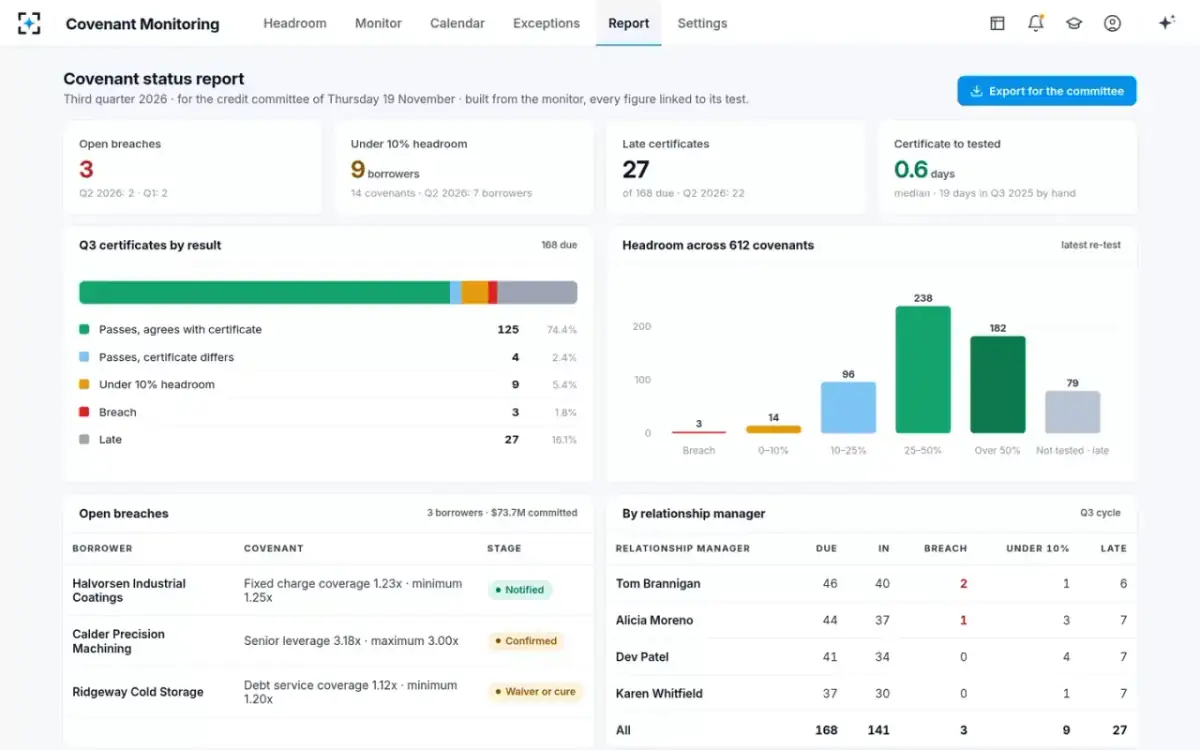
Of the three breaches, one was reported by the borrower, one came with a waiver request, and one was a certified pass that the bank's own re-test turned into a breach. The third kind is the one the trend makes more likely. When a borrower is close to its limit, the definitions decide the result: whether an add-back counts, whether a cap applies, whether an amendment changed either. How one capped add-back turned 1.23x into 1.31x shows the arithmetic, and covenant headroom shows how to read a book by distance to the limit.
What this means for the covenant desk
The response to a harder environment is not more covenants; it is testing the ones a bank has properly, every quarter, from source. The checklist below is what we would ask of any covenant programme in 2026, with or without software.
Six things a covenant programme should do in a harder market
- Re-test, do not accept
Recalculate each financial covenant from the borrower's statements under the agreement's definitions. A certified ratio is the borrower's answer, not the bank's test.
- Read every amendment into the test
Waivers, resets and amended definitions pile up over a loan's life; the test in force is rarely the one at closing.
- Count late certificates as exceptions on day one
The borrowers with the worst quarters have the most reason to be late. Untested is not the same as passing.
- Watch trends, not only levels
Three quarters of falling headroom is a warning even at 20% headroom, especially on coverage covenants.
- Write your own definition of a leveraged loan, and track it
Since December 2025 the OCC and FDIC expect each bank to define it and to compare leveraged borrowers' performance with their projections.
- Keep waivers and restructurings visible
A waived breach is still an exception in the OCC's count, and the OCC warns that restructurings can mask deterioration.
The fifth and sixth items are the ones most often left to memory. A waived breach drops out of the monitoring spreadsheet the day the waiver is signed, but not out of the examiner's count: why a waived covenant is still an exception sets out what to keep. For a programme that does all six without adding headcount, start from Covenant Monitoring.
Questions people ask
What should a borrower do if it expects to breach a covenant?
Tell the lender before the test date, with the numbers and a plan. A lender asked for a reset in advance negotiates over a forecast; one that learns of a breach from the certificate negotiates over a default, with its rights reserved. Roberts found that some renegotiations happen "in anticipation of a covenant violation", which is the cheaper kind for the borrower.
How much does a covenant waiver cost?
There is no market rate; the fee is negotiated and usually reflects the size of the loan, the size of the miss and the lender's view of the plan. Banks often set a minimum in credit policy, and the price may come as a margin step-up or tighter terms rather than a fee. Bank covenant waivers covers how a bank should approve and record one.
Does a covenant breach change the borrower's risk rating?
It should prompt a review, but it does not set the rating on its own. The OCC tells examiners not to criticise a loan "solely because it has an exception", while warning that a consistent pattern of exceptions can reflect weak controls (OCC, 2026). A breach backed by a falling trend and a missed forecast is what usually moves a borrower to special mention.
What is a covenant-lite loan?
A loan without financial maintenance covenants: the borrower is tested only when it takes certain actions, such as borrowing more. It removes the quarterly signal a maintenance covenant gives, so a lender relies on reporting, trends and its own analysis instead. A 2024 Federal Reserve note reported industry commentary that some large private credit deals were "devoid of financial maintenance covenants".
Do banks have to report covenant breaches to examiners?
There is no separate filing, but examiners ask. The OCC's request list includes covenant tracking reports, and its booklet lists "covenant breaches and waivers" among the management reports examiners review. A breach that is waived stays in that count.
Do private credit loans have covenants?
Many do, and a 2024 Federal Reserve note credited private credit's low default rates partly to "periodic monitoring of borrowers through loan covenants". Its borrowers are also more leveraged, with a median debt-to-EBITDA of 5x against 3.2x in the leveraged loan market (FEDS Notes, August 2026), so their covenants tend to sit nearer the limit.