The Policy Statement on Prudent Commercial Real Estate Loan Accommodations and Workouts is the guidance the OCC, Federal Reserve, FDIC and NCUA issued in 2023 on how banks and credit unions should handle CRE borrowers who cannot meet their loan terms, and how examiners will judge the result. Its message is short: a prudent accommodation or workout will not be criticised, even if the loan ends up adversely classified, provided the bank did the analysis first. The long part is what "the analysis" means: updated financials on borrower and guarantors, a current valuation, global debt service coverage, a tested guarantor, a fitting structure and an accurate grade, for each loan. Botminds' CRE Loan Maturity Management assembles that file for every loan approaching maturity, so a credit officer decides an extension from evidence the statement recognises rather than from a memo written under the date.
Where this page shows a worked file, it follows a fictional sample bank, Marrowstone Bank, as its maturing loans run through the solution; its people and properties are invented. Everything attributed to the statement is quoted from the Federal Register text, 88 FR 43115.
Workouts are routine: what banks modified in 2025
$11.6B
of modified CRE loans at FDIC-insured banks in 2025
0.38% of the CRE secured portfolio
82%
of that modified volume was performing
29%
share of CRE-secured loans held by banks over $100 billion, which made more than half the modifications
What is the policy statement on prudent commercial real estate loan accommodations and workouts?
It is supervisory guidance, issued on July 6, 2023 at 88 FR 43115, that sets out the risk management, classification, regulatory reporting and accounting expectations for loans to commercial real estate borrowers in difficulty. It replaced the 2009 statement: "This final Statement supersedes the 2009 Statement for all supervised financial institutions" (88 FR 43115). The OCC conveyed it in Bulletin 2023-23, which also rescinded OCC Bulletin 2009-32, and the Federal Reserve in SR 23-5, which applies it to "all institutions supervised by the Federal Reserve, including those with $10 billion or less in consolidated assets" (SR 23-5). Both pages were live, with no rescission notice, in October 2026.
Guidance is not a regulation: each agency has adopted a rule clarifying the role of supervisory guidance, and the statement cites them. In practice it is the text examiners carry into a CRE file review, and its appendix of worked examples, nine loan types from an office building to a land loan in 27 scenarios, is the nearest thing the industry has to a grading key. Compared with 2009, the agencies say the 2023 version incorporates "views on short-term loan accommodations, information about changes in accounting principles since 2009, and revisions and additions to the CRE loan workouts examples," and it removed troubled debt restructuring language.
What is a loan accommodation, and how is it different from a workout?
An accommodation is short-term relief; a workout is a longer arrangement under a formal program. The statement defines an accommodation as "any agreement to defer one or more payments, make a partial payment, forbear any delinquent amounts, modify a loan or contract, or provide other assistance or relief to a borrower who is experiencing a financial challenge." When those measures "are not sufficient or have not been successful," banks move to workouts, which "can take many forms," including "renewing or extending loan terms", "granting additional credit" or "restructuring the loan with or without concessions."
The distinction matters at maturity because a renewal of a loan to a borrower in difficulty is a workout under the statement, even when nobody in the bank calls it one. A footnote adds the line that separates a restructuring from a mere renewal: "A restructuring involves a formal, legally enforceable modification in the loan's terms." Each choice leaves a different trail through grading and accounting, and the five paths a maturing loan can take are compared side by side on another page.
Modified loans to borrowers who have the ability to repay their debts according to reasonable terms will not be subject to adverse classification solely because the value of the underlying collateral has declined to an amount that is less than the outstanding loan balance.
Policy Statement on Prudent CRE Loan Accommodations and Workouts, 88 FR 43115 (2023)
The two protections the statement gives a lender
The statement reaffirms two principles from 2009, and both protect a bank that does its homework. First, institutions "that implement prudent CRE loan accommodation and workout arrangements after performing a comprehensive review of a borrower's financial condition will not be subject to criticism for engaging in these efforts, even if these arrangements result in modified loans with weaknesses that result in adverse classification." Second, the value protection quoted above: a loan to a borrower who can pay on reasonable terms is not adversely classified just because the collateral is now worth less than the loan.
Both protections are conditional, and the condition is the file. The first depends on "a comprehensive review"; the second on "the ability to repay … according to reasonable terms", which a bank can show only with current income, a current value and a realistic payment. Neither word is defined. The agencies declined to define "comprehensive" and "reasonable" on purpose, because each workout "is case-specific." What they did provide is a list of what management must have done.
What do examiners need to see before they leave a workout uncriticised?
Examiners need, for each loan, a workout plan built on current information, a global cash flow analysis, a guarantor analysis, evidence the bank will monitor the borrower, an accurate grade and a GAAP allowance. The table maps each expectation in section IV of the statement to the evidence that satisfies it and the way it usually fails.
The 2023 workout statement's expectations, mapped to the evidence in a defensible file
| The statement expects | Evidence that satisfies it | How it usually fails |
|---|---|---|
| "Updated and comprehensive financial information on the borrower, real estate project, and all guarantors and sponsors" | Current rent roll and leases, trailing twelve months, sponsor and guarantor statements and returns | Last year's spread rolled forward; guarantor statement two years old |
| "Current valuations of the collateral supporting the loan and the workout plan" | A new appraisal or an evaluation that updates the old assumptions | Origination appraisal reused, or a value estimated by the lender |
| "Appropriate loan structure (e.g., term and amortization schedule), covenants, and requirements for curtailment or re-margining" | Term, amortisation, paydown, reserve and sweep stated and justified | Interest-only renewal with no mitigant |
| "Analyzed the borrower's global debt service coverage, including realistic projections" | Cash flow across all the borrower's and guarantor's properties and debts | Property coverage only |
| "Analyzed the available cash flow of guarantors" | Liquidity after personal obligations, tested against all guarantees outstanding | Net worth taken from the guarantee file |
| "Willingness and ability to monitor the ongoing performance" | Covenants, reporting dates and a named owner after the decision | No follow-up until the next maturity |
| An internal grade that "accurately and consistently reflects the risk" | Grade with its reason, confirmed by credit | Pass kept because payments are current |
| An allowance methodology under GAAP that recognises losses "in a timely manner" | Allowance change and accrual decision with the memo | Allowance left at the pooled rate |
The right-hand column is where criticism comes from, and its first two rows are the ones a maturity deadline causes. When a loan reaches committee a week before its date, the rent roll is whatever the borrower last sent and the value is whatever was on file. The statement's office example shows what that costs.
Two 1.12x office loans: one pass, one special mention
The statement's first example is an office loan: $15 million, 20-year amortisation, a $13.6 million balloon in year five, 75% loan-to-value on a $20 million "as stabilized" value, 1.30x coverage. Hybrid work has cut its cash flow. In both of the first two scenarios the lender renews the $13.6 million at a market rate, amortising over the remaining 15 years, and the borrower has never been delinquent. The difference is what the lender did before renewing.
The statement's office example: the same coverage, two grades
Scenario 1: graded pass, examiner agreed: 1.12x "based on updated financial information"
Scenario 2: graded pass, examiner listed special mention: Projected not to fall below 1.12x on leases in place and letters of intent
Scenario 1: graded pass, examiner agreed: A recent appraisal: $13.3 million "as stabilized", 102% loan-to-value
Scenario 2: graded pass, examiner listed special mention: The lender's own estimate: $14.5 million, 94% loan-to-value; "a current valuation has not been ordered"
Scenario 1: graded pass, examiner agreed: Tenants stable, long leases, major tenants not on hybrid work
Scenario 2: graded pass, examiner listed special mention: Lender "has not asked the borrower or guarantors to provide current financial statements"
Scenario 1: graded pass, examiner agreed: Most tenants stable occupants with long-term leases
Scenario 2: graded pass, examiner listed special mention: Leases coming up for renewal; concessions may be needed; absorption slowed
Scenario 1: graded pass, examiner agreed: "The borrower has the ability to continue making loan payments based on reasonable terms"
Scenario 2: graded pass, examiner listed special mention: "The lender failed to request current financial information and to obtain an updated collateral valuation, representing administrative weaknesses"
The lesson is counter-intuitive and precise. Scenario 1 has the higher loan-to-value, 102% against 94%, and keeps its pass. Scenario 2's lower number came from the lender's own estimate, and that, with stale financials and leases rolling, is what the examiner downgraded. Scenario 2 also carried real weaknesses, a declining revenue trend and slowing absorption, so documentation was not the only issue; but it is the one the examiner named as an administrative weakness, and it is the one a bank fully controls. Current evidence turned a 102% loan-to-value into a defensible pass.
When does a renewal turn substandard? Interest-only, below market, sporadic payments
A renewal turns substandard when its terms stop being reasonable or the borrower's ability to pay on them is in doubt. Scenario 3 of the same office example restructures the $13.6 million "on a 12-month interest-only basis at a below market interest rate" for a borrower who "has been sporadically delinquent," with a projected 1.10x and three leases expiring within three months. The lender graded it pass. The examiner classified it substandard, citing "the borrower's limited ability to service a below market interest rate loan on an interest-only basis, sporadic delinquencies, and an increase in the LTV," and the loan went to nonaccrual because it "was not restructured with reasonable repayment terms."
Three office renewals from the 2023 statement, and what moved the grade
| Scenario | Terms at maturity | Coverage and value | Grade and accrual |
|---|---|---|---|
| 1 | Renewed one year, market rate, amortising over 15 years | 1.12x on updated financials; recent appraisal, 102% LTV | Pass, examiner agreed; accrual |
| 2 | Renewed at market rate, amortising over 15 years | 1.12x projected; value estimated by lender, 94% LTV; no current financials | Special mention; accrual |
| 3 | Restructured 12 months interest-only, below-market rate; sporadic delinquency | 1.10x projected on interest-only terms; recent appraisal, 94% LTV | Substandard; nonaccrual after the examiner's review |
The retail and hotel examples repeat the pattern. A hotel renewed for 12 months interest-only at a market rate stays a pass because the guarantors' updated statements show "sufficient unencumbered liquid assets" and a pledged reserve covers the renovation. The same hotel restructured at a below-market rate, after the renovation failed, at 0.60x coverage and with guarantors "highly leveraged", is substandard and nonaccrual. Interest-only terms are not fatal in themselves; interest-only at a subsidised rate to a borrower who cannot amortise is.
What happened to troubled debt restructurings?
They left the accounting. ASU 2022-02 eliminated the troubled debt restructuring model for banks that had adopted the current expected credit loss standard, and the agencies removed TDR discussion from the examples: commenters noted "the relevant accounting standards for TDRs will no longer be applicable after 2023. The agencies agree with the commenters and are removing discussion of TDRs from the examples." In its place, banks report and disclose modifications to borrowers experiencing financial difficulty, a population the FDIC describes as modifications with "principal forgiveness, an interest rate reduction, an other-than-insignificant payment delay, a term extension, or a combination thereof."
Two accounting rules from the statement still bite at maturity. A loan "restructured so as to be reasonably assured of repayment and performance according to prudent modified terms need not be placed in nonaccrual status," but that needs "a current, well-documented credit assessment." And a restructured loan placed on nonaccrual returns to accrual only after "sustained repayment performance," which "generally would be a minimum of six months." A term extension to a borrower in difficulty is therefore both a credit decision and a disclosure, and the file has to support both.
Building the file loan by loan: one extension that stays a pass
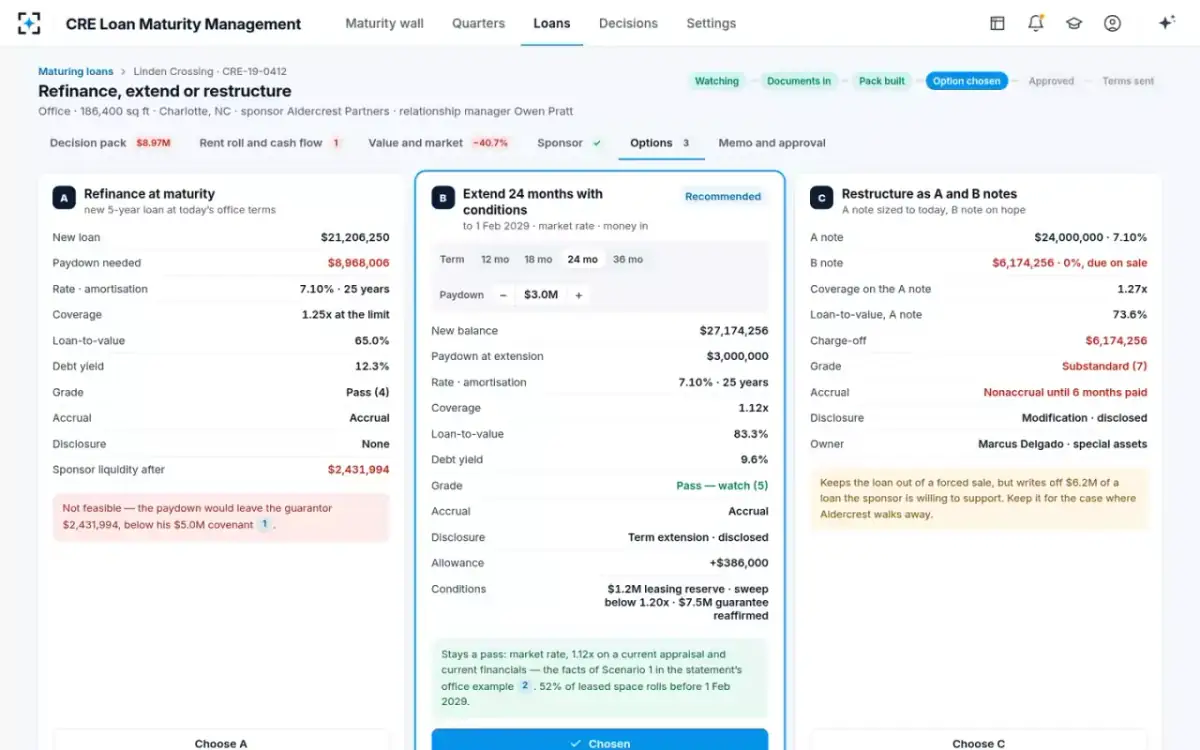
The sample bank's Linden Crossing loan is a four-storey office in Charlotte owing $30,174,256 on 1 February 2027. At the bank's office refinance terms (7.10%, 25 years, 1.25x, 65% loan-to-value, 10% debt yield) a new loan would be $21,206,250, so a refinance fails by $8,968,006. The decision file, built by six agents from 41 documents, holds each element the statement asks for.
Linden Crossing's extension, checked against the statement's expectations
- Current financials on property, borrower and guarantor
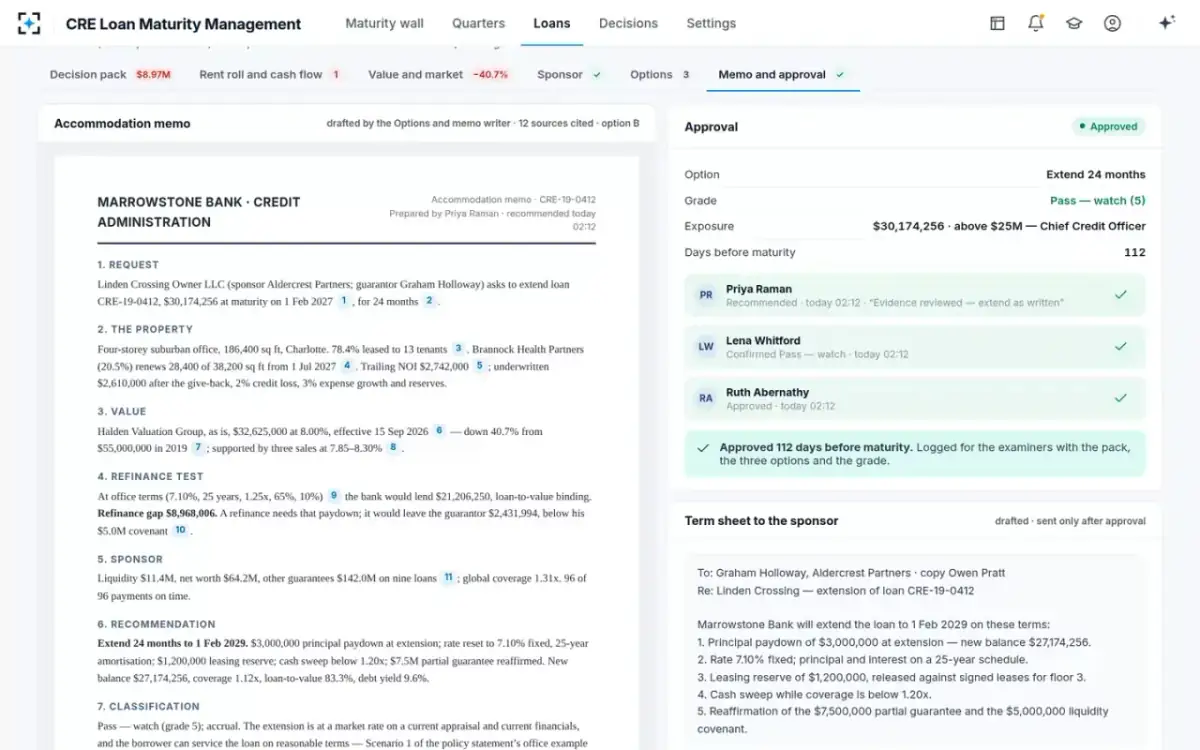
Rent roll of 30 September 2026, 13 leases, three operating statements; guarantor statement of 30 June 2026 and 2025 return. Underwritten NOI $2,610,000 against $2,742,000 trailing.
- A current valuation
Appraisal effective 15 September 2026: $32,625,000 as is at an 8.00% cap rate, down 40.7% from $55.0 million in 2019, three sales cited.
- A structure with curtailment
Extend 24 months with a $3,000,000 paydown, a $1,200,000 leasing reserve and a cash sweep below 1.20x, at the market rate for office.
- Global coverage and guarantor capacity
Global coverage 1.31x; $142.0 million of other guarantees counted; the paydown leaves $7,200,000 of liquidity, above the guarantor's $5.0 million covenant.
- A grade with its reason
Proposed pass, watch (grade 5): 1.12x at market rate on a current appraisal and current financials. The senior credit officer confirms; the chief credit officer approves above $25 million.
- Accounting and disclosure
Accrual; disclosed as a term extension to a borrower in financial difficulty; allowance increase of $386,000 shown with the option.
The extension's numbers are not flattering: 83.3% loan-to-value and a 9.6% debt yield, both outside the bank's refinance terms. That is the point the statement's scenario 1 makes. The grade rests on the borrower's ability to pay at a market rate, shown on current information, not on the collateral margin alone. Whether this renewal needed a new appraisal at all is a separate question, answered by the appraisal rules rather than by the workout statement.
Refinance, extend or restructure, each with the grade and disclosure it would carry
The accommodation memo and its approvals
Banks have been doing this work at scale. Federal Reserve research found that "banks modify more CRE loans than CMBS, contributing to better loan performance when property incomes decline" (Glancy, Kurtzman and Loewenstein, FEDS 2022-050). The statement does not ask banks to modify less. It asks them to show why each modification was prudent, loan by loan, and the officer who carries that file needs it before the date, not after.
Questions people ask
Does the 2023 CRE workout statement apply to community banks and credit unions?
Yes. OCC Bulletin 2023-23 states that "the interagency policy statement applies to community banks," and the Federal Reserve's SR 23-5 covers institutions with $10 billion or less in assets. The NCUA joined the statement, with notes on how its classification rules for credit unions differ.
Is a renewed CRE loan automatically adversely classified?
No. The statement says renewals or restructurings of maturing loans to borrowers who can repay on reasonable terms "will not automatically be subject to adverse classification," though they "should be identified in the financial institution's internal credit grading system and may warrant close monitoring."
How often must a bank update financials and collateral values in a workout?
The statement sets no frequency. The agencies said the final text "does not set bright lines" and that the right frequency varies "on a case-by-case basis, depending on the type of collateral and other considerations." Its examples show what happens when a lender relies on an estimate instead of a current valuation.
What is a well-conceived and prudent workout plan?
One that "supports the ultimate collection of principal and interest" and is based on updated financial information, current valuations, an appropriate structure with curtailment or re-margining where needed, and the right legal agreements. It is judged loan by loan, alongside global cash flow, guarantor support and the grade.
Does a guarantor make a workout loan a pass?
It can help, if the guarantor is financially responsible: the statement requires "the financial ability, the demonstrated willingness, and the incentive" to support the loan. In the retail example, an interest-only renewal whose guarantor could cover global debt service for a year was listed special mention and stayed on accrual; in a later scenario, a guarantor who was highly leveraged left the loan substandard.