Commercial real estate loan servicing software keeps the loan: it books payments, holds escrows and reserves, tracks insurance and tax, produces statements and investor reports, and stores the maturity date. What it cannot do is the work between that date and a decision: rebuild the property's income from a new rent roll, re-read the value, test the guarantor across every guarantee he has signed, size the loan as a new lender would today, and lay out refinance, extension and restructure side by side. That work is where maturity decisions get made late. Botminds' CRE Loan Maturity Management is built for it. It reads the servicing system without changing it and puts a sized, sourced decision file in front of the credit officer 120 days before each maturity, a design target the bank can set.
The examples come from a fictional sample bank, Marrowstone Bank, with 512 commercial real estate loans and $4.2 billion outstanding; its people, sponsors and properties are invented. Rules and research are linked to the regulator or author that published them.
What servicing software holds, and what a maturity decision needs
Commercial real estate loan servicing software: Maturity date, extension options, notice periods
A maturity decision under the 2023 statement: A plan agreed before the date, with time to negotiate
Commercial real estate loan servicing software: Covenant figures the borrower reported, if captured
A maturity decision under the 2023 statement: "Updated and comprehensive financial information" on borrower, project, guarantors and sponsors
Commercial real estate loan servicing software: Appraised value and date from origination
A maturity decision under the 2023 statement: "Current valuations of the collateral supporting the loan and the workout plan"
Commercial real estate loan servicing software: Name and guarantee type
A maturity decision under the 2023 statement: Ability, willingness and incentive, across every guarantee outstanding
Commercial real estate loan servicing software: Original terms and payment schedule
A maturity decision under the 2023 statement: What the loan can borrow today at the bank's own refinance terms
Commercial real estate loan servicing software: A status field and a note
A maturity decision under the 2023 statement: Options compared, a grade that "accurately and consistently reflects the risk", and approvals
What does commercial real estate loan servicing software do?
It is the bank's authoritative source for each loan after closing: payments, balances, rate resets, escrows, reserves, insurance and tax tracking, borrower statements, investor and participation reporting, and the tickler of dates, maturity among them. People also search for "commercial real estate lending software", which usually adds origination and underwriting in front of the servicing.
That is valuable and it is not optional, but it is administration of terms already agreed. The OCC's description of what a bank's CRE policy must set reads like a servicing system's configuration screen: "maximum loan maturities by type of property", "amortization schedules", "pricing structure", "LTV limits by type of property", and, among underwriting standards, "minimum debt yield" (OCC Comptroller's Handbook, Commercial Real Estate Lending, v2.0). A servicing system stores those parameters as they were at origination. It does not re-apply today's version of them to a loan coming due.
Where does the servicing system stop at maturity?
It stops at the date. The servicing system tells the bank that a $30.2 million office loan matures on 1 February 2027 and that every payment arrived on time. It does not tell the bank that the building is now 78.4% leased, that its value has fallen 40.7% since 2019, or that at today's terms the bank would lend only $21.2 million against it. All three are true of the sample bank's Linden Crossing loan.
That gap matters more in commercial real estate than in most lending, because so little principal is repaid before maturity and the payment history says nothing about the balloon. The OCC's CRE booklet makes the point directly: "Even if borrowers are able to meet their payment obligations, they could find it difficult to refinance their balloon payment amount at maturity because of declines in property value" (OCC Comptroller's Handbook, Commercial Real Estate Lending, v2.0). The risk sits exactly where the servicing system has least to say. How much principal a typical term retires is worked through on the balloon payment calculator page.
The work between the date and the decision, task by task
Between a maturity date and an approved decision sit eight tasks. Some belong in the servicing system, some belong to people, and most of the hours sit in tasks an agent can do if every figure it produces is tied to its source page and it is forbidden from deciding. The grid below is how the sample bank divides them.
Who does what between a CRE loan's maturity date and its decision
Know the date, balance, rate and terms
TodayServicing system
AgentReads it nightly, read-only
Person keepsNothing: the servicing system stays the source
Ask the borrower for documents
TodayRelationship manager, weeks before
AgentStarts the clock at 180 days
Person keepsRelationship manager follows up
Rebuild trailing and underwritten NOI
TodayAnalyst spreadsheet
AgentReads rent roll, leases, statements; cites each line
Person keepsAnalyst reviews the adjustments
Read the appraisal and the market
TodayOfficer, from the credit file
AgentCompares today's value with origination; flags age
Person keepsAppraiser sets value; reviewer accepts it
Test guarantors and global cash flow
TodayAnalyst, if time allows
AgentTotals all guarantees; tests any paydown
Person keepsOfficer judges willingness
Size the refinance at today's terms
TodayRarely done before maturity
AgentLesser of coverage, loan-to-value and debt yield
Person keepsCredit policy sets the terms
Compare options and draft the memo
TodayOfficer, against the clock
AgentThree options with grade, accrual, disclosure
Person keepsOfficer recommends; credit grades; CCO approves
Send terms to the sponsor
TodayRelationship manager
AgentDrafts the term sheet; never sends it
Person keepsSent only after every approval
Two rows deserve a second look. The sizing row is the one most banks skip before maturity, because it needs every other row first: underwritten income, a current value and the bank's current terms. And the last row is the one a buyer should test hardest. Software that drafts a term sheet is useful; software that can send one without an approval is a control failure waiting for a busy week.
Where the working days go on one maturing loan when it is done by hand
What to look for in CRE lending software for maturities
Look for software that sizes every maturing loan at your own refinance terms, shows which test binds, ties every figure to a page, and cannot grade, value or send anything. Those four properties separate a decision tool from a dashboard. The checklist below is what we would ask any vendor, ourselves included.
Ten checks before you buy maturity software for a commercial real estate book
- Sizes at your terms, by property type
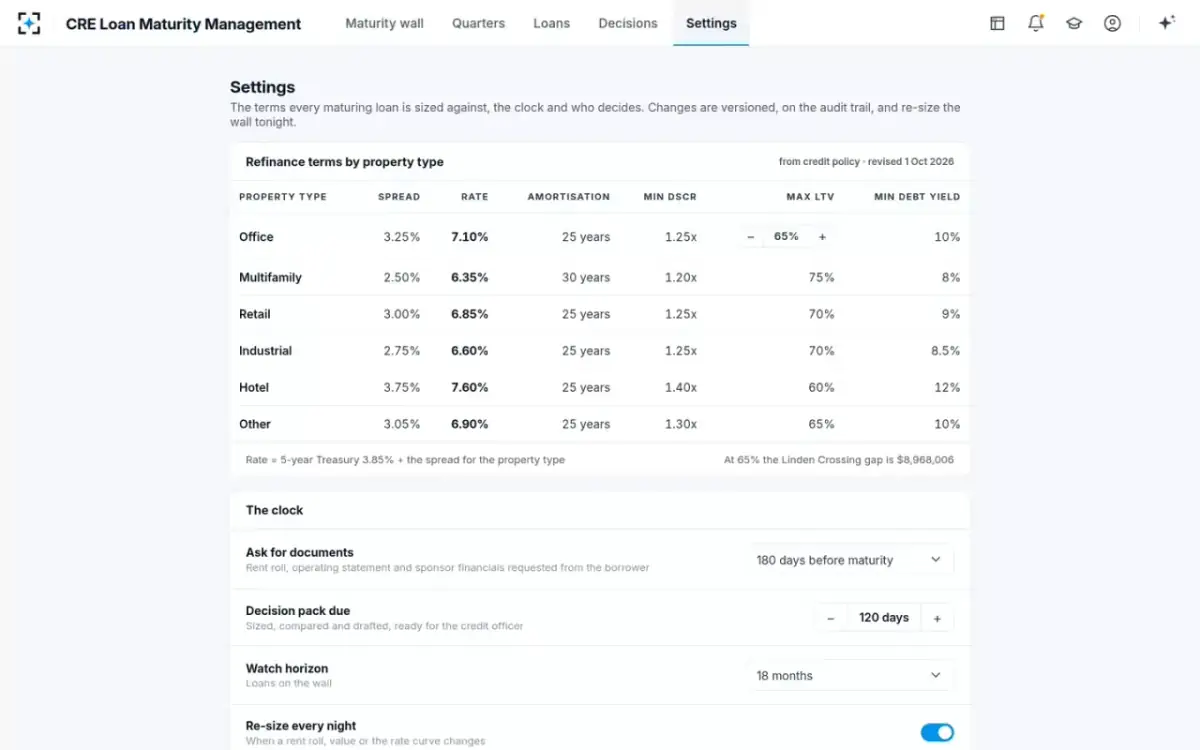
Rate, amortisation, minimum coverage, maximum loan-to-value and minimum debt yield are your policy settings, versioned, not the vendor's defaults.
- Shows the binding test
The loan amount is the lesser of the three tests; the screen should say which one binds and by how much.
- Re-sizes when an input changes
A new rent roll, a new appraisal or a move in rates should re-size the loan without someone re-keying a spreadsheet.
- Cites every figure
Each number opens the rent roll line, appraisal page or guarantor schedule it came from. Without that, the analysis cannot be reviewed.
- Tests the guarantor across all guarantees
The 2023 statement asks for a guarantor's capacity across everything it has guaranteed. One loan's view is not enough.
- Refuses unsigned income
An unsigned lease or a letter of intent should never count as income in the sizing; ask how the tool treats one.
- Never sets a value or a grade
Values come from appraisers and evaluations; grades come from credit officers. The tool may propose; it should not decide.
- Never sends terms
Term sheets and borrower letters leave only after approvals are in, and the tool should make that impossible to bypass.
- Keeps a decision log examiners can read
Option chosen, grade, disclosure, who signed and how many days before maturity, exportable.
- Reads your core, does not replace it
Read-only access to the servicing system; no second source for balances and dates.
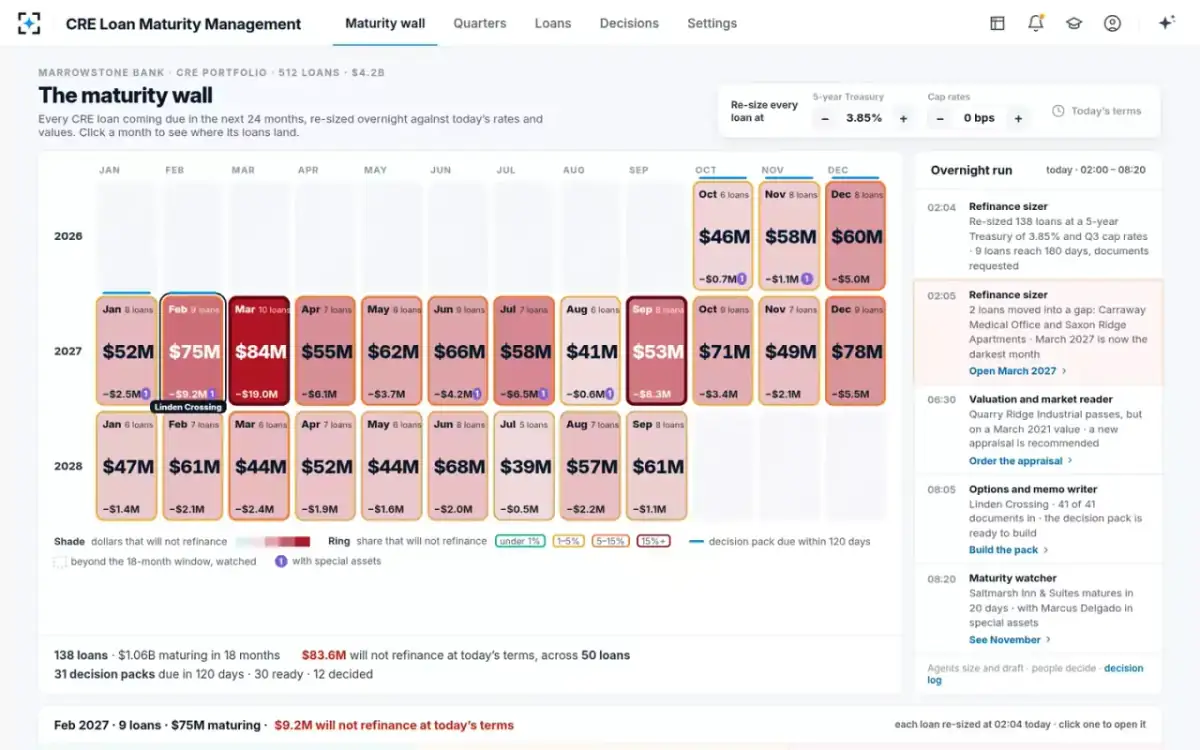
The maturity wall: every loan in the window sized at today's terms
How to test maturity software on your own loans
Test it on decisions you have already made. Take last year's maturities, twenty or thirty of them across property types, with the documents that were in the file at the time, and ask the software to size each one and lay out the options. Then compare its sizing with your committee's, line by line.
A four-week test on last year's maturities, and what each week should prove
| Week | What you give it | What it must show |
|---|---|---|
| 1 | Your refinance terms by property type and 20–30 closed maturity files | The same loan amount your committee approved, or a reason it differs that you can check. |
| 2 | The rent rolls, operating statements and appraisals in those files | Trailing and underwritten NOI within your analysts' tolerance, each adjustment cited to a page. |
| 3 | Guarantor statements and your other exposure | Global coverage and the guarantor's total contingent liabilities, matching your spreads. |
| 4 | Loans you extended that later went bad | Whether the tool would have flagged them earlier, and on which test. |
The fourth week matters because extensions are where banks get hurt quietly. The 2023 statement warns that "the liberal use of extensions and renewals masks credit weaknesses and obscures a borrower's inability to meet reasonable repayment terms." A tool that re-sizes a loan you extended in 2024 and shows it was already short tells you more about its value than any presentation.
Can AI analyze a loan extension, and what will examiners ask?
Yes, if it shows its work and leaves the decision to a person. AI agents can read the rent roll, rebuild income, compare values and lay out an extension against a refinance and a restructure; the grade, the terms and the approval must stay with credit officers. Examiners will judge the result exactly as they judge a memo written by hand.
The model-risk guidance is less settled than vendors suggest. The revised interagency guidance of April 2026 (OCC Bulletin 2026-13, Federal Reserve SR 26-2) says that "generative AI and agentic AI models are novel and rapidly evolving. As such, they are not within the scope of this guidance," and that "the term 'model' … excludes simple arithmetic calculations, such as those found within spreadsheets" (OCC Bulletin 2026-13). The agencies have promised a request for information on AI. Until it comes, the practical standard is the one the workout statement already sets: the file must show current financials, a current value, the guarantor analysis and a grade that fits the risk, and a reviewer must be able to check every number.
How a maturing loan moves through CRE Loan Maturity Management
Agent
Maturity watcherReads the loan system each night and runs the clock: documents at 180 days, the decision file at 120.
Never: Changes a loan's terms or dates
Agent
Rent roll and cash flow analystReads the rent roll, leases and statements; rebuilds trailing and underwritten NOI.
Never: Counts an unsigned lease
Agent
Valuation and market readerReads the appraisal or evaluation, sales and cap rates; says when a new appraisal is needed.
Never: Sets or adjusts a value
Agent
Sponsor and guarantor analystBuilds liquidity, net worth, contingent liabilities and global coverage; tests any paydown.
Never: Counts a guarantee without demonstrated liquidity
Agent
Refinance sizer and memo writerSizes the loan at your terms; compares refinance, extend and restructure; drafts the memo and term sheet.
Never: Grades, approves or sends terms
A person decides
Credit officer and chief credit officerRecommend, grade and approve by limit, signed with the meaning of the signature.
Build maturity software, buy it, or keep the spreadsheet?
A spreadsheet can size a loan; it cannot read forty documents, keep every figure tied to its page, or re-size a book of 138 loans when the rate curve moves. A bank with a dozen maturities a year can manage by hand. A bank with a CRE book in the hundreds of loans, maturing in balloons, will find the spreadsheet is fine and the people around it are not.
The scale is not small. The FDIC reports that CRE loans held by banks grew 3.1% in 2025, and that modified CRE loans "totaled $11.6 billion (0.38 percent of the CRE secured portfolio), of which 82 percent was performing" (FDIC, 2026 Risk Review). Every one of those modifications needed the file the statement describes. Building that capability in-house is possible: the arithmetic is simple and the rules are public. The hard parts are reading unstructured leases and appraisals reliably, and keeping the citations that let a reviewer trust the output.
Your credit policy as settings, not as code
Where CRE Loan Maturity Management fits, and where it does not
It fits a bank or credit union that holds income-property loans with balloon maturities and decides each one by committee: refinance, extend with conditions or work out. It reads the servicing system, the credit file, the borrower's documents and market data, and produces the sizing, the options, the memo and a decision log. The maturity schedule it needs from your core is set out field by field elsewhere in this series.
It does not replace a servicing system: it books no payments, holds no escrows and produces no investor reports. It is not a CMBS special servicer's platform, it does not value property, and it does not grade or approve. It is also not a fit for a lender whose CRE maturities are few and simple; the case for agents grows with the number of loans and documents, not with the size of any one loan.
Questions people ask
What is the difference between loan servicing software and loan origination software?
Origination software takes a loan from application to closing: intake, underwriting, approval and documents. Servicing software runs the loan after closing: payments, escrows, statements and dates. Maturity analysis falls between them, because a maturing loan needs to be underwritten again while it is still being serviced.
How do banks track commercial loan maturities today?
Usually from a servicing system report or tickler, exported to a spreadsheet the portfolio manager maintains. The OCC lists maximum loan maturities by property type among a CRE policy's required elements, so the dates are always known; what is rarely known in advance is whether each loan can refinance.
Does loan servicing software size a refinance?
Generally not at today's terms. It holds the original rate, amortisation and covenants. Sizing a refinance means applying the bank's current minimum coverage, maximum loan-to-value and minimum debt yield to current income and a current value, and taking the lowest result.
Is AI used for loan extensions covered by model risk guidance?
Not by the 2026 guidance. OCC Bulletin 2026-13 and SR 26-2 place generative and agentic AI outside their scope and promise a request for information. Banks still owe examiners a well-supported grade and file under the 2023 workout statement, whatever produced the analysis.
What should commercial loan portfolio management software show at maturity?
For each loan coming due: the balance at maturity, what today's terms would lend, which test binds, the gap, the days left and the next step. At the sample bank, 50 of 138 maturing loans carried a gap, $83.6 million in all, and the largest was 29.7% of its balance.