A special assets officer is the banker who takes over a commercial loan once it stops being routine: a maturing commercial real estate loan the borrower cannot refinance, a credit graded special mention or worse, a workout that needs a plan. In practice the job is two jobs. One is judgment: what to offer the borrower, how hard to lean on the guarantor, when to stop extending. The other is assembly: current financials, a current valuation, the guarantor's real capacity, a global cash flow, all written up the way the 2023 interagency workout statement expects. Botminds' CRE Loan Maturity Management exists for the second job. Its agents gather and size the evidence for every loan coming due, so the officer receives a maturing loan 120 days before its date with the file already built, rather than a few days before with nothing.
The examples below follow a fictional sample bank, Marrowstone Bank, with 512 commercial real estate loans and $4.2 billion outstanding, as its loans run through the solution. Every person, sponsor and property in them is invented. The rules and research come from regulators and are linked where they appear.
Five people carry one maturing CRE loan, and the officer inherits what the others left undone
Today
Receives a maturing loan when the borrower says it cannot refinance, often weeks out, and rebuilds the file from the start.
With agents
Receives it 120 days out with the rent roll read, the value current, the guarantor tested and three options compared.
Still theirs: The workout strategy, the negotiation and the recommendation.
Today
Keeps the maturity list in a spreadsheet and learns of a gap from the relationship manager.
With agents
Sees every loan in the 18-month window sized at today’s terms and ranked by the shortfall.
Still theirs: Which loans go to special assets, and when.
Today
Chases the rent roll and the guarantor’s statement in the last weeks.
With agents
Sends the document request at 180 days and knows what paydown to ask for.
Still theirs: The conversation with the sponsor.
Today
Grades extensions from memos written against the clock.
With agents
Grades from options set side by side, every figure tied to its source page.
Still theirs: The grade, and approval within the limit.
Today
Needs to see before the date why an extended loan is still a pass.
With agents
Approves above the limit with the evidence already on file for the examiners.
Still theirs: Approval of large exposures and downgrades.
What does a special assets officer do?
A special assets officer manages loans that have left the normal relationship: troubled credits, workouts, restructurings and, in the end, recovery, foreclosure or sale. For a commercial real estate lender the daily work is deciding what happens at maturity to a loan whose property no longer supports the balance, then negotiating it, documenting it and monitoring it until it is either cured or gone.
The searches people run for the title tell the story: job listings, salaries, "special assets workout officer". The Bureau of Labor Statistics does not publish a series for the role. The nearest are loan officers, with a median wage of $76,690 in May 2025 and "about 283,000 jobs" (BLS Occupational Outlook Handbook), and credit analysts, 64,390 jobs at a median of $83,510 (BLS occupational employment statistics, May 2025). Neither isolates commercial real estate, and neither describes the workout seat, which in many banks sits apart from both lending and credit administration so that the person who made the loan is not the person who decides how much of it to forgive.
What the role is asked to produce is better defined than the role itself. The 2023 Policy Statement on Prudent Commercial Real Estate Loan Accommodations and Workouts (88 FR 43115) lists what examiners need to see before they will leave a workout uncriticised, and the OCC was explicit that "the interagency policy statement applies to community banks" (OCC Bulletin 2023-23). That list is the officer's real job description, and the file that holds up under it is worked through item by item elsewhere in this series.
When does a loan go to special assets?
A loan goes to special assets when the bank's policy says it has stopped being a relationship decision: usually on a downgrade to special mention or substandard, on a payment default, or when a maturing loan cannot be refinanced or renewed on the bank's ordinary terms. The trigger is a bank choice, not a regulatory one. What matters is how early it fires.
At maturity the trigger is often late because nobody sizes the loan until the borrower asks. A five-year loan written in 2021 at a low rate looked fine on every payment; whether it can be refinanced at today's rate, at today's value, is a calculation no one runs until the date is close. The Federal Reserve told its examiners in June 2026 that "elevated interest rates, lower commercial property values, and other factors may affect CRE borrowers' ability to refinance or pay off loans," and that they are "reviewing … underwriting practices, classifications, and credit loss reserve methodologies" (Federal Reserve, Supervision and Regulation Report, June 2026). A loan that reaches special assets six weeks before maturity reaches it with fewer options and a grade already in question.
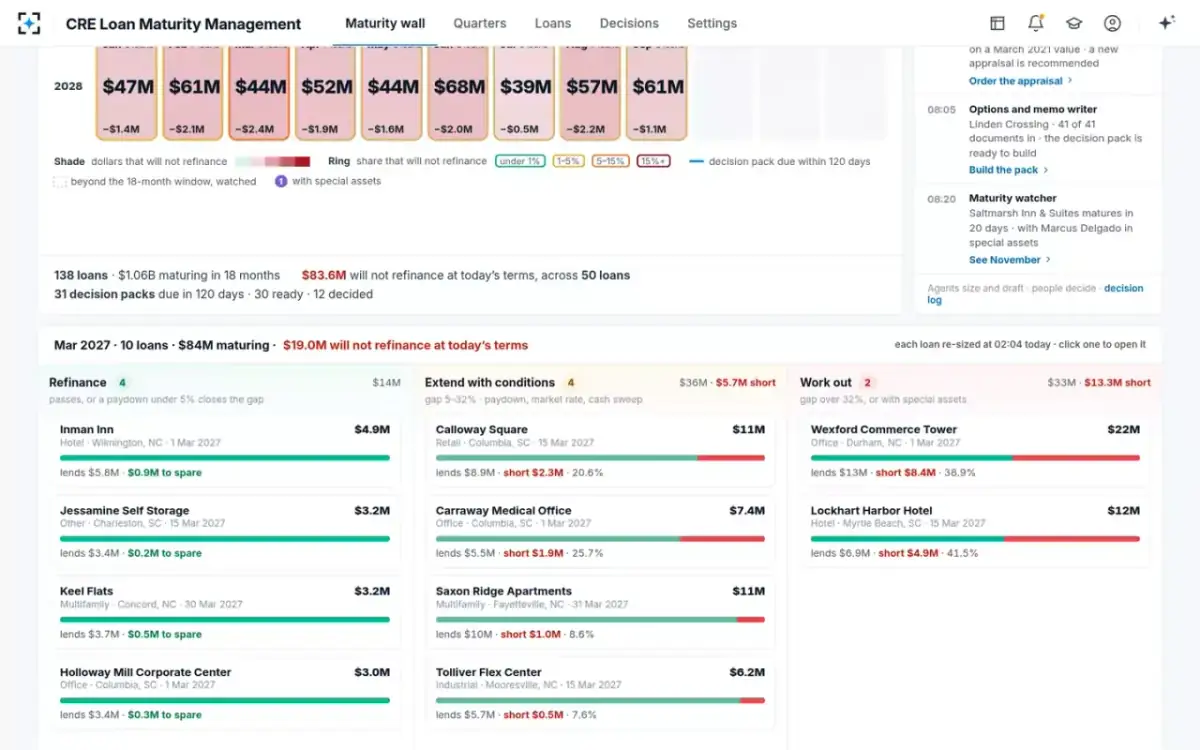
The sample bank writes the trigger into its settings instead. Each maturing loan is re-sized at the bank's refinance terms for its property type, and each month on the maturity calendar splits into three lanes: refinance (the loan passes, or a paydown under 5% closes the gap), extend with conditions (a gap of 5% to 32%), and work out (a gap over 32%, or a loan already with special assets). The work-out lane is the special assets officer's queue, and it fills months before the dates.
A month of CRE maturities in three lanes, with the work-out lane already named
The file a special assets officer owes the examiner
Under the 2023 statement, a workout escapes criticism, even if the loan ends up adversely classified, when management has done a defined set of things for each loan. The list is short and it is unforgiving, because each item needs evidence that is current at the time of the decision.
What the 2023 statement requires before examiners leave a CRE workout uncriticised
- A well-conceived workout plan for each loan
Built on "updated and comprehensive financial information on the borrower, real estate project, and all guarantors and sponsors."
- A current valuation
"Current valuations of the collateral supporting the loan and the workout plan," not the appraisal from origination.
- A structure that fits the plan
Term, amortisation, covenants and "requirements for curtailment or re-margining."
- Legal analysis and agreements
Including those "for changes to original or subsequent loan terms."
- Global debt service coverage
With "realistic projections of the borrower's cash flow" and the "availability, continuity, and accessibility of repayment sources."
- The guarantors' available cash flow
Tested, not assumed from the guarantee document.
- Monitoring after the decision
"The willingness and ability to monitor the ongoing performance of the borrower and guarantor."
- An accurate grade and allowance
A rating that "accurately and consistently reflects the risk," and an allowance under GAAP that recognises losses in time.
Read as a work plan, six of the eight items are assembly: obtaining, reading and reconciling documents the bank does not yet hold in usable form. Only the plan itself and the grade are judgment. That ratio is the reason the seat feels overloaded. The officer's scarce skill is negotiation and structuring; the hours go on chasing a rent roll, rebuilding net operating income and working out whether a guarantor who signed in 2019 could pay anything today.
How does a special assets officer test a guarantor?
A guarantee counts only if the guarantor has the ability, the willingness and the incentive to pay. The statement puts it plainly: "A financially responsible guarantor possesses the financial ability, the demonstrated willingness, and the incentive to provide support for the loan through ongoing payments, curtailments, or re-margining." It adds the test that most files skip: "whether the guarantor has the financial ability to fulfill the total number and amount of guarantees currently extended by the guarantor."
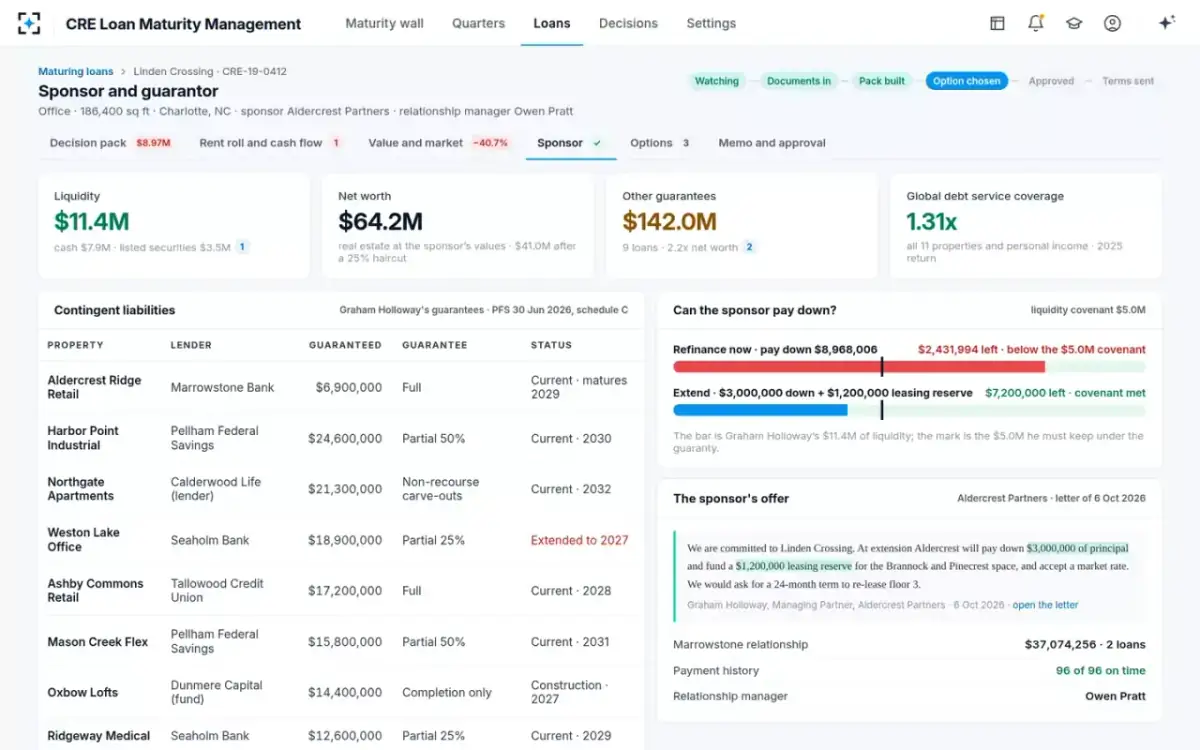
That second sentence is where a guarantor who looks strong on one loan turns out to be thin across all of them. The sample bank's Linden Crossing loan, a four-storey suburban office in Charlotte owing $30,174,256 on 1 February 2027, shows the arithmetic.
One guarantor, tested the way the 2023 workout statement asks
| Test | What the file shows | What it means for the workout |
|---|---|---|
| Liquidity | $11.4 million: $7.9 million cash and $3.5 million listed securities | Real money, but small against a $30.2 million loan. |
| Net worth | $64.2 million at the sponsor's values; $41.0 million after a 25% haircut on real estate | Mostly illiquid property, much of it already pledged. |
| All guarantees outstanding | $142.0 million on nine other loans, 2.2 times net worth | The statement's "total number and amount" test: other lenders have the same claim on the same money. |
| Global debt service coverage | 1.31x across 11 properties and personal income, 2025 return | Enough to support payments; not enough to refinance the whole gap. |
| Full refinance paydown | $8,968,006 would leave $2,431,994 | Breaks the guarantor's own $5.0 million liquidity covenant. Not feasible. |
| Offered support | $3,000,000 principal and a $1,200,000 leasing reserve | Leaves $7,200,000: willingness and incentive shown, covenant kept. |
The table changes the conversation. A full refinance would need the guarantor to empty his liquidity below a covenant another lender is relying on, so the realistic offer is a partial paydown with a reserve. The guarantor's own letter offers exactly that. An officer who sees this 112 days before maturity negotiates from evidence; one who sees it the week before negotiates from hope.
The guarantor's other guarantees, and whether a paydown breaks his covenant
Where a special assets officer's days go on one maturing loan
Most of the working days on a maturing loan go on gathering and rebuilding numbers, not on deciding. No regulator or academic study has measured the split, so the figures below are Botminds' own estimate for one maturing CRE loan handled by hand, set against the same loan with the solution: 23 working days against six.
Most of a maturing loan's working days are assembly, not judgment
By hand: 23 working days
- Chasing the rent roll, statements and sponsor financials · 43%
- Rebuilding trailing and underwritten NOI · 13%
- Reading the appraisal and the market · 9%
- Global cash flow and guarantor liquidity · 9%
- Sizing the loan and comparing options · 9%
- Writing the memo and getting signatures · 17%
With the solution: 6 working days
- Chasing documents (requested at 180 days) · 50%
- NOI, value, guarantor and sizing, reviewed · 33%
- Memo review and signatures · 17%
The chase does not disappear. A borrower still has to send the rent roll, and a guarantor still has to sign a current statement. What changes is when it starts and who does the reading. The solution requests documents 180 days before maturity, and once they arrive six agents read them: in the sample, 41 documents for Linden Crossing, from 13 leases to two appraisals, read and sized in 1 minute 37 seconds.
Two hand-offs: 120 days out, or the week of maturity
The value of an early hand-off is the number of options still open when the officer gets the loan. At 120 days a loan can still be extended on negotiated terms, a paydown can be raised, a new appraisal can be ordered and read, and the credit committee can meet on schedule. At a week, most of those are gone and the decision defaults to a short extension that the officer will inherit again.
The same maturing loan, handed to special assets late and early
- No one sizes the loanuntil ~30 days
- Chase and rebuild28 days
- Short extension at the date
- Watched; documents requested180 → 120 days
- File read by agents; officer negotiates and decides120 days of runway, decided at 112
At the sample bank the clock is two settings: documents requested 180 days before maturity, the decision file due at 120. Both can be changed, from 150 to 240 days and from 60 to 180, and the change is versioned. The officer gets loans from the work-out lane with one action that hands over the file, the options and the draft memo together. The cost of letting a loan drift to its date is the subject of its own page in this series.
Who should hold the pen: officer, analyst or agent?
The officer should hold every decision that changes a borrower's position or the bank's risk: the offer, the structure, the grade recommendation, the reserve, the timing of a foreclosure. Agents can hold the reading, the arithmetic and the first draft, provided every figure carries its source and nothing leaves the bank without a signature.
That division is not only good practice; it matches where regulators currently stand. The OCC's Spring 2026 risk report describes banks' generative and agentic AI as "generally limited to specific use cases with guardrails and human-in-the-loop accountability." In the solution the limits are written into each agent. The sponsor and guarantor analyst counts a guarantee only with demonstrated liquidity; the valuation and market reader never sets or adjusts a value; the options and memo writer proposes but never grades, approves or sends terms. The credit officer grades, the chief credit officer approves above the limit, and the term sheet goes to the sponsor only after every approval.
The maturing loans the officer will inherit, ranked by refinance gap
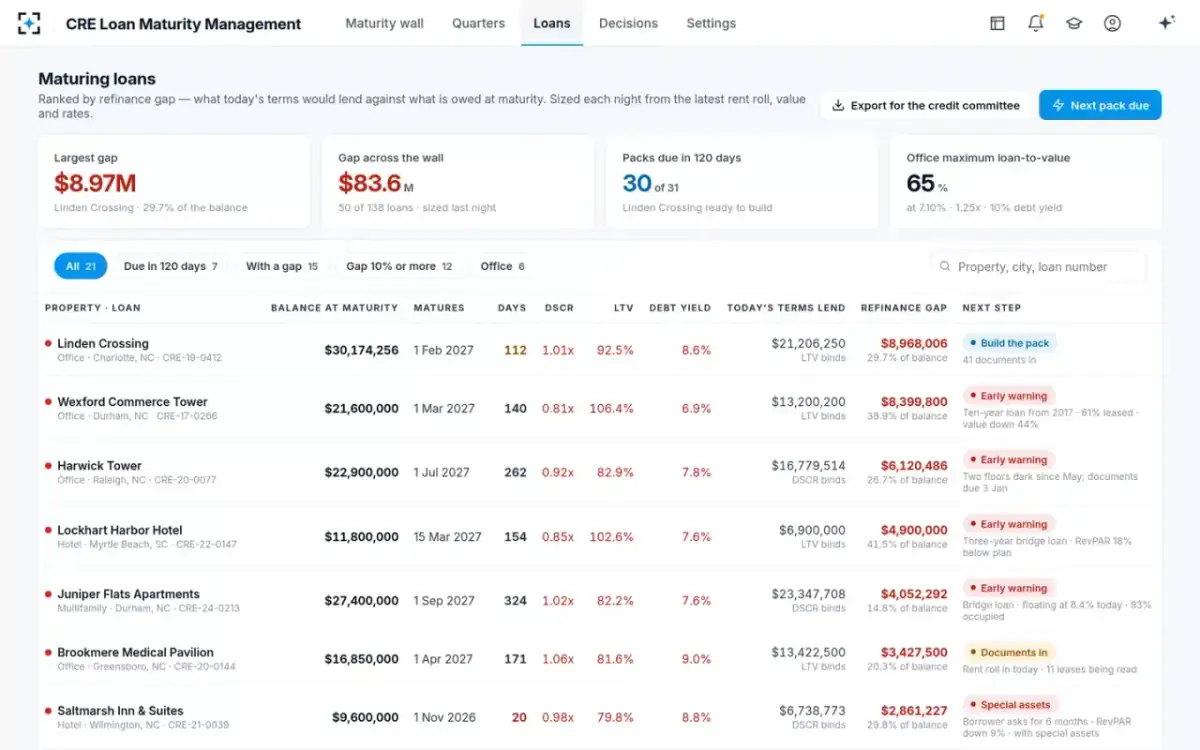
For the officer, the ranking is the useful part. The loans with the largest gaps and the fewest days are the ones that will land in special assets whatever happens; seeing them a quarter early is the difference between a workout plan and a crisis. The five paths a maturing loan can take, from refinance to exit, are set out in another guide.
What the job asks for that the file cannot supply
A complete file does not make the decision. The 2023 statement deliberately declines to define "comprehensive" or "reasonable", saying more specific definitions "could result in overly prescriptive supervisory guidance," and it does not set how often financial and collateral information must be refreshed: "the final Statement does not set bright lines." The space between those words is where the special assets officer earns the title.
Three judgments stay human in any workout. Whether the sponsor will keep supporting a property once its equity is gone, which no financial statement shows. Whether a tenant's renewal letter is a commitment or a negotiating position. And when an extension has become, in the words of the OCC's CRE booklet, one of the "rewrites or renewals for the sole purpose of deferring repayment" (OCC Comptroller's Handbook, Commercial Real Estate Lending). Those are the questions an officer should spend the 120 days on.
Questions people ask
What is the difference between a special assets officer and a loan officer?
A loan officer originates and manages performing relationships; a special assets officer takes loans that have become troubled or need a workout. Many banks separate the two so the person who made a loan does not decide how to restructure it. BLS counts loan officers (about 283,000 jobs in 2025) but publishes no separate series for special assets.
What does special assets mean in banking?
Special assets are loans and other assets that need more attention than the normal portfolio: loans graded special mention or worse, loans in workout, nonaccrual loans and foreclosed property. The special assets department manages them toward cure, restructuring, sale or recovery. The definitions of special mention and substandard the department works with are the agencies' own, reprinted in Appendix 4 of the 2023 workout statement.
How early should a maturing CRE loan reach special assets?
Early enough to negotiate, order a valuation and take a decision to committee before the date. The 2023 statement sets no deadline, but it notes that "proactive engagement by the financial institution with the borrower often plays a key role in the success of the workout." The fictional sample bank uses 180 days for documents and 120 days for the decision file.
Does a workout always mean the loan is adversely classified?
No. The statement says renewals or restructurings of maturing loans to borrowers who can repay on reasonable terms "will not automatically be subject to adverse classification." Its own office example keeps a renewed loan at 1.12x coverage and 102% loan-to-value as a pass, because current financials and a recent appraisal showed the borrower could pay.
What skills does a special assets workout officer need?
Credit analysis of income property, reading leases and appraisals, guarantor and global cash flow analysis, negotiation, and enough legal knowledge to structure forbearance, modification and A/B note agreements. BLS notes that commercial loan officers "need to understand general business accounting, including how to read financial statements"; the workout seat needs that and the judgment to know when a sponsor will walk away.