Refinance risk in commercial real estate is the risk that a loan coming due cannot be refinanced for enough to repay it. Because most income-property loans leave a large balloon at maturity, repayment depends on a new loan, and a new lender sizes that loan on today's rate, today's net operating income and today's value. When rates are higher and values lower than at origination, the new loan is smaller than the old balance, and the difference, the refinance gap, has to come from the borrower, the existing lender or a loss. The way to measure the risk is to size each maturing loan as a new lender would: the least of what the bank's minimum coverage, maximum loan-to-value and minimum debt yield allow. Botminds' CRE Loan Maturity Management does that for every loan in the maturity window, every night, and ranks the book by the gap.
The examples follow a fictional sample bank, Marrowstone Bank, as its maturing loans run through the solution; its people, sponsors and properties are invented. Research and supervisory figures are linked where they appear.
Where a refinance gap comes from, and how one extension closes part of it
Linden Crossing: $30,174,256 due at maturity
- What today's office terms lend · 70.3%
- Refinance gap · 29.7%
The $8,968,006 gap under the extension the bank approved
- Closed by the sponsor's paydown at extension ($3.0M) · 33.5%
- Carried for 24 months, to be closed by re-leasing and amortisation · 66.5%
The sample bank's 18-month window: $1.06B maturing
- Refinances at today's terms · 92.1%
- Will not refinance ($83.6M across 50 loans) · 7.9%
What is refinance risk in commercial real estate?
It is the risk that a borrower cannot repay a maturing loan from a new loan, because the amount a lender will advance against the property today is less than the amount owed. It differs from payment risk: a property can cover its current payments comfortably and still fail to refinance, because the new payment is set at a higher rate and the new loan amount is capped by a lower value.
The OCC named it as the CRE risk to watch in its Spring 2026 report: several property types "continue to experience headwinds. These have not resulted in significant credit defaults, although refinance risk merits continued attention. A substantial volume of CRE loans originated in a lower-interest environment will mature in the next several years and will need to be refinanced at prevailing rates" (OCC, Semiannual Risk Perspective, Spring 2026). Searches for the "OCC refinance risk guidance" usually land on this passage; there is no separate OCC guidance document on refinance risk.
How do you measure refinance risk? The lesser of three tests
Size each maturing loan three ways at the bank's current terms for its property type, and take the smallest. Coverage: net operating income divided by the minimum debt service coverage ratio gives the payment the property can carry, which at today's rate and amortisation converts to a loan amount. Value: the maximum loan-to-value times today's value. Debt yield: net operating income divided by the minimum debt yield. The OCC lists all three, with loan-to-cost and guarantor liquidity, among the financial covenants appropriate for income-producing CRE loans.
Each test catches a different failure. The OCC describes debt service coverage as "calculated by dividing the NOI by the annual debt service requirements"; it moves with the rate and the amortisation. Its definition of debt yield explains why the third test exists: "Debt yield provides a measurement of risk that is independent of the interest rate, amortization period, and capitalization rate," and "debt yields vary according to market conditions and property types, with higher debt yields recommended for riskier properties" (OCC Comptroller's Handbook, Commercial Real Estate Lending). A loan that passes on coverage because rates fell, or on value because cap rates are low, can still fail on debt yield.
Linden Crossing sized three ways: loan-to-value binds
Which test binds, and what it tells you
The binding test names the problem. When loan-to-value binds, value has fallen faster than income, as on offices whose cap rates have risen; the fix involves equity or time for value to recover. When coverage binds, the rate is the problem, as on floating-rate bridge loans and hotels; a lower rate, a longer amortisation or more income helps. When debt yield binds, the property simply earns too little for the debt, whatever the rate; only a smaller loan helps.
Which test binds on the sample bank's largest refinance gaps
| Loan | Owed at maturity | Today's terms lend | Binding test | Gap |
|---|---|---|---|---|
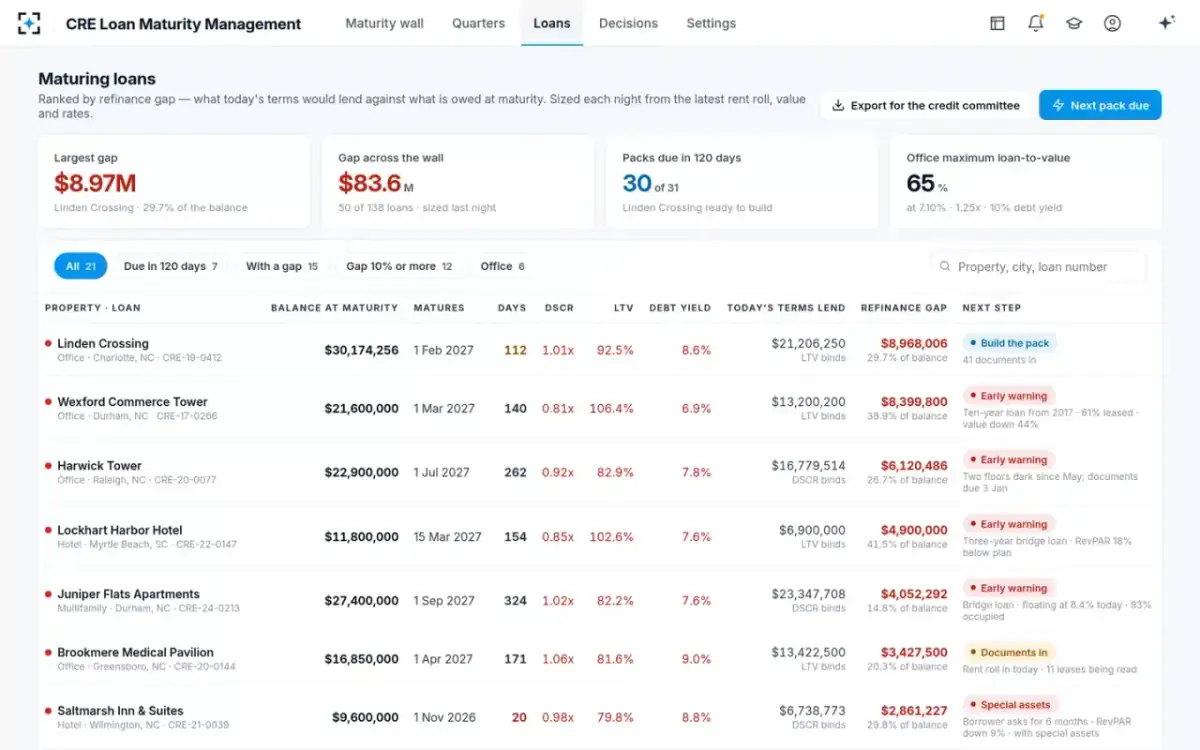
| Linden Crossing, office | $30,174,256 | $21,206,250 | Loan-to-value | $8,968,006 · 29.7% |
| Wexford Commerce Tower, office | $21,600,000 | $13,200,200 | Loan-to-value | $8,399,800 · 38.9% |
| Harwick Tower, office | $22,900,000 | $16,779,514 | Coverage | $6,120,486 · 26.7% |
| Lockhart Harbor Hotel | $11,800,000 | $6,900,000 | Loan-to-value | $4,900,000 · 41.5% |
| Juniper Flats Apartments, floating at 8.4% | $27,400,000 | $23,347,708 | Coverage | $4,052,292 · 14.8% |
What is a refinance gap?
A refinance gap is the balance due at maturity minus the largest loan the bank's current terms would make against the property. If the gap is zero or negative, the loan can be refinanced as it stands. If it is positive, someone has to put in that amount, or the bank has to decide to carry it.
No regulator defines the term, and banks compute it differently: some use the note rate, some a stressed rate; some size on trailing income, some on underwritten. The definition matters less than consistency. The sample bank sizes every loan at the five-year Treasury plus a spread by property type, on underwritten income that excludes unsigned leases, against the value in the most recent appraisal or evaluation. Applied the same way to every loan, the gap becomes a ranking: which loans to start on first, and how much equity the bank should expect to ask for. The balloon that the gap is measured against is worked through on the calculator page.
How much of a CRE portfolio cannot refinance?
Estimates vary with the date and the method, and they are large. An NBER study using loan-level data found that after the rise in rates and the shift to hybrid work, "14% of all CRE loans and 44% of office loans are in negative equity," and "43% of all CRE loans and 64% of office loans may face cash flow and refinancing issues" (NBER Working Paper 31970). Federal Reserve staff research on bank books adds that "higher LTVs, larger property sizes, and greater local remote work tendencies are all associated with increased delinquency risk, particularly for office loans" (Glancy and Kurtzman, FEDS 2024-072).
How much CRE debt faces refinancing trouble, by one academic estimate
43%
of all CRE loans may face cash flow and refinancing issues
64%
of office loans may face cash flow and refinancing issues
14%
of all CRE loans in negative equity
44%
of office loans in negative equity
A bank's own figure is usually smaller and far more useful, because it is measured on its own loans at its own terms. In the sample bank's 18-month window, 50 of 138 maturing loans carry a gap, $83.6 million on $1.06 billion. The research says which property types to look at first; the bank's own sizing says which loans.
How to stress-test refinance risk: rates, cap rates and income
Move the inputs and re-size every loan. The OCC's CRE booklet asks for exactly this: the income factors behind a property's value "should be considered under both normal and stressed conditions," and "capitalization rates, interest rates, and DSCRs should be stress-tested to determine whether a property will likely remain viable during a period of economic stress." For a maturity book, the stress that matters is the one in force on each loan's date.
Cap rates up 50 basis points: the whole maturity window re-sized at once
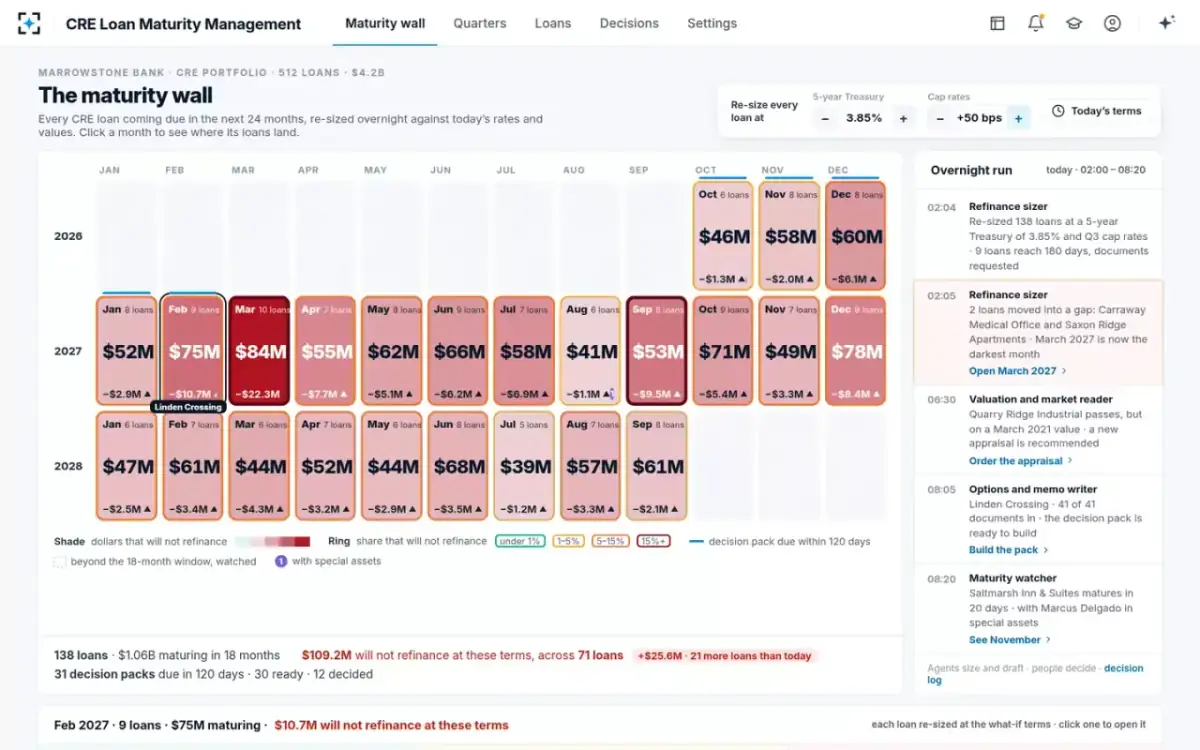
At the sample bank, a 50-basis-point rise in cap rates lifts the dollars that will not refinance from $83.6 million to $109.2 million and the loans affected from 50 to 71. On a single loan the sensitivity is sharper. Linden Crossing's gap moves by more than a million dollars for each half-point of cap rate, and by more again if a second tenant leaves.
Linden Crossing's refinance gap by income and cap rate
| Underwritten NOI | Cap rate 7.50% | Cap rate 8.00% | Cap rate 8.50% |
|---|---|---|---|
| $2,610,000 (as underwritten) | $7.55M | $8.97M | $10.22M |
| $2,450,000 (if a second tenant leaves too) | $8.94M | $10.27M | $11.44M |
Refinance risk by property type in 2026
It is concentrated in office and in loans whose income depends on rates, and it is lower in multifamily and retail. The OCC's Spring 2026 report gives the supervisor's view property by property: "Net absorption of office CRE turned positive during the last half of 2025, pointing to gradual stabilization," yet banks with over $250 billion in assets "took additional charge-offs on office loans"; "multifamily properties remain resilient" despite falling Sun Belt rents; warehouse vacancy "is expected to remain high for the near term"; "hotel industry performance has declined due to low room demand"; and "retail remains a bright spot."
The sample bank's largest gaps follow the same lines: four of its seven largest are office loans, two are hotels, and the one multifamily loan in the group is a floating-rate bridge loan on which coverage, not value, binds. The property type tells a bank where to look first; only a loan-level sizing tells it how big each gap is and which test is driving it.
How do lenders close a refinance gap?
With some combination of the borrower's money, time and structure. The borrower can pay down principal, add collateral or a guarantee, or fund reserves; the lender can extend at a market rate with conditions so income can recover; or the loan can be restructured, for example into a note the property supports and a note that is charged off. If none works, the property is sold.
Ways to close a refinance gap, and what each asks of whom
What the borrower puts in: Cash from the sponsor or guarantor, tested against its own liquidity covenants
What the lender gives or decides: A smaller loan that fits today's terms, or an extension with the balance reduced
What the borrower puts in: Leasing reserve, cash sweep, tighter reporting
What the lender gives or decides: An extension at a market rate while income recovers
What the borrower puts in: Additional guarantee or collateral
What the lender gives or decides: Credit for a guarantor only with ability, willingness and incentive shown
What the borrower puts in: Acceptance of a split into A and B notes
What the lender gives or decides: Note A sized to what the property supports; Note B charged off
What the borrower puts in: Sale or refinance elsewhere at a discount
What the lender gives or decides: Discounted payoff, note sale or enforcement
The sponsor's own balance sheet often decides which route is possible. At Linden Crossing, closing the whole gap with a paydown would take the guarantor's liquidity from $11.4 million to $2,431,994, below the $5.0 million covenant another lender relies on. A $3,000,000 paydown with a $1,200,000 leasing reserve leaves $7,200,000 and keeps the covenant. That is why the approved answer was a 24-month extension, not a refinance: 1.12x coverage on a $27,174,256 balance, at the market rate. What happens if no route is found before the date is covered in the guide on maturity default.
Every maturing loan ranked by its refinance gap
Questions people ask
What is refinancing risk in simple terms?
The risk that, when a loan comes due, the borrower cannot replace it with a new loan large enough to pay it off. In commercial real estate it is driven by higher rates, lower values and weaker income at the maturity date compared with origination.
What is a good debt yield?
No regulator sets one. The OCC says only that debt yields vary by market and property type, "with higher debt yields recommended for riskier properties," and lists a minimum debt yield as a policy item. The fictional sample bank's policy uses 8% for multifamily, 10% for office and 12% for hotels.
Is refinance risk the same as interest rate risk?
Not quite. Rates drive one of the three tests, coverage, but refinance risk also comes from value, through loan-to-value, and from income, through debt yield. A loan can fail to refinance at an unchanged rate if its value or income has fallen.
How far ahead should a bank measure refinance risk?
Far enough to act: the fictional sample bank watches 18 months, asks for documents at 180 days and wants a decision file at 120. The OCC notes that loans originated in a lower-rate environment "will mature in the next several years," so a rolling window, re-sized as rates move, works better than a once-a-year study.
Do examiners expect banks to stress-test refinance risk?
They expect CRE income and values to be considered "under both normal and stressed conditions," with cap rates, interest rates and coverage stress-tested, per the OCC's CRE booklet. Banks with CRE concentrations are also expected to stress-test the portfolio under the 2006 concentration guidance.