A maturity default happens when a loan reaches its maturity date and the borrower cannot repay the remaining balance, usually a large balloon, because it cannot refinance, sell or pay it off, even though every scheduled payment was made. A term default is the other kind: a missed payment or broken covenant during the life of the loan. In commercial real estate the maturity default is the characteristic one, because most income-property loans repay little principal before the end, and a borrower who paid perfectly for five years can still fail on one day. For the lender, a maturity default is also the most avoidable default, because its date is known years ahead. Botminds' CRE Loan Maturity Management sizes every maturing loan at today's terms long before its date, so the bank decides between refinance, extension and workout while it still has room to choose.
The loans below belong to a fictional sample bank, Marrowstone Bank, as they run through the solution; people, sponsors and properties are invented. Regulatory rules and research are linked where they are used.
Every loan at the top of the sample's list sits below the Fed's 1.2x line at today's terms
What is a maturity default?
A maturity default is a failure to pay a loan off when it comes due. The borrower owes the whole remaining balance on the maturity date, and if neither a payoff, a refinance by another lender, a sale nor an agreed extension arrives, the loan is in default from that day, regardless of its payment history. In commercial real estate the unpaid amount is typically a balloon, because the loan was amortised over 20 to 30 years but written for five or ten.
No regulation defines the term; it is market usage, and searches for "maturity default meaning" and "term default vs maturity default" show readers looking for exactly that distinction. The Federal Reserve's stress-test documentation explains the mechanism in its own words: "most CRE loans on income-producing properties are not fully amortizing and often have a significant balloon payment due at maturity. The standard practice is to roll this balloon payment over into a refinance loan, and lenders generally require a minimum DSCR between 1.2 and 1.5 to qualify" (Federal Reserve, Supervisory Stress Test Documentation: Credit Risk Models). A maturity default is what happens when the roll-over test fails and nothing replaces it.
Term default vs maturity default: what is the difference?
A term default is caused by cash flow failing during the loan; a maturity default is caused by refinancing failing at the end of it. The first is about whether the property can pay; the second is about whether anyone will lend against it again at today's rates and values. They need different early warnings, and a bank that watches only the first will be surprised by the second.
Two ways a commercial real estate loan defaults
Term default: A missed scheduled payment, or a covenant breach, during the term
Maturity default: The balance is not repaid on the maturity date
Term default: Property income falls below debt service
Maturity default: The loan cannot be refinanced: rates are higher, value is lower, or both
Term default: Falling coverage, late rent, tenant loss
Maturity default: A refinance gap: what today's terms would lend is less than the balloon
Term default: Usually deteriorates first
Maturity default: Can be perfect until the last day
Term default: Quarter by quarter, from statements
Maturity default: Years ahead, from the maturity date and a re-sizing
Term default: Covenant monitoring and early workout
Maturity default: Sizing every maturing loan early and deciding before the date
Why do commercial real estate loans default at maturity?
Because the balloon has to be refinanced at whatever the market offers on that date, and the market may offer far less than is owed. The OCC's CRE booklet names the trade-off that creates the risk: "Although interest-only terms or long amortization periods can decrease the likelihood of payment default by providing higher debt-service coverage, such terms can increase the loss given default and the balloon or full repayment risk at maturity if not properly mitigated" (OCC Comptroller's Handbook, Commercial Real Estate Lending).
Three forces usually combine. Rates: a loan written at 4.15% in 2019 must refinance at a 2026 rate; at the sample bank's office terms that is 7.10%, a 3.85% five-year Treasury plus a 3.25% spread. Value: higher cap rates cut the value the refinance is sized against, and the sample's Linden Crossing office is worth 40.7% less than at origination. Income: rollover, concessions and vacancy cut the net operating income that has to cover the new payment. How to size that refinance risk loan by loan is set out on another page.
The Federal Reserve multiplies the risk by four
The clearest official signal of how dangerous the last stretch before maturity is comes from the Fed's own supervisory stress test. Its CRE model lists "loan age and the proximity of the loan to maturity" among the drivers of projected losses, and then makes a hand-set adjustment on top of the statistics.
How the Fed's stress test treats a weak CRE loan near maturity
×4
adjustment to the modelled default probability for income-producing loans near maturity below 1.2x
1.2–1.5x
the minimum coverage lenders "generally require" to refinance a balloon
$1M+
loans in the supervisory data; smaller loans are not reported
The wording is worth reading closely. The PD for "income producing loans that approach maturity with DSCR below 1.2 (a typical minimum underwriting threshold)—is adjusted upwards by a factor of four, to account for the tendency of the logistic regression model to underpredict PD for such loans." In plain terms, the Fed's statisticians found that their model, left to itself, understates how often a thinly covered loan fails at maturity, and corrected it by hand. A bank's own watch list should make the same correction: a loan near maturity with coverage under 1.2x at today's terms is a different risk from the same loan two years earlier.
What happens after a commercial loan goes into maturity default?
The loan becomes past due, then, if nothing changes, nonaccrual, and it moves through the bank's grading, allowance and recovery machinery. The Call Report sets the reporting clock; the bank's own policy and the 2023 workout statement set the rest.
After a missed balloon: the reporting clock a bank cannot stop
- Unpaid, in defaultdays 1–29
- Reported past duedays 30–89
- Nonaccrual unless well secured and in collectionday 90 on
Alongside the reporting clock, the grade and the allowance move. If the loan has become collateral-dependent, the 2023 workout statement classifies "any portion of the loan balance that exceeds the amount that is adequately secured by the fair value of the real estate collateral less the costs to sell" as loss. Resolution then runs through forbearance, restructuring, a note sale, foreclosure or a deed in lieu, each with its own valuation and legal costs.
The nonaccrual step is the expensive one for earnings. Once a loan is on nonaccrual, interest is no longer recognised as income, and under the 2023 statement a restructured loan on nonaccrual generally needs six months of sustained payments before it returns to accrual. A loan that slides past its date for a quarter can cost half a year of interest recognition even if it is eventually extended on good terms.
What each month of drift costs on one loan
Drift is the time a maturing loan spends without a decision. It has a price even when the loan never formally defaults, because the decision that finally gets made is usually a worse one. The table works the arithmetic on the sample bank's Linden Crossing office loan: $30,174,256 due on 1 February 2027 at a 4.15% note rate, against a 7.10% market rate for office.
What drift costs on Linden Crossing, month by month
| What drift does | The arithmetic | Per month |
|---|---|---|
| A short extension at the note rate instead of the market rate | $30,174,256 × (7.10% − 4.15%) ÷ 12 | $74,178 of interest the bank gives up |
| Interest at risk if the loan goes to nonaccrual | $30,174,256 × 4.15% ÷ 12 | $104,353 no longer recognised as income |
| Guarantor liquidity the bank is not yet relying on | $3,000,000 paydown offered on 6 October, not yet documented | Uncommitted while other lenders' maturities compete for it |
| Leasing time lost | The largest tenant's lease ends 30 June 2027; 52% of leased space rolls before 1 February 2029 | One month less to agree the reserve that funds re-leasing |
| Options lost | A new appraisal, committee time and a negotiated paydown each need weeks | Fewer of the five paths still open |
The first row is the trap most drift ends in. When the date arrives without a decision, the path of least resistance is a 90-day extension at the existing rate "while we look at it." That is a below-market renewal to a borrower who cannot refinance, which is the pattern the statement's own examples grade harshly, and it has to be undone, at a worse moment, three months later. The OCC adds that a renewal "on an interest-only basis can indicate a troubled loan," and that re-amortising a balance over the original period "in effect diverts cash flow from the bank to the borrower," a choice whose rationale "should be clearly addressed in the bank's credit approval document."
Why short extensions don't stop the clock
An extension without new analysis moves the date; it does not change the refinance gap. The balloon is the same size three months later, rates and values have moved on, and the borrower's other lenders have had three more months to call on the same guarantor. At the sample bank, Graham Holloway, who guarantees Linden Crossing, has $142.0 million of other guarantees on nine loans, and one of them, on another lender's office building, has already been extended to 2027.
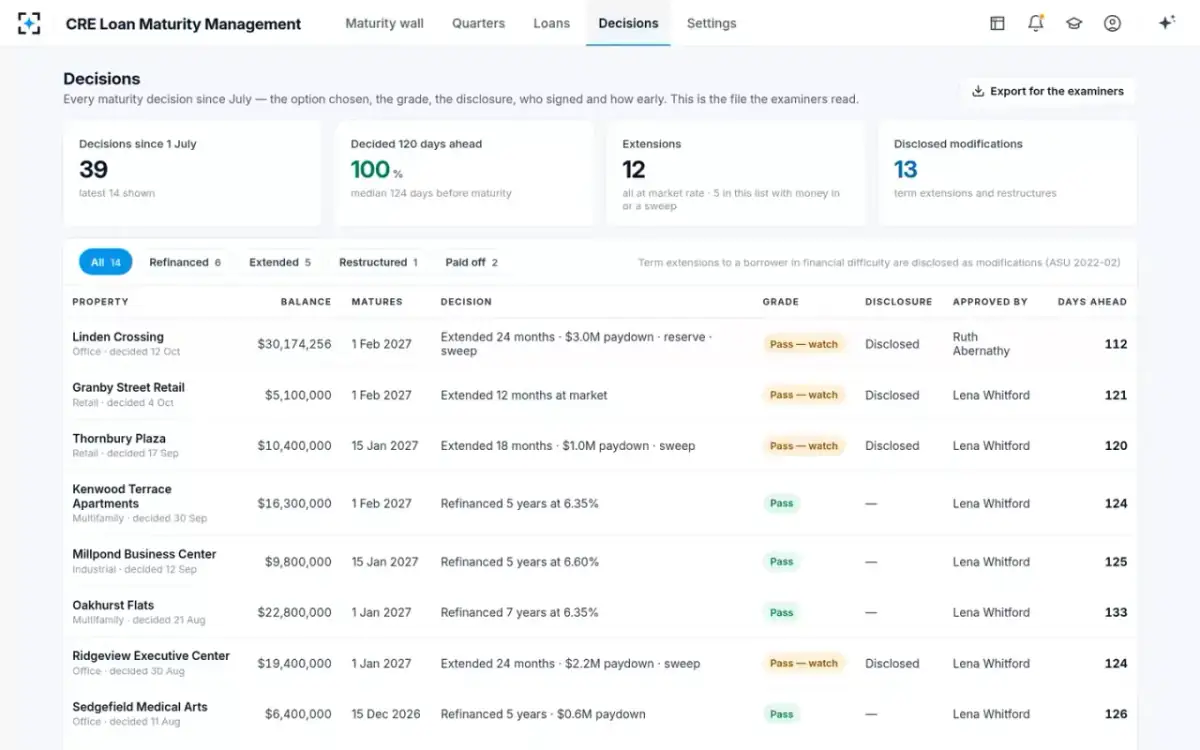
That is why the useful measure is not how many loans were extended but how many were decided early, on current evidence. The decision log at the sample bank shows, for every maturity, the option chosen, the grade, whether it was disclosed as a modification, who approved it and how many days before the date. Linden Crossing was approved 112 days ahead. A bank that tracks that last column has a direct measure of drift. Why the industry's maturity wall keeps moving is, in large part, the same story told across the whole market.
The decision log: every maturity, how it was decided and how many days ahead
The clock that prevents a maturity default
The prevention is a calendar with enough lead time to do the work the 2023 statement expects. At the sample bank it is two settings: documents requested from the borrower 180 days before maturity, and a decision file in front of the credit officer at 120 days. Between those dates, agents read the rent roll and leases, rebuild income, read the appraisal, test the guarantor across every guarantee and size the loan at today's terms; the credit officer then grades and the chief credit officer approves above the limit.
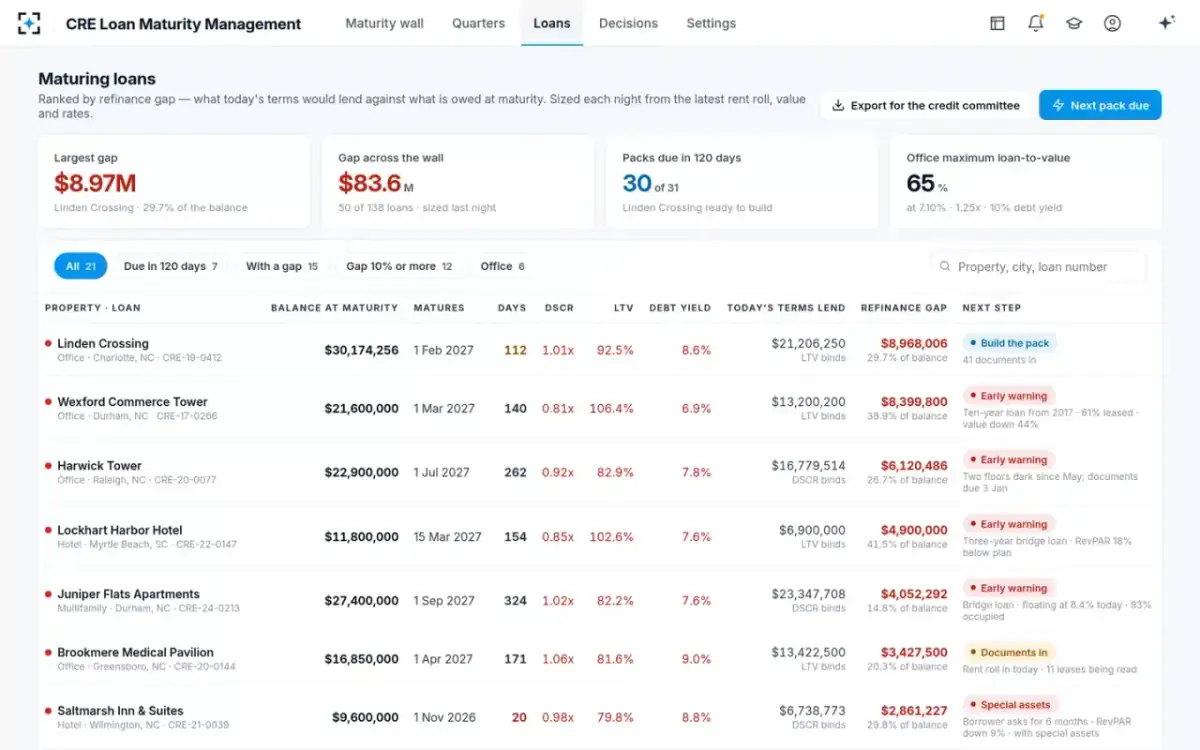
Every night the solution re-sizes each loan in its watch window and shades the maturity calendar by the dollars that will not refinance. In the sample, 138 loans and $1.06 billion mature within 18 months, and $83.6 million across 50 loans would not refinance at today's terms. Those 50 are the bank's candidate maturity defaults. Seeing them a year or more early converts each one into a choice the bank makes, rather than one the date makes for it.
The loans most likely to default at maturity, ranked by the gap
Questions people ask
What does maturity default mean on a loan?
It means the borrower did not repay the outstanding balance when the loan's term ended. In commercial real estate that balance is usually a balloon left by a long amortisation on a short term, so a borrower can be current on every payment and still default at maturity if it cannot refinance or sell.
Is a maturity default reported as past due?
Yes, once the unpaid principal passes the Call Report's past-due thresholds, and after 90 days in default it generally goes to nonaccrual unless it is both well secured and in the process of collection. Many banks extend or forbear before then, which is why the decision before the date matters.
What happens if a commercial loan is not paid at maturity?
The lender can extend or modify it, enter a forbearance agreement, restructure it (for example into A and B notes), sell the note, or enforce: foreclosure or a deed in lieu. Under the 2023 workout statement, the part of a collateral-dependent loan above the property's fair value less costs to sell is classified loss.
Why is a maturity default called a balloon default?
Because the payment that fails is the balloon. A loan amortised over 25 years but written for five still owes roughly nine-tenths of its original amount at maturity at a 6% rate, which is why refinancing, not the monthly payment, decides most CRE defaults.
How can a bank prevent maturity defaults in its CRE book?
By sizing every loan well ahead of its date at today's terms, starting document requests early, and deciding each loan before maturity on current financials and a current valuation. The Federal Reserve's fourfold adjustment for low-coverage loans near maturity is a good rule for which loans to start with.