A commercial loan balloon payment is the principal still owed when the loan matures, because the monthly payments were set as if the loan would run for 20 to 30 years while the term ends after five, seven or ten. To calculate it, work out the monthly payment from the loan amount, the rate and the amortisation period, then find the balance remaining after the number of payments in the term: that balance is the balloon. The OCC's own example is a $1,000,000 loan at 6% amortised over 25 years with a five-year term: the payment is $6,443 a month and the balloon is $899,000, so five years of payments retire only about a tenth of the loan. The calculator below does the arithmetic for any loan. What it cannot do is say whether that balloon can be refinanced, and that is the question Botminds' CRE Loan Maturity Management answers for every maturing loan in a bank's book.
Commercial loan balloon payment calculator
The examples on this page use the OCC's published arithmetic, our own calculations, and a fictional sample bank, Marrowstone Bank, whose loans and people are invented.
How do you calculate a balloon payment on a commercial loan?
In two steps. First, the monthly payment on a fully amortising loan: P × r ÷ (1 − (1 + r)−N), where P is the loan amount, r the monthly rate (the annual rate divided by 12) and N the number of months of amortisation. Second, the balance after n payments, where n is the number of months in the term: P × (1 + r)n − payment × ((1 + r)n − 1) ÷ r. That balance is the balloon.
Equivalently, the balloon is the present value of the payments that would still be due if the loan ran to full amortisation. That is how the OCC describes it in its CRE booklet: the balance at maturity "would be $899,000 (the present value of the $6,443 monthly payments for the remaining term of 20 years)" (OCC Comptroller's Handbook, Commercial Real Estate Lending, footnote 48). Both routes give the same number; the present-value form is easier to check by hand.
The balloon payment formula, term by term
Monthly payment
P × r ÷ (1 − (1 + r)^−N)
P = amount, r = annual rate ÷ 12, N = amortisation in months. $1,000,000 at 6% over 300 months: $6,443.01.
Set at origination
Growth of the original balance
P × (1 + r)^n
What the loan would grow to after n months with no payments. 60 months at 0.5%: $1,348,850.
Arithmetic
Value of payments made
payment × ((1 + r)^n − 1) ÷ r
The 60 payments, carried forward at the same rate: $449,529.
Arithmetic
Balloon
growth − value of payments
$1,348,850 − $449,529 = $899,321, the OCC's "$899,000".
Due at maturity
The OCC's worked example, line by line
The OCC uses the example to make a point about interest-only loans, and the point applies to every balloon. Its full sentence: "assume that a bank's loan policy would permit a loan of $1 million on a particular property for five years with an amortization period of 25 years at a rate of 6 percent. The balance at maturity would be $899,000 … In an interest-only scenario, to offset this risk, a mitigant would be to lower the loan amount at origination to $899,000; this mitigates the additional risk posed by the lack of amortization under the interest-only terms."
Read the other way round, the example says that after five years of on-time payments the bank's exposure has fallen by about $101,000 on a million. Over those 60 months the borrower paid $386,581, and almost three-quarters of it was interest. The loan that matures is, for practical purposes, the loan that was made, and it has to be refinanced against the property as it is five years later.
What five years of payments retire on $1 million at 6%
Commercial loan amortization schedule with a balloon payment, year by year
An amortisation schedule with a balloon is an ordinary schedule cut off at the term. Each year the same payments are made, a little more of each goes to principal, and at the end of the term the remaining balance is due at once. On the OCC's loan, the first year's $77,316 of payments includes only $17,800 of principal; by year five, principal is still under a third of what is paid.
Amortisation schedule for the OCC example: $1 million, 6%, 25-year amortisation, 5-year term
| Year | Payments made | Interest | Principal | Balance at year end |
|---|---|---|---|---|
| 1 | $77,316 | $59,516 | $17,800 | $982,200 |
| 2 | $77,316 | $58,418 | $18,898 | $963,301 |
| 3 | $77,316 | $57,252 | $20,064 | $943,237 |
| 4 | $77,316 | $56,015 | $21,301 | $921,936 |
| 5 | $77,316 | $54,701 | $22,615 | $899,321 balloon due |
The schedule is also a reminder of what a lender gets in return for a long amortisation: a lower payment, so higher coverage during the term, and a larger balloon at the end. The OCC's booklet describes that trade in its discussion of debt yield, which it recommends partly because "debt yields that reflect normalized or higher-rate levels can be used to establish stressed loan amounts that are less vulnerable to higher-rate environments." A loan sized that way at origination is one whose balloon is more likely to be refinanceable when it falls due.
Commercial loan 5-year term on a 25-year amortisation, and other common structures
The share of principal a term retires depends on three inputs: the amortisation period, the term and the rate. Longer amortisation and higher rates both mean less principal repaid by maturity, because more of each early payment goes to interest. At today's office rates in the sample bank's policy, 7.10%, a five-year term on a 25-year schedule repays less than 9% of the loan.
Share of a commercial loan repaid by maturity, by structure and rate
| Amortisation · term | Payment per $1M at 6% | Repaid by maturity at 6% | Payment per $1M at 7.10% | Repaid by maturity at 7.10% |
|---|---|---|---|---|
| 20 years · 5-year term | $7,164 | 15.1% | $7,813 | 13.6% |
| 25 years · 5-year term | $6,443 | 10.1% | $7,132 | 8.7% |
| 30 years · 5-year term | $5,996 | 6.9% | $6,720 | 5.8% |
| 25 years · 7-year term | $6,443 | 15.0% | $7,132 | 13.2% |
| 25 years · 10-year term | $6,443 | 23.6% | $7,132 | 21.1% |
| 30 years · 10-year term | $5,996 | 16.3% | $6,720 | 14.0% |
| Interest-only, any term | $5,000 | 0% | $5,917 | 0% |
That is the structure behind the industry's maturity problem. A New York Fed staff report puts it in one line: CRE loans "are originated with substantial leverage and, unlike most residential mortgages, amortize over horizons that are considerably longer than their contractual maturities. As a result, borrowers often face large balloon payments at maturity and must refinance a substantial share of the original principal" (Crosignani and Prazad, FRBNY Staff Report 1130).
How is an interest-only balloon calculated?
It is the original loan amount: with no principal payments, the whole balance is due at maturity. The monthly payment is simply the loan amount times the annual rate divided by twelve, $5,000 a month on $1 million at 6%.
That is why the OCC treats interest-only structures with care. Its booklet says that even where terms permit interest-only payments, "the property should nonetheless meet the bank's repayment capacity (debt service coverage) requirements as though the loan were amortizing," and that "LTV and as-if amortizing debt-service coverage requirements for interest-only loans are more conservative" than for amortising loans. The 2023 workout statement's examples go further at maturity: a renewal "on a 12-month interest-only basis at a below market interest rate" for a weak borrower ends up substandard and nonaccrual (88 FR 43115, Appendix 1).
How lenders limit balloon risk when they write the loan
Through policy limits on amortisation and interest-only terms, and by sizing the loan conservatively at origination. The OCC expects a bank's CRE policy to set, for each loan or property type, "amortization criteria, including standards for the acceptability of and limits on nonamortizing loans," alongside minimum coverage, maximum loan-to-value and a minimum debt yield. Its general parameters for income-producing property: "a range of 15 to 30 years is appropriate in most cases," with stabilized multifamily up to 30 years, hotels "generally not more than 20 years," and office, retail and industrial "generally 25 years."
The trade-off is explicit in the booklet: long amortisation and interest-only terms "can decrease the likelihood of payment default by providing higher debt-service coverage," but "can increase the loss given default and the balloon or full repayment risk at maturity." A lender can offset it with a smaller loan, as in the OCC's interest-only example, with a shorter amortisation, or with covenants that force curtailment when coverage or debt yield falls. None of those helps a loan already on the books; for those, the only defence is to size the balloon against today's terms well before it is due.
Why the balloon, not the payment, is the refinance test
A borrower who has made every payment has proved the property can carry the old payment at the old rate. The balloon has to be carried by a new payment at today's rate, on today's income, against today's value. Those are different questions, and the second is the one that decides whether a commercial loan is refinanced at maturity.
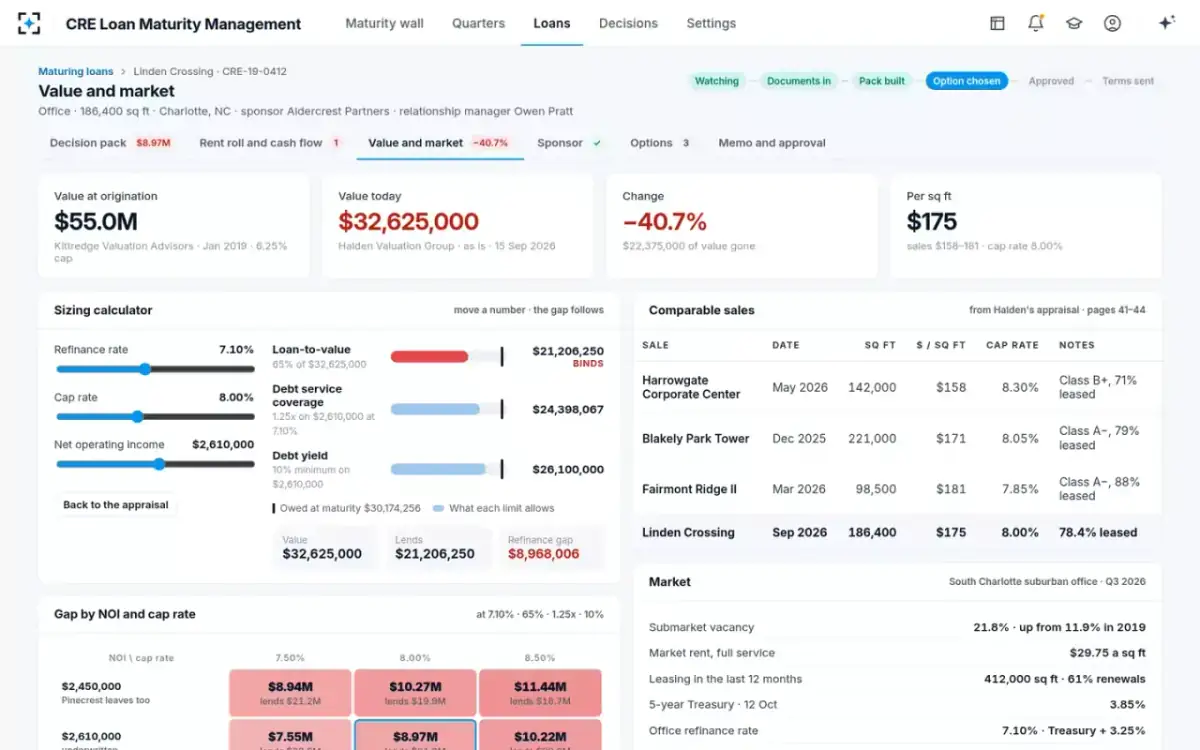
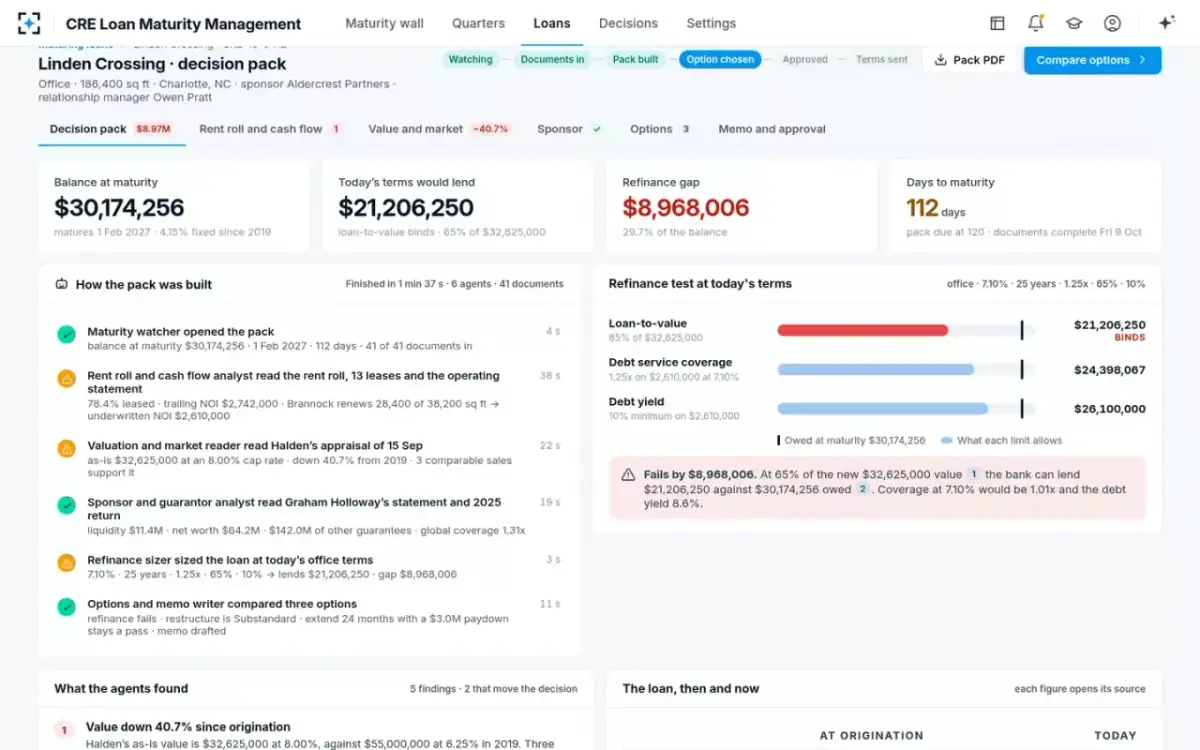
The sample bank's Linden Crossing office shows the gap. Its loan, at 4.15% since 2019, owes $30,174,256 on 1 February 2027. At the bank's office refinance terms, 7.10% over 25 years, the constant is 8.56% of the loan a year, so the $2,610,000 of underwritten net operating income would cover the full balloon only 1.01 times, against a 1.25x minimum. The value test is worse: 65% of the $32,625,000 appraised value is $21,206,250. The balloon is $8,968,006 larger than today's terms would lend.
Linden Crossing's balloon against today's terms
$30.17M
balloon due 1 February 2027, at a 4.15% note rate since 2019
$21.21M
what 65% of the current $32.6M value would lend
1.01x
coverage of the full balloon at 7.10% over 25 years
$8.97M
refinance gap: 29.7% of the balance
A live sizing calculator: move the rate, cap rate or income and the gap follows
What a balloon calculator leaves out
A balloon calculator answers how much is due. It does not answer the three questions a lender needs at maturity: what the property earns now, what it is worth now, and what the bank's policy would lend against those numbers at today's rate. Each needs a document, not a formula: the current rent roll and leases, a current appraisal or evaluation, and the bank's refinance terms for the property type.
Nor does a calculator say what to do when the balloon is too big. The answer might be an extension with a paydown; at Linden Crossing a 24-month extension with $3,000,000 down leaves $27,174,256 at 1.12x coverage, and by our arithmetic its own balloon in February 2029 would be about $26.3 million. It might be a restructuring or an exit. The five paths at maturity and how the refinance gap is sized are covered in their own guides.
The refinance test: which of three limits binds, and by how much
Questions people ask
What is a balloon payment on a commercial loan?
It is the lump sum due at maturity when the loan's payments were calculated over a longer amortisation than its term. On the OCC's example, a five-year loan amortised over 25 years at 6%, it is $899,000 of every $1,000,000 borrowed.
How much principal is paid off in five years on a commercial mortgage?
On a 25-year amortisation, about 10% at 6% and under 9% at 7.10%; on a 30-year amortisation, about 7% at 6%. Interest-only loans repay none.
Can you refinance a balloon payment?
Yes, that is the usual plan: the balloon is repaid from a new loan. It works when today's terms would lend at least the balloon; if they lend less, the borrower must pay the difference, or the lender considers an extension, restructuring or other workout.
What happens if you can't pay a balloon payment on a commercial loan?
The loan is in maturity default unless the lender agrees an extension, forbearance or restructuring. Under the 2023 interagency workout statement, lenders that work out loans prudently after a full review of the borrower are not criticised for doing so, even if the loan ends up adversely classified.
Is the balloon payment included in the monthly payment?
No. The monthly payment covers interest and the amortising share of principal; the balloon is the unpaid principal left at the end of the term and is due in one amount.