The CRE maturity wall is the large volume of commercial real estate debt scheduled to come due in the next few years, much of it written when interest rates were far lower. In 2026 it stands at about $875 billion: the Mortgage Bankers Association reports that 17% of $5.0 trillion of outstanding commercial and multifamily mortgages is scheduled to mature this year, down 9% from the $957 billion scheduled for 2025, with $652 billion due in 2027. It keeps moving because many loans that reach their dates are not repaid but extended, which pushes their balances into later years and makes each new year's wall partly last year's. For a single bank, the industry figure says little; what matters is which of its own loans cannot refinance at today's rates and values. Botminds' CRE Loan Maturity Management builds that bank-level wall every night.
Industry figures on this page come from the MBA's annual survey and from Federal Reserve research, linked where they appear. The bank-level examples follow a fictional sample bank, Marrowstone Bank, with invented loans and people.
Commercial mortgages scheduled to mature in the year of each MBA survey
How big is the CRE maturity wall in 2026?
About $875 billion of commercial and multifamily mortgages is scheduled to mature in 2026, 17% of the $5.0 trillion outstanding, according to the MBA's 2025 survey released in February 2026 (MBA, February 9, 2026). That is less than the $957 billion scheduled for 2025, and the MBA read the decline as a turn: "the 9 percent decline from 2025 suggests that the market is beginning to move past the peak of the maturity wave in recent years."
Two cautions apply to the headline. The figures are balances at December 31, 2025, so "the balances at the time of maturity will generally be lower," though only slightly for loans that amortise little. And the number is a schedule, not a forecast of what will actually be repaid: every year so far, part of the scheduled volume has been extended into later years. The MBA's chief economist described 2025 as "a transition year, with the maturity wall shrinking after several years where the wall of scheduled maturities had been increasing," and added that "lenders were no longer simply extending loan terms."
The 2026 CRE maturity wall in four numbers
$875B
of commercial and multifamily mortgages scheduled to mature in 2026
17%
of the $5.0 trillion outstanding
$396B
of it serviced for depositories: 21% of their balance
$652B
scheduled for 2027, before any extensions are added
Who holds the 2026 maturities?
Depositories hold the largest share in dollars, but not in proportion. Banks and thrifts face $396 billion of 2026 maturities, 21% of their commercial mortgage balance. CMBS, CLOs and other asset-backed vehicles face $200 billion, 25% of theirs, and credit companies, warehouse lines and other lenders $163 billion, 29%. Life insurers and the agency programmes, whose loans are longer, face far less.
Who holds the 2026 CRE maturity wall, by holder
Inside the depository figure the exposure is spread across many banks. The Federal Reserve's H.8 release puts commercial real estate loans at all US commercial banks at $3,140.0 billion in September 2026, and of the CRE held by domestically chartered banks, $2,107.6 billion of $3,017.2 billion, about 70%, sat outside the 25 largest (Federal Reserve, H.8, October 23, 2026). Most of the bank share of the wall is therefore owned by institutions that size their maturities by hand, which is the argument for sizing them earlier.
How much CRE debt do banks have maturing?
Less each year in the MBA's figures, but still about a fifth of their book. The share of depositories' commercial mortgage balances scheduled to mature in the survey year was 25% in both 2024 and 2025 and fell to 21% for 2026. In dollars that is $441 billion, $452 billion and $396 billion.
Bank and thrift CRE maturities in each MBA survey year
| Survey released | Maturing that year | Share of depositories' balance | All holders |
|---|---|---|---|
| February 2024 | $441 billion | 25% | $929 billion |
| February 2025 | $452 billion | 25% | $957 billion |
| February 2026 | $396 billion | 21% | $875 billion |
The burden falls hardest where CRE is concentrated, and that is in mid-sized banks rather than the largest. The FDIC's 2026 Risk Review puts the industry's median CRE concentration, CRE loans as a share of tier 1 capital plus the allowance, at 200% at the end of 2025, with a median of 289% at banks of $10 billion to $100 billion and 311% at banks of $1 billion to $10 billion (FDIC, 2026 Risk Review). A bank at three times capital in CRE, a fifth of which matures in a year, re-underwrites more than half its capital's worth of loans every twelve months.
Commercial real estate loan maturities by year: why the wall keeps moving
The wall moves because loans scheduled for one year are extended into the next, so each year's figure is made of new maturities plus old ones carried forward. The MBA said so plainly in February 2024: "many loans that were set to mature in 2023 have been extended or otherwise modified and will now mature in 2024, 2026, 2028 or in other coming years," and "these extensions and modifications have pushed the amount of CRE mortgages maturing this year from $659 billion to $929 billion" (MBA, February 12, 2024).
How the 2024 maturity wall grew before it arrived
- Originally scheduled for 2024$659B
- Added by extensions and modifications$270B
- Scheduled for 2025 as of February 2025$957B
A bank sees the same mechanics in its own book. Federal Reserve Bank of New York researchers, using the supervisory loan-level data of large banks, plotted each year's schedule and found that as of the end of 2022 "there were $73.6 billion in CRE mortgages maturing in 2023, $84.2 billion maturing in 2024, $79.7 billion maturing in 2025," and that over time "the lines become taller and steeper (resembling a wall)," with front-loading peaking in late 2024 (Crosignani and Prazad, FRBNY Staff Report 1130). A short extension does not shrink a balloon; it re-dates it.
Is extend and pretend real? Two Federal Reserve studies disagree
Both studies find that banks extended many maturing CRE loans after 2022; they disagree on why, and on whether it was prudent. One says weakly capitalised banks extended distressed loans to avoid recognising losses. The other says extensions were common long before the stress, and that after 2023 banks extracted more from borrowers in exchange for them.
Extend-and-pretend or amend: two readings of the same extensions
New York Fed, Staff Report 1130 (2024, revised 2026): Weakly capitalised banks "provided maturity extensions and granted payment relief to distressed commercial real estate (CRE) borrowers to preserve capital"
Federal Reserve Board, FEDS 2026-025 (2026): "Between 2023 and 2025, banks extended a large share of loans (roughly half) as they matured. However, this behavior was not unusual"
New York Fed, Staff Report 1130 (2024, revised 2026): "These maturity extensions increased the stock of CRE mortgages maturing in the near term, raising the risk of large losses materializing over a short period"
Federal Reserve Board, FEDS 2026-025 (2026): Banks "reduced extensions for low-debt-yield loans after 2022" and for nonrecourse loans
New York Fed, Staff Report 1130 (2024, revised 2026): Extensions and payment relief to distressed borrowers
Federal Reserve Board, FEDS 2026-025 (2026): Borrowers "were more likely to pay down principal, provide additional guarantees, or accept higher loan spreads for extensions after 2022"
New York Fed, Staff Report 1130 (2024, revised 2026): "Associated with reduced origination of new CRE mortgages and C&I credit to firms"
Federal Reserve Board, FEDS 2026-025 (2026): Stress-era extensions "performed slightly better than prepandemic ones"
For a lender, the useful part of the disagreement is the test it implies. Glancy's paper distinguishes extensions that "remedy frictions in selling or refinancing a financially viable property", which come with paydowns or higher income requirements, from extensions that delay loss recognition, which come with "subsidized terms" to "highly stressed borrowers." Any bank can apply that test to its own extensions: who got them, on what terms, and how they performed. The renewal that hides a weak credit inside a performing loan is examined from the loan-review side in a guide on extend and pretend in our annual credit review series.
What regulators say about the 2026 maturity wall
The Federal Reserve's May 2026 Financial Stability Report treats the wall as a live risk and the extension habit as the reason it has been contained so far: "A large volume of CRE debt is scheduled to mature over the coming year, raising the possibility that forced sales, were they to occur, could put downward pressure on CRE prices. Lenders' willingness to extend or modify maturing loans has helped to limit this risk to date. However, this option may be increasingly limited going forward, and this is a particular concern in the non-agency CMBS market" (Federal Reserve, Financial Stability Report, May 2026).
The same report notes that banks' lending standards on new CRE loans, "which tightened steadily from 2022 through 2024, have eased over the second half of 2025," and that banks "modified their CRE loan terms to manage exposure, including by requiring additional collateral from some borrowers." Easier standards help the refinance side of the wall. They do not help a loan whose value has fallen below what any lender's loan-to-value limit will cover, which is why the decision on each loan still has to be made on its own numbers. What happens to a loan that cannot refinance is set out path by path elsewhere.
Which loans in the wall are most likely to need a workout?
Those whose income and value have both moved against them since origination, which in 2026 means mainly office loans and floating-rate loans written at the bottom of the rate cycle. The share of each property type maturing tells a bank where volume is; the gap at today's terms tells it where the trouble is, and the two do not line up. In the MBA's 2026 figures hotels carry the highest share maturing, 30% of their balance, while office, at 17%, carries most of the value loss.
For a bank the practical test is the same one an outside lender would apply: size each loan at today's rate on current income against today's value, and look at the shortfall. A loan that passes can be refinanced or extended on ordinary terms. A loan with a small gap is a paydown conversation. A loan with a large gap, or a sponsor who cannot fund one, is a workout, and the earlier it is identified the more options it keeps. Refinance risk, sized loan by loan, sets out the three tests and how the gap is closed.
What the maturity wall looks like inside one bank
At bank level the wall is a calendar of loans, each with a balance, a date and a gap. The sample bank's calendar covers 24 months; 138 loans and $1.06 billion mature within its 18-month watch horizon, and $83.6 million across 50 of them would not refinance at today's terms. March 2027 is the darkest month: $84 million maturing, $19.0 million short.
A bank's own maturity wall, shaded by the dollars that will not refinance
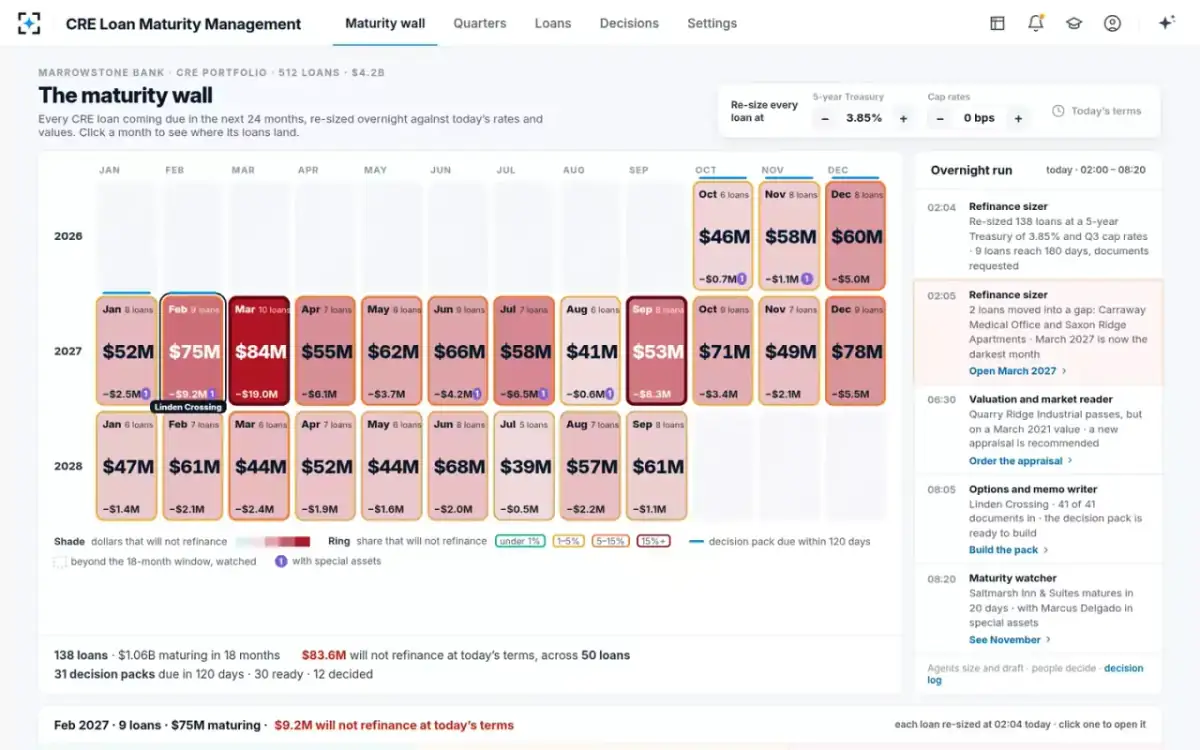
The calendar answers the board's version of the 2026 question: not how big the industry's wall is, but how much of our own will not refinance, when, and in which property types. It also shows how the wall moves inside a bank. The overnight run on the sample's calendar lists two loans moving into a gap after new information arrived, and March 2027 becoming the darkest month as a result.
Move the rates, and the whole wall re-sizes
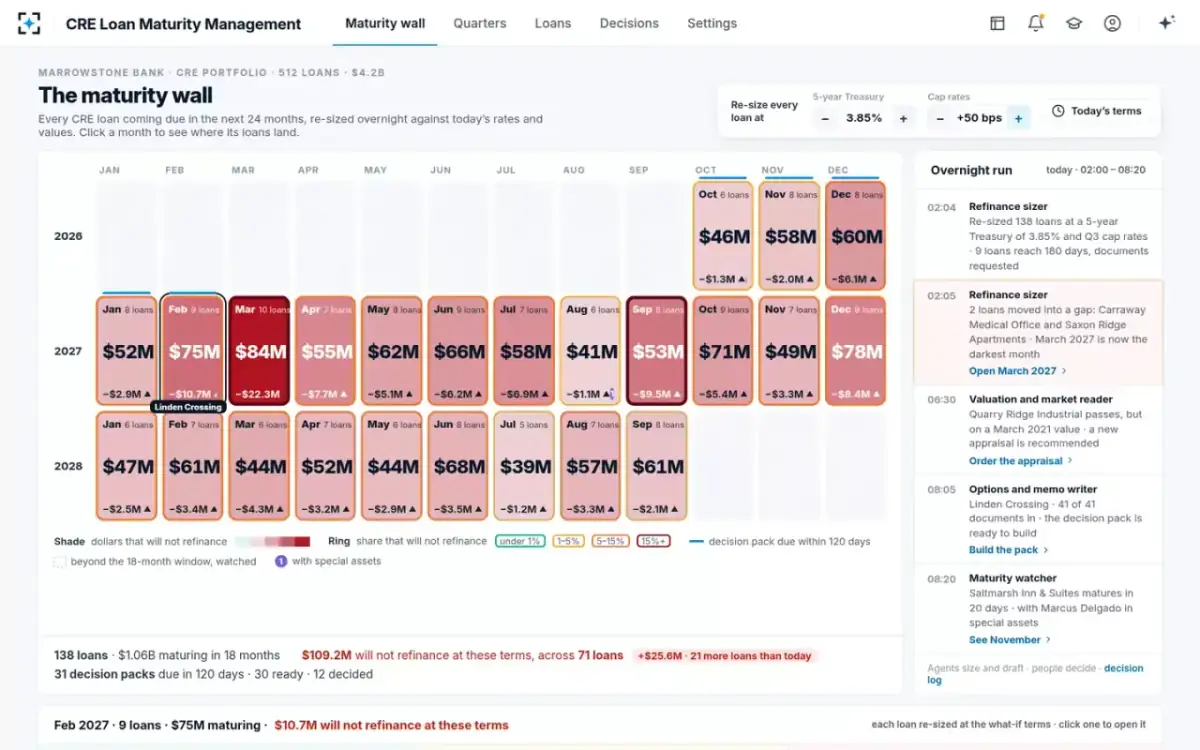
That sensitivity is the bank-level version of the Fed's warning. If extensions become harder to grant, or values soften further, the share of the wall that cannot refinance grows quickly, and it grows unevenly by month and property type. A board that sees the what-if before the year starts can plan capital, staffing and conversations with sponsors accordingly; one that sees it when the loans arrive cannot.
Questions people ask
How much commercial real estate debt matures in 2026?
About $875 billion of commercial and multifamily mortgages, 17% of the $5.0 trillion outstanding, according to the MBA's survey released in February 2026. The figures are balances at the end of 2025; extensions during the year will move some of it into 2027 and later.
How much CRE debt do banks have maturing in 2026?
The MBA puts depositories' 2026 maturities at $396 billion, 21% of the commercial mortgage balance they hold. A year earlier it put their 2025 maturities at $452 billion, 25% of their balance.
When does the CRE maturity wall peak?
On the MBA's schedules, the year-of-survey figure peaked at $957 billion for 2025 and fell to $875 billion for 2026, with $652 billion scheduled for 2027. Because extensions are added to later years as they happen, the 2027 figure will almost certainly rise before 2027 arrives.
Which property types have the most loans maturing in 2026?
By share of each type's outstanding balance, hotels and motels lead at 30%, then industrial at 23%, office at 17%, health care at 15% and multifamily at 13%, per the MBA's February 2026 release.
Why are so many commercial real estate loans being extended?
Because many loans written at low rates cannot refinance at today's rates and values, and an extension avoids a forced sale. Federal Reserve research finds banks extended roughly half of maturing loans between 2023 and 2025, often with paydowns, extra guarantees or higher spreads, while New York Fed research finds weakly capitalised banks extended distressed loans to preserve capital.