When a commercial loan matures, the entire remaining balance is due on that date. Most commercial real estate loans are written for five to ten years but amortised over twenty-five or thirty, so the amount due is a large balloon that few borrowers pay from cash. What happens next follows one of five paths: the loan is refinanced, by the same lender or a new one; renewed or extended, often with conditions; restructured, sometimes split into an A note and a B note; put under forbearance while a sale or lease completes; or ended by a payoff from a sale, a note sale or foreclosure. Which path a lender takes depends on whether the property's current income and value support the debt, and whether the sponsor will put in more money. Botminds' CRE Loan Maturity Management sizes every maturing loan at today's terms months ahead and sets the realistic paths side by side, so the credit officer chooses one before the date rather than on it.
Worked examples come from the 2023 interagency workout statement and from a fictional sample bank, Marrowstone Bank, whose people, sponsors and properties are invented.
Five paths for a maturing commercial loan, as a lender works through them
- 1
Can the loan be refinanced at today's terms, here or elsewhere?
If yesPath 1 · Refinance
- 2
Can the borrower pay on reasonable terms if given time, perhaps with a paydown or reserve?
If yesPath 2 · Renew or extend
- 3
Is part of the debt collectible on modified terms, and the rest not?
If yesPath 3 · Restructure, including A/B notes
- 4
Is the problem temporary: a sale, a lease or a refinance in progress?
If yesPath 4 · Forbear for a short, defined period
- 5
None of the above
If yesPath 5 · Exit: payoff from sale or equity, note sale, foreclosure or deed in lieu
What happens when a commercial loan matures?
The balance becomes due. If the borrower pays it, from a refinance with another lender, a sale or its own funds, the loan ends. If not, the lender decides between a new loan on today's terms, an extension or renewal, a restructuring, a period of forbearance, or enforcement. If nothing is agreed and the balance is not paid, the loan is in maturity default from the day after the date, however good its payment history.
Lenders design for this moment. The OCC's CRE booklet notes that "some types of income-producing property loans have a built-in restructuring trigger, for example, a loan with a five-year tenor and payments based on a 20-year amortization. In these situations, the bank is able to periodically review the strength of the primary and secondary repayment sources and re-underwrite the credit" (OCC Comptroller's Handbook, Commercial Real Estate Lending). Maturity is the re-underwriting. The question each path answers is what that re-underwriting found.
Path 1: refinance at today's terms
A refinance pays the old loan off with a new one, sized on today's income, value and rate. It works when the new loan is at least as large as the balloon, or when the borrower can cover the difference in cash. It is a new credit decision with fresh underwriting. A new lender needs an appraisal by a state-certified appraiser for a commercial real estate loan above $500,000; the existing lender may instead rely on the renewal exemption in the appraisal rules, which still requires an evaluation.
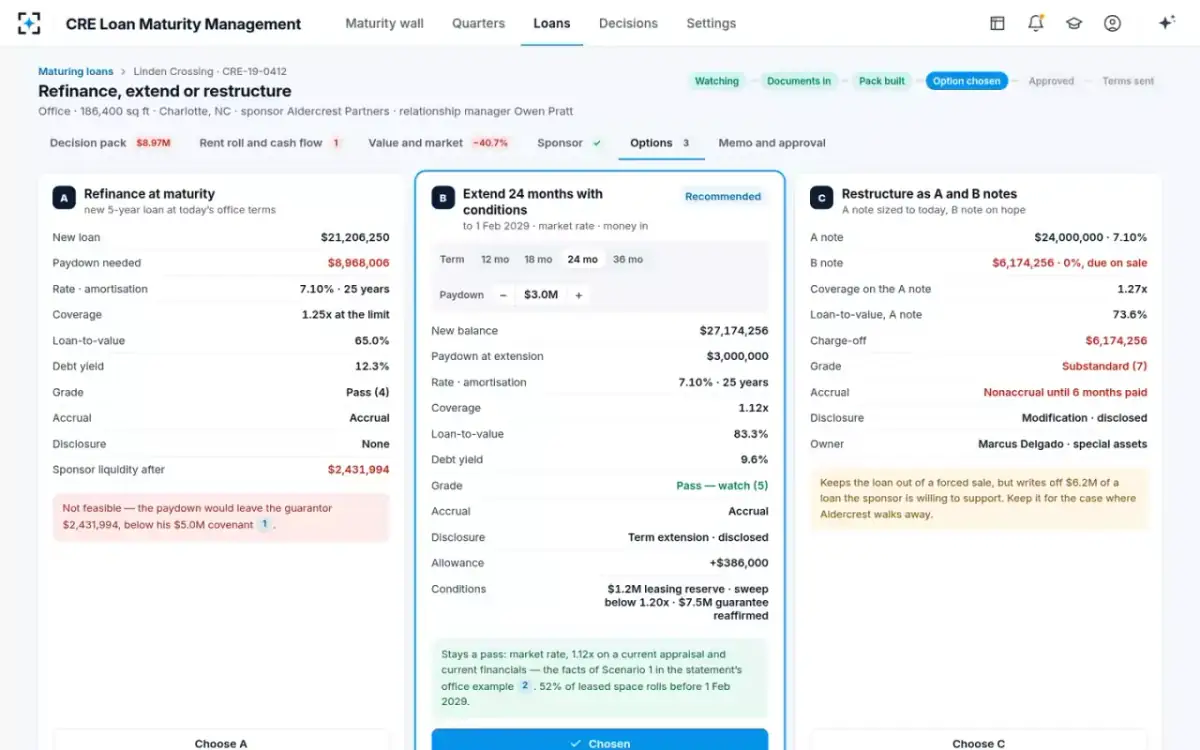
The test is the gap between the balloon and what today's terms would lend. At the sample bank's office terms, 7.10% over 25 years, 1.25x coverage, 65% loan-to-value and a 10% debt yield, the four-storey Linden Crossing office in Charlotte would raise $21,206,250 against $30,174,256 owed: a gap of $8,968,006. A refinance needs that much new equity. The sponsor's guarantor could find it only by dropping his liquidity to $2,431,994, below the $5.0 million covenant he owes other lenders, so path 1 is closed for this loan. How the refinance gap is sized is worked through on its own page.
Path 2: can a commercial loan be extended at maturity?
Yes. An extension or renewal keeps the loan with the same lender for a further term, usually at today's market rate and often with conditions: a principal paydown, a leasing or interest reserve, a cash sweep if coverage falls, a reaffirmed guarantee. It is the most common path: Federal Reserve research finds that banks extended roughly half of maturing CRE loans between 2023 and 2025, and that after 2022 extensions more often came with paydowns, extra guarantees or higher spreads (Glancy, FEDS 2026-025).
An extension is judged by its terms and its evidence. The 2023 statement observes that "a restructured loan typically reflects an elevated level of credit risk, as the borrower may not be, or has not been, able to perform according to the original contractual terms," but its examples keep a renewed loan a pass when the rate is a market rate and the borrower can pay on current financials and a current value (88 FR 43115). For Linden Crossing the realistic path is a 24-month extension with $3,000,000 down, a $1,200,000 leasing reserve and a sweep below 1.20x: a new balance of $27,174,256 at 1.12x coverage.
Refinance, extend or restructure, set side by side for one maturing loan
Path 3: restructure, and what is an A note B note structure?
A restructuring is "a formal, legally enforceable modification in the loan's terms," in the 2023 statement's words. The best-known form at maturity is the A/B note: the lender splits the debt into a note the property can support (Note A) and the remainder (Note B), which is charged off but kept as a legal claim. Note B is what bankers call a hope note.
The statement sets the mechanics. "When restructuring a collateral-dependent loan using a multiple note structure, the amount of Note A should be determined using the fair value of the collateral." A "properly structured and performing Note A generally would not be adversely classified by examiners," while Note B "would be adversely classified 'loss' and must be charged off." And the split matters for income: if a lender takes a partial charge-off without splitting the loan into notes, "the loan should remain on, or be placed in, nonaccrual status."
The statement's retail example: a $10 million loan split into an A note and a B note
At maturity: $10 million owed on a mall worth $7 million
- Note A, sized to the $7 million value, 20-year amortisation at a market rate · 70%
- Note B, 2% interest-only, charged off · 30%
The same example shows the alternative the statement does not favour. In scenario 4 the lender kept one $10 million note, charged off $1 million and graded the rest a pass; the examiner classified the $9 million substandard and put it on nonaccrual, because coverage on the whole note remained 0.88x. Splitting the note is not cosmetic. It creates a loan that can be performed on, graded on its own and accrued, while the uncollectible part is recognised.
Path 4: forbearance and short-term accommodations
Forbearance is a lender's agreement not to enforce a default for a defined period, usually while the borrower completes a sale, signs a lease or closes a refinance. The 2023 statement treats it as an accommodation, its term for short-term relief such as deferring payments, accepting partial payments or forbearing delinquent amounts for a borrower in difficulty. It asks banks to give "clear, accurate, and timely information about the arrangement to the borrower and any guarantor" and to keep accommodations inside "prudent risk management practices and appropriate internal controls."
A forbearance agreement at maturity usually sets a short new deadline, often with milestones: a signed purchase contract by one date, closing by another. It buys time; it does not change the gap. If the milestones slip, the loan arrives at the same five paths with fewer months left, which is why the statement describes moving to longer-term workouts "when short-term accommodation measures are not sufficient or have not been successful."
Path 5: exit by payoff, note sale or foreclosure
Exit ends the bank's exposure. The cleanest exit is a payoff: the borrower sells or refinances elsewhere and repays in full. If the property is worth less than the balance, the exit costs money, through a discounted payoff, a sale of the note, or enforcement by foreclosure or a deed in lieu.
The 2023 statement sets how the loan is graded on the way. For a problem loan dependent on the sale of the collateral, the part of the balance "adequately secured by the fair value of the real estate collateral less the costs to sell generally should be adversely classified no worse than 'substandard,'" the excess is classified loss, and a "doubtful" grade is reserved for cases where pending events may change the outcome, to be used "infrequently." Exit is rarely the first choice, because the 2023 statement notes that prudent workouts "are often in the best interest of the financial institution and the borrower."
Five paths at maturity, and what each one triggers
| Path | Valuation | Grade, typically | Accrual | Disclosure |
|---|---|---|---|---|
| 1. Refinance | New appraisal if new money above the threshold | Underwritten as a new loan | Accrual | None, unless the borrower is in financial difficulty and terms are modified |
| 2. Renew or extend | Existing value if still valid; otherwise an evaluation or appraisal | Pass or pass-watch if payable on reasonable terms; worse if not | Accrual if well supported | A term extension to a borrower in financial difficulty is a reportable modification |
| 3. Restructure (A/B) | Fair value of the collateral sizes Note A | Note A not adversely classified if properly structured and performing; Note B loss | Note A may return to accrual after sustained payment | Reportable modification |
| 4. Forbear | Depends on the plan; a current value if the sale is the exit | Set by repayment capacity; closely watched | Case by case | An accommodation; tracked and reported |
| 5. Exit | Fair value less costs to sell | Excess over that value classified loss | Nonaccrual is common | Charge-off and, on foreclosure, other real estate owned |
Is a loan extension a modification?
For accounting disclosure, a term extension granted to a borrower experiencing financial difficulty is a reportable modification. Since ASU 2022-02 removed troubled debt restructuring accounting, banks disclose modifications to borrowers in financial difficulty that take the form of principal forgiveness, a rate reduction, an other-than-insignificant payment delay or a term extension. An extension to a healthy borrower on market terms is not one.
The disclosure is separate from the grade. A disclosed term extension can be a pass, as in the statement's office example, and an undisclosed refinance can be weak. At the sample bank, each decision is logged with its option, grade and disclosure together, and term extensions to borrowers in difficulty are marked as disclosed modifications automatically; whether a borrower is in financial difficulty is still the credit officer's call. How the statement's examples grade each kind of renewal is set out in a separate guide.
How a bank chooses the path for each maturing loan
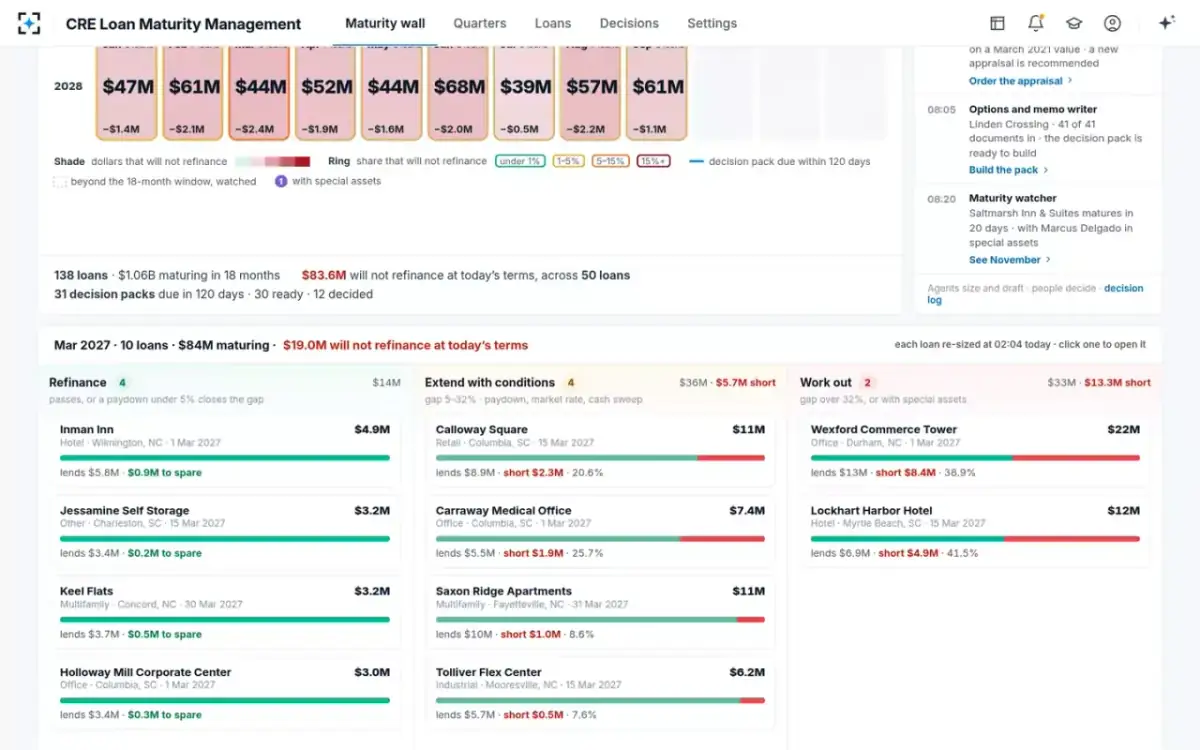
It starts with the gap and works down the tree. The sample bank's calendar does the first cut automatically: each month's loans fall into three lanes, refinance (passes, or a paydown under 5% closes the gap), extend with conditions (a gap of 5% to 32%), and work out (a gap over 32%, or a loan already with special assets). The lanes are a starting point for the officer, not a decision.
One month's maturities sorted into the first three paths
What a borrower should have ready six months before a commercial loan matures
- A current rent roll and copies of leases
Including renewals, give-backs and letters of intent; lenders count signed leases.
- Trailing twelve-month operating statement
With the prior two years, so the lender can see the trend and reconcile it to the rent roll.
- Guarantor financial statements and tax returns
Showing liquidity and every other guarantee outstanding; a guarantor stretched across many loans counts for less.
- A view on value
The lender will order or update a valuation; a borrower who knows the likely number can plan the paydown.
- A proposal
What the sponsor will contribute: principal, a reserve, a guarantee, a market rate. Glancy finds extensions after 2022 were more often paid for this way.
Questions people ask
What happens when a business loan matures and you can't pay?
The balance is due and unpaid, so the loan is in default from the maturity date unless the lender agrees an extension, a forbearance or a restructuring. Lenders usually prefer one of those to enforcement when the borrower can pay on reasonable terms; when it cannot, the lender may sell the note or foreclose on the collateral.
What is a hope note?
It is bankers' slang for the B note in an A/B restructuring: the part of the debt the lender does not expect to collect. The 2023 statement requires that portion to be classified loss and charged off, though the borrower still owes it and any later payments are booked as recoveries.
What is a forbearance agreement on a commercial loan?
A contract in which the lender agrees not to exercise its remedies for a set period, in return for conditions such as milestones for a sale or refinance, fees, reporting or additional collateral. The 2023 statement counts forbearing delinquent amounts as an accommodation and expects clear, timely information to the borrower and any guarantor.
Does an extension need a new appraisal?
Not always. Under 12 CFR 34.43 a renewal of an existing loan needs no new appraisal if no new money is advanced beyond reasonable closing costs, or if market and property conditions have not materially changed, but it still needs an appropriate evaluation. The workout statement adds that material deterioration may call for a new valuation.
Is it better to refinance or extend a commercial loan at maturity?
A refinance at today's terms is cleaner if the property supports the balloon. If it does not, an extension at a market rate with a paydown or reserve often costs the borrower less than the equity a refinance needs and keeps the loan a pass for the lender, provided current financials and a current value support it.