A new appraisal is required for a commercial real estate loan above $500,000 unless an exemption applies, and the exemption that matters at maturity is the one for existing loans. Under 12 CFR 34.43(a)(7) and its FDIC and Federal Reserve twins, renewing or extending a loan the bank already holds does not require a new appraisal if no new money is advanced beyond reasonable closing costs, or if there has been no obvious and material change in the market or the property that threatens the collateral protection. Either way, the bank must still obtain an appropriate evaluation, and it may reuse an existing appraisal or evaluation only if its value conclusion is still valid. If new money is advanced and conditions have materially changed, a new appraisal is required. Separately, when a renewal is a workout, the 2023 interagency workout statement lists six kinds of deterioration that should make a lender consider a new valuation. Botminds' CRE Loan Maturity Management applies these tests, written as the bank's own valuation rule, to every maturing loan well before its date, so the valuation is ordered in time to be reviewed before the decision.
Worked examples come from the agencies' 2018 appraisal FAQs and from a fictional sample bank, Marrowstone Bank, whose loans and people are invented.
Does this CRE renewal need a new appraisal? The decision, step by step
Agent
Valuation and market readerReads the appraisal or evaluation on file, its date, basis and cap rate; compares today's rent roll, sales and cap rates with its assumptions; applies the bank's valuation rule.
Never: Sets or adjusts a value
A person decides
Is new money advanced beyond reasonable closing costs?No: an appraisal is not required by the rule, but an appropriate evaluation is. Yes: go to the next question.
A person decides
Has there been an obvious and material change that threatens the collateral protection?Yes, with new money: a new appraisal is required unless another exemption applies. No: an evaluation is required, and a valid existing one may be used.
A person decides
Is the renewal a workout with material deterioration?The 2023 statement's six factors: if any has deteriorated materially, obtain a new appraisal or an evaluation that updates the old assumptions.
A person decides
Review before the decisionThe appraisal or evaluation is received, reviewed and accepted before the final credit decision.
When is a new appraisal required?
For a bank, an appraisal by a state-certified or licensed appraiser is required for every real estate-related financial transaction except those the appraisal rules exempt. The commercial thresholds have not moved since 2018: a commercial real estate transaction of $500,000 or less is exempt, and so is a business loan of $1 million or less that is "not dependent on the sale of, or rental income derived from, real estate as the primary source of repayment" (12 CFR 34.43(a)(5) and (a)(13)). Above those amounts, a new commercial real estate loan needs an appraisal.
A renewal is different because the bank is not making a new decision to lend against the property; it is continuing one it made before. That is why the rules carry a separate exemption for existing extensions of credit, and why most of the real questions at maturity are not "appraisal or nothing" but "appraisal, new evaluation, or the valuation already on file".
Is an appraisal required for a loan renewal? 12 CFR 34.43(a)(7)
Not if the renewal meets either condition of the existing-credit exemption. The rule exempts a transaction that "involves an existing extension of credit at the lending institution, provided that: (i) There has been no obvious and material change in market conditions or physical aspects of the property that threatens the adequacy of the institution's real estate collateral protection after the transaction, even with the advancement of new monies; or (ii) There is no advancement of new monies, other than funds necessary to cover reasonable closing costs."
The exemption from an appraisal is not an exemption from valuation. Paragraph (b) follows immediately: "For a transaction that does not require the services of a State certified or licensed appraiser under paragraphs (a)(1), (5), (7), (13), or (14) of this section, the institution shall obtain an appropriate evaluation of real property collateral that is consistent with safe and sound banking practices." And paragraph (c) keeps the regulator's hand on the switch: the OCC "reserves the right to require an appraisal under this subpart whenever the agency believes it is necessary to address safety and soundness concerns."
New money or not: the four examples regulators give
The agencies' 2018 appraisal FAQs work the rule through four renewal examples. The pattern is that new money combined with a material change requires an appraisal; anything less requires an evaluation, which may be a valid existing one.
Four renewal cases from the agencies' 2018 appraisal FAQs
| Case | New money? | Material change threatening collateral? | What the rules require |
|---|---|---|---|
| 1. Revolving line renewed for a new term | No | Yes: existing valuation cannot be validated | An evaluation, not an appraisal, because no new money was advanced; an appraisal is optional |
| 2. ADC loan renewed at maturity with new money above the original commitment | Yes | Yes | An appraisal |
| 3. Same ADC loan, but no material change found | Yes | No | An appropriate evaluation; a valid existing evaluation or appraisal may be used |
| 4. Residential balloon renewed for another term | No | No | An appropriate evaluation; a valid existing one may be used |
The FAQ's own summary is the clearest statement of the rule at maturity: "When there has been an obvious and material change in market conditions or physical aspects of the property that threatens the adequacy of the real estate collateral protection, the existing appraisal or evaluation is no longer valid. In such situations, if no new money is advanced, a financial institution must obtain a new evaluation, or may choose to satisfy the agencies' appraisal regulations by obtaining a new appraisal. However, if new money is advanced, a financial institution must obtain a new appraisal unless another exemption from the appraisal requirement applies."
Can you reuse an existing appraisal at renewal?
Yes, if its market value conclusion is still valid, and the bank documents why. The FAQs answer the question directly: "A financial institution may use an existing appraisal or evaluation to support the renewal of an existing loan at the financial institution when the market value conclusion within the appraisal or evaluation remains valid." Validity is "a fact-specific determination, based on market conditions, property condition, and nature of the transaction," and the bank "should establish criteria for validating an existing appraisal or evaluation in its written valuation policies."
The FAQs list the factors those criteria should consider, and two of them are the ones that move income-property values most: "changes in underlying economic and market assumptions, such as capitalization rates and lease terms." The others are the volatility of the local market, changes in the terms and availability of financing, natural disasters, the supply of competing properties, improvements or lack of maintenance, changes in zoning, building materials or technology, environmental contamination, "and the passage of time." On that last factor the FAQs add a sentence often misremembered: "there is no provision in the agencies' appraisal regulations specifying the useful life of an appraisal or evaluation." The shelf life is the bank's to set and to defend, and for a commercial property the documentation of validity is expected to be more detailed than for a residential renewal.
What triggers a new appraisal in a CRE workout?
Material deterioration. When a maturing loan is renewed as part of a workout, the 2023 interagency statement says a prudent lender considers a new appraisal or evaluation when there has been material deterioration in any of six factors. The list is the practical test for most problem renewals, and it overlaps with, but is not the same as, the appraisal rule's "material change".
Six workout triggers for a new appraisal or evaluation, from the 2023 statement
- The performance of the project
Income below what the last valuation assumed; vacancy or arrears rising.
- Conditions for the geographic market and property type
Cap rates, rents or absorption moving against the property since the last value.
- Variances between actual conditions and original appraisal assumptions
Lease-up, rent growth or expenses that did not follow the appraisal's case.
- Changes in project specifications
The statement's example: "changing a planned condominium project to an apartment building."
- Loss of a significant lease or a take-out commitment
A large tenant leaving, or a committed permanent lender withdrawing.
- Increases in pre-sale fallout
Buyers walking away from contracts on for-sale projects.
The statement also says when a full appraisal is not needed: "A new appraisal may not be necessary when an evaluation prepared by the financial institution appropriately updates the original appraisal assumptions to reflect current market conditions and provides a reasonable estimate of the underlying collateral's fair value." And it sends new-money cases back to the rule: "If new money is being advanced, financial institutions should refer to the agencies' appraisal regulations to determine whether a new appraisal is required."
As is or as stabilized: which value to use at renewal
Use the value that matches the plan for the loan. Commercial appraisals often carry more than one conclusion, an "as is" market value and prospective "as complete" or "as stabilized" values, and the 2023 statement tells banks to use "the market value conclusion (and not the fair value) that corresponds to the workout plan objective and the loan commitment."
Which value conclusion a renewal should rest on
If the plan is to work with the borrower to stabilise: The "as stabilized" market value, after confirming the appraisal's assumptions are reasonable
If the plan is to foreclose or sell: Fair value of the property "in its current 'as is' condition"
If the plan is to work with the borrower to stabilise: None beyond the review of assumptions
If the plan is to foreclose or sell: Less costs to sell, where repayment depends on the sale
If the plan is to work with the borrower to stabilise: Lease-up and rent assumptions that are not being met
If the plan is to foreclose or sell: A distressed-sale discount the appraisal did not assume
What appraisals and evaluations cost in time, by the agencies' own numbers
The cost argument for evaluations is real but smaller than often claimed. When the agencies raised the commercial threshold from $250,000 to $500,000 in 2018, they estimated the change would exempt about a third of transactions but under 2% of dollar volume, and that "an evaluation takes approximately 30 minutes less to review than an appraisal" (Real Estate Appraisals final rule, 83 FR 15019, 2018).
The 2018 commercial appraisal threshold, by the agencies' estimate
$500K
commercial real estate appraisal threshold, raised from $250,000 in 2018 and unchanged since
31.9%
of loans in the agencies' sample exempted from the appraisal requirement
1.8%
of the sample's dollar volume exempted
~30 min
less to review an evaluation than an appraisal
For a large maturing office loan none of this changes the answer: the value is the variable most likely to have moved, and a stale one is what the examiner will question first. The statement's own office example turns on exactly that difference, and the two 1.12x loans it grades differently are compared on another page.
Writing a valuation rule every maturing loan can be tested against
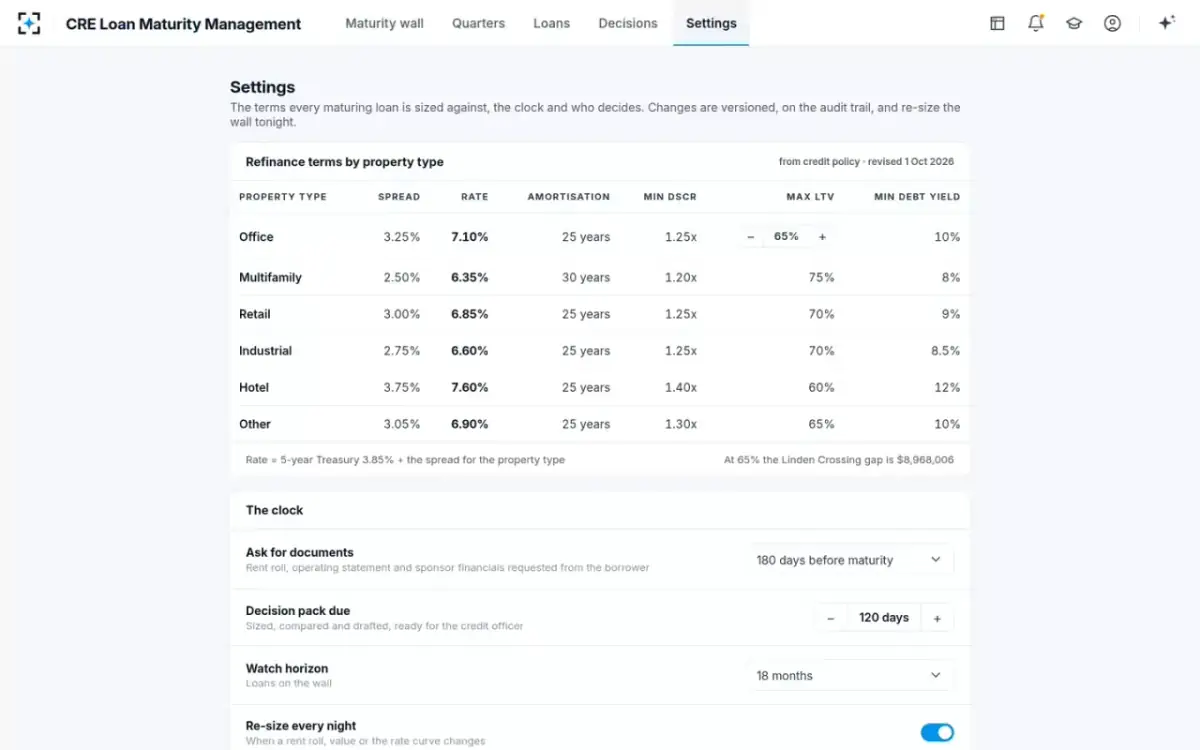
The appraisal rules and the workout statement both leave the threshold to the bank, so the useful step is to write it as a test. The fictional sample bank's rule is a setting: a new appraisal is required when the value may have fallen 20% or more, or when a lease over 15% of the space is lost; the alternatives on offer are a 15% fall, or a new appraisal on every extension. The valuation and market reader applies the rule to each maturing loan from the rent roll, the leases, recent sales and cap rates, and flags the loans that need an order.
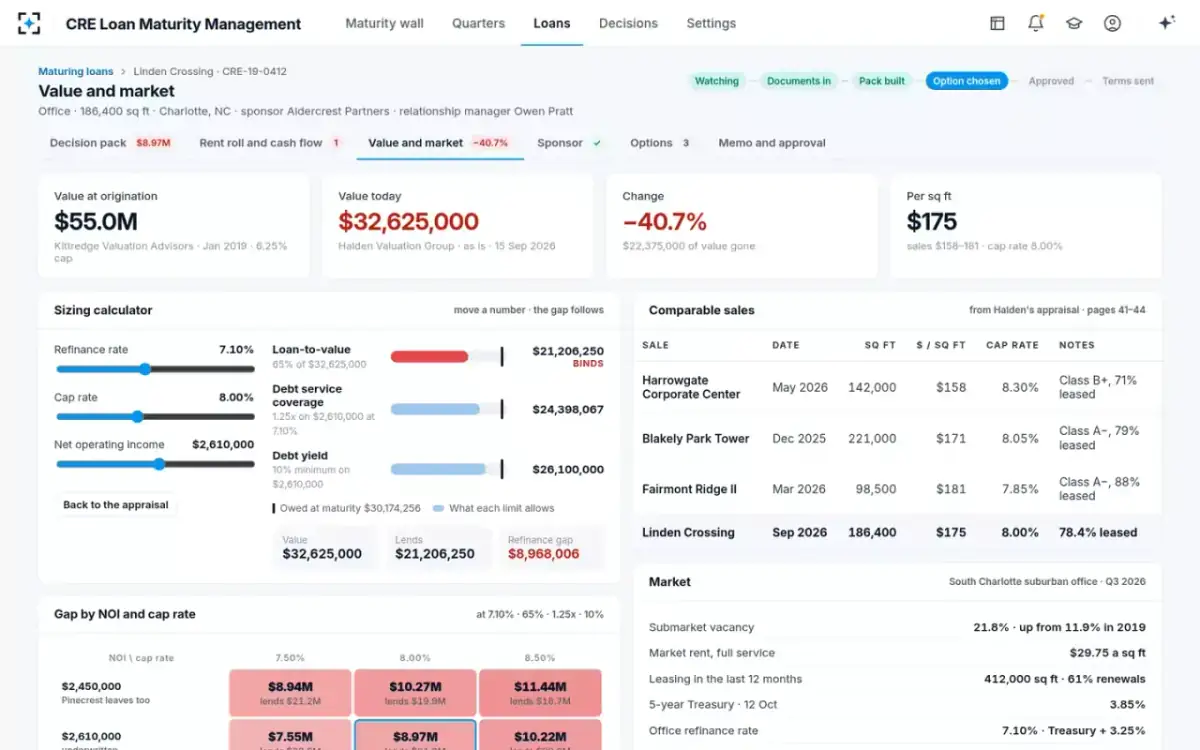
On Linden Crossing the rule fired early. The 2019 appraisal valued the office at $55.0 million at a 6.25% cap rate; current sales pointed to cap rates near 8%, and the largest tenant, with 20.5% of the building, was giving back 9,800 square feet. The new appraisal, effective 15 September 2026, came in at $32,625,000 as is at an 8.00% cap rate, down 40.7%, supported by three sales at 7.85% to 8.30%. It was in the file, and reviewed, before the extension was decided 112 days ahead of the maturity date.
The value on file, the value today, and the sales behind it
The valuation rule as a setting the credit policy owns
Timing is the last requirement. The FAQs state that a bank "may grant conditional approvals … before obtaining an appraisal or evaluation. However, a final credit decision or action should only occur after the financial institution receives, reviews, and accepts the appraisal or evaluation." A valuation ordered when the borrower first asks for an extension, a few weeks before maturity, often cannot meet that test. One ordered when the rule fires, months ahead, can. The officer who negotiates the renewal needs that number before the conversation, not after.
Questions people ask
Does a commercial loan extension need a new appraisal?
Not by rule if no new money is advanced beyond reasonable closing costs, or if there has been no obvious and material change threatening the collateral. An appropriate evaluation is still required, and a valid existing appraisal or evaluation may serve. If new money is advanced and conditions have materially changed, a new appraisal is required.
How long is a commercial appraisal good for?
No federal rule sets a useful life; the 2018 interagency FAQs say so expressly. Each bank sets validation criteria in its valuation policy, considering factors such as market volatility, cap rate and lease changes, property condition and the passage of time, and documents the assessment in the credit file.
When is an evaluation allowed instead of an appraisal?
For commercial real estate transactions of $500,000 or less, qualifying business loans of $1 million or less, and renewals of existing loans that meet the existing-credit exemption, among other cases. An evaluation must still be consistent with safe and sound practices, and a bank may always choose an appraisal instead.
When is a certified appraisal required for commercial property?
Under 12 CFR 34.43(d), any commercial real estate transaction of more than $500,000 that needs an appraisal must have one prepared by a state certified appraiser, as must any transaction of $1,000,000 or more. Below those levels a state licensed or certified appraiser may be used where an appraisal is required at all.
What does an examiner do if the bank's valuation is weak?
The 2023 statement says examiners should direct the bank to address the weakness, which "may require the financial institution to obtain additional information or a new collateral valuation." If the bank cannot or will not, examiners assess the property's cash flow and sale value themselves when classifying the loan.