A special assets department is the group inside a bank that takes over loans which have stopped being a lending relationship and become a recovery problem. Its officers do not originate; they work names out — restructuring, re-documenting, re-margining, selling, foreclosing or charging off — and they are measured on how much of the bank's money comes back and how fast. A loan goes there when the work it needs stops being relationship management and starts being collection strategy, which is a judgement the committee makes against written thresholds rather than a verdict on the lender who made the loan. Botminds' Problem Loan Management keeps one current page per troubled loan, cited to the documents behind it, so the name that transfers arrives whole on the first morning instead of being reassembled from other people's inboxes.
Banks use several names for the same function — special assets, managed assets, asset recovery, loan workout, problem loan workout. Some split it: a commercial workout group for the large relationships, a collections operation for small-balance consumer paper. What follows uses the US supervisors' own language for the work, and a fictional sample bank, Calder Plains Bank, for the examples of how it runs in practice.
What is a special assets department?
It is a small group of experienced credit officers who hold a portfolio of troubled names and nothing else. Their work is partly legal, partly analytical and mostly negotiation: establishing what the bank can actually enforce, working out what the borrower can actually pay, and choosing between the routes out. The job needs a temperament the lending side does not reward — comfort with conflict, patience with detail, and a willingness to be the person who says the collateral is worth less than everybody hoped.
The supervisors treat the function as part of the same credit machinery as review and grading. The interagency guidance on credit risk review notes that the system may include responsibilities assigned to "credit underwriting, loan administration, a problem loan workout group, or other organizational units", which among other things "administer the internal problem loan reporting process" and "confirm that timely and appropriate changes are made to risk ratings". A special assets department is therefore not a side office. It is one of the places where a bank's grades are kept honest.
What it is not is a collections department. Collections chases payments on a standard product at volume, mostly by letter, call and script, and the unit of work is an account. Special assets takes one relationship at a time, reads its documents, and decides a strategy that may run for two years. The two are often confused because both appear downstream of a default, and a bank that staffs special assets as if it were collections will discover the difference at the first contested foreclosure.
One bank's transfer rules, written as numbers
$10M
Substandard relationships above this are flagged for Special Assets to co-manage with the lender
$5M
Any non-accrual relationship above this transfers outright, or by committee vote at any size
41names
on the watch list, $286.4M of exposure, of which the department holds a fraction
What triggers a transfer to special assets: thresholds, events and a vote
Three things move a name. The first is a threshold in the credit policy, of the kind in the panel above: a dollar amount crossed with a grade, so that the largest substandard exposures are at least co-managed and the largest non-accrual ones transfer outright. The second is an event the policy treats as decisive whatever the size — a bankruptcy filing, a judgement, an acceleration, an environmental problem, a fraud concern, a guarantor who stops answering. The third is the committee simply deciding, by vote, that this name needs a workout officer now. For a commercial real estate loan approaching maturity, how many months ahead the hand-off should come is a question of its own, answered in the guide to the special assets officer.
Thresholds are the least interesting of the three and the most argued about, because they are the only part a policy can express exactly. The real question is the one no number answers: has the relationship moved from a conversation about the business to a negotiation about the debt? Once the borrower's incentives and the bank's have separated — once every concession the lender grants is being valued by the borrower as a free option — the relationship manager is on the wrong side of the table and should be allowed to say so.
When the timing goes wrong, it tends to go wrong late. A name handed over while there are still options is a workout; the same name handed over after the equity has gone, the collateral has been milked and the guarantor has restructured his own affairs is a recovery exercise with fewer moves available. The special assets officer's standing request — give me the name while there are still options — is not territorial. It is a statement about which routes are still open.
Give me the name while there are still options.
Rosa Delgado, special assets officer, on the fictional sample bank's watch list
What moves with the name, and what the officer needs on day one
A transfer is only as good as the file that arrives with it. The officer's first week is spent answering three questions — what are we owed, what can we enforce, and what is it worth — and every day spent assembling the answer is a day the borrower has and the bank does not. The supervisors' own list of what a prudent workout plan rests on reads like a packing list for the hand-off: updated and comprehensive financial information on the borrower and every guarantor and sponsor, up-to-date collateral valuations, an appropriate structure with covenants and re-margining requirements, and the legal analyses and agreements behind any change to the original terms (Policy Statement on Prudent CRE Loan Accommodations and Workouts, SR 23-5).
The day-one file: what has to arrive with the name
- The debt, exactly
- Every facility, its balance, rate, maturity, amortisation and what each one secures — including the facilities nobody thinks of as debt, such as a letter of credit or a swap that is out of the money.
- The documents that give the bank its rights
- The note, the loan agreement and every amendment, the security agreements, mortgages and assignments, the guarantees, and the evidence that each lien is perfected.
- Twenty-four months of modifications
- Each amendment, extension, deferral, rate concession, interest-only period and payment-in-kind feature, with coverage recomputed on the original schedule as well as the modified one.
- The collateral, with its date
- What secures what, the last valuation of each item and when it was made, the field exam or inspection history, and the insurance.
- The guarantors and sponsors
- Who is on the hook, for how much, and their own financial position — tested rather than assumed.
- What the committee has decided before
- Every grade since the name first appeared, with the reasons, the plan it set each time and what was actually done.
- The last twelve months of behaviour
- Payments, past dues, overdrafts, line use against the borrowing base, deposit trends, and late or missing statements and certificates.
Two of those rows are where hand-offs actually fail. Lien perfection is checked too late, because everybody assumes it was done at closing and nobody wants to be the one who finds out it was not; a lapsed filing discovered in month three can cost the whole secured position. And modifications are under-counted, because an interest-only period agreed by email in a quiet quarter does not look like an amendment to anybody except the person recomputing coverage on the original schedule.
A transfer, step by step
Agent
The trigger is noticedA substandard relationship crosses the co-management line or a non-accrual passes the transfer line in the bank’s own settings, and the grade recommender names the rule in its proposal.
Never: moves a name on its own. It proposes.
A person decides
The committee votes the transferOutright transfer or co-management, with the reasons recorded and the first actions set in the same minute.
A person decides
The hand-off meetingLender, special assets officer and credit officer go through the name together: the history, the people, the promises made, the ones the bank regrets.
Agent
The file is assembledEvery statement, certificate, valuation, amendment, guarantee and prior decision in the file is already on the name’s page with its source, and a late statement shows as late.
Never: contacts the borrower.
A person decides
The first thirty daysEnforceability confirmed, collateral inspected or re-valued, a position taken on what the borrower can pay, and a written plan with dates.
A person decides
The plan goes back to the committeeThe workout plan is approved, amended or rejected by the same committee that voted the transfer — and reviewed against the file at every meeting after it.
Co-management: when the lender keeps the relationship
Not every troubled name should leave the line, and the middle road is co-management: special assets takes the strategy, the lender keeps the relationship and the day-to-day contact, and both report to the same committee. It suits the case where the borrower is likely to survive, the bank wants to keep the customer on the other side, and the lender's twenty years of knowledge are an asset rather than an attachment.
It also has a failure mode worth naming. Two owners can mean no owner, and the borrower will quickly learn which of the two says yes. Co-management works when one of the pair demonstrably holds the pen — the plan, the concessions and the deadlines are the workout officer's, and the calls, the visits and the relationship are the lender's — and when both of them read the same page.
The same name on the line, and co-managed with special assets
Managed on the line: The relationship manager, within the committee’s plan.
Co-managed: The special assets officer, with the lender in the room.
Managed on the line: The relationship manager.
Co-managed: The relationship manager, with the officer present for anything that changes the debt.
Managed on the line: Judged case by case; easy to grant one at a time.
Co-managed: Priced against the plan: every concession buys something dated and written down.
Managed on the line: Re-valued at review, or when something forces it.
Co-managed: Re-valued and inspected on a schedule the plan sets, because the number drives everything else.
Managed on the line: The lender’s report on the name.
Co-managed: The plan, item by item, checked against the file rather than against the report.
Managed on the line: Smaller exposures, a cooperative borrower, a weakness with an identified cure.
Co-managed: Large substandard exposures where the relationship is still worth having and the structure is not.
What a workout is allowed to be, and what the supervisors say about accommodation
A workout is a renegotiation with a purpose, and the purpose is written into the supervisory definition: "An effective loan workout arrangement should improve the lender's prospects for repayment of principal and interest, be consistent with sound banking and accounting practices, and comply with applicable laws and regulations." Everything else follows from that sentence. A change that does not improve the prospects of repayment is not a workout; it is a delay with paperwork.
The agencies distinguish the short measure from the long one. An accommodation is the lighter intervention: deferring a payment, taking a partial one, forbearing on arrears, modifying the loan, or otherwise giving relief to a borrower in a financial squeeze. A workout is what comes next, once short-term relief has proved insufficient or has failed, and it can mean renewing or extending terms, lending more to improve the prospects of overall repayment, or restructuring with or without concessions.
Two supervisory positions matter most to a workout officer deciding how far to go. First, a decline in collateral value is not on its own a reason to classify a performing loan or to force a partial charge-off, even when the value has fallen below the balance; what justifies classifying a performing loan is a well-defined weakness that puts repayment at risk (SR 23-5, section V). Second, the thing examiners are actually looking at is cash: "The primary focus of an examiner's review of a CRE loan, including binding commitments, is an assessment of the borrower's ability to repay the loan."
Those two together explain most grade disputes in a workout. The lender argues from the appraisal; the examiner argues from the repayment capacity; and the loan that is current on a restructured schedule while failing on its original one sits precisely between them. That is why what counts as a troubled restructuring is worth settling before the concession is granted rather than after.
The policy statement's own worked examples: twenty-seven scenarios, and where the examiner disagreed
| Loan in the example | Scenarios worked | Where the examiner took a different grade |
|---|---|---|
| Office building, income producing | 3 | 2 — a market-rate renewal graded pass that the examiner listed special mention, citing stale financials and no new valuation; and an interest-only restructuring at a below-market rate, graded pass, that the examiner classified substandard. |
| Retail and shopping centre | 4 | 3 — an interest-only renewal graded pass that the examiner listed special mention; a substandard loan from which the examiner carved $1 million as loss; and a single restructured note, graded pass after a partial charge-off, that the examiner classified substandard. |
| Hotel | 4 | 1 — a 12-month extension at a market rate, graded pass on 0.85x coverage, that the examiner listed special mention. |
| Residential acquisition and development | 3 | None on the grades; the examiner disagreed with the accrual treatment in one. |
| Single-family construction | 4 | 1 — an extension funded by a new interest reserve, graded pass, from which the examiner classified $390,000 as loss after the lender reversed $18,000 of capitalised interest. |
| Land acquisition and condominium conversion | 2 | None on the grades; the disagreement in one was about accrual. |
| Operating line with owner-occupied real estate | 2 | None. |
| Land loan | 2 | 1 — a loan graded pass because it was current and at a market rate, which the examiner adversely classified, with $550,000 as loss. |
| Apartment building | 3 | 2 — a renewal graded pass that the examiner classified substandard, and a substandard loan from which the examiner carved $900,000 as loss. |
The lesson of that table is not that examiners are harsh. It is that the disagreements cluster on one kind of decision: a loan renewed, extended or restructured and then kept at pass, usually because it was current on its new terms. Eight of the ten disagreements started from a pass grade, and in all ten the more severe view was the examiner's. A workout officer who grades against that pattern in advance will have a much shorter examination.
The temptation the research has a name for
The permanent danger in a workout function is the one that feels most like care. A borrower cannot pay; the bank advances a little more so that it can; the loan stays current; nobody books a loss. Economists studying Japan's lost decade named it. Lending enough to a weak borrower to keep it paying, wrote Peek and Rosengren, "benefits the firm because it can avoid (or at least delay) bankruptcy. It also enables the bank to avoid (or delay) a further increase in its reported nonperforming loans, so that the bank does not have to make additional loan charge offs and loan loss provisions, which would reduce the bank's earnings, and thus capital."
Their finding was not that this happened occasionally. Across their sample there was "widespread evergreening of loans by banks, with banks being more likely to increase loans to a firm the weaker is the firm's health" — credit flowing towards weakness rather than towards prospects, which is the opposite of what a lending function is for.
The supervisory counterweight is timing, and it is stated without softness. Banks should not be allowed to attempt long-term recoveries while the credit remains on the books, says the Federal Reserve's examination manual: "Losses should be taken in the period in which they surface as uncollectible." And an improvement has to be demonstrated before it is rewarded. The OCC's handbook on rating credit risk tells examiners to wait, before upgrading a classified credit, until its well-defined weaknesses have been corrected and the borrower has performed for a sustained period on reasonable terms — and says a plan to improve does not, on its own, justify an upgrade (Comptroller's Handbook, Rating Credit Risk).
A plan is not performance. That single line, applied inside the bank before an examiner applies it, is the cheapest discipline a special assets function can adopt.
The name's whole file, on one page
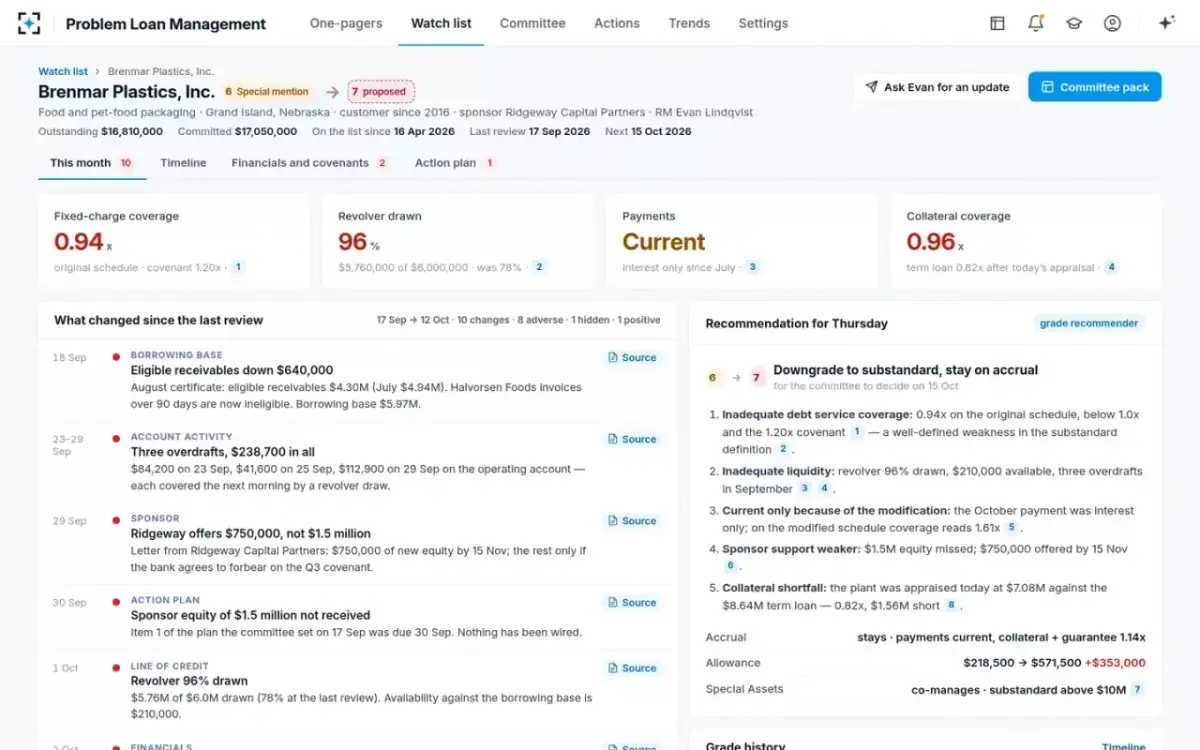
Exit routes: cure, restructure, sale, foreclosure, charge-off
Every workout ends in one of a small number of ways, and naming them early helps, because each needs different evidence and different lead time. A cure — the borrower trades out, refinances elsewhere, or the sponsor puts in money — is the only route that depends mostly on the borrower, and the only one that needs the bank to have kept the relationship civil. A restructure keeps the loan and changes its shape; its test is the supervisory one, whether it genuinely improves the prospects of repayment. A sale of the loan moves the problem for a price, and the price is set by the quality of the file, which is a direct argument for keeping the documents in order throughout.
Foreclosure or enforcement takes the collateral and starts a second, slower problem; its lead time is months and its costs are real, so the decision to begin should be taken on a value the bank believes rather than on one it hopes for. A charge-off recognises that some portion will not come back, and it is a timing decision as much as a measurement one. Those five are not a sequence. A good plan names its primary route and its fallback on day thirty, with the date at which the bank will stop waiting.
Seven questions before a name is handed over
- What exactly are we owed, across every facility?
Including the exposures that do not look like loans: letters of credit, unfunded commitments, a derivative out of the money, overdraft lines.
- What can we actually enforce?
Each lien, each guarantee, each assignment, with evidence of perfection and of what the documents permit after default — tested, not assumed.
- What is the collateral worth today?
With the date of the valuation, who made it and on what basis. A four-year-old appraisal is an opinion about a different economy.
- Is the loan current only because of a modification?
Recompute coverage on the original schedule. If the answer is yes, the grade and the plan both change.
- Who else is lending, and on what terms?
Other lenders’ maturities and covenants decide how much time the bank really has, whatever its own documents say.
- What did the committee ask for last time, and did it happen?
Checked against the file, not against the relationship manager’s recollection of the call.
- What is the primary route out, and the fallback?
Named on day thirty, each with a date at which the bank stops waiting and moves to the next one.
Why the hand-off goes wrong, and the one thing that fixes it
Hand-offs fail for a reason that has nothing to do with either officer's competence: the knowledge that mattered was never written down. The FDIC's examination manual puts its finger on the underlying condition when it lists the causes of problem loans, among them the "Absence of effective active management supervision of loans which possessed reasonable soundness at inception. Ineffective supervision almost invariably results from lack of knowledge of a borrower's affairs over the life of the loan." A bank that has not kept that knowledge current cannot transfer it, however good the meeting is.
The manual's own list of warning signs is organised by document for exactly this reason — the note and its history, the financial and operating statements, the cash-flow projections, the correspondence and credit files, the collateral — because the evidence of trouble is distributed across the file rather than summarised anywhere in it. A page that is rebuilt only when somebody needs it falls behind the file the day after it is printed.
The fix is unglamorous: keep the page current as the documents arrive, with the source of every line in the margin, and the hand-off becomes a conversation rather than an archaeology project. In the sample bank that is what the monitoring agents do — reading each new statement, certificate, payment, overdraft, valuation and lender update, and rewriting the line it changes with its source — and what the receiving officer inherits on day one is the same page the committee read, not a summary of it. On the sample bank's October agenda one office partnership is proposed for transfer to special assets at $18.75 million; if the committee votes it, the officer who receives it already has the file, the plan and what has not happened yet.
The workout plan, item by item, checked against the file
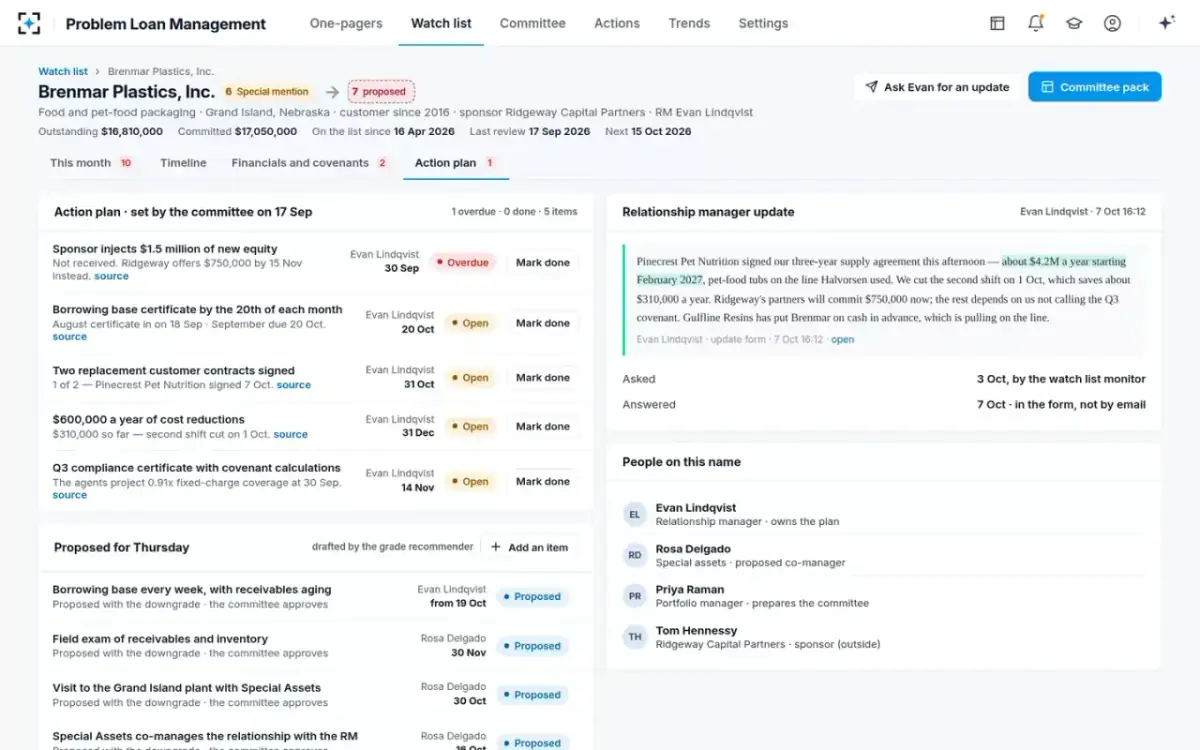
What the department is measured on
Four measures carry most of the weight, and the order matters. Recovery against the exposure at transfer is the headline, and it is only meaningful alongside the second: how long the name was held, because a dollar recovered in four years is not the same dollar. Third is the accuracy of the first assessment — how close the officer's day-thirty view of what the bank would recover turned out to be, which is the measure that keeps optimism honest and is almost never kept. Fourth is the state of the file on arrival, measured in days from transfer to a complete position, which is the one measure that indicts the sending side rather than the receiving one.
Two more are worth tracking as discipline rather than performance. The proportion of names that leave the department upgraded, against those that leave sold, foreclosed or charged off, says something about whether transfers are happening early enough to matter. And the age of the oldest open plan item says whether anybody is chasing. A department with no overdue actions is either very well run or not writing down what it is owed.
Questions people ask
What does a special assets department do?
It takes custody of a bank's troubled loans and works each one out. In practice that means establishing what the bank is owed and can enforce, re-valuing and inspecting the collateral, testing what the borrower and any guarantors can actually pay, negotiating a restructuring or an exit, and recommending the grade, the accrual status and any charge-off to the committee that decides them. It does not originate new credit.
What happens when a loan goes to special assets?
The committee votes the transfer and records it; a hand-off meeting passes the history and the relationships over; the receiving officer confirms the bank's legal position, re-values the collateral and takes a view on repayment capacity, usually within the first thirty days; and a written workout plan with dates goes back to the committee for approval. The loan's grade may change at the same meeting, but the transfer and the grade are separate decisions.
What is the difference between special assets and collections?
Scale and method. Collections works high volumes of standardised accounts through calls, letters and scripted treatments, and measures itself on cure rates across a portfolio. Special assets works a small number of complex commercial relationships one at a time, reading the documents and negotiating a bespoke strategy that may run for years. Many banks run both, with a size or product line dividing them.
Who owns the relationship after a transfer to special assets?
It depends on whether the transfer is outright or a co-management. On an outright transfer the special assets officer owns the relationship, the contact and the strategy. Under co-management the relationship manager keeps the contact and the lender's knowledge while the workout officer holds the plan and prices every concession, and both report to the same committee — which only works where it is clear in writing which of the two may say yes.
What is a loan workout?
A renegotiation of a troubled loan intended to improve the lender's prospects of being repaid. Supervisors expect it to be consistent with sound banking and accounting practice and to rest on current information: updated financials on the borrower and every guarantor, current collateral valuations, an appropriate structure and covenants, and the legal work behind any change of terms. Forms include renewing or extending terms, extending further credit to improve overall repayment prospects, and restructuring with or without concessions.
Does the borrower know its loan has moved to special assets?
Usually, because the officer handling the loan changes and the conversation changes with it — new information requests, inspections, and a plan with dates. Banks differ on how the change is framed, and some keep the relationship manager visible precisely so that the borrower does not treat the move as the end of the discussion. Under co-management the lender often stays the borrower's day-to-day contact, so the change may feel smaller from the outside than it is inside the bank.