A criticized assets committee is the standing body that decides the internal risk grade of every loan a bank has already flagged as weak: who moves down, who moves up, who goes on non-accrual, who goes to special assets and what each borrower must do next. It exists so that no single lender both owns a relationship and grades it, and its real product is not the meeting but the record it leaves — each decision, the reasons behind it, the actions it set and the person who owes them. Botminds' Problem Loan Management keeps one current page for each troubled loan, cited line by line to the documents in the file, so the committee argues about the credit rather than about whose spreadsheet is right.
Banks call it different things — criticized assets committee, watch list committee, problem loan committee, classified asset review — and the name matters less than the three questions this guide answers: who sits at the table, who may change a grade, and what has to be written down afterwards. The examples come from a fictional sample bank, Calder Plains Bank, as it runs through the solution; the rules come from the US banking agencies, linked where they appear.
What a criticized assets committee is for
The committee is the place where a bank discharges a duty its regulator states in a single clause: find the problem assets, and stop them getting worse. The Interagency Guidelines Establishing Standards for Safety and Soundness, the standards every insured depository institution is measured against, require a system to identify problem assets, and the first item on that system's list is a periodic review of asset quality to find them (12 CFR part 364, appendix A, II.G). The rest of the list is the committee's agenda in order: estimate the losses inside those assets, compare the totals with capital, take corrective action, consider concentrations, and report to the board.
That is worth saying plainly, because committees drift. A criticized assets committee is not a loan committee: it approves no new credit and prices nothing. It is not the asset-liability committee, and it is not the allowance committee, although what it decides feeds the allowance within the hour. It does one thing — it sets the grade and the plan on loans that are already in trouble — and a committee that spends its ninety minutes hearing new deals will not do that thing well.
Nor is it the same as credit risk review. The agencies' guidance treats the two as separate and mutually checking: an effective review system validates risk ratings and adjusts them where needed, above all on the loans whose weaknesses could put repayment at risk (Interagency Guidance on Credit Risk Review Systems). Review tests whether the grades follow the facts; the committee decides the grade. Where both exist, loan review usually sits at the table without a vote, which is exactly where it should be.
A criticized assets committee charter, on one card
- Who chairs
- The Chief Credit Officer. The chair signs the minutes and owns the record of each decision.
- Who votes
- Four senior officers, none of whom owns a relationship on the agenda.
- Who attends without a vote
- Loan review, special assets, and the portfolio manager who prepares the meeting and writes down what is decided.
- Quorum
- Three of the four voting members. No quorum, no grade change: the name rolls to the next meeting and stays where it is.
- Cadence
- Monthly for substandard and non-accrual names; quarterly for special mention.
- What may never be delegated
- A grade change in either direction, a move to non-accrual, a transfer to special assets, and the workout plan itself.
- What the meeting produces
- A decision for every name discussed, the reasons behind it, the actions it sets, the person who owes each one and the date it is due.
Who sits at the table, and who should not grade their own relationship
The seats divide into three kinds, and the division is the whole point. There are voters, who must be senior enough to overrule a lender and independent enough to want to. There are attendees without a vote, who bring the facts and the challenge. And there is the person who prepares the meeting and writes down what it decided, who is usually a portfolio manager in credit administration and whose work determines whether the meeting is about evidence or about memory.
The relationship manager is the hard case. Nobody knows the borrower better; nobody has a stronger reason to hope. The agencies put both halves of that in one paragraph. Loan officers and line staff should make the first identification, because "Because of frequent contact with borrowers, loan officers and line staff can usually identify potential problems before they become apparent to others." And then, in the next breath, the same guidance warns institutions not to lean too heavily on those same officers to identify their own problem loans. A common answer is that the relationship manager presents and answers questions, and leaves the room for the vote.
The OCC's handbook on rating credit risk is blunter about why. Loan officers have the closest contact and the freshest information, but that closeness can compromise their objectivity, and their incentives tend to reward producing loans over rating them accurately. The handbook notes that many banks rate more accurately when a grade is a joint decision of at least one lender and one credit officer (Comptroller's Handbook, Rating Credit Risk). A committee of four voters who have never met the borrower, hearing a lender who has, is that rule written as a meeting.
Five seats around the watch list table, and what each one carries
Today
Reads a deck that repeats last month, and answers to the examiners for every grade in it.
With agents
Reads each page redlined against the version the committee saw last month, and votes on proposals whose every reason is cited to a document.
Still theirs: The casting judgement, and the signature on the minutes.
Today
Form a view in the room from a summary written by somebody else, a month ago.
With agents
Arrive with the same page the chair has, including what changed since the last meeting and what has not been answered.
Still theirs: The vote. A grade is never set by anything but a vote.
Today
Tests that grades follow the facts, from a deck that shows a modified loan as simply current.
With agents
Reads every modified loan with coverage recomputed on the original schedule, the source one click away.
Still theirs: The independent challenge, and the right to escalate a grade she thinks is wrong.
Today
Inherits names late, with a file assembled from other people’s inboxes.
With agents
Sees substandard relationships above the transfer threshold flagged for co-management before the name is handed over.
Still theirs: The workout plan, once the committee votes the transfer.
Today
Spends about four days rebuilding slides from email for a ninety-minute meeting.
With agents
Opens pages that are already current and records each decision as it is taken; the minutes draft themselves from the record.
Still theirs: The agenda, the minutes and the action log.
Who approves a risk rating downgrade?
The committee, by vote. A grade proposed by a lender, by credit administration, by loan review or by a model is a proposal until the committee records it, and in a well-drafted charter the relationship manager can neither approve a downgrade alone nor block one. That holds even where the loan officer assigns the first grade in the system: the first grade is where the record starts, not where it ends.
Disagreement is normal and should be settled by a rule written down before anybody needed it. The agencies expect rating differences to be resolved by a process agreed in advance — an appeal, an independent arbiter, or a default to the lower grade — and where review judges a loan worse than the line does, the worse grade typically stands unless someone brings new information that persuades the reviewer (Interagency Guidance on Credit Risk Review Systems). How that process works between loan review and the lender, step by step, is the subject of the guide to who assigns a loan risk rating.
For the committee the consequence is practical. The person who wants the better grade has to produce new information, not a better argument — and that is why the quality of a committee's papers decides the quality of its grades. A chair who cannot see where a number came from cannot tell new information from an old assumption restated with confidence. On the sample bank's agenda the contested name is a packaging manufacturer, and the question was whether a newly signed replacement contract offset a lost one; the page showed the contract, its date, its value and the fact that only one of the two replacements was signed, and the committee voted the downgrade four to nil.
From a document arriving to a decision on the record
Agent
The file is read as it arrivesStatements, compliance and borrowing base certificates, payments, overdrafts, line use, valuations and the relationship manager’s own update are read, and the line each one changes is rewritten with its source.
Never: changes a grade, or alters an action plan.
Agent
A grade is proposedThe facts are tested against the bank’s own rating scale and the regulatory definitions, and an upgrade, downgrade, non-accrual, exit or transfer is proposed with every reason cited and the allowance effect shown.
Never: sets a grade. The committee decides.
A person decides
The relationship manager answersOne update form instead of six emails: what the borrower says, what has been signed, what is late, in the lender’s own words and dated.
A person decides
The committee votesEach discussion name is taken in turn. Quorum is checked, the proposal is put, members vote, and the decision and its reasons are recorded as they are spoken.
Agent
The minutes are draftedA draft minute is written from the recorded decisions only, with the vote, the reasons and the actions set, and sent to the chair to sign.
Never: records a decision the committee did not take.
A person decides
The chair signsThe signed minute is the bank’s position on that name until the committee changes it.
How often should a criticized assets committee meet?
Often enough that the worst names are looked at before they move again, and no less often than the board expects to hear from the function behind them. The agencies anchor the second half: results of credit risk review typically go to the board or an appropriate board committee quarterly, and more often when material adverse trends appear — the point the criticized asset report turns on. A committee that meets quarterly and reports quarterly leaves no room for that.
Many commercial banks settle on monthly for the worst grades and quarterly for the watch band, with the ability to call a name up sooner. That is the sample bank's setting too: substandard and non-accrual names every month, special mention every quarter. What decides the split is not the grade's label but how fast the facts behind it can move: a name whose repayment depends on a seasonal working-capital cycle, a single contract or a collateral value needs a shorter interval than one whose weakness is structural and slow.
The useful test is not the interval but the gap. If the average criticized name is looked at every thirty days and the average adverse change reaches the committee forty days after the document that caused it arrived, the cadence is a fiction. Measure the second number before arguing about the first.
The month between two meetings, and what arrived in it
- Sponsor equity of $1.5M missed; $750,000 offered on 29 Sep12 d
- Quarter-end figures: coverage 0.94x on the original schedule, revolver 96% drawn13 d
- New plant appraisal read at 08:14 on 12 Oct: term loan coverage 0.82x3 d
- Nothing, until the deck was rebuilt from email in the last week21 d dark
- Four days of chasing, re-keying and rewriting≈ 4 days of work
The agenda: discussion names, the consent list, and the decisions owed
A good agenda is ordered by decision weight and exposure, not alphabetically and not by grade. Names that need a decision come first, with the largest and the most changed at the top; names where nothing material has happened go on a consent list that the committee adopts in one vote, with any member free to pull a name off it. The point of the consent list is not speed. It is that the committee's attention is finite, and spending it evenly across forty names guarantees that the three that matter get a sixth of the time they need.
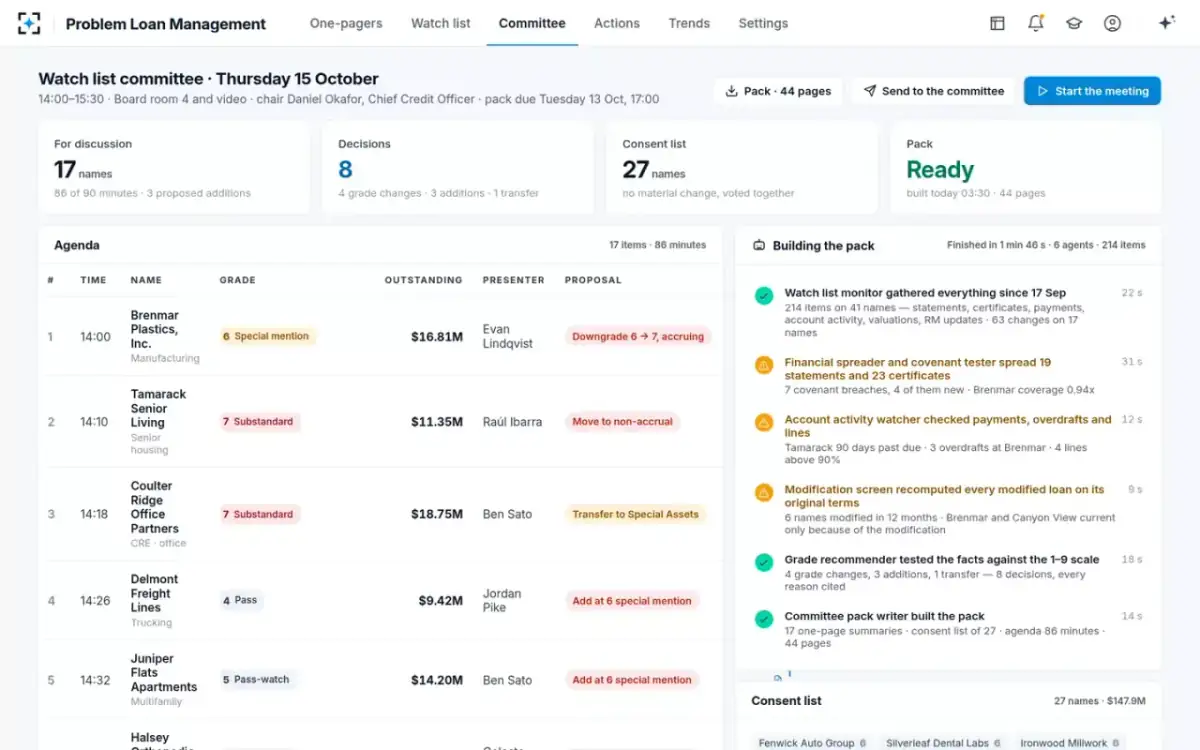
On the sample bank's October agenda the watch list holds 41 names and $286.4 million. Seventeen are discussion names scheduled across 86 minutes; 27 go to the consent list; eight decisions are owed. Each discussion name arrives as one page: the grade now and the grade proposed, the exposure, five lines of story with the source of each in the margin, collateral and guarantor, the plan from last time with its status, and the decision being asked for. A page that cannot be read in four minutes will not be read.
Three facts belong on every page before the meeting starts. What changed since the committee last read this name. Whether the loan is current only because of a modification, with coverage recomputed on the original schedule. And what the committee asked for last time, checked against the file rather than against the lender's recollection. A page with those three is hard to argue with; a page without them is where the criticized asset report quietly stops being evidence.
Thursday's agenda, and the pack behind it
The minutes the examiner will read
Minutes are the committee's only output that survives the room. An examiner reading them a year later is trying to answer one question — did the grades follow the facts, and did they follow them in time — and the FDIC's examination manual puts upgrades on the examiners' list alongside downgrades. Among the loans it tells them to select are those "Upgraded or removed from internal adverse classification since the prior examination, to ensure that procedures for managing the watch list are appropriate." A minute that records a downgrade with five reasons and an upgrade with none is a finding waiting to happen.
What every minute has to record, and why it matters later
- The date, the quorum and who voted
A decision taken without a quorum is not a decision. Record who was present, who voted and who withdrew because the name was theirs.
- The grade before and the grade after
Both numbers, on the bank’s own scale, plus the regulatory category each one maps to. An examiner reconciles the two.
- The accrual decision, separately
A downgrade and a move to non-accrual are two decisions and are often taken differently. Record each, even when the answer is to leave the loan on accrual, and why.
- The reasons, in the committee’s words
Not "deteriorating performance" but the facts that were weighed: the coverage on the original schedule, the appraisal and its date, the missed equity injection, the contract signed.
- What was rejected, and the dissent
A four-to-nil vote and a three-to-one vote are different pieces of evidence about the bank’s culture. So is a proposal the committee declined to put.
- The actions, each with an owner and a date
An action with no name against it is a wish. The log of these is the bridge between this meeting and the next.
- The allowance effect
What the decision does to the allowance, noted at the time rather than reconstructed at quarter-end.
- The upgrades, in the same detail
Supervisors read removals from adverse classification to test whether the watch list is being managed or quietly emptied.
Between meetings: the action log, and who chases it
Everything a committee decides lands in one of two places: a grade, or an action. The grade takes care of itself. The actions are where committees fail, because the person who owes one is usually the person with the least time and the most reason to let it slide, and because nobody between meetings is responsible for noticing. The agencies' expectation here is specific: any deficiency still unresolved after its deadline for correction should go promptly to senior management and the board or its committee (Interagency Guidance on Credit Risk Review Systems). Promptly means before the next meeting, not at it.
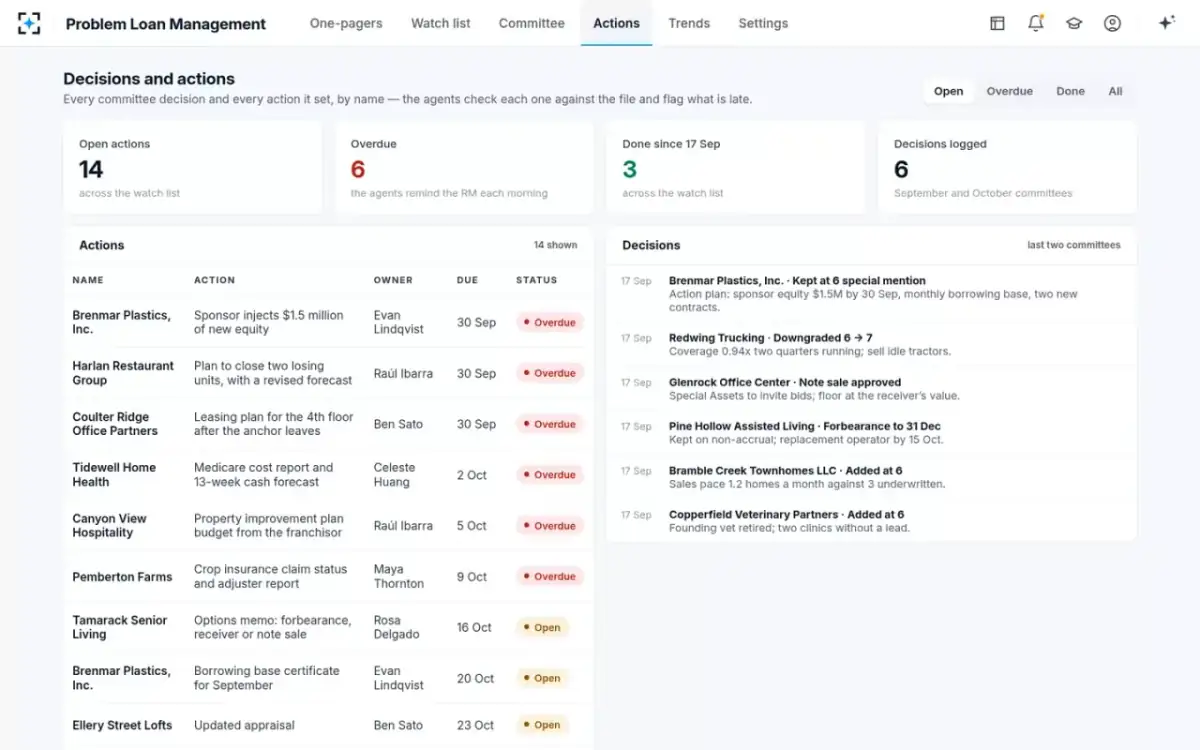
The sample bank carries 14 open actions across its watch list, six of them overdue, each written back to the name it belongs to and checked against the file rather than against an inbox. When a plan item falls due within five days, the relationship manager is asked for an update; when the document that would close an action arrives — a wire, a certificate, a signed contract — the action closes against that document. The committee's first slide is then not a status update but a list of what did not happen, which is the only part of last month a chair needs to spend time on.
Every decision and the action it set, checked against the file
What goes wrong: the committee that reads last month's story
The common failure is not a bad decision. It is a decision taken on a story that was true four weeks ago, dressed in the confidence of a freshly printed deck. A pack rebuilt by hand from email inherits whatever the last person remembered, and a borrower's worst month leaves fewer traces in an inbox than its best one does.
The Federal Reserve's examination manual has a name for what that produces. Among the manifestations of complacency it lists is "optimistic interpretation of known credit weaknesses based on past survival of recurrent hazards and distress" — the borrower has come back from worse, so the grade holds. The weakness is known. It is the interpretation that is doing the work, and a committee reading a month-old summary has nothing to interpret it against.
The same meeting, with a deck rebuilt from email and with pages that rewrite themselves
Rebuilt from email: A summary written up to four weeks ago, mostly repeating the month before it.
Kept from the file: The page redlined against the version the committee last read: old sentence struck through, today’s underlined.
Rebuilt from email: Re-keyed from a spreadsheet into a slide. The document behind it is in somebody’s folder.
Kept from the file: Each line carries its source in the margin, one click from the statement, certificate, appraisal or account record.
Rebuilt from email: Shows as current, because it is.
Kept from the file: Shows coverage on the original schedule next to the modified one, and says when the loan is current only because of the change.
Rebuilt from email: Copied forward, with status from the relationship manager’s memory.
Kept from the file: Checked item by item against the file, with the document that closed each one named and what is late flagged.
Rebuilt from email: About four days of chasing, re-keying and rewriting, every month.
Kept from the file: A morning: the pack is built from the file, and the work left is judgement.
Rebuilt from email: Minutes typed from notes, days later.
Kept from the file: Minutes drafted from the decisions as they are recorded, sent to the chair to sign.
Hesitant to downgrade: the pattern a failure review found
When a bank fails and the loss falls on the insurance fund, an inspector general writes up what went wrong. Those reviews are the closest thing the industry has to an autopsy of a credit culture, and one question runs through their reading of the credit function: did the grades move in time?
In the material loss review of a Chicago bank that failed in 2010, examiners found that management "had not adequately identified and properly risk-graded many large relationships that had portrayed a high-risk profile for an extended period of time, in a timely manner." Of the loans examiners themselves reviewed and criticized, 59 needed further downgrades. The report records an apparent contravention of the same safety-and-soundness standards this guide opened with — the duty to maintain a system that identifies problem assets.
Note what that failure looks like from inside the room. Nobody votes to be late. Each individual decision to wait one more quarter for the sponsor, the lease, the appraisal, is defensible on its own facts; it is the pattern that is fatal, and the pattern is invisible unless somebody measures it. Two measures catch it cheaply: the average age of the facts a grade rests on, and the ratio of downgrades proposed to downgrades taken. A committee whose proposals are accepted every time is either very well prepared or not being asked for anything hard.
Agents propose, the committee decides: where the line sits
Software can prepare a criticized assets committee. It cannot be one, and a bank that lets it be one has swapped a governance problem for a worse one. The line that matters is between the work of assembling evidence, which is clerical and endless, and the act of judgement, which is why the four officers are in the room.
In Problem Loan Management the agents read every new item on a watch list name and rewrite the line it changes, with the source in the margin. They recompute every covenant as the loan agreement defines it, on the original schedule, even under a modification. They test the facts against the bank's own scale and propose a grade with each reason cited and the allowance effect attached. They never set a grade, never move a loan to non-accrual, never change an action plan and never contact a borrower. The proposal arrives at the table as a proposal; the committee's vote is what makes it the bank's position, and the chair's signature is what makes the minute the record.
That division also survives an examination better than the alternative, because every reason behind a proposal points at a document with a date on it. The reasons an examiner can check are the reasons a chair can trust. To see the pages, the pack and the minutes together, start from Problem Loan Management, or read how the same file produces the measures a watch list board asks for.
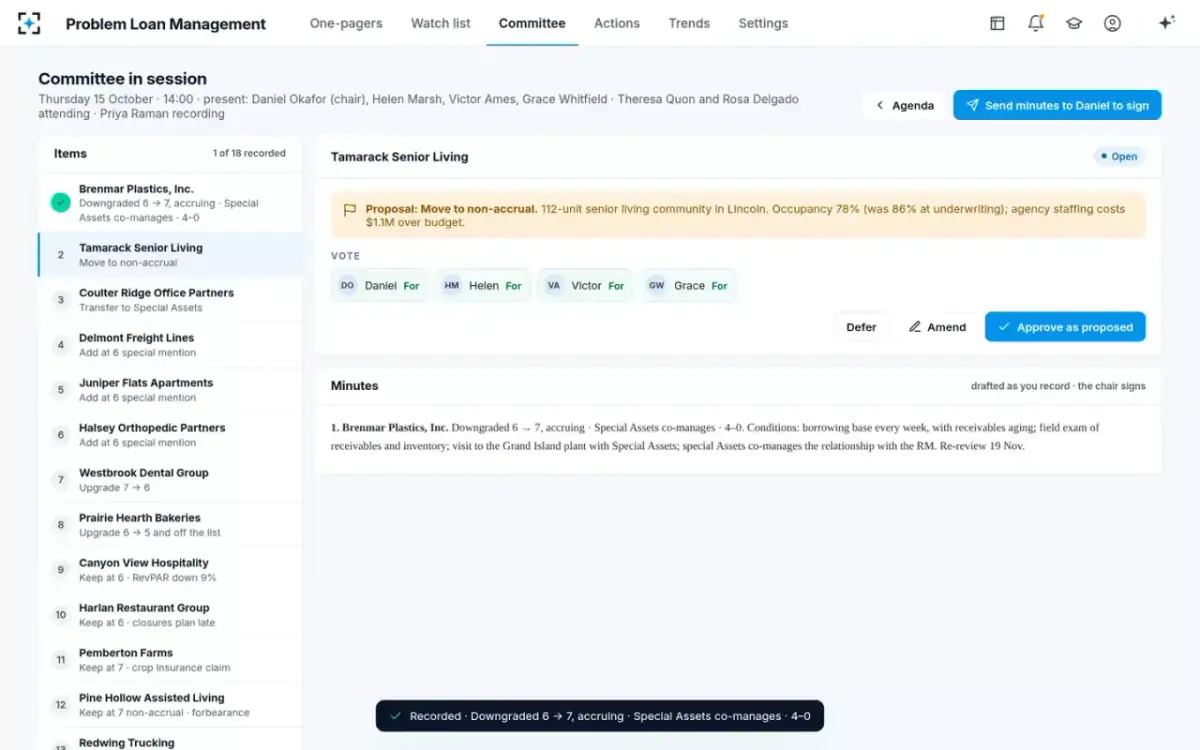
The committee in session: each proposal, the vote, the minute
Questions people ask
What is a criticized assets committee?
It is the standing committee that reviews every loan a bank has graded special mention, substandard, doubtful or loss, and decides what happens to each one: the grade, the accrual status, the workout plan and any transfer to special assets. It is also called the watch list committee or the problem loan committee. Its authority comes from the bank's own credit policy, under the safety-and-soundness standards that require an institution to identify problem assets and take corrective action on them.
Who is on a criticized assets committee?
Commonly three to five senior officers with a vote — often the chief credit officer as chair, with the chief risk officer, the chief lending officer and the chief financial officer or their equivalents — plus loan review and special assets attending without one. The portfolio manager who prepares the papers attends to record each decision as it is taken.
What quorum does a credit committee need?
There is no regulatory figure; it is set in the committee's charter, and a common choice is a simple majority of the voting members, such as three of four. What matters more than the number is the consequence: with no quorum there is no grade change, so the name keeps the grade it had and rolls to the next meeting rather than being settled by whoever happened to attend.
Can a criticized assets committee upgrade a loan?
Yes, by the same vote it uses to downgrade, and the upgrade deserves the same written reasons. The OCC expects examiners to wait for a well-defined weakness to be corrected and for sustained performance on reasonable terms before upgrading a classified credit, and says a plan to improve is not on its own enough. The FDIC's examination manual lists loans upgraded or removed from internal adverse classification among those examiners sample.
Does the relationship manager vote on their own borrower?
Not in a well-drafted charter. The relationship manager presents the name and answers questions, then leaves the vote to officers who do not own it, because the OCC's handbook warns that a loan officer's closeness to the borrower can compromise objectivity. The first grade the lender assigns is still useful; it is simply not the final one.
How long should a criticized assets committee meeting take?
Long enough to decide each name that needs a decision, which is a function of how well the papers were prepared rather than of the size of the watch list. The sample bank schedules 17 discussion names across 86 minutes — about five minutes each — and adopts 27 unchanged names on a consent list in one vote, with any member free to pull one back for discussion.