Problem loans are the loans a bank no longer expects to be repaid in the ordinary way — the ones its own grading system has pushed out of pass into special mention, substandard, doubtful or loss, because something about the borrower, the collateral or the terms puts full repayment in doubt. The grade is not a comment on how late a payment is. It is a decision that obliges the bank to act: to watch the name more closely, to stop booking interest it does not expect to collect, to hold more allowance against it, or to write it off. The hard part is keeping that judgement current, because the facts behind it arrive one document at a time between monthly meetings. That is the work Botminds' Problem Loan Management does: one page per troubled loan, rewritten by agents as each statement, payment, appraisal and relationship manager update lands, with the source of every line one click away.
The bank, the borrowers and the people in the examples below are fictional sample data from the solution: Calder Plains Bank, its 41-name watch list and its packaging borrower Brenmar Plastics. The supervisory definitions and the market figures come from the federal banking agencies and are linked where they appear.
How much of a large syndicated book is not pass
$6.9T
of commitments reviewed in the 2025 Shared National Credit programme, across 6,857 borrowers
8.6%
of those commitments rated special mention or classified, down from 9.1% a year earlier
+30.4%
in nonaccrual commitments year on year, from $65.1 billion to $84.9 billion
What are problem loans? The definition supervisors and the regulation use
There is no statute that defines the phrase "problem loan". What the law defines is the duty to find them. The Interagency Guidelines Establishing Standards for Safety and Soundness, at 12 CFR part 364, appendix A, tell every insured depository institution to keep a system, sized to its own business, that identifies problem assets and stops them deteriorating (12 CFR 364, appendix A, II.G). The regulation names the output — problem assets — and leaves the bank to define the test, subject to examination.
In practice the test is the risk rating. Every commercial loan carries a grade, and the grades divide at one line: pass, or not pass. The agencies' own reporting uses exactly that word. "Non-pass," the 2025 Shared National Credit definitions say, "is any loan rated special mention, substandard, doubtful, or loss" (2025 SNC programme charts, appendix A). So the working answer to what are problem loans at a US bank is precise: every credit the bank's own grading system has moved below pass, plus anything an examiner moves below pass on review.
Two vocabularies sit on top of each other, which is why the question gets confusing answers. The four supervisory grades are common to every federally supervised bank. Many banks also run a numeric scale of their own — the sample bank here uses a 1–9 scale adopted in 2024, where 6 is its special mention band and 7 its substandard band — and map it to the four. That mapping is the bank's own policy choice, not an industry standard; a 7 at one bank is not a 7 at the next. What travels between banks, and what an examiner reads, is the four-grade translation.
Why a loan that is paying on time can still be a problem loan
Because the grades are about repayment prospects, not payment history. Read the FDIC's definition of the first grade and notice what is missing from it. A special mention asset, in the examination manual, has potential weaknesses that need management's close attention and that, if nobody corrects them, may weaken the asset's repayment prospects or the bank's credit position at some later date; it is expressly not adversely classified (FDIC RMS Manual of Examination Policies, section 3.2). There is no mention of days past due anywhere in it. The grade is a forecast.
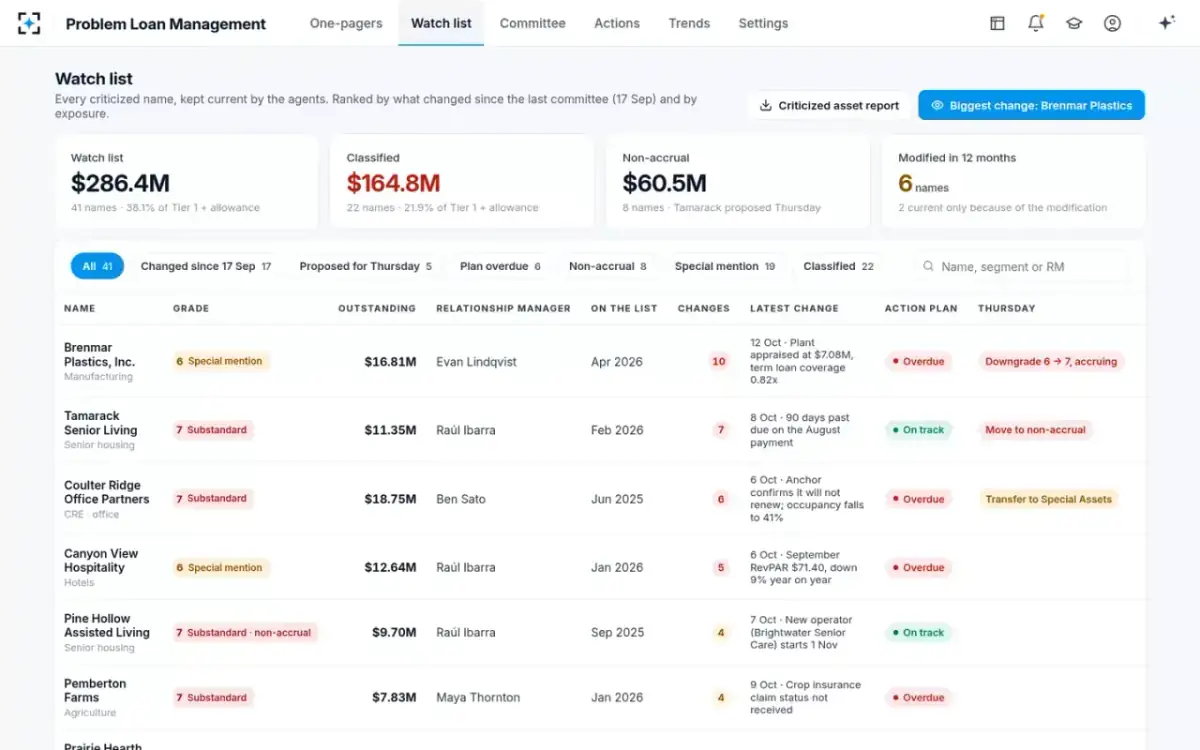
That is also why delinquency reports are a poor proxy for the watch list. A borrower whose covenant was breached and then waived is current. A borrower whose plant has lost a quarter of its appraised value is current. A borrower on an interest-only amendment is current precisely because the bank agreed it could be. The sample bank's Brenmar Plastics is the third kind: since July its term loan has paid interest only, with $110,000 a month of principal deferred to December, and on the schedule it originally signed its fixed-charge coverage is 0.94x against a 1.20x covenant. Nothing on the delinquency report says so.
A late loan and a problem loan are different questions
A late loan asks: Did the payment arrive on the day the note says?
A problem loan asks: Will the whole debt be repaid, on the terms the borrower actually signed?
A late loan asks: The payment record in the loan system.
A problem loan asks: Statements, covenant results, collateral values, guarantor strength, the sector, the amendments.
A late loan asks: Day by day, and it can be cured by one wire.
A problem loan asks: Quarter by quarter, and one wire cures nothing.
A late loan asks: Cures it: the new schedule is the schedule.
A problem loan asks: Usually confirms it: a borrower who needed the concession is the borrower in question.
A late loan asks: Loan operations and collections.
A problem loan asks: The credit officer who proposes the grade, and the committee that votes it.
The Federal Reserve's examiners put the consequence plainly in the Commercial Bank Examination Manual: "Many loans that are sound at their inception develop into problems and losses because of ineffective supervision. This lack of supervision usually results from a lack of knowledge about the borrower's affairs over the lifetime of the loan" (CBEM section 2010.1, Loan Portfolio Management). The grade goes stale not because anyone decided wrongly, but because nobody read the appraisal that arrived in October against the decision taken in September.
The four grades: special mention, substandard, doubtful, loss
The four grades are a ladder of how much of the debt is in doubt, and each rung has a published definition the examiner will hold the bank to. Special mention marks a weakness that could damage repayment later. Substandard marks a weakness that already jeopardises it. Doubtful adds that full collection is improbable. Loss says the asset is not worth carrying.
The grade ladder as the supervisors define it, and what each one sets in motion
| Grade | The supervisory definition | What the bank does next | Where the number appears |
|---|---|---|---|
| Special mention | Potential weaknesses that need management’s close attention and could, if nobody corrects them, weaken repayment later. Not adversely classified. | Watch list, a named owner, a written action plan and a review cycle. Interest usually still accrues. | Criticized totals; the board report. Counted outside the classified figure. |
| Substandard | Not adequately protected by the borrower’s present worth and capacity to pay, or by the collateral; a well-defined weakness that puts repayment at risk, with a distinct chance of some loss if it is not put right. | A workout plan, a collateral view, and a test of whether full collection of interest is still expected. Often a move to Special Assets. | Criticized and classified totals; the classified-to-capital ratio. |
| Doubtful | Every weakness of a substandard credit, plus enough more that collecting or liquidating the debt in full is, on present facts and values, very unlikely. | Nonaccrual, which the OCC treats as required at this grade. The loss is estimated, and the part that is certain is split out and charged off. | Classified totals, weighted more heavily than substandard in any weighted ratio. |
| Loss | Uncollectible, and worth so little that keeping it on the books as an asset is not warranted. | Charge off now. Recovery may still be pursued; the balance does not stay on the books while it is. | Charge-offs for the period, not the classified balance. |
The substandard definition is the one that does the most work, because it is the first rung at which the bank concedes that it may lose money. The weakness has to be well defined, it has to put the repayment of the debt at risk, and there has to be a distinct possibility of some loss if nobody corrects it. Well-defined is the operative phrase. A vague unease about a sector is not a substandard grade; a coverage ratio below 1.0x on the contractual schedule is. The regulatory wording of all four grades, and how a bank maps its own scale onto them, is set out in the guide to commercial loan risk rating definitions.
The grade most easily misused is the first one. The OCC's handbook tells examiners that special mention is not a halfway house between pass and substandard, and must not become a way of putting off that judgement (Comptroller's Handbook, Rating Credit Risk). A special mention grade on a credit with a well-defined weakness is not caution; it understates the risk. Where exactly that line falls, and how two reviewers can be brought to draw it in the same place, is the subject of special mention versus substandard.
Criticized and classified: the two totals every problem loan lands in
Criticized is the wider circle and classified is the inner one. Criticized assets are everything below pass: special mention plus substandard plus doubtful plus loss. Classified assets are the adversely classified grades only — substandard, doubtful and loss — and the OCC's handbook is explicit that pass and special mention credits never count in the classified figure (Comptroller's Handbook, Rating Credit Risk).
The distinction is not academic, because the two totals are read for different things. Criticized totals show how much of the book management has flagged at all, and a criticized total that is small relative to the portfolio's stress is itself a finding. Classified totals are what get compared with capital, drive the allowance conversation, and appear in the ratios a board and a rating agency watch. A bank whose criticized balance is rising while its classified balance is flat is either catching problems early or grading them too kindly, and only the file behind each name says which.
In the 2025 syndicated review the split was $155.3 billion of special mention against $437.5 billion of classified commitments. Roughly a quarter of the non-pass balance sat on the rung that is still only a warning — which is also the rung where a bank has the most room to act. What those totals look like on one bank's own report, and who reads them, is the subject of the criticized asset report.
What each grade obliges the bank to do next
A grade is an instruction, not a label, and the instruction gets heavier at every rung. Special mention obliges attention: a named owner, a written plan, a stated review cycle. Substandard obliges a view on collection — whether the bank still expects full payment of principal and interest, and what the collateral is actually worth. Doubtful obliges nonaccrual and a loss estimate. Loss obliges a charge-off in the period it is identified.
How often each rung is looked at is the bank's own policy, and the sample bank's settings are a reasonable shape: special mention names are reviewed by the committee every quarter, substandard and non-accrual names every month. Two thresholds sit beside them — Special Assets co-manages any substandard relationship above $10,000,000, and any non-accrual relationship above $5,000,000 transfers outright. Those are settings in the solution, versioned and on the audit trail, not rules the regulation sets; another bank would pick different numbers for the same reasons.
Two of those obligations have their own guides, because each turns on a test rather than a judgement. Whether a credit must stop accruing interest is the 90-day rule and its exception, worked through in when a loan should be placed on nonaccrual. When a relationship leaves the line officer and moves to the workout team is set out in what a special assets department does.
The rules on managing problem loans, in plain words
Strip the citations away and the supervisory expectation is six duties, in order. Find the problem assets, by a system sized to the bank. Estimate the losses inside them and reserve for it. Compare the problem totals with capital, so the board sees the exposure against the thing that absorbs it. Take corrective action on each name. Watch for concentrations, because ten problem loans in one sector are not ten independent problems. And report all of it to management and the board often enough to be useful. Those are the asset-quality standards of 12 CFR part 364, appendix A, in the order the appendix lists them.
A seventh expectation sits beside them in the Interagency Guidance on Credit Risk Review Systems: the grading has to be independent of the people who made the loans, and the review function has to be able to disagree with a line officer and be heard. A bank where the relationship manager's grade is final has a reporting system, not a credit risk review system, and the first examination that finds a well-defined weakness in a pass credit will say so.
None of the six duties can be met from a file that is a month behind. A loss estimate on last quarter's collateral value is not an estimate. Corrective action on a plan nobody checked against the file is not action. This is why the question of who keeps the file current sits underneath all of them, and it is the question the rest of this guide turns to.
The watch list: the list that sits between the grade and the committee
A watch list is the bank's working list of the names it is actively monitoring: every criticized credit, plus the pass credits that have shown a trigger and may be heading there. It is not a grade — a name can sit on the watch list at a pass grade — and that is exactly its purpose. The interagency guidance describes it as part of what a credit risk review system must do: "Identification or grouping of loans that warrant the special attention of management or other designated 'watch lists' of loans that management is more closely monitoring" (Interagency Guidance on Credit Risk Review Systems, SR 20-13).
What puts a name on it is a trigger, and triggers are measurable things a bank can set once and test on every name every day. The five below are the sample bank's; the thresholds beside them are settings, and the point of writing them down is that the list then stops depending on who happened to notice.
Five tests that put a commercial name on a watch list
- Fixed-charge coverage below 1.00x on the original schedule
Recomputed on the terms the borrower signed, not on an amended schedule, so a concession cannot read as a cure.
- The line of credit drawn above 90%
A revolver that no longer revolves is funding losses, not working capital, and the availability left is the real number.
- Two overdrafts in 30 days
The cheapest early signal a bank owns, and the one that arrives from its own deposit system without asking the borrower anything.
- Statements late by more than 30 days
A borrower whose quarter went badly has the most reason to be slow. A late statement is information, not a gap.
- Collateral value down more than 15%
Measured against the value carried, so a new appraisal re-tests coverage the morning it arrives rather than at the next annual review.
How a name reaches the watch list, and then the committee, in Problem Loan Management
Agent
Watch list monitorReads every new item on a name — statements, compliance and borrowing base certificates, payments, overdrafts, line use, valuations, relationship manager updates — and logs each as a change since the last review, with its source.
Never: Never changes a grade or an action plan.
Agent
Financial spreader and covenant testerSpreads each statement into the bank’s template, computes trailing twelve months, and recomputes every covenant exactly as the loan agreement defines it.
Never: Never treats a waiver as compliance.
Agent
Grade recommenderTests the facts against the bank’s scale and the supervisory definitions and proposes an upgrade, a downgrade, non-accrual, an exit or a transfer — with each reason cited and the allowance effect stated.
Never: Never sets a grade.
A person decides
Relationship managerAnswers one update form on the names he owns, in his own words, and the answer lands on the plan with its date and source.
A person decides
Watch list committeeVotes every grade change, every move to non-accrual and every transfer to Special Assets, with a quorum of three of its four voting members.
A person decides
Chief Credit OfficerChairs the meeting and signs the minutes, which are drafted from the decisions as they are recorded.
The watch list in Problem Loan Management: 41 names, $286.4M
How much of this there is: $592.9 billion in the syndicated market alone
Scale is worth knowing because it tells a credit officer whether a rising watch list is a bank problem or a market one. The best published count is the Shared National Credit review, in which the three federal banking agencies examine the large syndicated credits together each year. It is a narrow slice: commitments of $100 million or more shared across multiple supervised institutions. It is not a count of all US bank lending, and a community bank's book looks nothing like it.
In the 2025 review, special mention plus classified commitments came to $592.9 billion, which is the 8.6% figure on a $6.9 trillion portfolio. Within it, $155.3 billion was special mention and $437.5 billion classified. The share fell from 9.1% the year before, but the agencies were careful to say why: mostly because new commitments grew, not because the credit underneath got better. The dollars of classified credit actually rose, by $3.5 billion.
What the $592.9 billion is made of, and the number inside it that moved
The nonaccrual line is the one to carry away. A 30.4% rise in the loans on which banks and other holders have stopped booking interest, in a year when the headline criticized share fell, is the shape of a portfolio where the weakest names are getting weaker while the denominator grows around them. It is the clearest argument for reading grade migration rather than grade levels, which is the measure a watch list board asks for.
Where the paper file runs out, and what one current page per troubled loan changes
Every definition on this page rests on facts that change between meetings. A grade set in September on a collateral value from 2022 is a September opinion about a 2022 fact. The failure mode is not bad judgement; it is a file that has moved and a page that has not.
Brenmar Plastics is the sample bank's illustration of it. Its Grand Island plant was last valued at $9,500,000 in March 2022. A new appraisal arrives on a Monday morning at an as-is market value of $7,080,000 — a quarter less. Read against the first mortgage securing the $8.64 million term loan, that moves term-loan coverage from 1.10x to 0.82x, a $1.56 million shortfall, and the whole relationship from 1.10x to 0.96x, or 1.14x counting the guarantee. On a hand-built file, that appraisal sits in an inbox until somebody rebuilds a slide. In the solution, the monitor reads it, matches it to the collateral it secures, recomputes coverage, and rewrites the line on the page it affects, with the margin note naming the document and the time it arrived.
What that buys is not speed for its own sake. It is that when the committee sits down, the four-grade question in front of it — is this still special mention, or is it now substandard — is being asked about today's facts. The recommender lays out the reasons on both sides and cites each to a document: coverage inadequate, liquidity inadequate, current only because of the modification, sponsor support weaker, a collateral shortfall. Then it stops. The grade is a vote of the Chief Credit Officer, the Chief Risk Officer, the Chief Lending Officer and the CFO, and the chair signs the minutes.
A name's full file in Problem Loan Management, with every reason cited
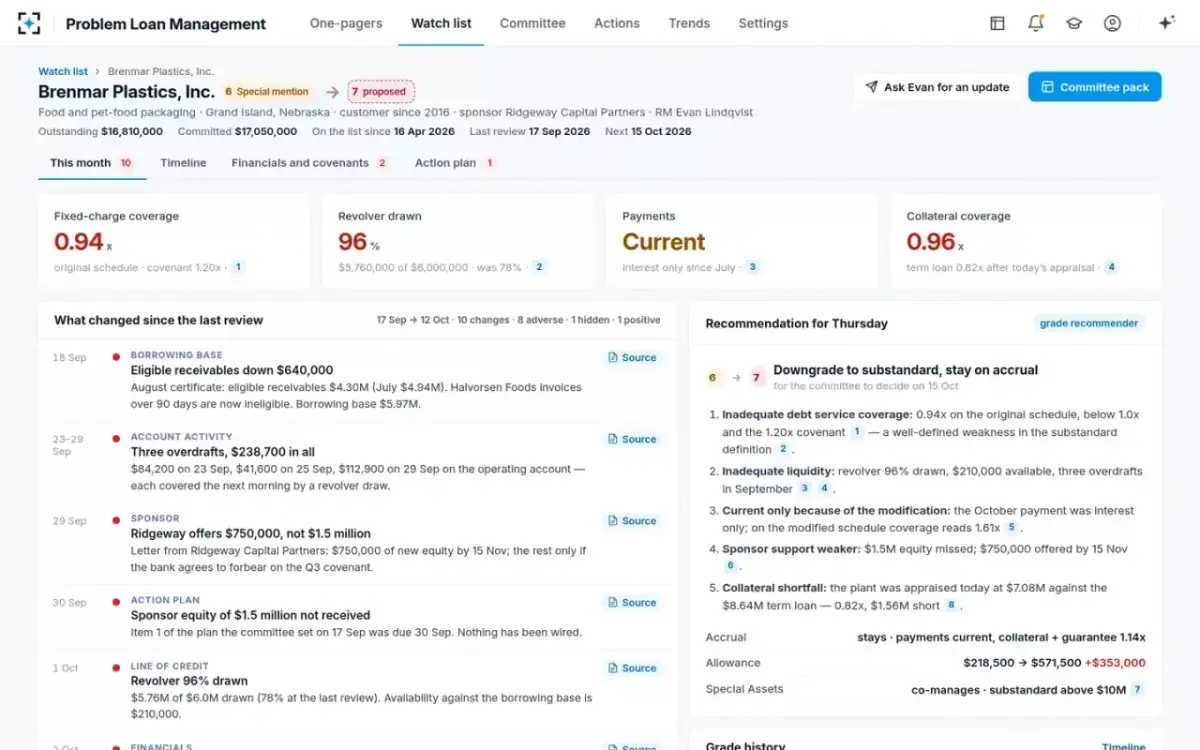
The grade recommender proposes. It never sets a grade.
That is the whole of what a problem loan grade is: a current reading of whether the bank will be repaid, made by people who can be held to it, from a file that is actually current. To see the watch list, the pages and the committee together, start from Problem Loan Management.
Questions people ask
Why is a loan that pays on time on the watch list?
Because the watch list tracks repayment prospects, not payment history. A covenant breach that was waived, a collateral value that fell, or an amendment that cut the payment can all leave a borrower current while its ability to repay the debt it signed for weakens. The sample bank's packaging borrower pays every instalment on time under an interest-only amendment, yet covers its original schedule only 0.94x.
How many problem loans do US banks have?
No agency publishes a criticized total for every bank; grades are supervisory and bank-specific. The nearest public figures are two. Across all FDIC-insured institutions, loans 30 or more days past due or in nonaccrual status were 1.44% of loans in the second quarter of 2026. In the 2025 Shared National Credit review of large syndicated loans, 8.6% of commitments were rated special mention or classified.
Who decides that a loan is a problem loan?
Inside the bank, the credit function proposes and a committee decides, usually with the Chief Credit Officer chairing and loan review attending independently of the lending line. The grade is then subject to examination: supervisors re-grade credits on review and can classify a loan the bank has rated pass. In Problem Loan Management the agents only ever propose, with every reason cited; the committee votes each change and the chair signs the minutes.
What is the problem loan ratio?
There is no single defined ratio of that name, which is why reports that use it should say what is in the numerator. The two that are actually comparable between banks are the criticized asset ratio — special mention plus classified — and the classified asset ratio, each usually measured against Tier 1 capital plus the allowance. Some banks also weight the grades, counting a share of special mention, more of substandard, more again of doubtful, and all of loss.
Is a non-performing loan the same as a problem loan?
No. Non-performing is a reporting status, generally nonaccrual loans plus those 90 days or more past due and still accruing. Problem loan is a grading judgement, and it is wider: a credit can be graded substandard while every payment is on time. Most non-performing loans are problem loans; many problem loans are not yet non-performing, and those are the ones a bank can still do something about.
Can a problem loan go back to pass?
Yes, and upgrades are as much a test of a grading system as downgrades. What supervisors look for is sustained performance against the terms actually owed, not a single good quarter or a renewal that postpones the test. For a restructured credit the OCC's handbook expects generally six months of performance under the restructured terms before a pass rating returns; the reasoning behind that, and why a waiver is never counted as compliance, is set out in the guide on what defines a troubled debt restructuring.