An 8-K filing is triggered when a US reporting company experiences one of the events listed as items in SEC Form 8-K, and for most items the company must file within four business days of the event. For a bondholder, about a dozen of those triggers are credit events or early signs of one: Item 1.03 (bankruptcy or receivership), Item 2.04 (a triggering event that accelerates or increases a debt), Item 2.06 (material impairments), Item 3.01 (a delisting notice), Item 4.01 (a change of auditor), Item 4.02 (non-reliance on past financial statements) and Item 5.02 (departures of principal officers), with Items 1.01, 1.02, 2.03 and 2.05 close behind. The hard part is not knowing the list but acting on it: reading each filing the night it appears, matching it to the bonds the firm holds, and deciding what it changes. Botminds' Credit Surveillance, a credit early warning system for buy-side credit teams, reads every held issuer's filings daily and turns these items into tripwires on the right bonds and the right analyst's screen.
Examples from the solution's sample data concern fictional firms and people, including Quillfield Capital, a London manager, and its French issuer Sorel Distribution. The form's text is quoted from the current SEC Form 8-K.
The clocks around an 8-K, in four numbers
4days
business days to file most items after the event
5:30p.m.
Eastern: transmitted later, a filing counts as filed the next business day
1day
business day after a 10-K or 10-Q is due to file a late-filing notice
1.03
the bankruptcy item, written for the registrant or its parent, not its subsidiaries
What triggers an 8-K filing?
An 8-K is triggered by an event, not a date. The form lists the events as numbered items in sections, from Section 1 (the registrant's business and operations) to Section 9 (financial statements and exhibits), and a company that experiences one must report it, in most cases within four business days. Two items, 7.01 for Regulation FD disclosure and 8.01 for other events, are voluntary channels a company may use for anything it wants on the public record.
For a credit analyst the useful division is between items that report a credit event, items that report a cause of one, and items that report the people or numbers a credit view depends on. An acceleration under Item 2.04 is a credit event. A material impairment under Item 2.06 or exit costs under Item 2.05 can be causes. A departing finance chief under Item 5.02 or a departing auditor under Item 4.01 changes who stands behind the numbers.
Which 8-K items matter to bondholders?
The table below reads each credit-relevant item the way a bondholder should: what it reports, why it matters for the bonds, and what a surveillance rule should do with it. It is a decision table, not a ranking; any item can matter on a given issuer.
8-K items a bondholder should act on, and what each should trigger
| Item | What it reports | Why it matters to the bonds | Surveillance action |
|---|---|---|---|
| 1.03 Bankruptcy or receivership | A receiver or a bankruptcy proceeding for the registrant or its parent; later, a confirmed plan | The issuer itself is in court: claims, priority and recovery now decide value | Court wire, red: open a case at once |
| 2.04 Triggering events | An event of default, acceleration or similar event that increases or accelerates a direct financial obligation | Cross-default and cross-acceleration clauses can carry it into the bonds | Restructuring wire, red; workout reads the clauses |
| 4.02 Non-reliance | Past financial statements, or an audit report on them, should no longer be relied on | Covenant tests and leverage built on those numbers are now unreliable; a late filing often follows | Late filing wire; check reporting covenants |
| 4.01 Auditor change | The auditor resigned, declined re-appointment or was dismissed; a new one engaged | Who stands behind the numbers has changed; the letter on disagreements matters | Auditor wire, amber |
| 5.02 Officer departures | A principal executive, financial, accounting or operating officer leaves, or a director | The finance chief often signs the compliance certificates the indenture relies on | Management wire, amber |
| 2.06 Material impairments | A material impairment charge is required | Asset values behind the debt are lower; covenant definitions may or may not exclude the charge | Note to the analyst; feeds covenant headroom |
| 3.01 Delisting notice | The exchange says the common equity fails a continued listing standard | Equity access narrows; some debt documents treat delisting as an event | Amber; read the indenture |
| 1.01, 1.02, 2.03 Agreements and new debt | Material agreements made or ended; a new direct financial obligation | New secured debt can rank ahead; a lost contract can be the cause of the next warning | Analyst reads; restructuring wire if it is a forbearance or support agreement |
| 2.05 Exit costs | A plan to exit or dispose of an activity, with charges | Cash costs and lost earnings in the next quarters | Note to the analyst |
For a holder of equities the same items read differently, and what each Form 8-K item means for an equity holding works through them for a stock's investment thesis. The bondholder's version is narrower and more contractual: the question is always which clause in which indenture the event touches.
What is Item 1.03 in an 8-K?
Item 1.03 is the bankruptcy and receivership item. It requires a filing when a receiver or similar officer is appointed, or when a court or governmental authority assumes jurisdiction over substantially all of the business, and again when a plan is confirmed. Its scope is the line every bondholder should read twice.
"If a receiver, fiscal agent or similar officer has been appointed for a registrant or its parent, in a proceeding under the U.S. Bankruptcy Code or in any other proceeding under state or federal law in which a court or governmental authority has assumed jurisdiction over substantially all of the assets or business of the registrant or its parent …"
SEC Form 8-K, Item 1.03(a)
The item names the registrant and its parent, and proceedings under US federal or state law. It does not name subsidiaries, and it does not name proceedings abroad. A guarantor subsidiary that enters a French safeguard or a German insolvency proceeding may therefore produce no Item 1.03 filing at all, even though the bonds' events of default may treat that proceeding as a default. It may surface elsewhere, under Item 2.04 if it accelerates a debt or Item 8.01 if the company chooses, but a surveillance system that waits for Item 1.03 will be told last. Searching the court dockets directly and matching the debtor to your bonds closes that gap.
What is Item 2.04 in an 8-K?
Item 2.04 reports a triggering event that increases or accelerates a direct financial obligation, or turns an off-balance-sheet obligation into a direct one, when the consequences are material. The form defines a triggering event as "an event, including an event of default, event of acceleration or similar event," as a result of which such an obligation is increased or accelerated (Form 8-K, Item 2.04(e)).
The instructions explain why Item 2.04 often arrives later than a bondholder would like. No disclosure is required "unless and until a triggering event has occurred in accordance with the terms of the relevant agreement," including, where the agreement requires it, notice to the company and "the satisfaction of all conditions to such occurrence, except the passage of time" (Instruction 2). A company that believes in good faith that no triggering event has occurred need not file unless it has received such a notice (Instruction 3). A missed coupon inside its grace period, or a covenant breach before the lenders give notice, can therefore exist for weeks without an Item 2.04 filing.
What does Item 4.02 non-reliance mean?
Item 4.02 means the company, or its auditor, has concluded that previously issued financial statements should not be relied on. It has two routes. Under 4.02(a) the board or authorised officers reach the conclusion themselves. Under 4.02(b) the trigger is the auditor: the item applies "If the registrant is advised by, or receives notice from, its independent accountant that disclosure should be made or action should be taken to prevent future reliance on a previously issued audit report or completed interim review" (Form 8-K, Item 4.02(b)).
For a bondholder the consequence is concrete. Leverage, coverage and covenant headroom calculated from the withdrawn statements are no longer reliable, compliance certificates delivered on them may be wrong, and the next periodic report is likely to be late. A late 10-K or 10-Q brings its own notice under Rule 12b-25, which must be filed "no later than one business day after the due date for such report" (17 CFR 240.12b-25(a)), and indentures usually set their own reporting deadlines. Why a going concern warning tends to follow these signals rather than lead them takes the sequence further.
What is Item 5.02 in an 8-K?
Item 5.02 reports departures and appointments of directors and certain officers. Its paragraph (b) covers the officers a credit analyst cares about most: a filing is required when "the registrant's principal executive officer, president, principal financial officer, principal accounting officer, principal operating officer, or any person performing similar functions, or any named executive officer, retires, resigns or is terminated from that position" (Form 8-K, Item 5.02(b)). Paragraph (a) adds directors who leave because of a disagreement with the company, with their letter attached.
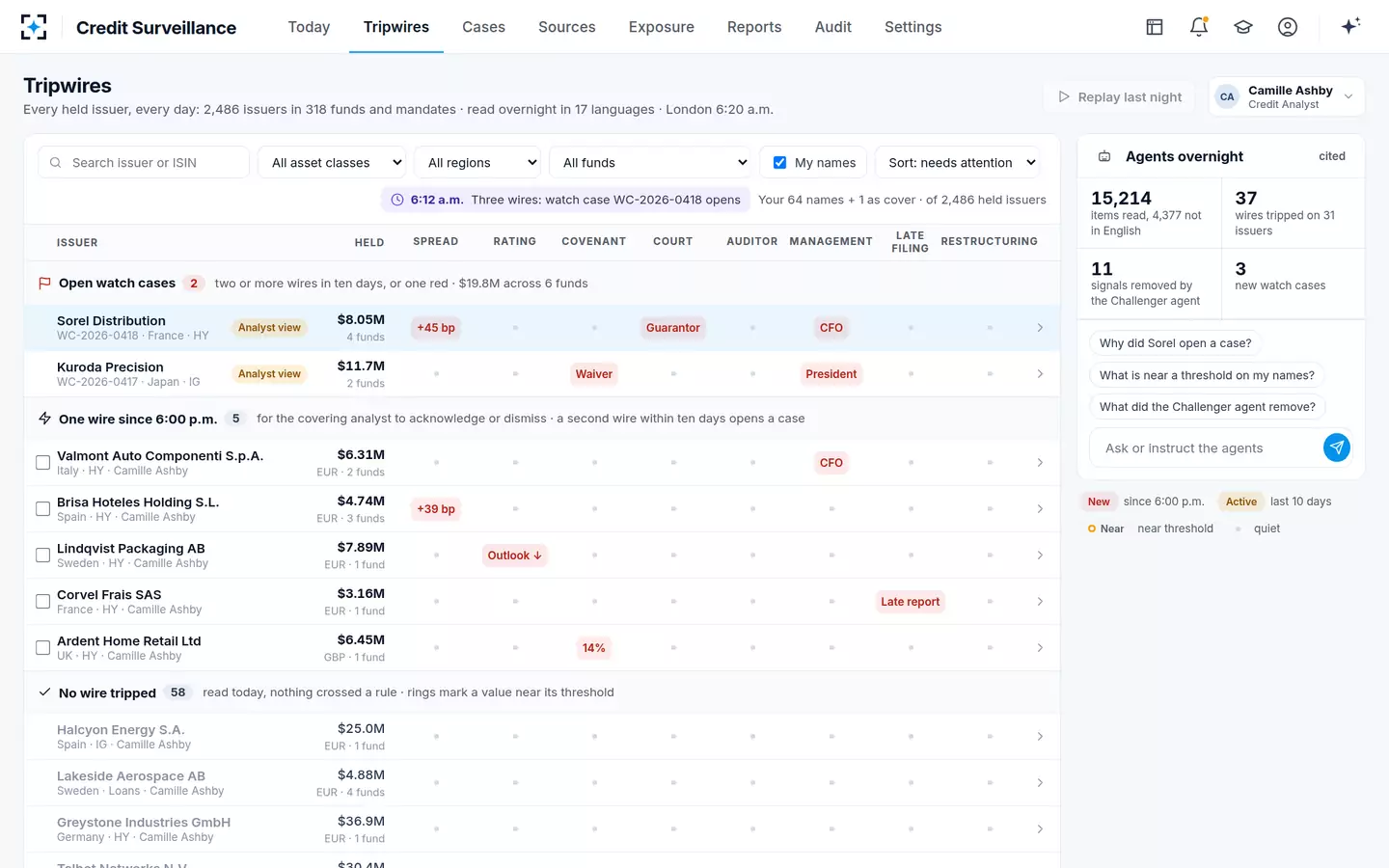
A finance chief's departure matters to bondholders for a specific reason: the finance chief usually signs the officer's certificates and compliance certificates the indenture and credit agreement rely on. In the sample, the group finance chief of Sorel Distribution resigned effective 30 October, eleven days before the third-quarter results, and the agents confirmed that the same officer signs Sorel's compliance certificates. On its own that was one amber wire. Less than three hours later the court wire tripped on a guarantor's safeguard proceedings in Lyon, and the two together, with a spread move, opened a case.
The management wire on the Credit Surveillance tripwire matrix, beside the court and spread wires
The quieter triggers: auditors, impairments, delisting and new debt
Some items rarely move a price on the day but change the credit picture over the following quarter. Item 4.01 applies when the auditor "resigns (or indicates that it declines to stand for re-appointment after completion of the current audit) or is dismissed" (Form 8-K, Item 4.01(a)), and requires the disclosures of Regulation S-K Item 304, including any disagreements. An auditor leaving a stressed company before the year-end audit is a signal in itself.
Item 2.06 is easy to miss for a different reason: no filing is needed if the impairment is concluded while preparing the next periodic report and that report is filed on time and discloses it. Many impairments therefore appear first in a 10-Q or 10-K, not an 8-K, and a surveillance rule that only reads 8-Ks will see them late. Item 3.01 concerns the listing of common equity, which matters to bondholders mainly as a sign of distress and because some debt documents treat a delisting as a trigger of their own. Items 1.01 and 2.03, new agreements and new debt, decide where the next dollar of secured debt ranks.
How many days to file an 8-K?
Four business days after the event, for most items, with the clock starting on the next business day if the event falls on a weekend or holiday. A few items run on their own clocks: an amended Item 2.05 or 2.06 report is due within four business days of the company determining the estimate it could not give at first, and Item 2.04 runs from the triggering event as the agreement defines it, not from the first missed payment. The four days are a maximum, and companies often file faster, but a credit team should assume that the event behind any 8-K happened before the filing, sometimes days before.
Are 8-Ks filed after hours?
Yes, and the timing has a rule. Under Regulation S-T, a filing transmitted after 5:30 p.m. Eastern time "shall be deemed filed as of the next business day" (17 CFR 232.13(a)(2)), but it is public as soon as EDGAR disseminates it, and EDGAR keeps taking filings into the evening. An 8-K that appears at 9:50 p.m. in New York is on the record before Asian markets open and while London's credit desk is asleep.
An evening 8-K in New York is a middle-of-the-night warning in London
- Business dayBusiness day
- After the 5:30 p.m. cut-offCounts as next day
- Filing read9:51 p.m.
- Management wire2:51 a.m.
- Court and spread wires, case5:44 to 6:12
- Analyst reads6:20 a.m.
What an 8-K cannot tell a bondholder
Three gaps matter. First, foreign private issuers do not file 8-Ks; they furnish reports on Form 6-K under different rules, and many publish first in their home market and language. Second, a high yield issuer that sold its bonds only under Rule 144A and has no securities registered with the SEC has no 8-K obligation at all; what it reports, and when, is whatever its indenture requires. Third, as Item 1.03 shows, events at subsidiaries and abroad can fall outside the form even when they are events of default under the bonds.
That is why a credit surveillance system cannot be an 8-K alert service with extra steps. In the sample night, 3,940 filings and disclosures were read from the SEC, municipal disclosures, national filing systems in France, Spain, Italy and the Nordics and Tokyo's timely disclosure, alongside 856 court and insolvency notices, and the court notice that turned Sorel's single management wire into a case came from a Lyon registry, not EDGAR.
Six questions to ask of every 8-K on a held issuer
- Which entity is it about?
Registrant, parent, issuer of the bonds, or a guarantor. Match it to the indenture's schedule, not to the ticker.
- Which clause does it touch?
Events of default, cross-acceleration, reporting covenants, change of control, asset sales.
- When did the event happen?
Up to four business days before the filing, and for Item 2.04 possibly weeks after the underlying breach.
- What else arrived on this issuer in the last ten days?
One item is a wire; two warnings in ten days are a case.
- Who signs the next certificate?
If the finance chief or the auditor has gone, ask who will sign, and when.
- Which funds hold it, and under what guidelines?
The same event is a footnote in one fund and a forced sale in a mandate with a rating floor.
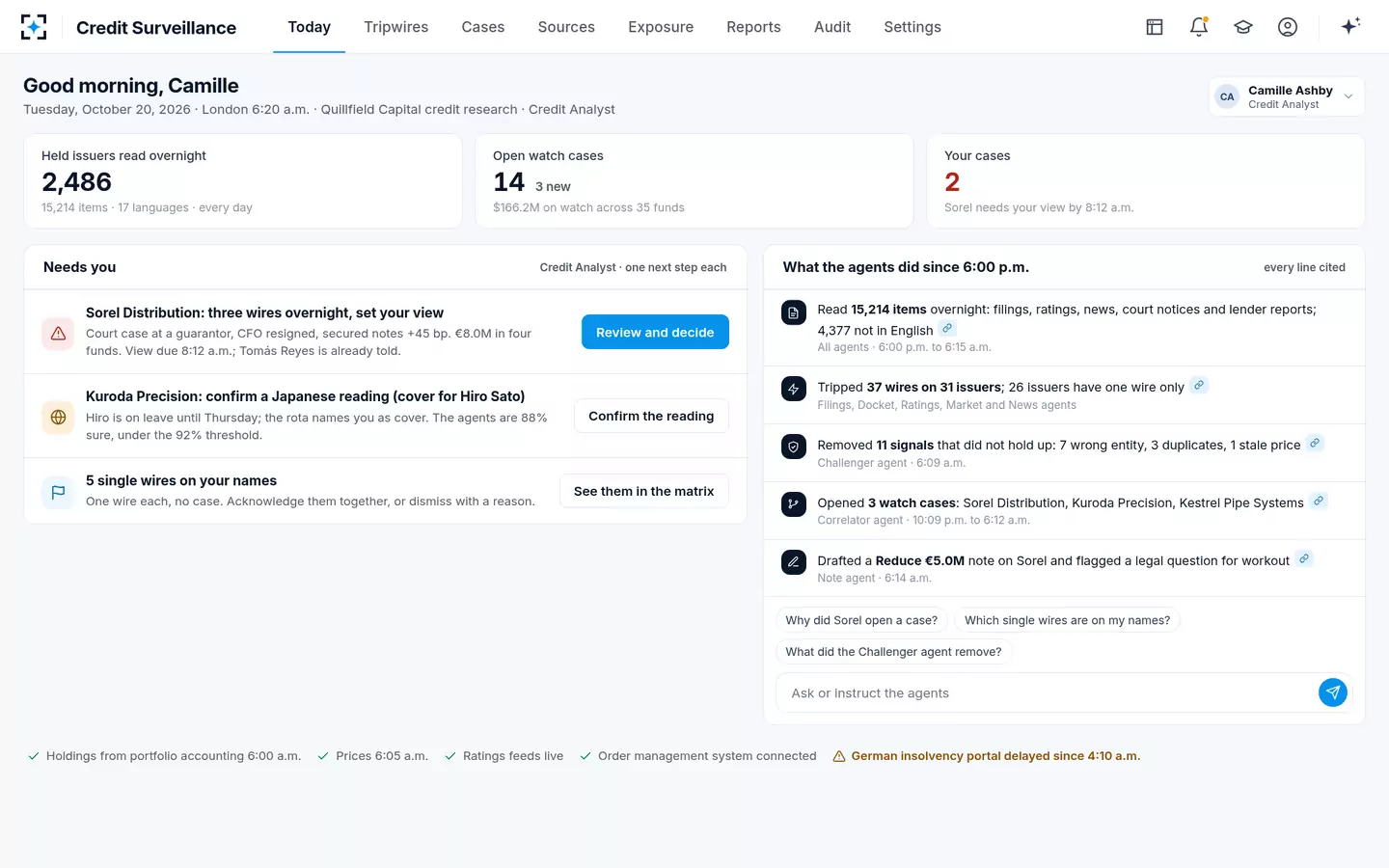
The analyst's morning screen after an after-hours 8-K
Where Credit Surveillance fits on 8-K monitoring, and where it does not
It fits a team that holds US registrants alongside issuers that do not file 8-Ks at all, and wants every item read the night it appears, matched to the right bonds, and combined with court notices, prices and rating actions on the same issuer. The Filings agent trips the management, auditor, late filing and covenant wires from filings in their original language; it cites the page for every fact and never treats a rumour as a filing.
It does not decide what an item means legally. Whether an Item 2.04 event cross-defaults into the bonds, or whether a guarantor's proceeding is an event of default, goes to the workout specialist and counsel with the clause attached. For the full set of tasks the agents take on, see the credit early warning system guide; the sample night is on the Credit Surveillance page.
Questions people ask
Do all companies have to file 8-Ks?
No. Only companies with Exchange Act reporting obligations file them. Foreign private issuers furnish Form 6-K instead, and a company whose only securities are Rule 144A bonds without SEC registration has no 8-K duty; its reporting comes from the indenture.
Is a late 8-K a warning sign?
It can be, but a late 10-Q or 10-K is the stronger one. A company that cannot file a periodic report on time must file a Rule 12b-25 notice within one business day of the due date, and it then has five extra calendar days for a 10-Q and fifteen for a 10-K. A notice that cites the auditor's inability to finish is worth an immediate look.
Does an 8-K Item 5.02 always mean trouble?
No. Officers retire and move on all the time, and a single departure is one amber wire in the sample's rules. It matters when it coincides with other warnings, or when the departing officer signs the certificates the bonds depend on, as the finance chief does in the sample case.
Can a subsidiary's bankruptcy trigger an 8-K?
Not under Item 1.03, which covers the registrant or its parent. It can appear under Item 2.04 if it accelerates or increases a direct financial obligation and the consequences are material, or voluntarily under Item 8.01. Many bond indentures treat a significant subsidiary's insolvency as an event of default whether or not an 8-K is filed.
How quickly do agents read an 8-K?
In the sample, the EDGAR feed ran about two minutes behind real time at 6:18 a.m., and wires trip as items are read. The point is less the minutes than the hour of day: a London team's analyst starts from a case built overnight rather than from the filing.