Credit surveillance is the daily watch a credit team keeps over every issuer it holds, between the scheduled reviews: reading filings, court dockets, rating actions, prices and news, deciding against written rules which items are warnings, and routing each warning to the analyst who covers the name with a deadline attached. Putting it live on your own holdings is a weeks-long project, not a quarters-long one, because nothing has to be built from scratch: positions sit in portfolio accounting, guarantor schedules sit in the indentures, and the sources are public. Botminds' Credit Surveillance, a credit early warning system for buy-side credit teams, goes live in seven setup steps that end with a dry run on the firm's own history and the head of credit risk's approval. This guide lays those steps out as a six-week plan, with what each week needs from whom.
Where the page uses examples, they are the solution's sample data on a fictional London manager, Quillfield Capital, with 2,486 held issuers in 318 funds and mandates; the people and issuers named are invented. The six-week schedule is our plan, a target for a typical buy-side team, not a measured result.
Six weeks from holdings feed to go-live, workstream by workstream
- Positions by fundWk 1
- Entity trees, guarantorsWk 2–3
- Kept current daily
- Filings and courtsWk 1–2
- Ratings, prices, newsWk 3
- Source health checked every 15 minutes
- Waiting
- Coverage, rotaWk 3
- Live
- Waiting
- SettingsWk 3
- 90-day replayWk 4
- Approved
- Waiting
- Parallel runWk 5–6
- SwitchLive
What is credit surveillance?
Credit surveillance is the continuous part of credit research: the monitoring of held issuers that happens between the initial credit work and the next scheduled review. Initial work answers whether to buy; surveillance answers whether anything has changed since. It covers every held name, not only those on a watch list, and it is judged by speed and completeness rather than depth: whether the warning reached the right analyst, how soon, with the position and the source attached.
The word means something slightly different in other places. Rating agencies use "surveillance" for the ongoing monitoring of ratings they have issued; securities regulators use it for market abuse monitoring. On a buy-side credit desk it means the firm's own watch over its own holdings, and the decisions it leads to, hold, reduce or exit, are the firm's.
Why credit surveillance can go live in weeks, not quarters
Most of the inputs already exist, and most of the work is mapping them rather than creating them. Positions by fund come from portfolio accounting every morning. The legal-entity tree and the guarantor schedule for each held bond are in the issuer's filings and the indenture. The sources, regulators' filing systems, court dockets, insolvency registers, rating actions and prices, are public or already licensed. What takes time is the matching: which registry number in Lyon or Frankfurt belongs to which guarantor of which held note.
The other reason is that the risky part, the rules, can be tested before anyone relies on them. A tripwire setting can be replayed on the last 90 days of your own history and its output compared with what the team actually did. That turns calibration from a debate into a measurement, and it is why the plan puts the replay before the parallel run and the switch.
What data do you need for credit surveillance?
You need five things from inside the firm and access to four kinds of public source. The internal list is short but each item must be current, because surveillance inherits every error in it: a stale coverage list sends warnings to an analyst who left, and a missing guarantor schedule means a court case at a subsidiary is matched to nothing.
What to bring to a credit surveillance go-live
- Positions by fund, start of day and intraday
From portfolio accounting. Every watch case is sized from it, in every fund that holds the name.
- Legal-entity trees and guarantor schedules
From filings and indentures. The schedule is what turns a subsidiary's court case into a warning on a held bond.
- Coverage list and cover rota
Who covers each issuer, and who covers when they are away. A warning with no owner is an alert, not a case.
- Fund guidelines and internal ratings
Rating floors, issuer limits and sale windows per fund, so a proposed trade shows each fund's consequence.
- Your current watch list and last quarter's decisions
The baseline for the replay and the parallel run.
- Public sources and their languages
Regulators' filing systems, court dockets and insolvency registers, rating actions, prices and news, in the languages your issuers publish in.
For European issuers, the insolvency side is easier than it was. The EU Insolvency Regulation requires each member state to publish insolvency proceedings in a register, including a company debtor's name and registration number (Regulation (EU) 2015/848, article 24). Those registration numbers are what the entity-mapping work in weeks two and three should capture for every guarantor, because they are how a notice is matched to a bond.
What is a tripwire in credit monitoring?
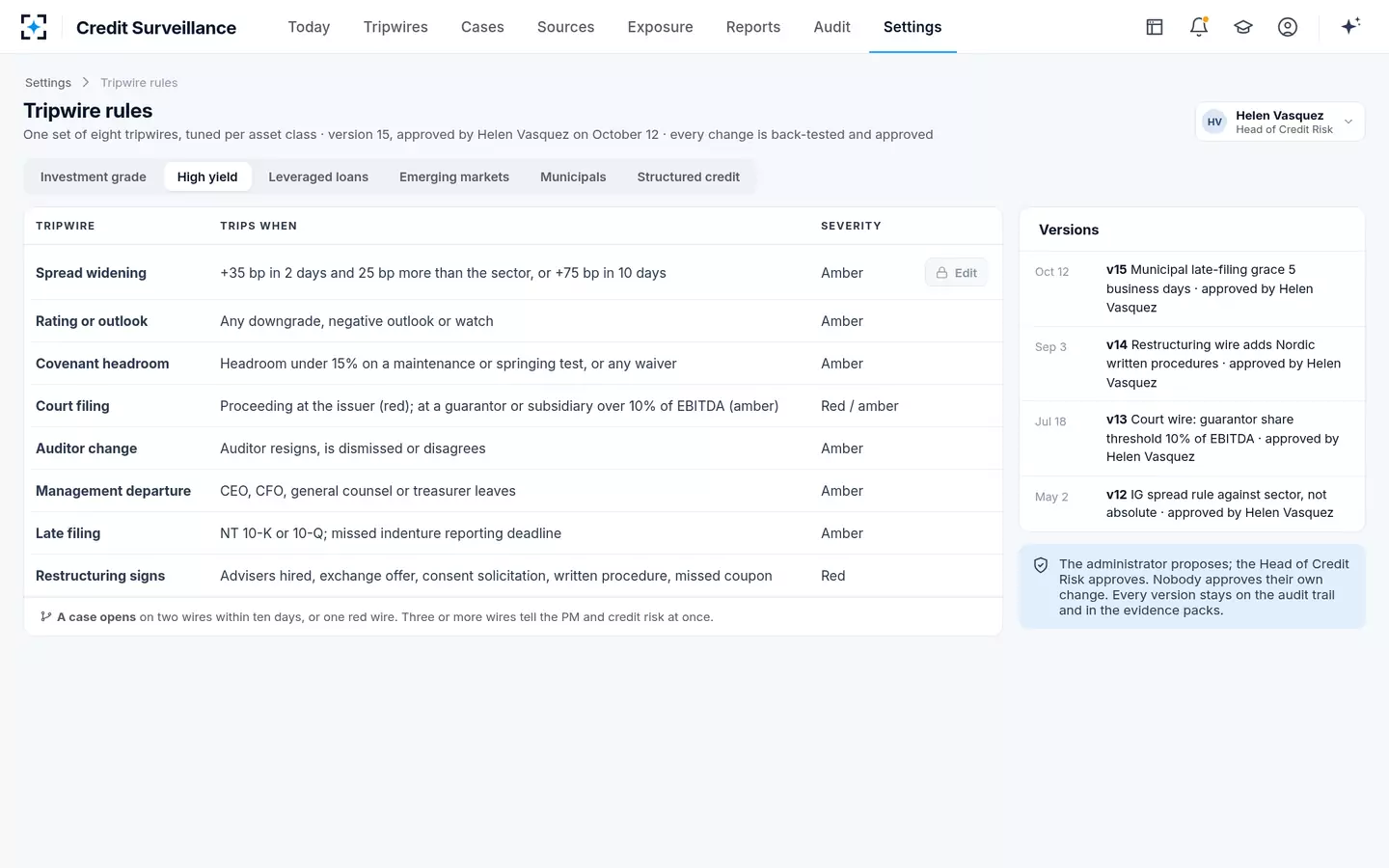
A tripwire is a written rule that turns a kind of event or a price move into a warning on a named issuer. It has a threshold, a severity and an owner for changes. In Credit Surveillance there are eight, spread, rating, covenant, court, auditor, management, late filing and restructuring, each tuned by asset class, and a case rule that combines them: a watch case opens on two wires within ten days, or on one red wire.
How the Credit Surveillance tripwires change across asset classes
| Tripwire | High yield setting | Other asset classes |
|---|---|---|
| Spread widening | +35 bp in 2 days and 25 bp more than the sector, or +75 bp in 10 days | Investment grade +25 bp in 5 days and 15 bp over the sector · leveraged loans down 2 points in 5 days · emerging markets +60 bp · municipals +30 bp · structured +40 bp |
| Court filing | Proceeding at the issuer (red); at a guarantor or subsidiary over 10% of EBITDA (amber) | Municipals: chapter 9 or receivership · emerging markets: any judicial or out-of-court reorganisation · structured: servicer or originator insolvency |
| Covenant headroom | Under 15% on a maintenance or springing test, or any waiver | Municipals: rate or days-cash covenant under 15% · structured: OC or IC test cushion under 1% |
| When a case opens | Two wires within ten days, or one red wire | Three or more wires tell the portfolio manager and credit risk at once |
| Analyst view due | Within 2 hours | If missed: head of credit research |
| Portfolio manager decision due | 4 hours after the view | If missed: chief investment officer, fixed income |
| Agent readings act alone at | 92% confidence | Below it, a person confirms before any use |
Tripwire rules per asset class, with every version and who approved it
How to calibrate credit alerts on 90 days of your own history
Calibrate by replay: run the proposed settings on the last 90 days of your holdings and sources, and compare what they would have raised with what the team actually did. Three numbers decide whether a setting is ready. How many of the names the team in fact put on its watch list would the rules have caught, and how much earlier? How many cases would they have opened that the team would have dismissed? And how many single wires per analyst per week would they have produced?
Set a budget for the third number before the replay, not after it. A team that agrees in advance that each analyst can handle, say, five single wires a week will tune the thresholds to that budget; a team that looks at the output first will argue about every line. The replay also exposes rules that never fire. In the sample, version 13 set the court wire's guarantor threshold at 10% of EBITDA, and version 12 moved the investment grade spread rule from an absolute move to one against the sector, both after replays.
Calibration does not end at go-live. Each later change is replayed on the latest 90 days before approval, and the replay result is kept with the version. For an adviser, that is the kind of evidence the annual review of compliance policies under Advisers Act Rule 206(4)-7 can draw on.
Can credit surveillance run in parallel with analysts?
It should, for about two weeks before the switch, and the parallel run is where trust is built or lost. During it, the analysts keep their current watch list exactly as before, and the system runs alongside, opening its own cases without anyone acting on them. At the end, the two lists are compared name by name.
What a parallel run compares, and what each outcome means
The finding: The system and the team agree on the name.
What to do about it: Compare the timing and the evidence: which saw it first, and from which source.
The finding: The system opened a case the team did not.
What to do about it: The analyst reviews it: a real warning the team missed, or a setting to tighten.
The finding: The team watched a name the system did not flag.
What to do about it: Find the reason: a source not connected, an entity not mapped, a rule too loose, or a judgment call no rule should make.
The finding: Warnings below the case rule.
What to do about it: Check the weekly count per analyst against the budget agreed before the replay.
The "team only" list is the important one. Some of those names will be judgment calls that no rule should try to make, such as a view on an industry. The rest are gaps: a German subsidiary whose registry number nobody mapped, a news source in a language not yet connected. Closing them before the switch is cheaper than finding them during a real case.
How to monitor money market fund holdings for credit risk
Money market fund holdings need the same surveillance plus a regulatory clock, and they should be set up as their own lane in week three. Rule 2a-7 requires the adviser's ongoing review of each security to be based on, among other things, financial data of the issuer or guarantor, "whether such data is publicly available or provided under the terms of the security's governing documents" (17 CFR 270.2a-7(g)(3)(ii)). It also lists the adverse events that trigger the disposal duty, and the third of them reads: "An event of insolvency occurs with respect to the issuer of a portfolio security or the provider of any demand feature or guarantee" (paragraph (f)(1)(iii)).
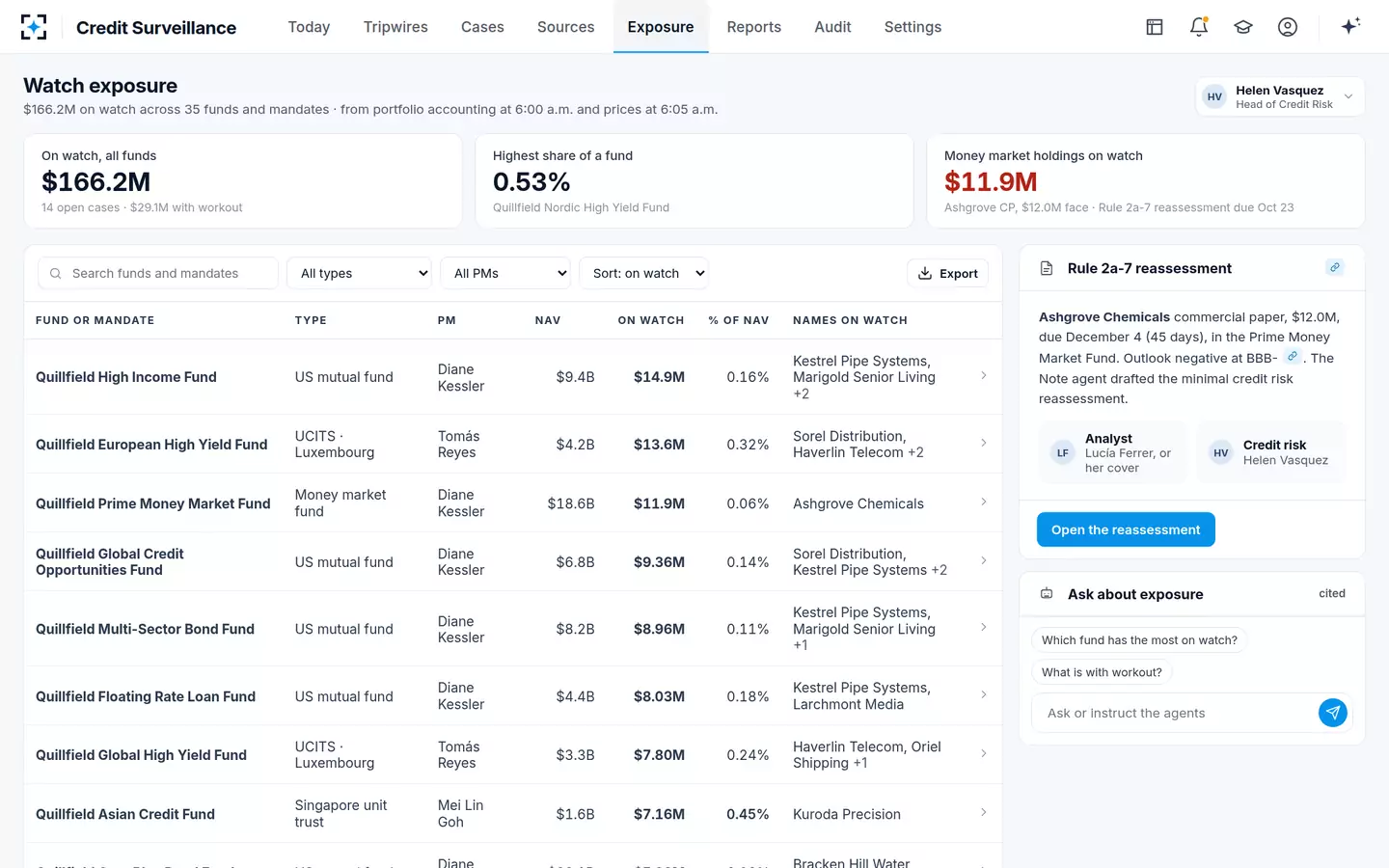
That last clause is why the guarantor mapping matters as much in a money market fund as in a high yield fund. In the sample, $12.0M face of commercial paper in the prime money market fund is on watch after a negative outlook, with a minimal credit risk reassessment drafted by the agents and due on 23 October for the analyst and the head of credit risk to sign.
Watch exposure by fund, with the money market reassessment due
Who approves the switch, and what they should see first
The head of credit risk should approve go-live, on a short written file: the replay results, the parallel run comparison with a reason for every "team only" name, the list of what each agent may and may never do, and the source health report. That file is also what a board, an auditor or an examiner will ask for later.
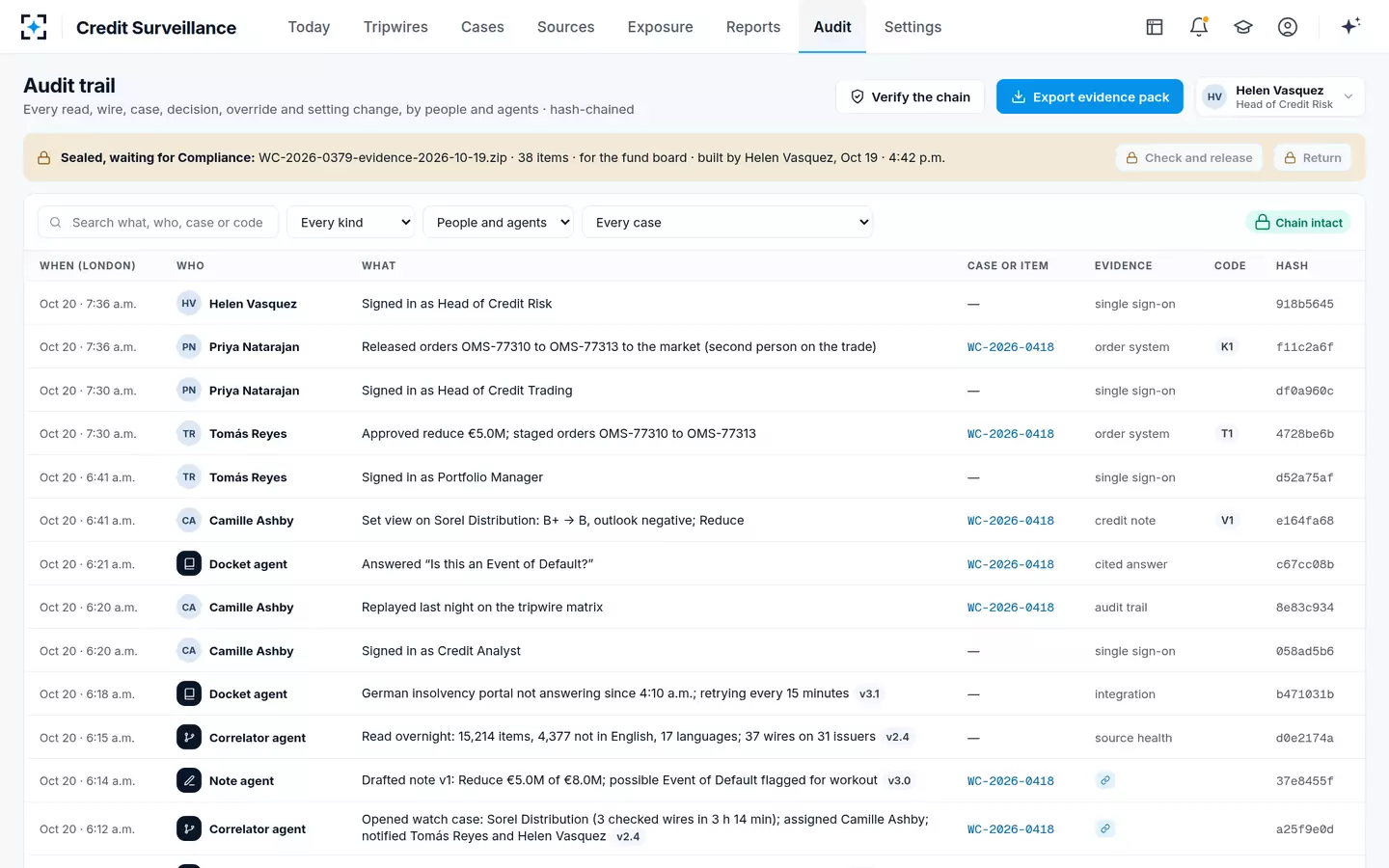
Regulators' expectations point the same way. FINRA's 2026 oversight report suggests that firms using AI agents decide how they will watch what systems an agent can reach and what data it handles, and where to place human oversight (FINRA, 2026 Annual Regulatory Oversight Report). ESMA's 2024 statement on AI in investment services expects firms to keep records of how AI is deployed, including the data sources used and changes made over time (ESMA public statement, May 2024). In the sample, agents are versioned and must pass an evaluation on a set of known answers before release, and every read, wire, view and decision sits on a hash-chained audit trail kept for seven years.
The audit trail the go-live file draws on: every read, wire and decision, by people and agents
What does credit surveillance software cost?
Vendors do not publish prices for credit surveillance software, and the price usually scales with the number of issuers, languages and court systems covered. The useful comparison is the cost of the work it replaces, which a team can estimate in an afternoon.
A year of watch-case work, priced, to set beside any quote
Watch cases
Cases a year × hours each from first signal to signed view
Our estimate for a high yield case is about 13 hours by hand and 2.4 with the agents doing the reading, matching and sizing.
Head of credit research
Single wires
Single wires a year × minutes each to acknowledge or dismiss
Counted in the replay; the budget agreed before calibration caps it.
Credit analysts
Late reads
Cases read a day late × position × spread duration × the further move
Use your own history: how many cases last year were opened after the price moved.
Portfolio managers
Rebuilding the trail
Requests a year × hours to reconstruct who knew what, and when
Board questions, audits and examinations. Our estimate is about 2 hours per case by hand.
Compliance
Where Credit Surveillance fits, and the cases for waiting
It fits a team that already has the inputs, holdings by fund, a coverage list and its indentures, and whose gap is reading and matching across many issuers and languages. The six weeks assume those inputs are current. A team whose coverage list or entity data needs rebuilding should do that first; surveillance will make the gaps visible on day one, which is useful, but painful to discover during a live case.
It is not a replacement for initial credit work, internal ratings or the committee, and it does not decide legal questions. For the test that should precede any purchase, see how to test credit risk monitoring tools with ten planted warnings; for who does what once it is live, see who watches every issuer on the credit watch list. The sample night from first wire to released orders is on the Credit Surveillance page.
Questions people ask
How long does it take to set up credit monitoring on a bond portfolio?
For a team with current holdings, coverage and indenture data, our plan is six weeks: three to connect and map, one to calibrate on 90 days of history and two in parallel with the current watch list. The longest single task is usually mapping guarantors' registry numbers for issuers abroad.
Do we need to change our watch list process to adopt credit surveillance?
Not at first. The parallel run keeps the current process unchanged for two weeks, and the case rule, clocks and escalation are settings that can mirror what the team does today. Most teams then tighten the clocks once they see warnings arriving with the position and the source attached.
Which asset classes can credit surveillance cover?
In the solution, investment grade, high yield, leveraged loans, emerging markets, municipals and structured credit, each with its own tripwire settings. Municipal disclosures come from the MSRB's EMMA system; structured credit uses its own covenant measures, such as an OC or IC test cushion under 1%.
What happens to private-side information during setup?
It should be connected last, if at all, and only behind the firm's information barrier. Advisers must keep written policies to prevent the misuse of material nonpublic information, and lender reports from private credit deals are exactly that kind of material. In the sample, private-side lender reports stay behind the barrier.
What if a source fails after go-live?
It should show, not hide. In the sample, the German insolvency portal stopped answering at 4:10 a.m., and the home screen and audit trail both flagged that 212 issuers' German entities had not been checked, while the agents retried every 15 minutes.