Credit spread widening means the extra yield a bond pays over a risk-free benchmark of the same maturity has gone up, so the bond's price has gone down relative to that benchmark. For a whole market it usually means investors want more pay for bearing credit risk; for one issuer whose sector has not moved, it usually means the market has read something about that issuer, often something already published in a filing or a court notice. For a credit team the meaning is practical: the spread is the price of the information, and the days between the filing and the spread move are the time it has to act at the old price. Botminds' Credit Surveillance, a credit early warning system for buy-side credit teams, watches each held bond's spread against its sector every day and ties a move to the filings, court notices and rating actions that explain it.
Where the page uses the solution's sample data, it is on a fictional manager, Quillfield Capital, and a fictional French issuer, Sorel Distribution; market statistics come from the Federal Reserve and peer-reviewed research, linked where they appear.
Where corporate credit spreads stood in September 2026, by the Fed staff's measure
93bp
average spread of US nonfinancial corporate bonds over Treasuries (GZ spread)
152bp
median of the same series since January 1973
−39bp
excess bond premium: the part not explained by expected default
9%
model-implied chance of a US recession within 12 months
What does credit spread widening mean?
A credit spread is the yield on a bond minus the yield on a government bond of the same maturity; widening means that difference has grown. Because a bond's yield moves inversely to its price, a wider spread with an unchanged government yield means a lower price. A spread of 398 basis points that becomes 443 has widened by 45, and every holder of that bond is poorer by roughly 45 basis points times its spread duration, whatever the government bond did.
Spreads are quoted in several ways, as a simple difference to the nearest government bond, as a spread over the swap curve, or as an option-adjusted spread for bonds that can be called. The measure matters less than consistency: a monitoring rule must compare like with like, on the same measure, day after day.
What causes credit spreads to widen?
Three things widen spreads, and only one of them is about the issuer. The first is expected default: the market's view of the chance the issuer fails to pay and how much it would recover. The second is the price of risk: how much investors as a whole demand for bearing default risk at all. The third is the plumbing of the market: supply, demand and liquidity, which can move spreads for reasons unrelated to any issuer.
The Federal Reserve's staff separate the first two every month. Gilchrist and Zakrajšek built an index from individual bond prices and split it into "a component that captures firm-specific information on expected defaults and a residual component–– the excess bond premium" (American Economic Review, 2012). The Fed's staff describe that residual as "a component of corporate bond credit spreads that is not directly attributable to expected default risk," a measure of investors' risk appetite (FEDS Notes, 2016). In September 2026 it stood at −39 basis points; the Fed's May 2026 Financial Stability Report explains that by construction the premium averages zero, and a negative value means investors' risk appetite is above its historical mean.
The third force is the reason a single bond's move must be read against its peers. Collin-Dufresne, Goldstein and Martin found that the variables that should drive credit spread changes in theory "have rather limited explanatory power," and that what is left over moves together across bonds, so that monthly changes "are principally driven by local supply/demand shocks" (Journal of Finance, 2001). A spread that widens with its whole sector is mostly a market story. A spread that widens while its sector does not is a story about the issuer.
The Fed staff's corporate spread in four stressed months, and now
Is credit spread widening good or bad for bondholders?
For a bond you already hold, widening is bad: its price falls. For money not yet invested, wider spreads are an opportunity, because the same bond now pays more for the same promise. The asymmetry is why widening on a single held name matters so much: the holder takes the price loss, and the buyer on the other side of the trade collects the extra yield.
Market-wide widening is a different problem from issuer widening. When the whole market widens, the fund's benchmark falls with it and relative performance may barely change. When one held issuer widens and its sector does not, the loss is the fund's alone, and the question is whether the move reflects information the fund could have read first.
What is spread duration, and how much does a bond lose when its spread widens?
Spread duration is the percentage change in a bond's price for a one-percentage-point change in its spread, holding the government yield constant. A bond with a spread duration of 2.6 loses about 2.6% of its value for every 100 basis points of widening, so about 1.2% for 45 basis points. Longer bonds have higher spread durations and lose more for the same move.
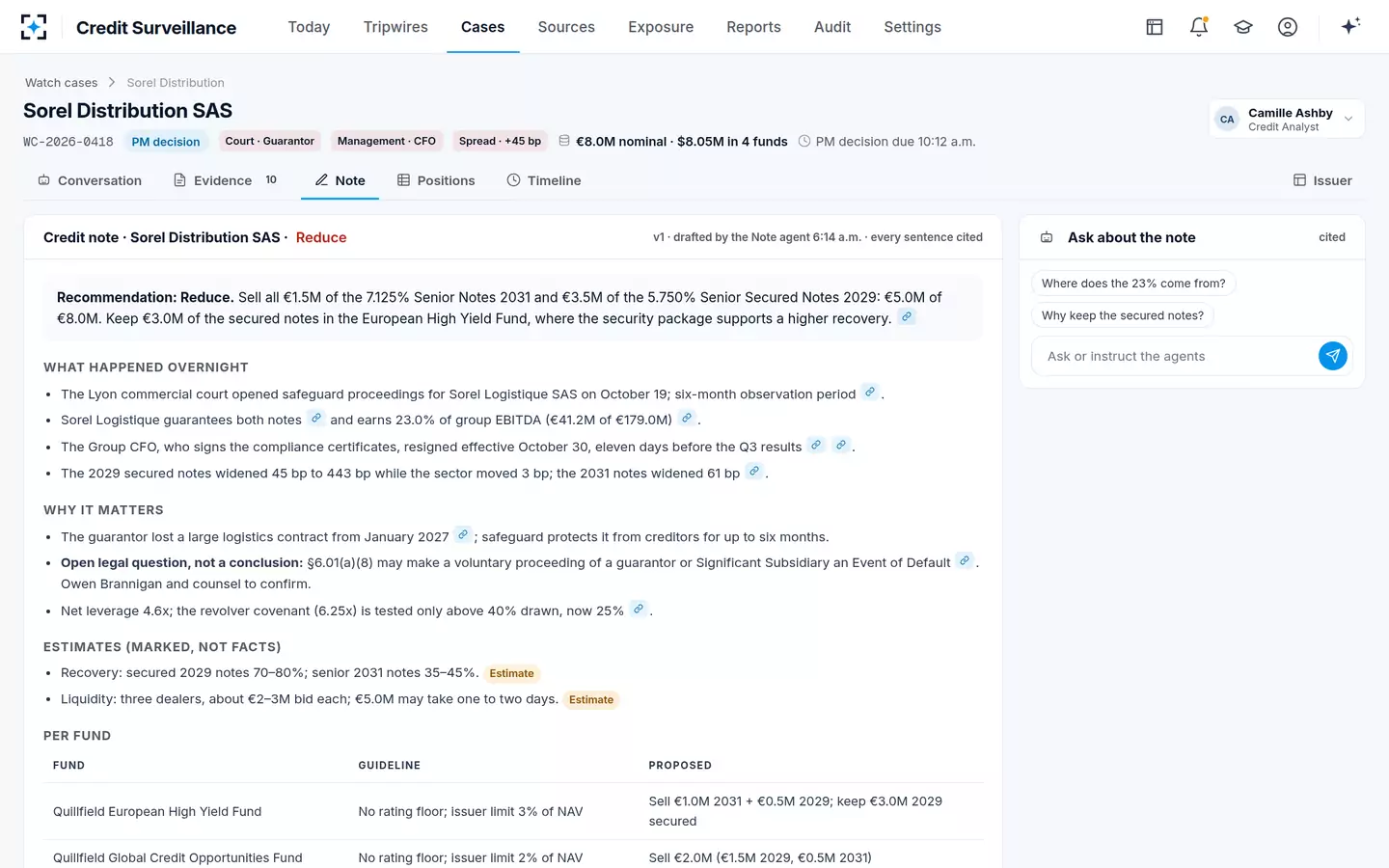
Take the sample case. The fictional firm holds €8.0M nominal of Sorel Distribution's notes, worth €7.42M at market. Overnight its 2029 secured notes widened 45 basis points to 443 while their sector moved 3; its 2031 notes widened 61. If the whole position had a spread duration of about 2.6, roughly that of a note with three years to run, a 45 basis point move would cost about €87,000. That is our arithmetic on assumed durations, and it understates the loss on the longer notes; what matters for the decision is the next move, not the one already taken.
The credit note: what happened overnight, with the spread move against the sector
Do credit spreads move before ratings?
Usually, yes, but less reliably than they used to. Researchers have long used credit derivatives to test how far rating changes are anticipated: Hull, Predescu and White examined "the extent to which credit rating announcements by Moody's are anticipated by participants in the credit default swap market" (Journal of Banking & Finance, 2004). The premise that credit derivatives led both bond prices and ratings is in the very title of a 2024 paper by the Office of Financial Research: "Do Credit Default Swaps Still Lead?"
That lead has weakened. The Office of Financial Research found that after post-crisis reforms made single-name credit default swaps costlier to trade, they "incorporate less information prior to rating decreases," and that CDS spreads lead corporate bond spreads more weakly than before (OFR Working Paper 24-04, July 2024). For a credit team the lesson is that neither the rating nor the spread should be the first warning. The filing that explains both usually exists before either moves.
The days between a filing and the price: what a slow read costs
When a warning is published in a filing or a court notice, there is a window before the price fully reflects it, and a credit team that reads in that window trades at a better price than one that reads the spread move. The window can be hours or days, depending on who reads the source and in what language. In the sample, both warning filings preceded the spread move.
One sample night: the filings came first, the spread came last
- From the finance chief's 8-K to the court notice2:51 to 5:44 a.m. · 2 h 53 min
- To spread21 min
Putting a number on a slow read is possible, as a method rather than a benchmark. The cost of a day's delay on a position is the further widening during the delay, times spread duration, times position value, plus the extra cost of selling into a market that is moving against you, minus the cost of false alarms that a faster but noisier process would trigger.
The cost of reading a warning one day late, as a sum
Further widening
Position value × spread duration × spread move during the delay
On the sample position, every 10 bp at a duration of 2.6 is about €19,000.
Portfolio manager
Selling into the move
Size ÷ dealer depth × extra concession per day of selling
In the sample, three dealers bid about €2–3M each, and €5.0M was estimated to take one to two days.
Head of credit trading
Guideline deadlines
Funds forced to sell × days lost against their window
A mandate that must sell within 30 days of a downgrade loses room each day it is not told.
Head of credit risk
False alarms avoided
Noise trades not made × their round-trip cost
The reason to compare spreads with the sector and to require two warnings before a case.
Credit analyst
Why a credit team compares a bond's spread with its sector
A spread rule that fires on any move fires on every market sell-off, and the analysts learn to ignore it. A rule that compares each bond with its sector fires when the issuer diverges, which is the signal a credit team can act on. The Fed's May 2026 report shows why dispersion matters even in a calm market: spreads overall stayed near the low end of their historical range, "although spreads for speculative-grade technology firms widened more notably" (Federal Reserve, Financial Stability Report, May 2026).
Spread widening rules per asset class in Credit Surveillance, each against the sector
| Asset class | Spread wire trips when |
|---|---|
| High yield | +35 bp in 2 days and 25 bp more than the sector, or +75 bp in 10 days |
| Investment grade | +25 bp in 5 days and 15 bp more than the sector |
| Leveraged loans | Price down 2 points in 5 days |
| Emerging markets | +60 bp |
| Municipals | +30 bp |
| Structured credit | +40 bp |
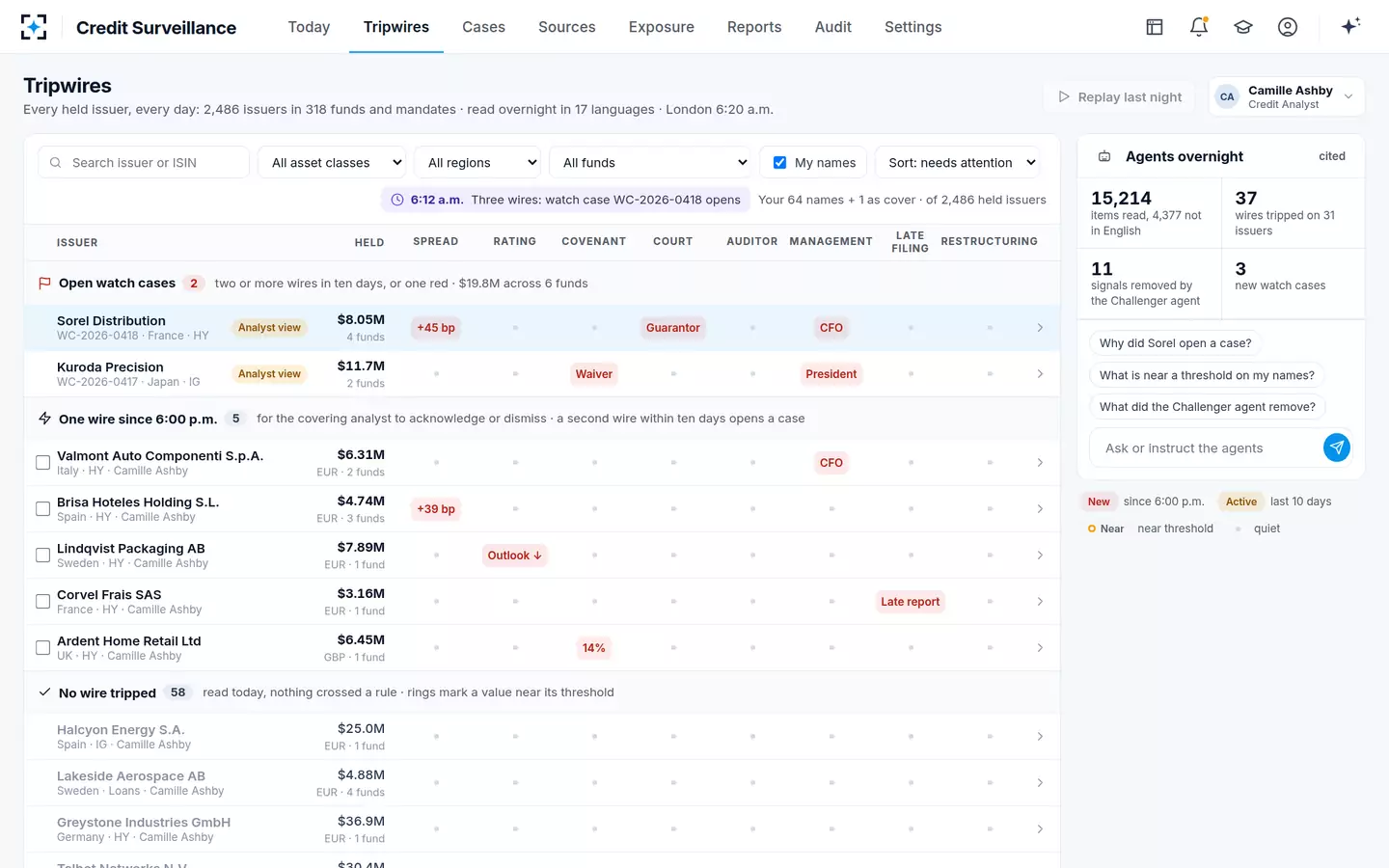
The sector comparison is also what separates the sample's two spread warnings that night. Sorel's 2029 notes widened 45 basis points against a sector that moved 3, and the move joined two filings in one case. A Spanish hotel issuer widened 39 basis points with no other warning, so it stayed a single wire for its analyst to acknowledge or dismiss.
The tripwire matrix: a spread wire beside the court and management wires on one issuer
How to monitor credit spreads on a bond portfolio
Monitor every held bond daily against its sector, on prices you can trust, and treat a missing or stale price as its own warning rather than as no news. For US corporate bonds, dealers must report trades to FINRA's TRACE system within 15 minutes of execution under FINRA Rule 6730, so traded prices exist for active bonds; many high yield and foreign bonds trade rarely, and their daily prices are evaluations or single quotes.
That is where most false spread alerts come from. In the sample night, 12 bonds carried prices too stale to use and were marked rather than tripped, and the checking agent removed one two-day-old single-dealer quote that would otherwise have raised a spread wire. A spread monitor also needs the position in each fund beside the move, because the same 45 basis points is a footnote in a fund that holds 0.1% and a decision in one that holds 3%.
What is a credit spread alert, and where Credit Surveillance fits
A credit spread alert is a rule that tells someone when a bond's spread crosses a threshold. On its own it is a price alert: it tells you the market has moved, not why. It becomes a credit tool when it is compared with the sector, checked for stale prices, and placed beside the filings, court notices and rating actions on the same issuer, so that the analyst sees the reason and the price together.
Credit Surveillance does that as one of eight tripwires, with the Market agent watching prices against the sector under each asset class's rule and the Correlator agent tying a spread wire to any other wire on the same issuer within ten days. It does not trade on a spread move, and it does not forecast spreads. For a team whose real gap is reading the filings that move spreads, which 8-K filing triggers signal credit trouble is the companion page, and what the public numbers say about defaults in 2026 sets today's tight spreads beside them. The whole sample case is on the Credit Surveillance page.
Questions people ask
Does credit spread widening predict a recession?
The excess bond premium, the part of spreads not explained by expected default, has been used for exactly that. The Fed's staff publish a model-implied probability of recession within 12 months alongside it; in September 2026 it was about 9%, with the premium below zero. It is staff research, revised as data change, not an official forecast.
What is the difference between spread widening and tightening?
Widening is the spread going up and the bond's price falling relative to government bonds; tightening is the reverse. A bond can tighten while its yield rises, if government yields rise by more, which is why credit teams watch the spread rather than the yield.
What is a normal credit spread for high yield bonds?
There is no fixed normal; spreads move with the cycle. The Fed's May 2026 report described corporate bond spreads as roughly unchanged and at the low end of their historical range. On the Fed staff's broad corporate measure, September 2026's 93 basis points compared with a median of about 152 since 1973.
Why did my bond's price fall when Treasury yields fell?
Because its spread widened by more than the government yield fell. The bond's yield is the government yield plus the spread, so a fall of 20 basis points in the Treasury and a widening of 45 in the spread leave its yield 25 higher and its price lower.
How fast do spreads react to a filing?
It depends on how many people read the filing and when. An English filing on a widely held issuer may be priced within minutes; a court notice in another language on a subsidiary may take hours or days. In the sample, the spread wire tripped 3 hours 14 minutes after the first warning filing and 21 minutes after the court notice.