Credit risk monitoring tools are the systems a credit team relies on to tell it, between quarterly reviews, that something has changed at an issuer it holds: terminal and news alerts, rating feeds, docket monitoring services and full early warning systems. The way to choose between them is not a demonstration but a seeded test: take a past period on your own holdings, plant ten warnings whose timing you know (a late 10-Q, a finance chief's exit, a foreign insolvency notice at a guarantor), add three decoys that should not fire, replay the period, and score each tool on what it caught, how fast, whether it matched the right bond, and how many false alarms it raised. Botminds' Credit Surveillance, a credit early warning system for buy-side credit teams, is built to be tested that way: its agents read every held issuer's sources every day, and its first-time setup ends with a dry run on the firm's own history.
Sample figures on this page come from the solution's fictional sample data, a London manager called Quillfield Capital holding 2,486 issuers; the people, funds and issuers named are invented. The rules and clocks are real, and linked where they appear.
What a monitoring tool's speed looks like: one sample night in Credit Surveillance
4min
from a Lyon court notice being posted to the court wire tripping
2min
behind real time on the SEC's EDGAR feed at 6:18 a.m.
28min
from the second warning sign to an assigned watch case, checks included
11
signals removed before anyone saw them: 7 wrong entity, 3 duplicates, 1 stale price
What are credit risk monitoring tools?
They are any system that watches held credits between scheduled reviews and tells someone when a threshold or event occurs. In practice a buy-side team uses four kinds at once, each built for a different job. Terminal and news alerts catch headlines on names someone has added. Rating feeds deliver agency actions. Docket monitoring services track court cases for named parties. Credit early warning systems try to do all of it for every held issuer, match each item to the bonds it touches and route it to an owner.
Each kind fails in a predictable place. Headline alerts miss what is not in English or not in the news. Rating feeds arrive after the market. Docket services find the cases of the entities you list, and miss the subsidiary you did not know to list. A seeded test makes those failures visible on your own book before you rely on any of them.
How to test a credit monitoring system: plant ten warnings in a period you know
To test a credit monitoring system, build an answer key from a past period and replay it. Pick a window of about 90 days that ended at least a quarter ago, freeze the holdings as they were then, and list ten events on held names whose first public moment you can date to the minute. Add three decoys: items that look like warnings but should not trip anything. Then run each tool on that window using only data available at the time, and compare its output with the key.
Two disciplines decide whether the result means anything. The first is point-in-time data: a news archive or a company database that has been corrected since will let a tool "catch" something that was not knowable on the day. The second is a fixed answer key written before the replay, by someone who will not be running the tool, so nobody adjusts the questions to the answers. A replay used to test changes to an alert threshold is a related exercise, set out for equity holdings in testing portfolio monitoring tools by replaying last quarter; the seeded test here is about whether the tool finds credit warnings at all.
The ten warnings to plant, and the three decoys
Choose warnings that cover every route by which credit news arrives: US filings, foreign filings, courts at home and abroad, prices and restructuring steps. The list below is one balanced set; each line names where the warning appears first and the clock that governs it.
Ten seeded credit warnings and three decoys, with where each appears first
| Planted signal | Where it appears first | The clock or rule | What a miss looks like |
|---|---|---|---|
| 1. Finance chief resigns | Form 8-K, Item 5.02(b), on EDGAR | Four business days; a filing transmitted after 5:30 p.m. Eastern counts as filed the next business day | The resignation is read from the morning news, or not at all |
| 2. Auditor resigns | Form 8-K, Item 4.01 | Four business days | Read at the next annual report |
| 3. Late quarterly report | Form 12b-25 (NT 10-Q) | Due no later than one business day after the 10-Q due date | Nobody notices a filing that did not arrive |
| 4. Prior statements withdrawn | Form 8-K, Item 4.02 | Four business days | Covenant arithmetic keeps using numbers the issuer no longer stands behind |
| 5. Guarantor enters French safeguard | Court registry, then BODACC | Claims due two months from BODACC publication, plus two for creditors outside metropolitan France | Read when the press reports it, inside the claim window |
| 6. German subsidiary insolvent | National insolvency register | Published "as soon as possible after the opening" under the EU Insolvency Regulation | Matched to no held bond, or to the wrong one |
| 7. US subsidiary files chapter 11 | PACER docket | No 8-K duty if the debtor is neither the registrant nor its parent | The issuer's own filings are silent, so the tool is too |
| 8. Bond widens against a calm sector | Evaluated prices and dealer quotes | House rule, for example +35 bp in two days and 25 more than the sector | A wire on the whole sector, or no wire at all |
| 9. Exchange offer or consent solicitation | Issuer notice, often with an 8-K | The offer's own deadlines | The early deadline passes before anyone reads the terms |
| 10. Covenant waiver in a Japanese filing | Tokyo timely disclosure, in Japanese | Exchange rules on timely disclosure | Read days later in translation, if at all |
| Decoy A. Namesake company in the news | News | None: a different legal entity | A wire on the wrong issuer |
| Decoy B. The same story from three outlets | News | None: one event | Three alerts for one event |
| Decoy C. Two-day-old single-dealer price | Pricing feed | None: not a price | A spread wire on a stale quote |
Lines 3, 6 and 7 are the ones that separate tools. A late quarterly report is an absence, and most alert systems are built to react to something arriving, not to notice that something did not. Rule 12b-25 requires a registrant that misses a 10-K or 10-Q deadline to file a notice "no later than one business day after the due date for such report" (17 CFR 240.12b-25(a)), which helps; a tool still has to know the due date to know the notice is a warning. And because Item 1.03 of Form 8-K is written for a receiver or bankruptcy proceeding of "a registrant or its parent" (SEC Form 8-K, Item 1.03), a subsidiary's chapter 11 case can be invisible in the issuer's own filings.
How to measure early warning accuracy
Measure accuracy as five numbers, not one. A tool that catches all ten warnings but takes two days and sends each to the wrong person has not done the job, and one that is fast but buries the analyst in decoys will be switched off within a month.
Five measures for a seeded test, and how to define each
- Catch rate: how many of the ten were flagged at all
Count a catch only if the flag names the right issuer. A flag on the sector or the parent counts as half at most.
- Time to catch, from first public moment to the flag
Use the source's own timestamp: EDGAR acceptance, registry posting, the price time. Report the median and the slowest.
- Right bond, right funds
Did the flag name the bonds the event touches and the funds that hold them? A guarantor's court case that is matched to no bond is a miss.
- Owner told, with a deadline
Who received it, and was that the covering analyst or her cover on the day? An alert to a shared inbox is not an owner.
- False alarms per analyst per week
Count every decoy that fired, and every other flag in the window that the analyst would have dismissed. Divide by analysts and weeks.
Report the results per warning, not as one score, because the failures cluster. A tool that misses lines 5, 6 and 7 has a court-matching problem; one that misses 3 cannot see absences; one that fires on decoy A has an entity problem. Those are different conversations with a vendor, and different risks for a fund.
What is a false positive in credit monitoring?
A false positive is a flag that does not describe a real change at the held issuer: the wrong company, the same event counted twice, or a price that was not a tradable price. The three decoys in the test stand for those three kinds, and in the sample night they were the only kinds the checking agent removed: seven wrong entities, three duplicates and one stale price.
False positives are not harmless. Each costs the analyst a minute to dismiss, and the cost that matters is the one after that: a team that dismisses forty alerts a day starts dismissing the forty-first unread. The test therefore counts false alarms per analyst per week alongside the catch rate, and a buyer should ask to see what a tool removed and why, not only what it raised. The Challenger agent in Credit Surveillance lists every removal with a reason code on the sources screen, so an analyst can check that nothing real was thrown away.
How quickly should a monitoring tool catch an 8-K?
Within minutes of the SEC disseminating it, and before the analyst's working day starts, wherever she sits. The issuer has four business days to file, so the filing itself may come days after the event; once it is public, the market can read it, and the tool's job is not to add hours to that.
Timing across time zones is where the minutes matter. Under Regulation S-T, a filing transmitted after 5:30 p.m. Eastern is deemed filed on the next business day (17 CFR 232.13(a)(2)), but it is public as soon as it is disseminated. An 8-K that appears late in the New York evening is in the middle of the night in London, which is exactly when a London credit team's alert screen is unwatched. In the sample, the management wire tripped at 2:51 a.m. London time on the finance chief's resignation, and the analyst read it, with two other warnings on the same issuer, at 6:20.
When each seeded warning becomes public, and when the issuer had to publish it
- Event
- The issuer may take up to four business days≤ 4 business days
- The tool should take minutesMinutes
- Due date passes
- Notice within one business day+1 business day
- Report within five calendar days+5 calendar days
- Judgment publishedBODACC
- Claims window2 months
- Extension outside metropolitan France+2 months
Can monitoring tools read foreign court notices?
Some can, and the EU has made it easier than it was. The EU Insolvency Regulation requires member states to keep insolvency registers that publish, among other things, the court, the case reference, the type of proceedings and, for a company, "the debtor's name, registration number, registered office" (Regulation (EU) 2015/848, article 24(2)). Since 26 June 2019 those registers are meant to be searchable together through the European e-Justice Portal (article 25). The registration number is the key: it is how a notice about "Sorel Logistique SAS" is matched to the guarantor listed in an indenture, rather than to a namesake.
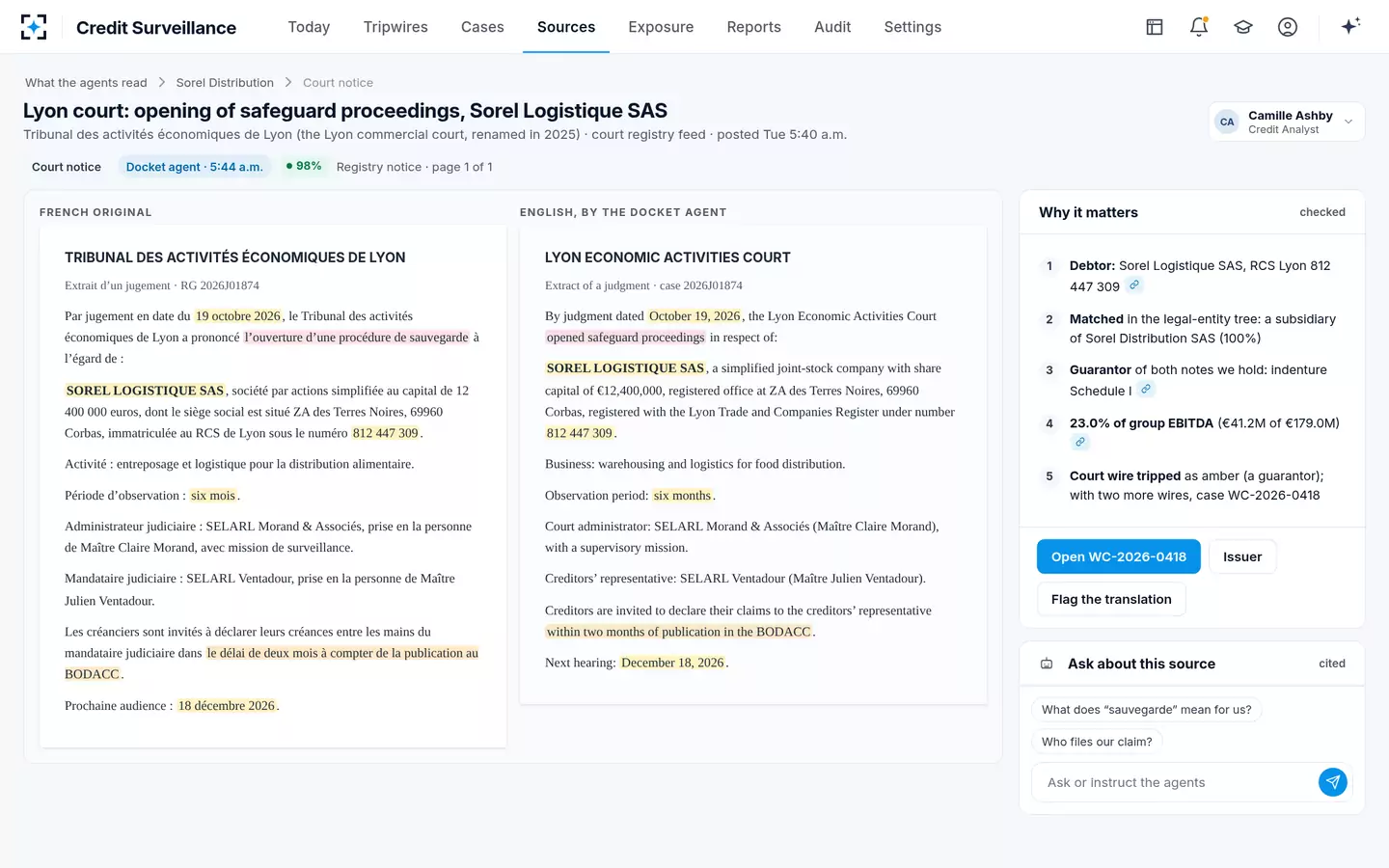
The test should still include a foreign notice, because reading is not matching. In the sample, the Lyon court's judgment was read in French and kept beside the English, matched by its registry number to the subsidiary that guarantees both notes the firm holds, and sized at 23.0% of group EBITDA, four minutes after the registry posted it. The deadline that follows is French law: creditors declare claims within two months of publication in the BODACC, plus two months for those outside metropolitan France (Code de commerce, article R622-24). Matching a court case to the bonds it touches works through that step in detail.
A French court notice beside the English, matched to the guarantor by registry number
What is the best credit risk monitoring tool?
The best tool is the one that passes your seeded test on your holdings, with the fewest false alarms per analyst. That is not an evasion: the right answer for a team holding 150 US investment grade names differs from the right answer for one holding 2,500 issuers across Europe, Asia and Latin America. The comparison below sets out what each kind of tool is built to do, so that a test can be aimed at its weak points.
What each kind of credit risk monitoring tool is built to do
Alerts, rating feeds and docket services: The names, tickers or parties someone has added, each on its own feed.
A credit early warning system with agents: Every held issuer, read from portfolio accounting each morning.
Alerts, rating feeds and docket services: Matches on names or tickers; a subsidiary must be listed separately.
A credit early warning system with agents: Matches registry numbers to each issuer's entity tree and guarantor schedule.
Alerts, rating feeds and docket services: Mostly English headlines; local filings in translation, later.
A credit early warning system with agents: Read in the original, kept beside the English.
Alerts, rating feeds and docket services: Each alert stands alone; combining them is the analyst's job.
A credit early warning system with agents: Weak signals tied into one case under a written rule.
Alerts, rating feeds and docket services: None: the analyst looks it up.
A credit early warning system with agents: Sized in every fund against that fund's guidelines.
Alerts, rating feeds and docket services: Inbox history, if kept.
A credit early warning system with agents: Every read, flag, removal, view and decision on an audit trail.
Market data deserves a line of its own in any test. The Office of Financial Research found that CDS spreads have led rating downgrades less since post-crisis reforms, and lead bond spreads more weakly (OFR Working Paper 24-04, 2024). A tool that relies mainly on price moves to raise credit flags will therefore catch line 8 of the test and may miss the rest until the market has moved.
How to evaluate credit surveillance software on your own book
Run the seeded test before signing, with your own holdings and your own people, and treat the vendor's setup effort as part of the result. A tool that needs months of entity mapping before it can be tested is telling you what the first year will be like.
A workable sequence takes three to four weeks. Week one: the head of credit risk writes the answer key and freezes the holdings; nobody running the tools sees it. Week two: each tool is connected to the same point-in-time sources and the same entity data. Week three: the replay runs and the results are scored per warning on the five measures. A final meeting compares the misses, because a miss on a guarantor's court case and a miss on a stale price are not equally expensive.
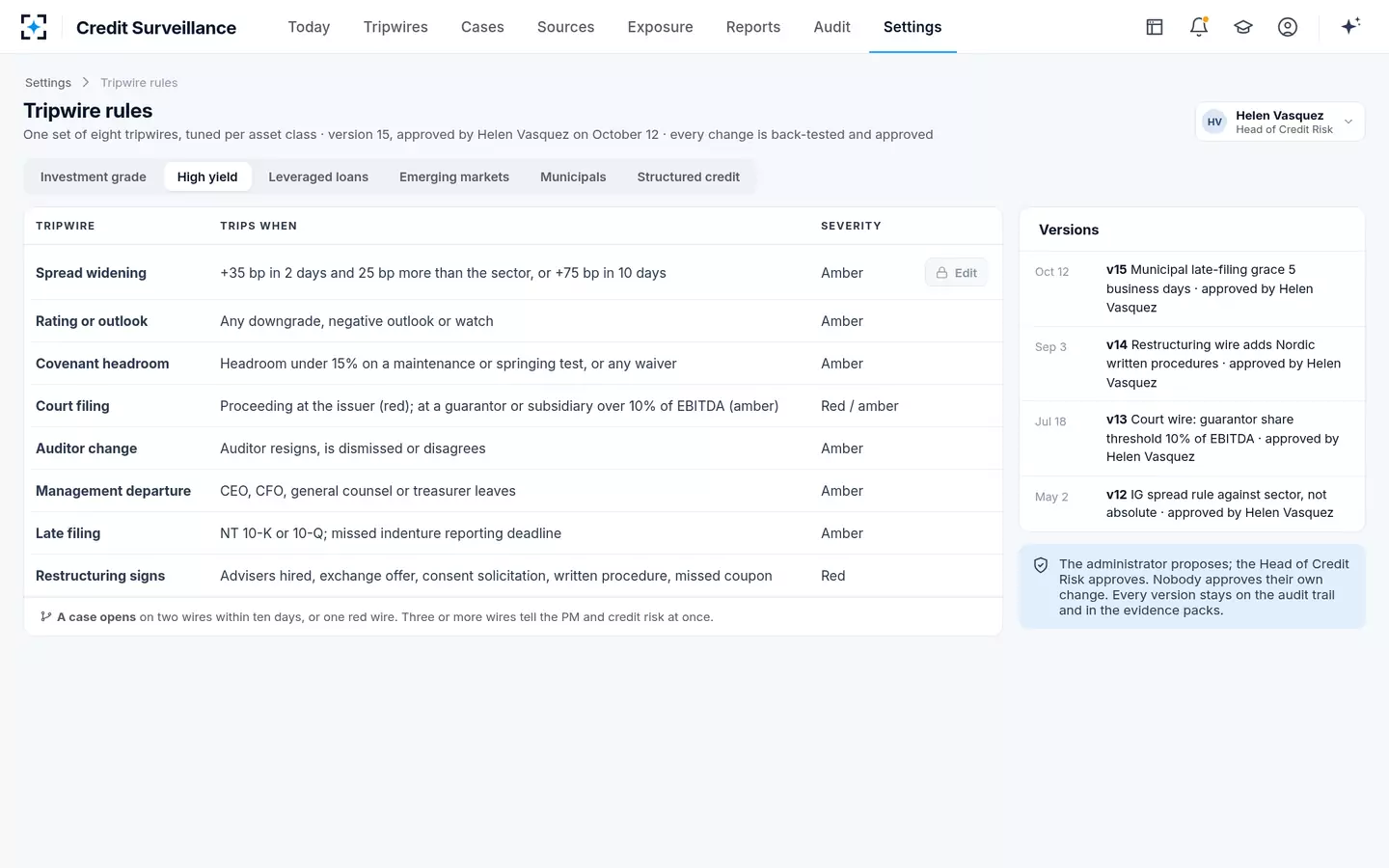
In Credit Surveillance the replay is part of normal operation as well as evaluation. Every change to a tripwire rule is replayed on the last 90 days before the head of credit risk approves it, and the first-time setup ends with a dry run on the firm's own history; the six-week plan to go live sets out that sequence.
Tripwire rules per asset class, each version approved and replayable
Where Credit Surveillance fits after a seeded test, and where it does not
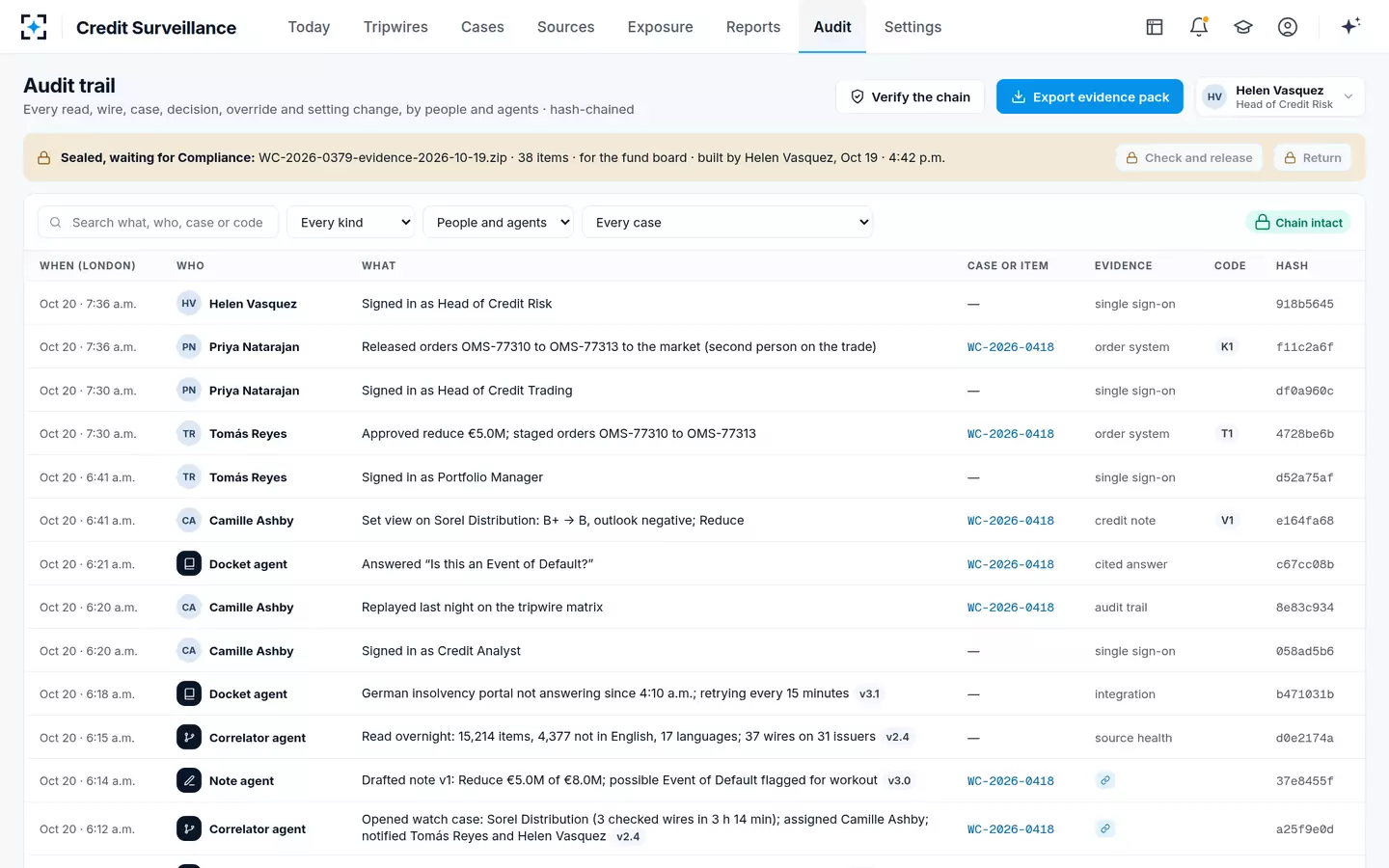
It fits a team whose seeded test fails on matching, languages and correlation: many issuers, subsidiaries and guarantors abroad, several funds with different guidelines. Every flag it raises names the issuer, the bonds, the funds and the owner, and every item it removed is visible with its reason, which is what makes the five measures above possible to score.
It is less useful where the book is small, domestic and investment grade only, where a few analysts can read every filing themselves and a rating feed adds most of what is missing. It also depends on inputs the firm must supply: positions by fund, the coverage list and the indentures' guarantor schedules. The whole sample night is on the Credit Surveillance page, and which tasks agents take on in a credit early warning system describes the design behind the test results.
The audit trail a seeded test is scored from
Questions people ask
How many warnings does a seeded test need?
Ten is enough to expose the main failure types if they are spread across sources: US filings, foreign filings, domestic and foreign courts, prices and restructuring steps. Fewer warnings tend to all come from one source and flatter the tool that reads it. Add at least three decoys so that false alarms are measured as well as catches.
Should we test on investment grade or high yield names?
Use the book you actually hold, weighted to where warnings are most frequent and most costly. For most credit teams that means high yield, leveraged loans and emerging markets issuers, and at least one foreign subsidiary that guarantees held bonds.
Can a tool be tested without sharing our holdings with the vendor?
Partly. The answer key and the scoring can stay inside the firm, and the holdings can be limited to the test window. But the tool cannot match a court notice to your bonds without your entity data, so a test without holdings measures only whether it reads sources, not whether it would have told the right person.
How long should a test window be?
About 90 days is long enough to contain ten real warnings on a large book and short enough to replay quickly. Choose a window that ended at least a quarter ago, so that its outcomes, such as which warnings led to a downgrade or a default, are already known.
What if every tool fails the same warning?
Then the gap is in the sources, not the tools. A warning that none of them catches, such as an absence like a missing 10-Q, or a court system no tool reads, needs a rule or a data feed of its own, and it should be written into the firm's procedures as a known gap until it is closed.