A consent solicitation is a request from an issuer to the holders of its bonds to approve changes to the indenture — removing or loosening covenants, waiving a default, or amending terms ahead of a refinancing — usually in return for a fee and often alongside a tender or exchange offer. The process matters because the vote binds everyone: if the required majority consents, holders who said no keep their bonds on the amended terms. What a majority cannot do, for an indenture qualified under the Trust Indenture Act, is impair a holder's right to be paid principal and interest when due. Reading a consent solicitation therefore means separating what the vote can take from what only each holder can give up. Botminds' Bond Covenant Analysis redlines every amendment and consent request on held bonds against the document as it currently stands, re-scores the deal and dates the deadline, so the portfolio manager votes knowing what changes.
Deal examples are sample data on fictional companies, from Quillfield Capital's held book as it runs through the solution. The statute, SEC rules, court opinions and SEC press releases are quoted from their own texts.
The numbers that frame every consent vote
>50%
a majority in principal amount may, by default, direct the trustee and waive past defaults under a qualified indenture
75%
the lowest share of holders a qualified indenture may empower to postpone an interest payment, for up to three years
30days
default record date: the later of 30 days before the first solicitation or the latest holder list given to the trustee
What is a consent solicitation?
A consent solicitation is the formal way an issuer asks bondholders to agree to change the indenture. The issuer sends a solicitation statement describing the proposed amendments, the vote needed, the deadline and any fee; holders deliver consents through the clearing system by the deadline; and if enough consent, the issuer and trustee sign a supplemental indenture that binds every holder.
Issuers use consents for routine fixes and for decisive ones. A consent can update a reporting obligation or permit a merger; it can also, as part of a refinancing or a distressed exchange, strip the covenants out of bonds left behind by holders who do not take the new securities. The second kind is where holders lose things by vote.
What a majority vote can change, and what needs every holder
A majority — or whatever threshold the indenture sets — can usually amend or waive the covenants: limits on debt, liens, restricted payments, asset sales, the change of control offer and reporting. Changes to the core payment terms need the consent of each affected holder. The House and Senate reports on the Act, as the Second Circuit quoted them, said section 316(b) "does not prevent the majority from binding dissenters by other changes in the indenture or by a waiver of other defaults." Between the two sits a band of terms the indenture itself protects with a higher threshold or individual consent, and that band is different in every deal.
What a consent vote can take, and what only each holder can give
Majority (or stated threshold) can change: Remove or loosen the debt, liens, restricted payments, investments and asset sale covenants; waive past breaches.
Each affected holder must consent: Only if the indenture lists a covenant among protected terms — read the amendments section.
Majority (or stated threshold) can change: Amend or waive the offer, unless protected by the indenture.
Each affected holder must consent: Some indentures protect a change of control offer once it has arisen.
Majority (or stated threshold) can change: Often a higher threshold, such as two-thirds, for releasing all or substantially all collateral.
Each affected holder must consent: Where the indenture says so.
Majority (or stated threshold) can change: Waive a past default and direct the trustee (TIA §316(a)(1)); if the indenture allows, holders of at least 75% may postpone interest for up to three years (§316(a)(2)).
Each affected holder must consent: The right to receive principal and interest when due, and to sue for it (TIA §316(b)).
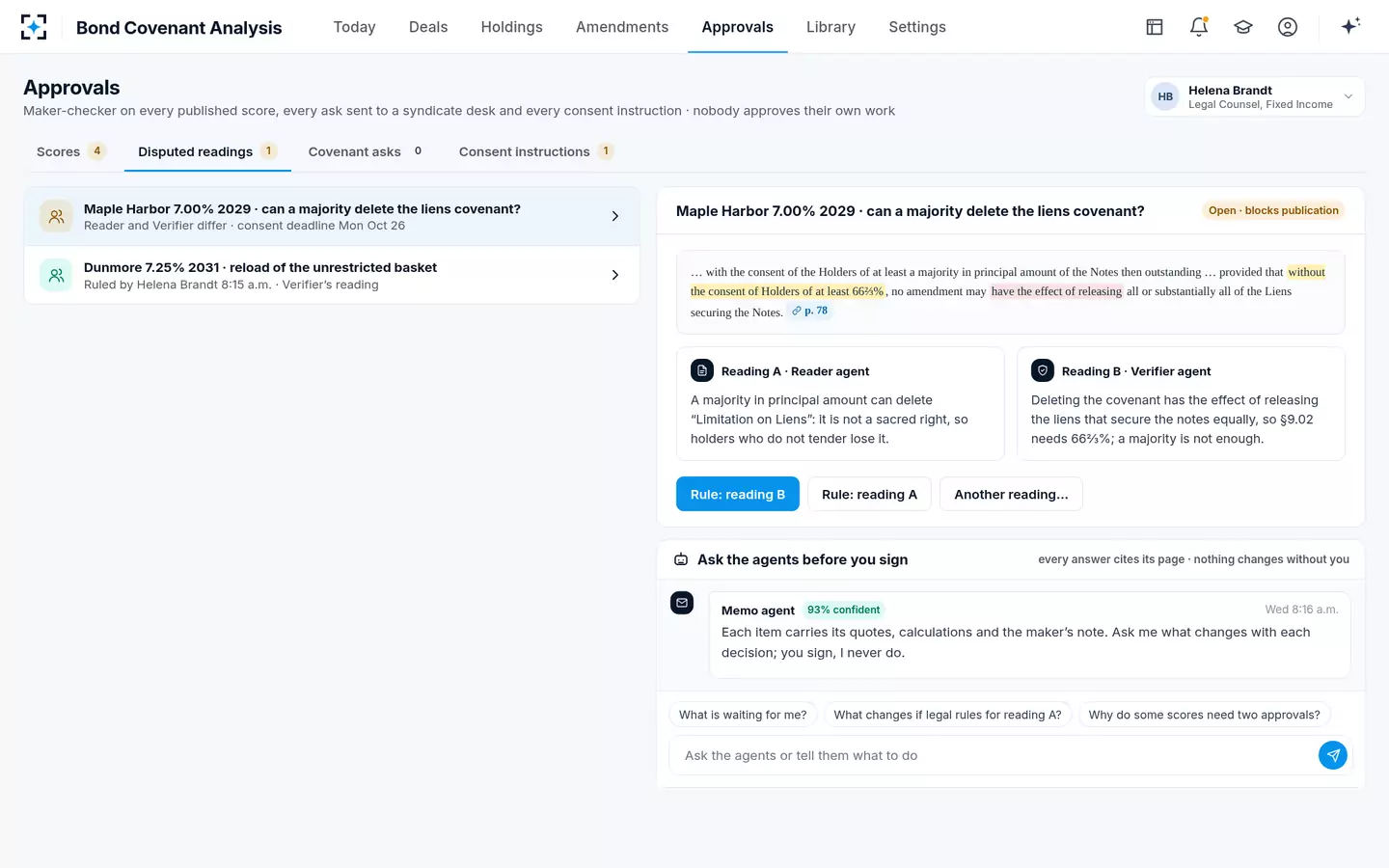
The sample book shows how narrow the band can be. On Maple Harbor's 7.00% notes due 2029, the amendments clause lets a majority amend, "provided that without the consent of Holders of at least 66⅔%, no amendment may have the effect of releasing all or substantially all of the Liens securing the Notes." The issuer's consent solicitation would delete the liens covenant with a majority. One reading says that is allowed; the other says deleting the covenant has the effect of releasing the liens, so two-thirds are needed. The answer decides whether holders who refuse can be overruled, and in the solution it waits for counsel.
A consent question two readings answer differently
How does a consent solicitation work? The process, step by step
A consent solicitation runs from announcement to effectiveness in a few weeks, and the dates inside it — record date, early consent deadline, expiration — decide who votes and who gets paid. When it is paired with a tender offer for the bonds, the SEC's tender offer rule also sets minimum periods.
A consent solicitation paired with a tender offer: where the days go
- Launchdays 0–2
- Early consent windowto about day 10
- Rest of the offerto day 20+
- Settlementafter expiry
Two details deserve attention. The record date decides who may vote: under the Trust Indenture Act, "Unless the indenture provides otherwise, such record date shall be the later of 30 days prior to the first solicitation of such consent or the date of the most recent list of holders furnished to the trustee" (§316(c)), so a holder who bought after it may hold bonds without a vote. And read when the amendments take effect — on receipt of the required consents or only at settlement — and whether the fee goes only to holders who consented by an early deadline.
What is Trust Indenture Act section 316(b)? Protection for payment, not covenants
Section 316(b) of the Trust Indenture Act of 1939 says that, notwithstanding anything else in a qualified indenture, "the right of any holder of any indenture security to receive payment of the principal of and interest on such indenture security, on or after the respective due dates expressed in such indenture security, or to institute suit for the enforcement of any such payment on or after such respective dates, shall not be impaired or affected without the consent of such holder" (15 U.S.C. 77ppp(b)). It is why bond restructurings outside bankruptcy proceed by exchange offers rather than majority votes on the amount owed.
The Second Circuit read it narrowly in 2017. In Marblegate Asset Management v. Education Management Finance Corp., the court concluded "that Section 316(b) prohibits only non-consensual amendments to an indenture's core payment terms," which it described as "the amount of principal and interest owed, and the date of maturity" (846 F.3d 1). It quoted the SEC official described as a principal author of the Act telling Congress in 1939 that "[a]ll that the section [316(b)] does is preserve the individual holder's right to bring an action at law to collect his interest and principal in accordance with the terms of his contract, unless he has himself consented to a variation from that contract." Covenants, on that reading, are the majority's to change.
Two limits on the statute matter in high yield. It applies to qualified indentures, and under section 304(b) the qualification requirements do not reach transactions exempt from Securities Act registration under its section 4 (15 U.S.C. 77ddd(b)), which covers private placements such as Rule 144A deals, as the description of notes in an offering memorandum explains; for those, the protection is whatever the indenture itself writes in. And the statute protects the right, not the value: a holder can keep an unimpaired right to payment from an issuer whose assets have gone elsewhere.
Section 316(b) protects the promise to pay. Everything that makes the promise worth something — the covenants — can be voted away.
What is an exit consent? The Oak Industries case
An exit consent is a consent that holders give as they leave: to tender their bonds in an exchange or purchase offer, they must also vote to strip the covenants from the bonds that remain. Holders who stay out keep bonds with fewer protections and, usually, a thinner market. The structure puts pressure on every holder to join.
The leading case is Katz v. Oak Industries (Del. Ch. 1986). Oak's offer required that "one may not tender securities unless at the same time one consents to the proposed amendments to the relevant indentures," and those amendments "would, if implemented, have the effect of removing significant negotiated protections to holders of the Company's long-term debt including the deletion of all financial covenants" (508 A.2d 873). The plaintiff argued the structure was coercive and breached the implied covenant of good faith. Chancellor Allen disagreed: "while it is clear that Oak has fashioned the exchange offer and consent solicitation in a way designed to encourage consents, I cannot conclude that the offer violates the intendment of any of the express contractual provisions considered or, applying the test set out above, that its structure and timing breaches an implied obligation of good faith and fair dealing." The injunction was denied.
Three authorities every consent reader should know
| Authority | What it says | What it means for a holder |
|---|---|---|
| Trust Indenture Act §316, 15 U.S.C. 77ppp | Majorities may direct the trustee and waive past defaults; payment rights cannot be impaired without each holder's consent; default record date rule. | Covenants are at risk in a vote; the right to be paid on the due date is not, in a qualified indenture. |
| Katz v. Oak Industries, 508 A.2d 873 (Del. Ch. 1986) | Linking a tender to consents that strip covenants did not breach the implied covenant of good faith. | Exit consents are a lawful pressure tactic; the protection is in the indenture's thresholds. |
| Marblegate v. Education Management, 846 F.3d 1 (2d Cir. 2017) | Section 316(b) prohibits only non-consensual amendments to core payment terms. | A restructuring that leaves the payment terms untouched can still leave a holdout with little to collect from. |
What percentage of bondholders is needed to amend an indenture?
The indenture sets it, term by term. The documents on this page show the usual shape: Maple Harbor's clause lets a majority amend but needs two-thirds to release substantially all the collateral, and Oak's offer was conditioned on tenders and consents from holders of more than 50% of three series and at least two-thirds of three others. Under a qualified indenture, notes owned by the issuer or anyone controlling, controlled by or under common control with it "shall be disregarded" when counting directions and waivers (TIA §316(a)); Oak's indentures likewise barred it from voting securities in its treasury.
So the question "what percentage is needed?" has no market answer, only a document answer, and the document can be ambiguous at exactly the point that matters, as the Maple Harbor clause shows. The analyst's job is to find every threshold, the terms each one protects, and any phrase — "have the effect of" — that could move a change from one threshold to another.
What is a consent fee, and what is it buying?
A consent fee is a payment, usually stated in basis points of principal, paid to holders who consent by the deadline. It compensates for the protection given up, and a fee paid only to early consenters adds pressure on the rest. The right question is never "is the fee attractive?" but "is the fee worth more than what the amendment lets the issuer do?"
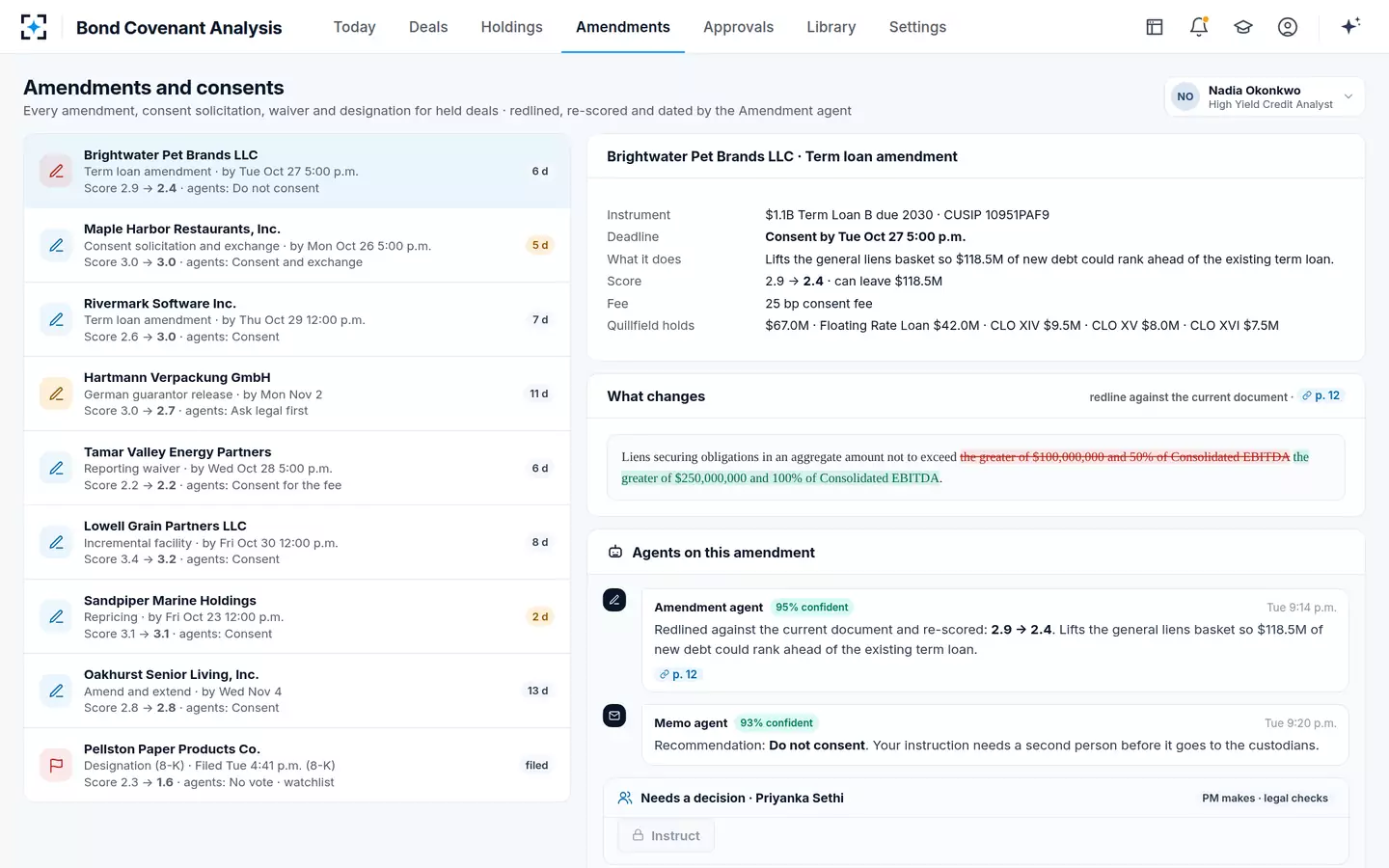
In the sample book, a term loan amendment offered a 25 bp fee — $167,500 on the $67.0M Quillfield held across its loan fund and three CLOs. The amendment lifted the general liens basket from the greater of $100M and 50% of EBITDA to the greater of $250M and 100% of EBITDA, so new debt could rank ahead of the existing loan; the agents re-scored the deal from 2.9 to 2.4 and recommended not consenting. The fee was real money; the liens capacity it bought for the borrower was larger.
Bond Covenant Analysis: amendments and consents, redlined, re-scored and dated before the vote
Ad hoc groups and inside information: the compliance side of a consent
Large consents and exchanges are often negotiated with an ad hoc group of holders before they are announced, and joining one can bring material nonpublic information. The SEC has brought cases on exactly that. In September 2024 it settled charges against Marathon Asset Management whose policies, the SEC found, did not address the inside information that came with sitting on ad hoc creditors' committees; the firm accepted a $1.5 million penalty, a cease-and-desist order and a censure (SEC press release 2024-158; the case and the wall it implies are set out in private side vs public side).
In December 2024 the SEC charged Silver Point Capital with similar policy failures relating to a consultant's participation on an ad hoc committee for Puerto Rico bonds; the case was litigated, not settled. The SEC's release now carries this update: "On April 4, 2025, the SEC announced the dismissal of this civil enforcement action against Silver Point Capital" (SEC press release 2024-209). No wrongdoing was established. The practical lesson for a fund voting on consents is the same either way: the analysis of a consent and the information behind it should sit inside the firm's information barrier, with a record of who saw what.
Reading a consent solicitation with Bond Covenant Analysis
For held bonds, the Amendment agent watches amendments, consent solicitations, waivers and 8-K designations, redlines each one against the current document, re-scores the deal and dates the deadline; the Memo agent drafts a recommendation. The agents never instruct a consent. The portfolio manager decides, and a second person checks the instruction before custodians and agent banks receive it.
The analysis answers the questions this page has walked through: which threshold applies, whether any term in the request needs each holder's consent, what the amendment would let the issuer do in dollars, and how that compares with the fee. Where the threshold itself is a reading question, as at Maple Harbor, the dispute goes to counsel. What a loosened basket can move and how a change of control put can be narrowed are the two changes holders are most often asked to approve.
Questions people ask
What happens if a consent solicitation fails?
The indenture stays as it was, and the issuer decides whether to extend the deadline, improve the fee or terms, or withdraw. If the solicitation is part of a tender offer, raising the consideration or changing the percentage sought keeps the offer open at least ten more business days under Rule 14e-1(b). A failed consent can also be a signal that holders are organised enough to negotiate.
Can bondholders be forced to accept new terms?
A required majority can bind every holder to amended covenants, and an exit consent can leave holdouts with stripped bonds. Under TIA §316(b), a qualified indenture cannot let a majority impair a holder's right to be paid when due. Restructurings that leave payment terms untouched, as in Marblegate, can still reduce what a holdout recovers in practice.
Is a consent solicitation the same as a tender offer?
No. A consent solicitation asks for votes on amendments; a tender offer asks holders to sell. They are often combined, with consents required from tendering holders, and then the SEC's tender offer rules, including Rule 14e-1's twenty-business-day minimum, apply to the offer.
Who decides how a fund votes on a consent?
The portfolio manager, usually on a recommendation from credit research, with legal counsel involved when the request is complex or a threshold is unclear. In the sample firm, the agents draft the recommendation, the PM decides and a second person checks the instruction before it goes to custodians and agent banks.
Does the Trust Indenture Act apply to high yield bonds?
To bonds issued under a qualified indenture, yes. Rule 144A private placements are exempt from the Act's qualification requirements under section 304(b), so their holders' protection against non-consensual payment changes depends on what each indenture itself provides.