A covenant database is a structured library of past indentures and credit agreements in which every covenant, basket and defined term is stored in a form that can be compared: the clause, its formula, its dollar size at issuance and the deal it came from. Every covenant score is a comparison with that library — this builder against the builders in similar deals — so the library decides what the score means. Botminds' Bond Covenant Analysis scores new issues against a firm's own covenant database rather than a generic one: the deals the team already holds and has read, its own rubric, its own consent history. This guide covers what a credit team should gather before it starts, where indentures can be found, and what each record needs to hold.
Examples are sample data on fictional people and companies — the library of Quillfield Capital, a fictional credit manager, as it runs through the solution. Rules and research are quoted from their own texts and linked where they appear.
What a covenant library looked like in the sample firm
2,860
bonds and loans in the library, from 3,140 documents and 612 issuers
512
deals under $250 million — small deals the firm holds and still has to score
318
peer deals behind one new issue's percentiles: same rating, region, sponsor, sector and vintage
What is a covenant database, and why build your own?
A covenant database stores each deal's covenant terms in comparable fields so that a new indenture can be ranked against past ones, basket by basket. A firm can subscribe to summaries of large public deals, but its own database holds what no subscription can: the private and smaller deals it actually owns, the readings its own analysts and counsel settled, the scores it published and the consents it voted on.
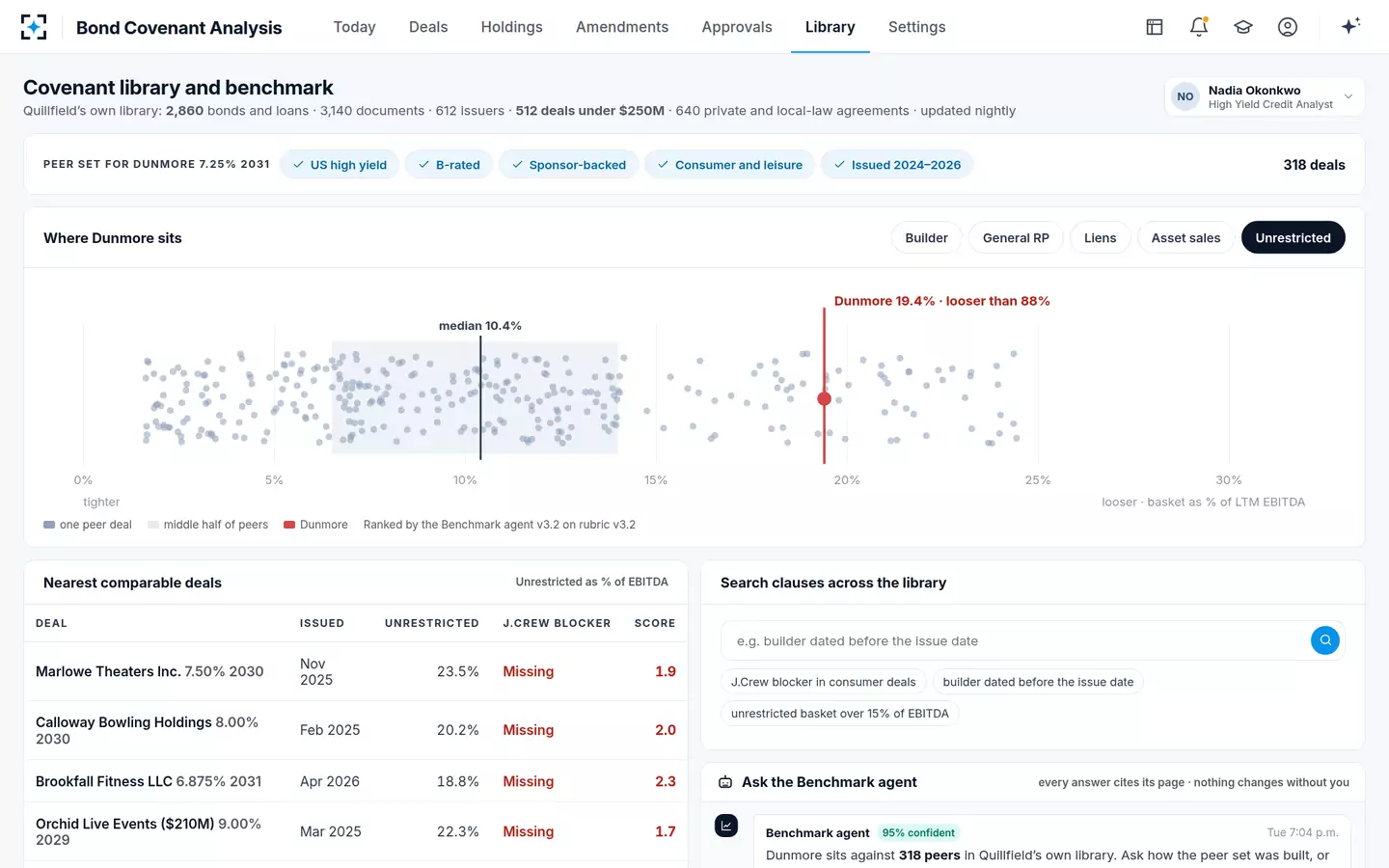
The difference shows up in the peer set. In the sample firm, 512 of 2,860 deals are under $250 million and 640 are private or local-law agreements — the documents a credit team holds and has to score whether or not anyone else summarises them. A new issue from a B-rated, sponsor-backed leisure company is scored against 318 such peers from the firm's own files, and every percentile shows the deals behind it.
What you bring: six inputs that decide the first month
The inputs that matter most are the ones only the team has: its past deals with the scores it gave them, the rubric those scores followed, and the history of how it read and voted on hard clauses. Everything else — current financials, holdings, new offering memoranda — arrives through systems the desk already runs.
What a credit team brings to start scoring with Bond Covenant Analysis
- Past indentures and offering memoranda
Final versions with supplements, for held deals and recent new issues you passed on. These become the peer library.
- Your scores and the memos behind them
Past covenant scores, sub-scores and covenant sections of credit memos: the answers a first comparison is checked against.
- The rubric, every version
Weights, scale definitions and reading rules, with the dates each version applied. Scores keep the version they were made under.
- Settled readings and disputes
Counsel's rulings on hard clauses — reloads, builder dates, majority thresholds. They become reading rules, not memories.
- Consent and amendment history
What you were asked, how you voted and what changed. It shows which protections your holders have actually defended.
- Connections to the systems you run
Document store and syndicate mailbox, financial data feed, portfolio accounting for holdings, and the order management system for pre-trade notes.
Where to find bond indentures: EDGAR, offering memoranda and your own files
Bond indentures of companies that report to the SEC are usually public as exhibits on EDGAR; indentures for Rule 144A deals of private companies usually are not, and reach investors only through the offering memorandum and the deal documents. Knowing which is which tells a team how much of its library it can rebuild from public sources and how much only it has.
For registered companies, Regulation S-K Item 601(b)(4) requires as exhibits "All instruments defining the rights of holders of the equity or debt securities being registered" and, in annual reports, the instruments defining the rights of holders of long-term debt — with an exception for unregistered debt that does not "exceed 10 percent of the total assets of the registrant and its subsidiaries on a consolidated basis," if the company agrees to furnish a copy to the SEC on request (17 CFR 229.601). EDGAR itself is open and free to anyone, with filings back to 1994 and 1995 (SEC, Accessing EDGAR Data; where each kind of bond document is published is mapped in bond prospectus database). Automated access is capped at ten requests a second, a limit a team building a library should respect.
Private placements are different by statute. Under Section 304(b) of the Trust Indenture Act, its qualification requirements do not apply to offerings exempt from registration under section 4 of the Securities Act (15 U.S.C. 77ddd), so a Rule 144A offering's indenture is not qualified with the SEC and, for a private issuer, need not be filed anywhere public. Rule 144A gives holders of non-reporting issuers a right to "reasonably current" financial information, not to the documents (17 CFR 230.144A(d)(4)). For those deals, the firm's own deal files are the library.
Where each kind of covenant document comes from
| Document | Where it usually is | What to keep |
|---|---|---|
| Indenture of an SEC-reporting issuer | EDGAR, as an exhibit to a registration statement, 8-K, 10-Q or 10-K | The filed version and every supplemental indenture, in date order |
| Rule 144A offering memorandum, private issuer | Your syndicate mailbox and deal files; not on EDGAR | The preliminary and final memoranda — the covenant read at pricing is the one you bought |
| Final indenture of a private issuer | The trustee, the issuer's data site, or your counsel | The executed version; compare it with the final memorandum |
| Amendments, consents and waivers | Trustee and agent notices; your custodian's corporate actions | Each document with its effective date and how you voted |
| Leveraged loan credit agreements | Agent bank data sites (private side) | Behind the information barrier the firm already runs |
How to store indenture terms so they can be compared
Store each basket as a quote plus the fields needed to recompute it, not as a summary. An entry that says "general RP basket: $50M / 15%" cannot be recomputed when EBITDA changes, cannot show whether the basket can fund investments, and cannot be checked by the next analyst. An entry that holds the clause, the formula and the definitions it uses can do all three.
Six fields every basket in a covenant database needs
The clause
Exact words, section, page and document version — the offering memorandum, the final indenture and every supplement are different versions.
The formula
Fixed amount, percentage, metric (EBITDA, total assets, net income) and whether it is the greater or the lesser.
The definitions it leans on
Each defined term the basket uses, quoted, with its own page — "Restricted Payment", "Permitted Investments", "Consolidated Net Income".
Start dates and reloads
When a builder starts counting, whether returns reload a basket, and whether unused capacity rolls over.
Cross-use
Which other purposes the basket can fund — the field that turns a list of baskets into leakage routes.
The deal context
Issuer, sponsor, rating band, sector, region, size, governing law and issue date — what makes a peer set.
Versioning matters as much as fields. ESMA's 2024 statement on AI in investment services expects a firm's records of AI to let it reconstruct a decision: the process followed, the data and algorithms behind it, and each modification since (ESMA35-335435667-5924, paragraph 24). For a covenant library, that means knowing which document version a basket was read from, which rubric version scored it and which agent and model versions did the reading — so a score made last year can be explained this year.
How many deals do you need to benchmark covenants?
Enough that each peer set is large after filtering, not before. A library of a few thousand deals sounds large until it is cut by rating band, region, sponsor status, sector and vintage; the sample firm's 2,860 deals produce 318 peers for one B-rated, sponsor-backed leisure issuer from 2024–2026, and a narrower filter quickly falls below a few dozen. Where a peer set is thin, the honest answer is to widen one filter and say which.
Labelled examples are expensive, which is why a firm's own scored deals are worth gathering. The researchers who built CUAD, a public dataset of 510 commercial contracts annotated by legal experts, put "a conservative estimate of the pecuniary value of CUAD" at "over $2 million," counting each page reviewed at least four times at $500 an hour (Hendrycks et al., NeurIPS 2021). A credit team's past covenant memos are labelled data of the same kind, already paid for.
The library, the peer set and a clause search across both
Can we use our own covenant rubric? Yes — versioned, and owned by one person
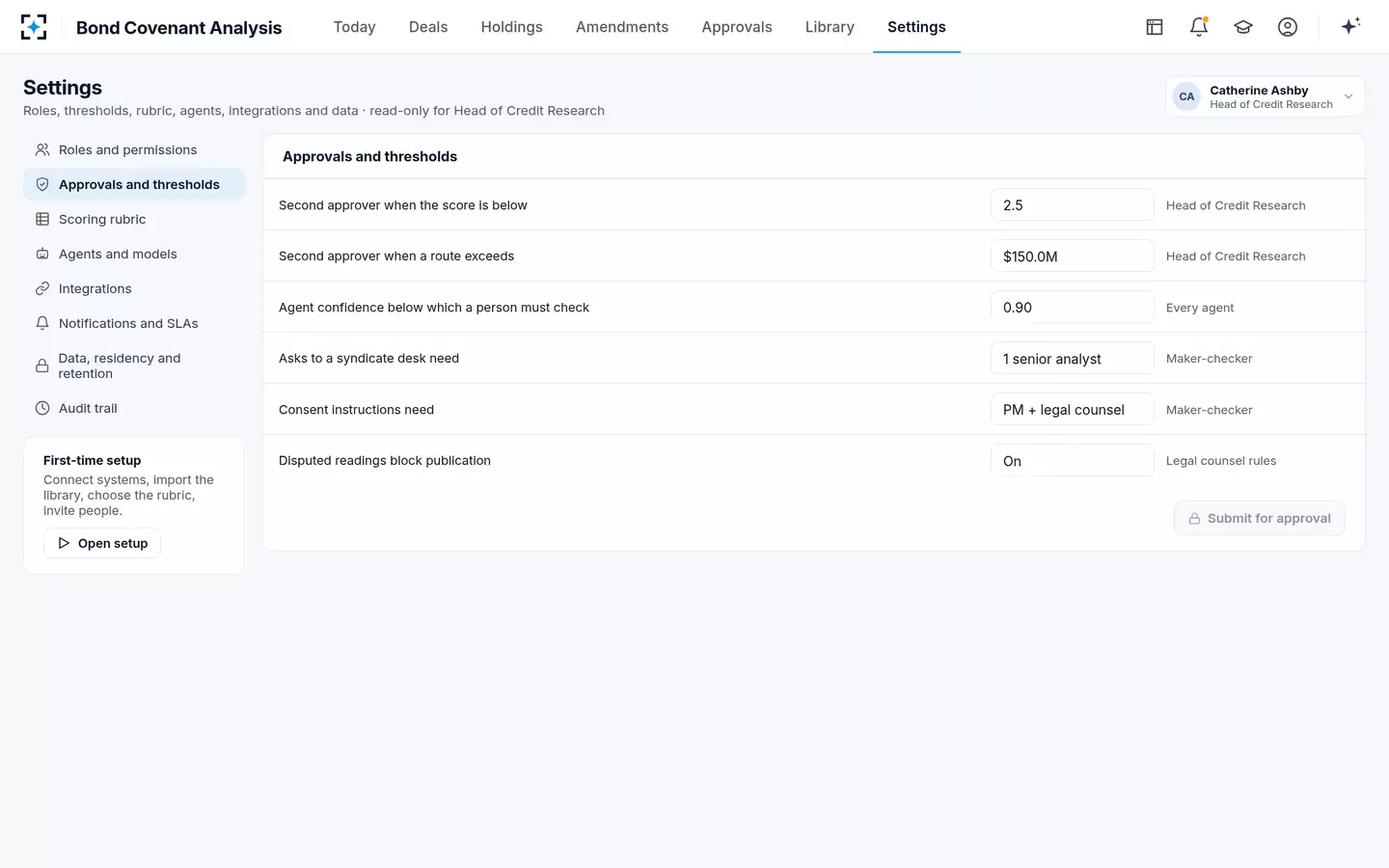
A firm should score with its own rubric, because the score has to mean what its portfolio managers already understand. In Bond Covenant Analysis the rubric is a setting: the sample firm's version 3.2 has eight weighted sub-scores, the head of credit research owns it, changes go to her for approval and onto the audit trail, and earlier versions (3.1 and 3.0) can be restored. The Benchmark agent applies the rubric; it never changes it.
Before importing a rubric, test whether two of the team's analysts apply it the same way; the covenant scoring system guide shows how to run that test and where rubrics usually need more words. A rubric that people cannot apply consistently will not become consistent by being automated.
Consent and amendment history: the part of a library no one can sell you
The most valuable records in a covenant database are often the ones about change: amendments, consent solicitations and waivers, each with what it altered and how the firm voted. They show which protections the firm defended and which it traded for a fee, and they let a new amendment be redlined against the document as it currently stands rather than as it was issued.
In the sample firm, the Amendment agent watches amendments, consents, waivers and 8-K designations on held deals, redlines each against the current document, re-scores it and dates the deadline; one term loan amendment that lifted the general liens basket from the greater of $100M and 50% of EBITDA to the greater of $250M and 100% was re-scored from 2.9 to 2.4 before the portfolio manager voted. What holders can lose by vote explains why that history matters.
The first month: from import to the first scored new issue
The first month is mostly import and checking, and the order matters: connect the documents and data, load the library and rubric, then compare the agents' readings with scores the team already trusts before anyone relies on a new one. The plan below is our suggestion for a team bringing the inputs above.
A first month with Bond Covenant Analysis, by week
- Connect documents, data feed, holdingsWeek 1
- Import library, rubric, rulingsWeek 2
- Re-score 20–30 known deals; compareWeek 3
- Live new issues, side by sideWeek 4
Where a vendor covenant service fits beside your own library
A subscription covenant service can add breadth — summaries of large public deals a firm does not hold — and some teams use one as a second reader. It does not replace the firm's own library for three reasons: it covers the deals a vendor chooses, its summaries are not the clauses, and it does not know the firm's rubric, rulings or votes. Vendors don't publish prices for these services, so the comparison a team can make is on coverage of its own holdings, which it can test by sampling them.
Bond Covenant Analysis is built to sit on the firm's own documents and systems rather than to replace a data subscription. It reads from the document store and syndicate mailboxes, takes twelve-month numbers from the financial data feed, syncs holdings from portfolio accounting each morning and writes pre-trade notes to the order management system only after two approvals. How the agents read and check once the library is in is covered separately.
Settings: the approvals and thresholds a firm brings with its rubric
Questions people ask
How do you build a covenant library?
Start with the final indentures and offering memoranda of deals you hold or recently reviewed, plus the scores and memos you wrote on them. Store each basket as its quoted clause, formula, defined terms, start date and cross-use, labelled with the deal's rating, sector, sponsor and vintage. Add amendments with effective dates and your votes, and version everything.
What data do you need for covenant analysis?
The document (offering memorandum, indenture and supplements), twelve-month financials to size grower and builder baskets, cumulative net income for builders, the amounts already used under each basket, and a peer set to compare against. For held bonds, add holdings and every amendment and notice since issue.
Are bond indentures public?
Many are: SEC-reporting companies file instruments defining their debt holders' rights as exhibits under Regulation S-K Item 601(b)(4), subject to a 10%-of-assets exception for unregistered debt. Rule 144A deals of private companies are not registered, their indentures are not qualified under the Trust Indenture Act, and they are usually available only to investors.
What is a covenant comparison?
A covenant comparison ranks each basket of one deal against the same basket in a defined peer set, usually as a share of EBITDA and in dollars. In the sample firm, Dunmore's unrestricted subsidiary basket at 19.4% of EBITDA sits against a peer median of 10.4%, looser than 88% of 318 deals. The comparison is only as good as the peer set and the consistency of the readings behind it.
Can the library include loans and private agreements?
Yes, and it should if the firm holds them; the sample library holds bonds and loans together, including 640 private and local-law agreements. Private-side loan documents sit behind the firm's information barrier, and the same barrier applies to the scores built from them.