A bond prospectus database is a searchable store of the offering documents behind bonds, and for public deals several exist and are free: the SEC's EDGAR for registered US offerings, the EU's network of issuer websites, national authorities and ESMA's prospectus register, the FCA's National Storage Mechanism in the UK, and the MSRB's EMMA for municipal bonds. What none of them holds is the Rule 144A offering memorandum, delivered privately to qualified buyers and never filed — and in 2017, the last year an SEC staff study counted, there were more Rule 144A offerings (2,099) than public debt offerings (1,846) (SEC DERA, 2018). For a credit desk that means its own inbox is the database for a large part of what it buys, and only as good as what it kept. Botminds' Prospectus Review keeps that archive as a by-product of reading: every preliminary memorandum, revised terms notice and final memorandum a desk receives is stored with its arrival time and hash, read into a cited one-page credit note, and searchable later.
The regulators' rules and data are linked where cited; product examples come from a fictional sample desk, Quillfield Capital, as it runs through the solution.
Where each kind of bond document lives, who can see it, and how to find it
US registered bond
Where the document isSEC EDGAR
Who can see itAnyone, free
When, and for how longFinal prospectus within two business days of pricing; EDGAR began in 1994/1995
Search byCompany name, CIK, form type, full text
EU prospectus or listed bond
Where the document isIssuer's or market's website; home authority; ESMA prospectus register
Who can see itAnyone, no registration or fee allowed
When, and for how longFrom approval; kept public at least 10 years; ESMA register since November 2020
Search byISIN, issuer LEI, approval date, document type
UK prospectus for a regulated market
Where the document isFCA National Storage Mechanism
Who can see itAnyone, free
When, and for how longUploaded after 6pm the next working day after approval
Search byCompany name, LEI, document type, keywords in the text
US municipal bond
Where the document isMSRB EMMA, the official repository since 2009
Who can see itAnyone, free
When, and for how longThe underwriter must receive the final official statement within seven business days of the sale agreement; official statements on file since 1990
Search byThe individual bond or its issuer
Rule 144A or Regulation S bond
Where the document isBookrunners' deal sites and the inboxes of invited buyers
Who can see itQualified buyers the banks chose to send it to
When, and for how longAt launch; versions follow by email
Search byWhatever the desk records when it arrives
Is there a database of bond prospectuses?
There are several, one per market, and none for private deals. Each public system exists because a law requires the document to be filed or published; the systems mirror the legal routes described in Rule 144A vs Reg S. Where no law requires publication — a 144A deal, a Regulation S deal not listed in the EU or UK, a private placement — no public database has the document, and commercial databases hold only what issuers or banks agree to give them.
The SEC describes EDGAR's reach precisely: companies "are required to file registration statements, periodic reports, and other forms electronically", and "anyone can access and download this information for free". The archive is old — "EDGAR started in 1994/1995" — but it holds only what was filed (SEC, Accessing EDGAR Data).
How long the public systems keep bond documents, and how fast they get them
1994
the year EDGAR began; earlier filings are on paper
10years
minimum that an approved EU prospectus stays public online
2
business days after pricing to file a final registered prospectus
Where can I find a bond prospectus?
Start from the route the bond was sold under. A registered US corporate bond has a final prospectus or prospectus supplement on EDGAR, filed within two business days of pricing (Rule 424(b)). A bond admitted to an EU regulated market has an approved prospectus on the issuer's or the market's website, listed by the home authority and copied to ESMA. A UK-listed bond's prospectus sits on the FCA's National Storage Mechanism. A municipal bond's official statement is on EMMA, which the SEC describes as providing "free public access to official disclosures", with official statements submitted to the MSRB since 1990 (SEC, Investor.gov); the underwriter must contract to receive the final official statement "within seven business days after any final agreement to purchase, offer, or sell" the bonds (Rule 15c2-12(b)(3)). What an official statement must disclose about the issuer's past filings, and how to check it, is covered in EMMA alerts and the late annual filing.
A 144A bond has none of these. Its memorandum came from the bookrunners at launch, with any revised terms notice by email and the final memorandum after pricing. If the issuer later registered an exchange offer, a registered prospectus for the exchange notes appears on EDGAR months after the deal; if the deal was "144A for life", it usually never does.
Are 144A offering memoranda public?
No. Rule 144A allows the bonds to be sold only to qualified institutional buyers, and nothing in the rule requires the offering memorandum to be filed or published. Since 2013 a 144A deal may be advertised, but the document still goes only to the buyers the banks choose. What the rule guarantees is narrower: for an issuer that does not report to the SEC, holders and prospective buyers have the right to obtain a short description of the business and recent financial statements on request (Rule 144A(d)(4)).
The prices are public even though the document is not. FINRA has disseminated 144A trades in TRACE-eligible securities since 30 June 2014 (FINRA Regulatory Notice 13-35), so anyone can see where a 144A bond trades without being able to read what it promises. Why the two documents differ in the first place is covered in offering memorandum vs prospectus.
Where are EU prospectuses published?
In three places at once, by law. The Prospectus Regulation requires an approved prospectus to be published on the issuer's, the offeror's, an intermediary's or the market's website, in a section that is "downloadable, printable and in searchable electronic format that cannot be modified", and says "Access to the prospectus shall not be subject to the completion of a registration process, the acceptance of a disclaimer limiting legal liability or the payment of a fee" (Regulation (EU) 2017/1129, Article 21). The home authority publishes the prospectuses or a list with links, and ESMA publishes everything the authorities send it, final terms included.
ESMA's register has been running in its current form since November 2020. Its economists describe it as a store in which national authorities "submit prospectus documents approved in their jurisdiction paired with a wide range of metadata (i.e. ISIN codes, issuer Legal Entity Identifier, approval date, etc.)", searchable "on either document or security level" (ESMA, Parsing prospectuses, 2022). In the 14 months to January 2022 it received 3,220 prospectus documents, 1,229 of them for debt securities, and over 5.3 million final terms. Two limits matter to a high-yield reader: a wholesale bond sold under an exemption and not admitted to a regulated market has no approved prospectus to register, and a listed 144A/Reg S deal's register entry is the listing document, not necessarily the memorandum the buyers were sent.
How to search bond documents by CUSIP or ISIN
It depends on the system, and only some search by security. ESMA's register is organised around ISIN codes and issuer LEIs. The FCA's National Storage Mechanism lets users "search all regulatory disclosures and documents using search criteria such as company name, LEI, document type, and keywords or phrases in the document content", and it moved to a new interface in October 2026 (FCA). EDGAR is organised by filer — company name, central index key and form type — so a CUSIP search usually starts by finding the issuer. For 144A memoranda there is no public search at all: the only identifiers attached to them are the ones the desk records when the document arrives.
That is the practical argument for indexing the desk's own archive by security identifier, issuer, deal and version from day one. At the sample desk each deal page carries the bond's ISIN, and every version of every document, the note and the decision sit under that one deal.
Can you get an offering memorandum after issuance?
Sometimes, from the issuer or the bookrunners, if you are a holder or a qualified prospective buyer; rarely from anywhere public. A non-reporting issuer's 144A holders have the Rule 144A(d)(4) right to basic information, and an indenture's reporting covenant may promise more, such as quarterly and annual reports posted to a restricted website. Neither obliges anyone to send a new holder the original memorandum. A desk that wants the document later — for a secondary purchase, a covenant question or an examiner — needs to have kept it.
Keeping it is also a records question for advisers. The SEC's books-and-records rule requires an investment adviser to keep the originals of written communications it receives about any recommendation made or proposed, or about placing or executing any order, for at least five years (Rule 204-2(a)(7) and (e)(1)). Whether a given memorandum falls inside that rule is for compliance; a desk that keeps every version it relied on does not have to argue the point.
How to build a prospectus archive your desk can search
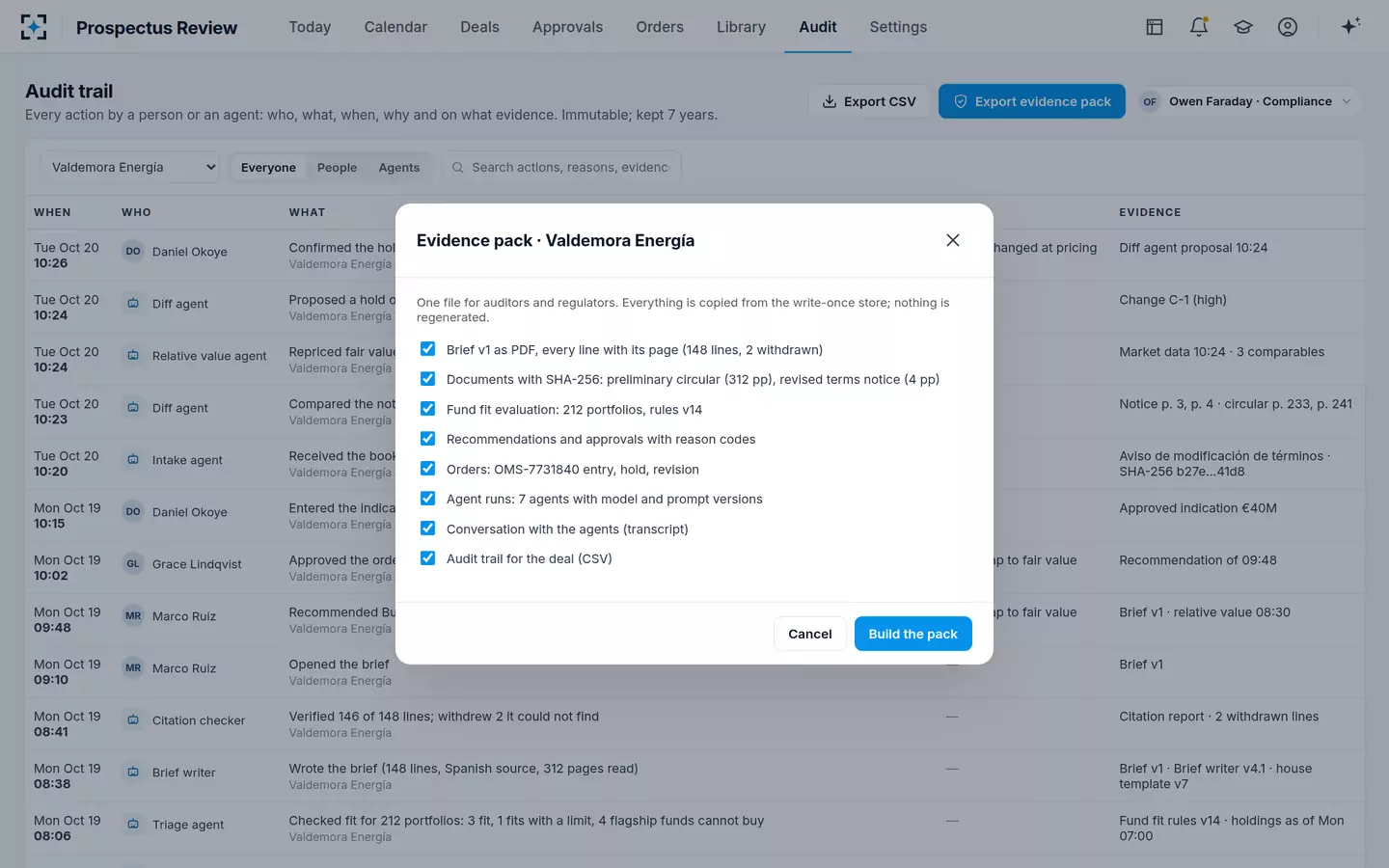
Capture at arrival, not at decision. The version that matters later is the one each person relied on at the moment they acted, so the archive has to record every document as it comes in — from the calendar feed, the bookrunners' emails or the deal site — with the time it arrived and a fingerprint that proves it has not changed.
What a usable bond document archive records for every deal
- Every version, kept separately
Preliminary memorandum, each revised terms notice, the pricing term sheet, the final memorandum. Never overwrite one with the next.
- When and how each arrived
Source (feed, email, deal site), sender and timestamp, so the time of sale can be reconstructed.
- A hash of each file
A SHA-256 fingerprint proves the document opened later is the one that was read.
- Identifiers and the deal
ISIN or CUSIP, issuer and legal entity identifier, linking every version to one deal.
- The language of the original
And, for a translated reading, the original sentence each English line came from.
- What the desk did with it
The note, the fit check, the recommendation, the approval and the order, each linked to the version it relied on.
- Duplicates merged, not deleted
The same memorandum from two bookrunners is one document with two arrival records.
- Retention and legal hold
At least the period your recordkeeping rules require, and a hold compliance can place.
Each document version kept with its hash, ready for an auditor
Buying a bond prospectus database: what to ask, and where Prospectus Review fits
Ask what the database cannot have. A commercial database can aggregate public documents and, by agreement, some private ones; vendors don't publish their coverage of 144A memoranda or their prices, so ask for both in writing. Then compare it with what your own inbox already holds, because for the deals you were invited to, you have the original and every version, and the database may not.
A market database vs your desk's own archive
Commercial bond document database: Aggregated across markets, searchable in one place.
The desk's own archive: Only the deals the desk looked at, unless it also pulls from EDGAR, ESMA and the NSM.
Commercial bond document database: Only those the issuer or banks agree to share; coverage varies.
The desk's own archive: Every deal the desk was sent, in every version it received.
Commercial bond document database: Rarely.
The desk's own archive: Yes, if captured at arrival.
Commercial bond document database: None.
The desk's own archive: The note, fit check, approvals and orders tied to the version used.
Commercial bond document database: Shows what existed.
The desk's own archive: Shows what the desk knew, when, and what it did.
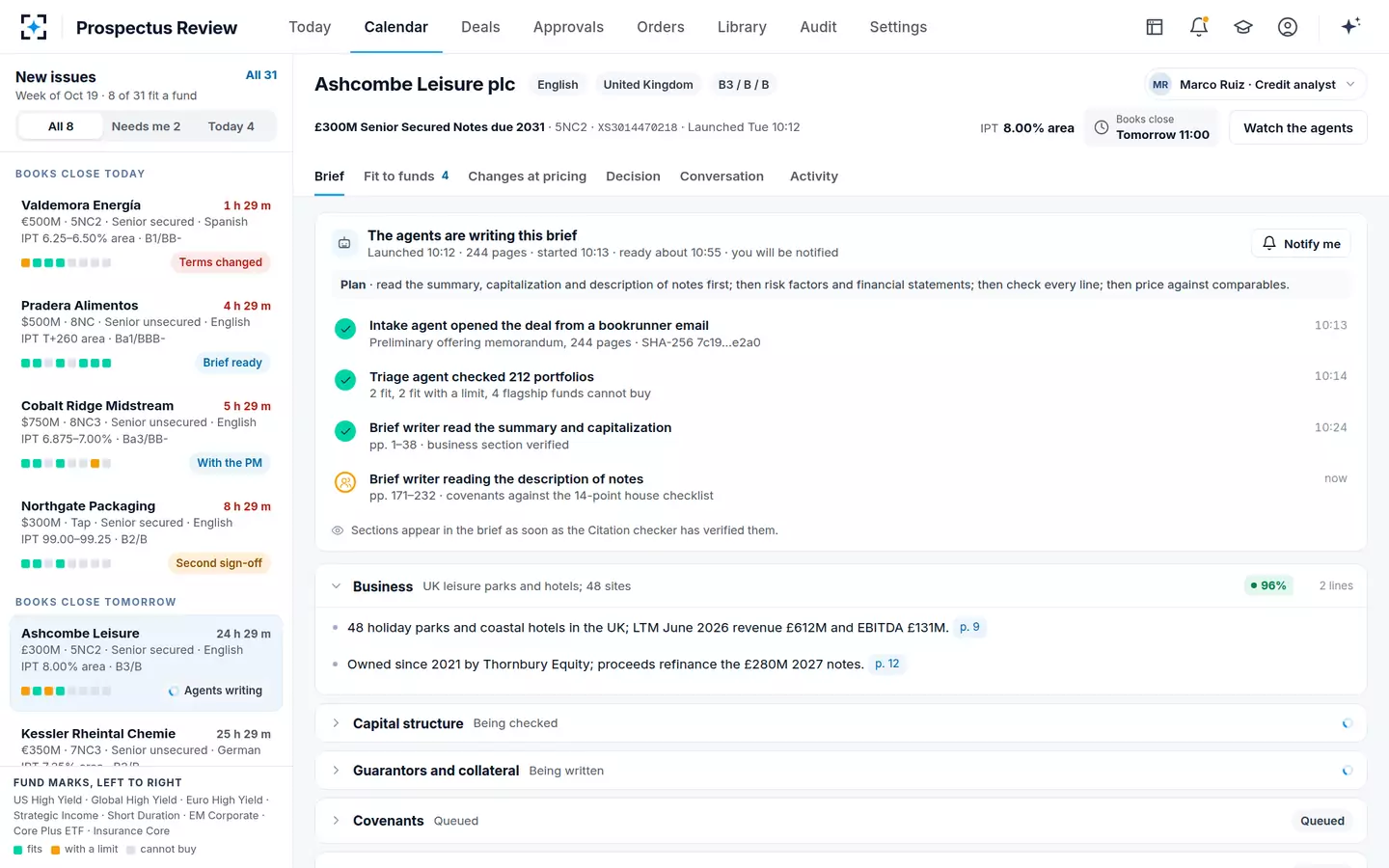
The solution fits the second column. Its Intake agent opens each launched deal from the syndicate calendar feed, the bookrunners' emails and deal sites, fetches every document version and merges duplicates; the reading, the fit check, the comparison of versions and every decision are stored against those versions; and the agents can be asked across past deals later — every deal this year that dropped a change of control put, say, or every deal not in English. It is not a market-wide database of deals the desk was never sent, and it never accepts private-side material. How to test it on the deals already in your inbox is the subject of replay last quarter's launches before you buy; to see the archive build as it reads, start from Prospectus Review.
Every new document opened, read and stored as it arrives
Questions people ask
How to find a corporate bond prospectus?
Check the route first. For a registered US bond, search EDGAR for the issuer and look for a prospectus supplement filed around the pricing date; for an EU- or UK-listed bond, search ESMA's register or the FCA's National Storage Mechanism by ISIN or issuer. For a 144A bond, ask the bookrunners or the issuer, and expect to need to show you are a qualified institutional buyer.
Is a bond prospectus the same as an indenture?
No. The indenture is the contract between the issuer and a trustee for the holders; the prospectus or offering memorandum describes the bonds and the issuer to buyers and summarises the indenture in its description of notes. For registered bonds the indenture is filed with the SEC; for 144A bonds it is usually available only to holders.
Does EDGAR have offering memoranda?
Not for Rule 144A deals, because they are not filed. EDGAR may later carry a registered prospectus for an exchange offer of the same bonds, and the issuer's periodic reports if it becomes an SEC reporter, but not the original memorandum the first buyers read.
How long must EU prospectuses stay online?
At least ten years after publication, on the websites where they were published and on ESMA's. The rule applies to approved prospectuses; a bond sold under an exemption without an approved prospectus is not covered.
Can I get bond documents from FINRA TRACE?
No: TRACE carries trade reports, not documents. It does show, for each new issue, whether Rule 144A applies, and it has disseminated 144A trade prices since June 2014, which is often the quickest public way to confirm a 144A bond exists and trades.