A pricing term sheet is the short document the bookrunners issue when a new bond prices: it states the final coupon, issue price, yield, size, settlement date and identifiers, and any term that differs from the preliminary offering memorandum — a call schedule, a basket, a put. Together with the preliminary memorandum and any revised terms notice, it is what the buyer knew at the time of sale, and US securities law judges disclosure by what was conveyed by then. The risk for a buy-side desk is simple: an order approved on Monday's reading of the preliminary memorandum can stand on Tuesday on terms that no longer exist, unless someone compares the new version with the old clause by clause. Botminds' Prospectus Review does that comparison automatically for every revised terms notice and final memorandum, rates each change, and sends the decision back to the people before books close.
The deal used throughout is a fictional sample run through the solution by a fictional desk, Quillfield Capital. The legal texts are quoted from the eCFR, the Federal Register, the Supreme Court and EUR-Lex.
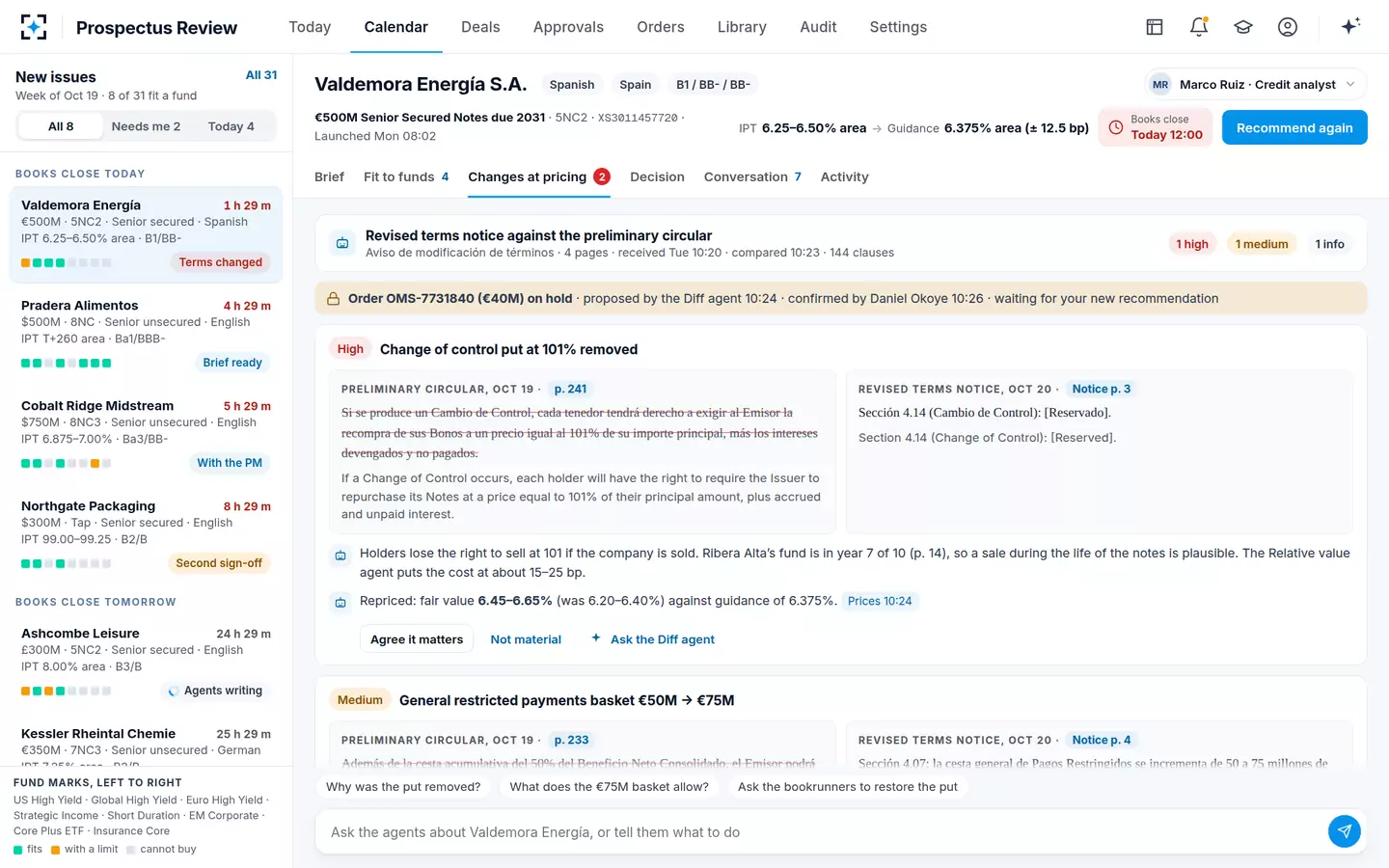
What changed at pricing on one deal: preliminary circular vs revised terms notice
Preliminary offering circular, Monday: Each holder may require the issuer to repurchase its notes at 101% of principal plus accrued interest (p. 241).
Revised terms notice, Tuesday 10:20: "[Reservado]" — the clause is removed (notice p. 3). Rated high.
Preliminary offering circular, Monday: €50 million (p. 233).
Revised terms notice, Tuesday 10:20: €75 million (notice p. 4). Rated medium.
Preliminary offering circular, Monday: 144 clauses in the Spanish original.
Revised terms notice, Tuesday 10:20: One further change, rated for information.
Preliminary offering circular, Monday: 6.20–6.40% against guidance of 6.375%.
Revised terms notice, Tuesday 10:20: 6.45–6.65% against the same guidance.
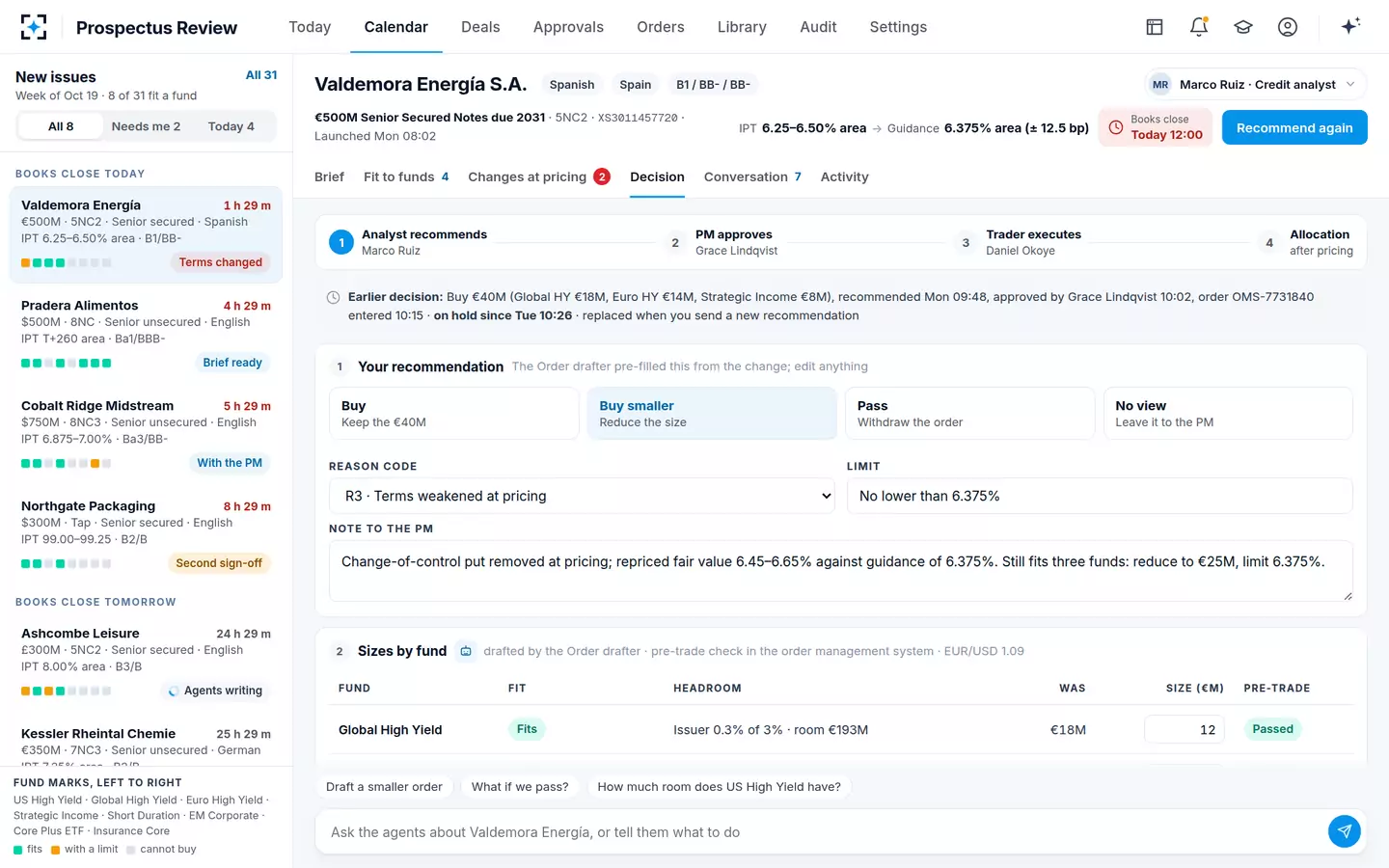
Preliminary offering circular, Monday: Buy €40 million across three funds, approved Monday 10:02.
Revised terms notice, Tuesday 10:20: Hold proposed 10:24, confirmed by the trader 10:26; revised to €25 million, limit no lower than 6.375%, by 10:44.
What is a pricing term sheet?
It is the final-terms summary of a bond, issued at pricing. In a registered US offering it is usually a free writing prospectus, and the SEC requires the issuer to file one "that contains only a description of the final terms" within "two days of the later of the date such final terms have been established for all classes of the offering and the date of first use" (Rule 433(d)(5)(ii)); the final prospectus follows "no later than the second business day" after pricing (Rule 424(b)). In a Rule 144A deal nothing is filed: the term sheet goes to the buyers by email, and the final offering memorandum, dated at pricing, follows before settlement.
The pricing term sheet is short, often one or two pages, and that is its danger. A change to a covenant can appear as one line among the coupon, the yield and the settlement date, and a revised terms notice sent before pricing may be four pages in the issuer's language. Neither repeats the context the analyst read on Monday.
Three clocks that start when a bond prices
2days
to file a registered deal's final-terms free writing prospectus with the SEC
2bus. days
to file the final registered prospectus, so it appears on EDGAR
3work days
for buyers in an EU public offer to withdraw after a prospectus supplement
Can bond terms change at pricing?
Yes. Until the bonds price, the issuer and bookrunners can change any term to clear the book: tighten or widen the coupon, change the size, move a call date, add or remove a covenant. An issuer can loosen terms only when demand allows it, and may add protection to win over a weak book. Either way the change arrives late in the deal, when the desk is reading other launches.
At the sample desk the change came 100 minutes before books closed. The bookrunners' revised terms notice for Valdemora Energía, a four-page Aviso de modificación de términos, removed the change of control put at 101% and raised the general restricted payments basket from €50 million to €75 million. The Diff agent compared it with the 312-page preliminary circular in three minutes, 144 clauses in the original Spanish, and rated the put's removal high.
Changes at pricing: the revised notice against the preliminary, clause by clause
What is the time of sale information, and what is Rule 159?
The time of sale is the moment the buyer commits — in a bond deal, usually when the order is confirmed at pricing — and the time-of-sale information is everything conveyed to the buyer by then: the preliminary memorandum, any revised terms, the pricing term sheet, what was said on calls. Rule 159 says that, for the Securities Act's section 12(a)(2) and separately for section 17(a)(2), information that reaches the purchaser only after the time of sale, or the contract of sale, is left out when judging whether the disclosure was misleading (17 CFR 230.159).
The SEC adopted the rule in 2005 as part of Securities Offering Reform, and it was blunt about the principle.
"In our view, the interpretation that liability under Section 12(a)(2) and Section 17(a)(2) should be determined based on information conveyed at the time of sale (including a contract of sale) is unassailable."
SEC, Securities Offering Reform, Release 33-8591, 70 FR 44722 (3 August 2005)
For the issuer and banks this means a material change must reach the buyer before the sale, not in the final memorandum afterwards. For the buyer it means the reverse discipline: whatever was conveyed by the time of sale is what the buyer will be taken to have known, whether or not anyone on the desk compared it with Monday's reading.
What a 144A buyer can and cannot rely on after pricing
Less than a buyer of registered bonds. The Supreme Court in Gustafson v. Alloyd confined the statutory "prospectus" to documents describing public offerings (513 U.S. 561 (1995)), so the section 12(a)(2) remedy that Rule 159 shapes is generally out of reach for a private 144A sale — the contrast offering memorandum vs prospectus sets out. Rule 159(b) still applies to section 17(a)(2), which reaches private sales too, and the general antifraud rule, Rule 10b-5, applies to any purchase (17 CFR 240.10b-5).
The practical point is the same either way: the buyer's best protection is its own comparison before the order stands. If a protection disappears at pricing and the buyer was told, the buyer bought the bonds without it. The SEC's 2005 release also describes how a sale can be reset when new information arrives after a contract: the parties may terminate the old contract and enter a new one, but "any rights to damages with respect to material defects in information in respect of the original contract of sale would cease to exist", and the investor must have "a meaningful ability to elect to terminate or not terminate the prior contract and to elect to enter into or not enter into the new contract" (Release 33-8591). An order revised on new terms is a new decision, and it should be made by the people who made the first one.
Which document counts, and when
| Document | When it arrives | Filed or public? | Part of what the buyer knew? |
|---|---|---|---|
| Preliminary offering memorandum | At launch | 144A: private; registered: filed | Yes, as read at launch |
| Revised terms notice | Before pricing, sometimes in the last hours | Private in a 144A deal | Yes, if it arrived before the order was confirmed |
| Pricing term sheet | At pricing | 144A: private; registered: free writing prospectus filed within two days | Yes, if conveyed before the time of sale |
| Final offering memorandum or prospectus | After pricing, before settlement | 144A: private; registered: filed within two business days | Only what was already conveyed; anything new after the sale is not taken into account |
Pricing supplement vs term sheet vs final terms
They are the same idea in three settings. A pricing term sheet closes a standalone deal. A pricing supplement closes one issue under a medium-term note or shelf programme, adding the issue's terms to a base document; for a registered shelf it is filed under Rule 424(b). In the EU, "final terms" do the same job under a base prospectus: they "shall only contain information that relates to the securities note and shall not be used to supplement the base prospectus", and must be made public and filed "as soon as practicable upon offering securities to the public" (Regulation (EU) 2017/1129, Article 8).
The EU draws a line the reader should notice. Final terms may not change the base prospectus; a "significant new factor, material mistake or material inaccuracy" requires a supplement, and buyers in a public offer who had already agreed to buy may withdraw "within three working days after the publication of the supplement" since the Listing Act took effect in December 2024 (Regulation (EU) 2024/2809). A wholesale bond sold under an exemption and not admitted to a regulated market has no supplement and no withdrawal right; a change simply appears in the next document.
How to compare preliminary and final terms
Compare the documents, not the summaries, and in the language of the original. The term sheet's description of a change may be accurate and still incomplete: a changed defined term reaches every covenant that uses it, and a larger basket can combine with others the issuer already has. A useful comparison starts from every clause of the preliminary, finds its counterpart in the new version, and rates the difference by what it does to the bondholder.
A clause-by-clause comparison at pricing
- Compare against the version the order was approved on
Not the latest summary. The preliminary memorandum page and the new notice page, side by side.
- Read the original language
A Spanish "[Reservado]" is a removal; a translation can soften it.
- Cover every clause, then rate
High for a protection removed or a basket widened materially; medium for a change in size; information for drafting.
- Follow the definitions
A changed defined term changes every covenant that uses it.
- Reprice
What is the change worth against guidance? On the sample deal fair value moved from 6.20–6.40% to 6.45–6.65%.
- Hold the standing order until people decide
Proposed by the comparison, confirmed by the trader, then recommended, approved and revised before books close.
- Compare the final memorandum too
When it arrives after pricing, check it against what was conveyed; a difference there is a question for the bookrunners and counsel.
Who should hear about a change at pricing, and in what order?
The trader first, the analyst second, the portfolio manager third, and compliance afterwards with the whole sequence. The order matters because the only thing that can go wrong in the next hour is an approved order standing on the old terms. On the sample desk the Diff agent proposed a hold on the €40 million order at 10:24, one minute after the comparison; the trader confirmed it at 10:26. The agent cannot hold, change or cancel an order itself, which keeps the order book in human hands and gives the trader a reason to look before books close.
Then the decision goes back to the person who made it. The analyst's earlier recommendation is reopened, with the change, its pages and the repricing in front of them; the portfolio manager approves a new size only for their own funds; and the trader revises the order to no more than the approved size. Compliance does not need to be in the room. It needs to know afterwards which version each person relied on, when the change arrived, who held and who approved — on the sample desk, a write-once trail of every person's and agent's action, with the hash of each document version, exportable as one evidence file per deal.
Without that sequence, a desk can find out at allocation, when the confirmation arrives on terms nobody re-approved. The rule that what was conveyed by the time of sale is what counts cuts both ways: the change was conveyed, so the fund owns it.
What is a covenant change at pricing, and what is it worth?
It is any change to the protections in the description of notes made between launch and pricing, and its value depends on the issuer. The removal of a change of control put matters most where a sale is likely. In the sample deal the issuer's owner held it through a fund in year seven of ten, so a sale during the life of the notes was plausible; the Relative value agent put the cost of losing the put at about 15–25 basis points and moved fair value above the 6.375% guidance. The mechanics of the put itself, and its triggers, are a subject for covenant analysis; what matters here is that the change arrived after the order was approved.
The desk's answer was not to walk away but to resize. The analyst kept a buy, reduced it from €40 million to €25 million across the three funds that could hold it, set a limit no lower than 6.375%, and recorded reason code R3, terms weakened at pricing; the portfolio manager approved at 10:39 and the trader revised the order at 10:44.
The decision, rebuilt on the new terms
Whether the desk would have read the deal at all depended on the earlier clock — from initial price talk to books closed — and whether the change could be traced to the page it came from depends on the citation trail described in the description of notes, hop by hop. To see every new version compared on your own deals, start from Prospectus Review.
Questions people ask
What is a final offering memorandum?
The version of the offering memorandum dated at pricing, with the coupon, price, size and any changed terms filled in. The bonds are issued under it. It should match what was conveyed by the time of sale; comparing it with the preliminary and the term sheet is the last check before settlement.
Is a pricing term sheet legally binding?
The term sheet describes terms; the binding contract for the bonds is the indenture, and the purchase is confirmed in the trade confirmation. For disclosure purposes, though, the term sheet is part of what the buyer was told at the time of sale, so a change it announces is one the buyer is taken to know.
What is a revised terms notice?
A notice from the bookrunners before pricing that changes terms in the preliminary memorandum. In the sample deal it was four pages, in Spanish, and removed a change of control put while widening a restricted payments basket. It deserves the same clause-by-clause comparison as the term sheet.
Can I cancel my order if the terms change?
Before books close a buyer can usually revise or withdraw an order with the bookrunners; after the sale, the SEC's 2005 guidance says a reset needs both sides to agree to terminate the old contract and enter a new one, with the investor given a meaningful choice. In an EU public offer, a supplement gives buyers three working days to withdraw.
Why would an issuer remove a covenant at pricing?
Because the book can bear it: when demand exceeds the deal, the issuer and bookrunners can loosen terms and still sell the bonds. A removal can arrive late and in a single line, which is why the comparison has to be run on every new version rather than on the headline.