Prospectus review, on a buy-side credit desk, is the work of reading each new bond's prospectus or offering memorandum — often 300 pages, sometimes in another language — checking which funds may hold the bond, pricing it against comparables and comparing every revised version, so that a portfolio manager can approve an order before books close. Regulators use the same words for something else: a securities authority's scrutiny of a draft prospectus before approval. Software for the desk's version is only worth buying if it does that work correctly on the desk's own deals, and the cheapest way to find out is to replay a quarter of launches the desk has already decided. Botminds' Prospectus Review is designed to be tested that way: its agents check fit against your fund rules, write a one-page credit note with every line cited to its page, compare each new version clause by clause, and leave every recommendation, approval and order to your people — and every one of those outputs can be scored against what your desk actually did.
Product examples come from a fictional sample desk, Quillfield Capital, as it runs through the solution; the pilot plan is ours, and the rules are quoted from regulators' texts.
A two-week replay of 20 past launches, day by day
- Gather documents and decisionsDays 1–2
- Fund rules proposed and approvedDays 3–4
- Replay: fit, notes, version comparisonsDays 5–7
- Analysts score every outputDays 8–9
- DecisionDay 10
- Research operations: documents1.5 d
- Compliance: rule review1 d
- Two analysts scoring; head of research deciding3.5 d
What is prospectus review?
It means two different jobs, and a search for it finds both. For a securities regulator it is the scrutiny of a draft prospectus before approval: in the EU the competent authority must decide "within 10 working days of the submission of the draft prospectus", extended to 20 working days for an issuer coming to market for the first time (Regulation (EU) 2017/1129, Article 20), and since the Listing Act ESMA must publish a yearly report on how well authorities keep to those limits (Regulation (EU) 2024/2809). That is the issuer's problem.
For a buy-side credit desk, prospectus review is the buyer's reading of the same document, or of a 144A offering memorandum that no regulator ever reviews, under a much shorter clock: the hours between launch and books closing. It covers fund fit, the credit read, relative value, the comparison of revised terms with the preliminary, and the decision trail. This guide is about the second job, and about how to test a tool that claims to do it.
How long does prospectus review take?
By hand, about 11.5 analyst hours for one high-yield deal with a 300-page memorandum, by our estimate: half an hour to find the deal and its documents, an hour on fund fit, six hours reading and writing the one-page note, an hour on relative value, two hours comparing revised and final terms, and an hour on the recommendation, approval and order. Our estimate for the same steps with Prospectus Review is about 1.5 hours of the analyst's time, because the agents do the finding, the fit check, the first reading and the comparison, and the analyst checks and decides.
What the sample desk sees, and what the design targets
4min
from launch to fit checked against 212 portfolios on the sample deal
39min
from launch to a cited one-page note on a 312-page Spanish circular
100%
of term changes announced before books close compared clause by clause and flagged — the target
Those are sample figures and a target, not proof. The replay below is how a desk turns them into its own numbers.
How to test prospectus review software: replay, don't demo
Test it on deals whose answers you already know. A vendor demonstration uses a clean memorandum chosen by the vendor; a replay uses twenty of your own past launches, each with the documents you received, the funds you ran, the decision you took and, now, the outcome. Every output the tool produces can then be compared with a known right answer, and the comparison is done by your analysts.
Choose the twenty to be hard. Include deals in each language you see, at least five whose terms changed between the preliminary memorandum and pricing, a few the desk passed on and a few where a fund could not buy. Include one with a bad scan. Withhold your own notes and decisions from the tool, then score its fit calls, its notes and its comparisons against them. Regulators' expectations point the same way: FINRA's 2026 report asks firms to test a generative tool thoroughly enough to know what it can do, where it fails and how well it performs, with privacy, integrity, reliability and accuracy among the areas to test (FINRA, 2026 Annual Regulatory Oversight Report; how to run that test on your own sources is set out in best AI for investment research? Prove it on your own sources).
What to bring to a two-week replay
- Twenty past launches, every version
Preliminary memorandum, revised terms notices, pricing term sheet and final memorandum, as received, with arrival times if you have them.
- Your fund documents
Prospectuses and investment management agreements for the portfolios in scope, so fit rules can be proposed from their clauses.
- Holdings as of each launch date
So fit and headroom are judged as they stood at the time, not today.
- Your note template and covenant checklist
The tool should write to your house template, not its own.
- What the desk actually decided
Recommendations, sizes, passes and reasons, kept back from the tool until scoring.
- Two analysts' time to score
About three days between them: the score is only as good as the people checking it.
What to score: six measures that decide the purchase
Score what would have changed an order, not the prose. Six measures cover it, and the desk should set its own pass marks before the replay starts so the result is not argued afterwards.
A scorecard for a prospectus review pilot
| Measure | How to score it | Why it matters |
|---|---|---|
| Citation accuracy | Share of note lines found on their cited page, in the original language, checked by an analyst | A line that is not on its page is a line nobody can rely on |
| Withdrawn lines | Lines the tool withdrew itself, and lines it should have withdrawn but did not | Shows whether the tool catches its own errors |
| Gaps found | Covenant gaps and silences the analysts had flagged at the time, found or missed | The findings that change sizes and limits |
| Fund fit | Fits, fits with a limit, cannot buy: each call against compliance's view at the launch date | A wrong fit call is either a breach or a missed deal |
| Changes at pricing | Term changes caught, rated correctly, and how long after the notice arrived | The check most desks skip, and the one that protects an approved order |
| Time to note | Minutes from the launch email to a checked note, against the guidance time | A note after guidance is worth less; after books close, nothing |
Two checks keep the score honest. Plant at least one error — a page out of order, a basket changed in a revised notice — and see whether it is caught. And score the version comparisons on the deals whose terms you know changed: on the sample desk the comparison of a four-page revised terms notice with a 312-page preliminary circular, 144 clauses, took three minutes and rated the removal of a change of control put high, but your own deals are the test. What the comparison should catch is set out in what changed at pricing.
Can AI review prospectuses in other languages?
It has to, in Europe. ESMA's machine reading of every prospectus approved in the EU between November 2020 and January 2022 found documents "drafted in 21 different languages" — "Almost 50% of docs are issued in English," its chart notes — and 303 documents contained more than one language (ESMA, Parsing prospectuses, 2022). A high-yield desk buying European deals will meet Spanish, German and French originals, among others, and a translation it cannot check is a risk it cannot see.
The test is the original wording. On the sample desk every line of a note on a Spanish circular opens the Spanish page beside the English, and the second agent re-checks each line against the original rather than the translation. In a replay, include at least one deal in each language you buy and have an analyst who reads it score those notes.
What records does compliance need for new issues?
Enough to show who decided what, on which version of which document, when and why. For a US adviser, the books-and-records rule covers written communications received or sent relating to recommendations and to placing orders, kept for at least five years (Rule 204-2). On the sell side in the EU, the bank placing the bonds must record and justify each final allocation (Delegated Regulation (EU) 2017/565, Article 43). And where AI is used, ESMA expects firms to keep records of how it was used, including the data sources and changes over time (ESMA public statement on AI, May 2024).
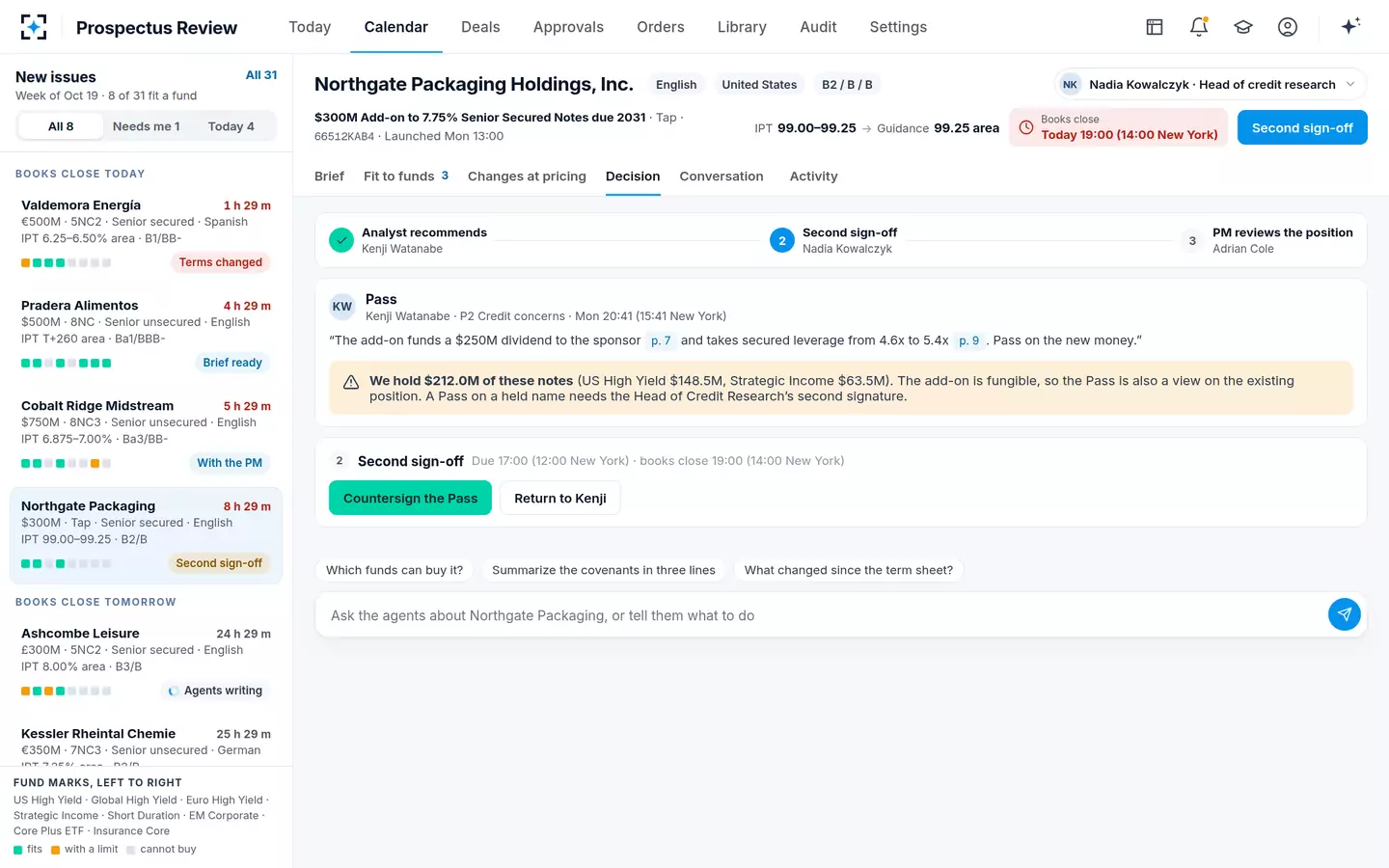
A pilot should produce the same evidence the live desk would: for each replayed deal, the documents with their fingerprints, the fit check and the rule version applied, the note with its withdrawn lines, the comparisons, and — in live use — the recommendations, approvals and orders with reason codes. On the sample desk compliance exports this as one evidence file per deal, and a Pass on a name the funds already hold needs the head of credit research's second signature.
A Pass on a held name waits for a second signature
What a prospectus review pilot costs, and what it is worth
The desk's cost is time, about six person-days on our plan: research operations gathering documents, compliance reviewing the proposed fund rules, two analysts scoring, the head of research deciding. Vendors don't publish prices for prospectus review software, so ask for the licence and setup cost in writing alongside the pilot terms, and price it against what the desk loses today.
Two numbers make that loss concrete. The hours: about ten analyst hours saved per properly read deal on our estimate, multiplied by the eligible launches a quarter. And the deals: every launch a fund could have bought but nobody read in time is a concession forgone, and every approved order that stood on terms changed at pricing is a risk nobody priced. What reading a deal too late costs works through the arithmetic. Public trade prices make the second number measurable: TRACE has disseminated Rule 144A corporate bond trades since June 2014 (FINRA Regulatory Notice 13-35), so the replay can show where each unread deal traded after issue.
Where Prospectus Review fits, and where it does not
It fits a public-side buy-side credit desk that reads new high-yield and crossover deals for several funds, in more than one language, and needs fit, a cited note and a version comparison before books close, with a record compliance can export. It is designed to work with the systems such a desk already runs: the syndicate calendar feed and mailboxes, deal roadshow sites, portfolio accounting for holdings and headroom, the order management system for pre-trade checks, market data for relative value, and research and document management for the notes.
Your mandates, approved by compliance, not the tool's
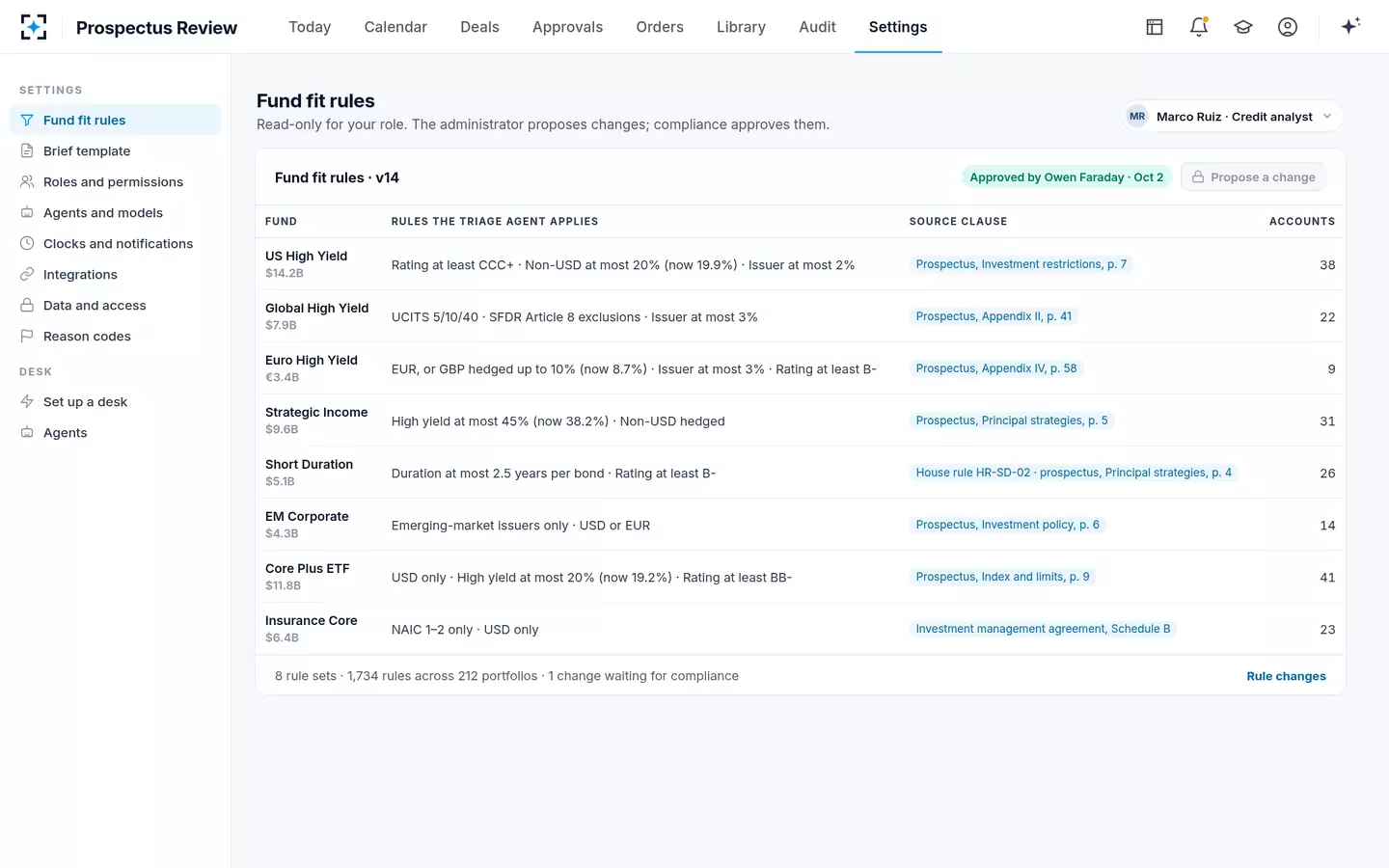
It does not fit where the goal is to automate the buying: the agents never recommend, approve, send, change or cancel an order, and the trader never sends more than the approved size. It does not read private-side material, and it is not a market-wide database of deals the desk was never sent. And it is only as good as the fund rules and house template the desk gives it, which is why the pilot starts with them. What the agents do when a memorandum is silent or unreadable — the behaviour a replay should probe hardest — is set out in agents that ask the bookrunners; where the documents themselves live is in why 144A deals are not in EDGAR. To set up a replay on your own launches, start from Prospectus Review.
Questions people ask
What software reviews bond prospectuses?
Three kinds: general AI document tools that summarise any file, data services that extract terms from public filings, and desk tools built around the new-issue workflow. The questions that separate them are whether every line is cited and re-checked against the original page, whether fit is checked against your own fund rules, and whether revised terms are compared with the preliminary before books close.
What does a prospectus review tool cost?
Vendors don't publish prices, so ask for licence and setup costs in writing. Weigh them against the desk's own numbers: our estimate is about 11.5 analyst hours per properly read high-yield deal by hand and about 1.5 with the solution, and every eligible deal left unread forgoes its new issue concession.
How to pilot AI in credit research?
On closed work with known answers. For new issues that means replaying last quarter's launches with the documents as received and the desk's own decisions withheld, then having analysts score citation accuracy, gaps found, fund fit, changes at pricing and time to note against pass marks set beforehand.
How long does a regulator take to review a prospectus?
In the EU, the competent authority must decide within 10 working days of a draft's submission, or 20 for a first-time issuer, and later resubmissions run on the 10-day clock. A Rule 144A offering memorandum is not reviewed by any regulator, which is why the buyer's own review carries more weight.
Can the pilot run on deals in other languages?
It should. Include at least one past deal in each language the desk buys, and have an analyst who reads that language score those notes against the original pages; on the sample desk notes on Spanish, German and French deals open the original page beside the English.