Initial price talk, or IPT, is the opening indication of where a new bond will price — a yield or spread range such as "6.25–6.50% area" — that the bookrunners announce when they launch the deal and open the order book. It is followed by tighter guidance, sometimes by revised terms, then by pricing and allocation. The hours between IPT and books closing are where a buy-side credit desk wins or loses a new issue: the portfolio manager cannot approve an order until the analyst has read a 300-page offering memorandum and checked which funds may hold the bond, and the trader cannot act until the manager approves. Botminds' Prospectus Review is built around that clock: its agents check fit and read the memorandum into a cited one-page credit note within the hour, so the people who decide spend the time deciding.
The timings below come from a fictional sample desk, Quillfield Capital, as it runs through the solution, and from published research on how bonds are priced and allocated.
Who waits on whom between initial price talk and books closed
Credit analyst
On whomBookrunners
For whatThe preliminary offering memorandum, every revised version, and answers to questions about gaps in it
Against which clockFrom launch; questions only help if answered before books close
Credit analyst
On whomFund rules and holdings
For whatWhich portfolios may hold the bond at all, and how much room each has
Against which clockShould be known before reading starts; by hand it often comes last
Portfolio manager
On whomCredit analyst
For whatA recommendation, a size and a limit for each fund
Against which clockBefore the PM's own approval deadline, set back from books close
Trader
On whomPortfolio manager
For whatAn approved order: sizes by fund and a price limit
Against which clockBefore books close; every change at pricing restarts this wait
Everyone
On whomBookrunners
For whatGuidance, revised terms and the final terms, which can reopen every step above
Against which clockUnpredictable; can land in the last hours
Investment compliance
On whomAll of the above
For whatWho decided, on which document version, at what time and why
Against which clockAfter the deal; months later in an exam
What is initial price talk (IPT) in bonds?
IPT is the bookrunners' first public range for the coupon or spread, set before they know how much demand there is. "6.25–6.50% area" invites orders around that yield; "T+260 area" does the same as a spread over Treasuries. As orders arrive the bookrunners publish guidance, typically a narrower range or a single level with a tolerance, and finally the price.
The first published study of this process in corporate bonds, using newly available initial-price data, found that the movement from IPT to the final price behaves the way bookbuilding theory predicts: the updates "reduce underwriters' pricing errors", and "underwriters propose a lower initial price in cases of greater uncertainty" — a higher yield, in bond terms. It also found something less comfortable for buyers.
"The CB price update has a large mean value and is smaller for lower-rated offerings, indicating part of the CB price update is unrelated to investors' information production."
Liying Wang, 'Lifting the veil: The price formation of corporate bond offerings', Journal of Financial Economics 142 (2021)
Read from the buy side, the price usually moves between IPT and pricing, and not only because of what investors learned. An analyst who has not finished the memorandum when guidance tightens is deciding whether to stay in the book at a level that is no longer the one the deal launched at.
What happens between IPT and pricing?
Five things happen, and only one of them is the buyer's own work. The bookrunners send the preliminary memorandum and hold calls or a roadshow; investors read and place orders, often with price limits; the bookrunners publish guidance as the book builds; the terms may change in a revised terms notice; and the deal prices, after which the bonds are allocated and can trade. FINRA must be told of a new corporate bond, including the time it priced, before its first trade (FINRA Rule 6760).
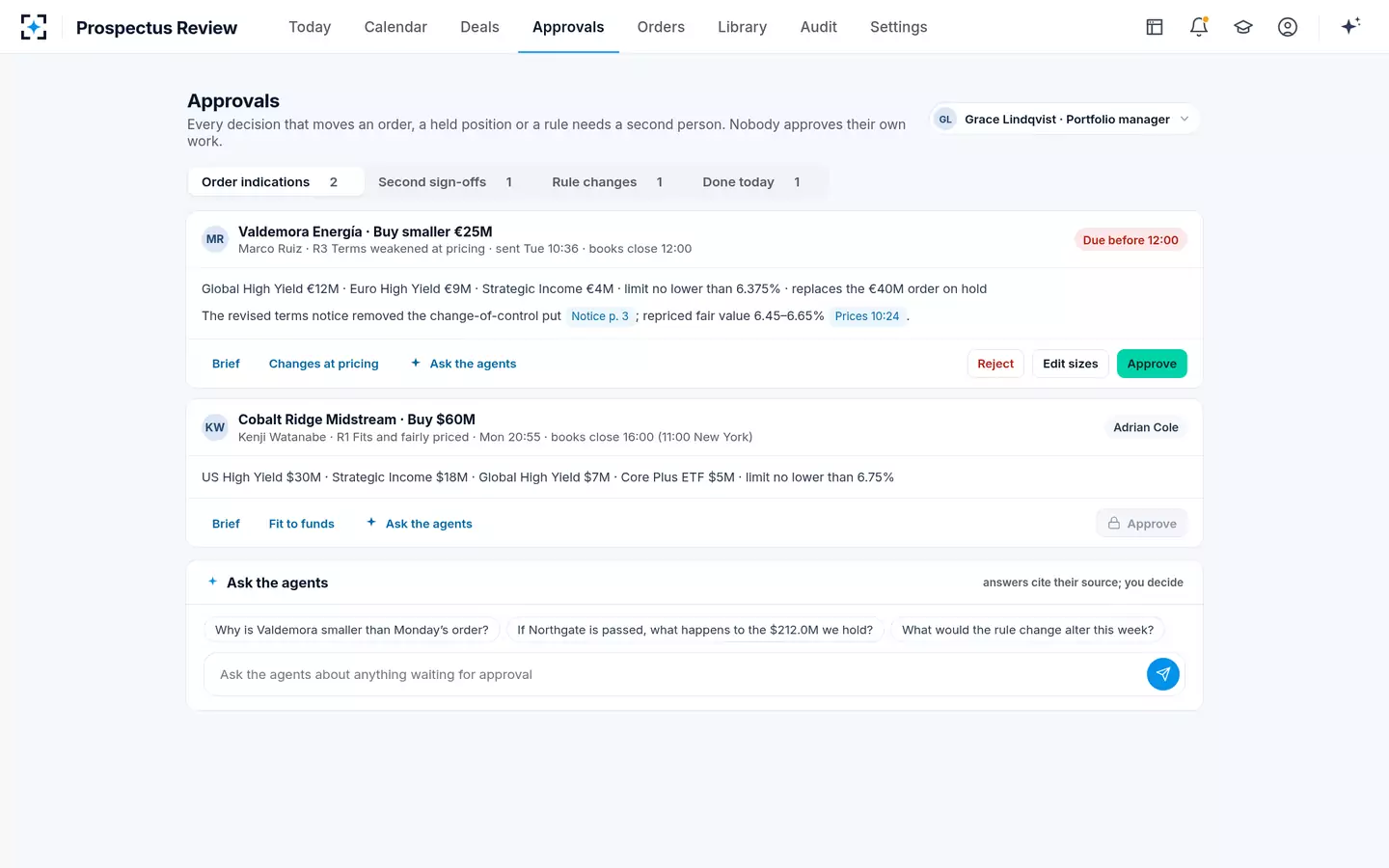
The buyer's work is the second step, and it is the slowest. At the sample desk a Spanish issuer, Valdemora Energía, launched €500 million of senior secured notes at 08:02 on a Monday with IPT of 6.25–6.50% area, a 312-page preliminary offering circular, and books closing at 12:00 London on Tuesday. Guidance later came at 6.375% area. On Tuesday at 10:20 a revised terms notice removed the change of control put, and every approval already given had to be revisited before noon.
One deal from launch to books closed: Monday's order, Tuesday's change
- Fit to 212 portfolios, then a cited note written and checked39 min
- Analyst reads, recommends Buy €40M67 min
- PM approves; order in the book27 min
- Notice compared (144 clauses), hold confirmed, analyst re-recommends €25M16 min
- PM approves; trader revises the order8 min
- Margin before books close76 min
How long are books open for a bond deal?
As long as the bookrunners say. No US or EU rule fixes a minimum or maximum time for a corporate bond order book; the launch announcement states when books are expected to close, and the bookrunners can close early if the deal is covered or extend if it is not. Some deals price within the day, others after a multi-day roadshow; the sample deal was open for just under 28 hours.
The length matters less than what fills it, because books on several deals run at once and the analyst's day does not stretch to fit them.
Why the smallest deals wait longest
When every deal competes for the same reader, the queue sorts itself by size and familiarity. A desk with 31 launches in a week, as the sample desk had in the week of 19 October, cannot give each a full reading inside its own window, and the deals that miss out are predictable: smaller issues, unfamiliar issuers, documents in a language the analyst reads slowly. The largest deals and the names the funds already own get read first because a mistake there is most visible.
The fit check changes the queue more than speed does. Of those 31 launches, 8 fitted at least one of the sample desk's funds, so only 8 needed reading at all, and the agents had a cited note ready on 7 of them a median 41 minutes after launch. The eighth, a German chemicals issuer, was held up because six pages of its 296-page prospectus were unreadable, and the agents had asked the syndicate desk for a clean copy at 07:52. Research suggests the deals a desk skips are the ones where a careful buyer earns the most, the subject of what reading a deal too late costs.
Who allocates new issue bonds, and on what record?
The bookrunners recommend allocations and the issuer agrees them; the buyer finds out what it got after pricing. In the EU the process is regulated on the bank's side. MiFID II's delegated regulation requires a firm placing securities to have "an allocation policy that sets out the process for developing allocation recommendations", to obtain "the issuer client's agreement to its proposed allocation per type of client", and to keep records so that "the final allocation made to each investment client shall be clearly justified and recorded" (Delegated Regulation (EU) 2017/565, Articles 40 and 43). It also bans allocations made to reward "disproportionately high fees for unrelated services" — laddering.
Research on US allocations shows why buyers care. Studying 2002–2014 insurer transactions, Nikolova, Wang and Wu found that "since bonds are often underpriced, allocations generate for investors an estimated $41 billion of first-day profits", and that those profits rise with investors' work during bookbuilding "and, more strongly, with investors' prior trading with underwriters" (Journal of Financial Economics, 2020). An order backed by a credible view of the credit is part of what earns a fair allocation; an order placed late, or not at all because the deal went unread, earns nothing.
Who waits on whom: the five seats around one order
Every wait in the map at the top is a person waiting for someone else's output, and most of them chain back to the analyst's reading. The portfolio manager cannot approve a size without a recommendation; the trader cannot enter a size without an approval; compliance cannot reconstruct the decision without knowing which version of the document each person relied on. When the terms change at pricing, the chain runs again in minutes rather than hours.
Five seats on one new issue: what each waited for, and what changes
Today
"I can read one memorandum properly before books close. This week there are eight." Smaller and foreign-language deals go unread.
With agents
Opens a cited note on every deal a fund can buy, checks any line against its original page, and spends the time on the call.
Still theirs: the recommendation, the size and the reason code
Today
"Tell me which of my funds can buy it, how much, and what changed." Hears late which funds can hold a deal.
With agents
Approves an order with the sizes by fund, the limit and any change at pricing on one screen.
Still theirs: approval, only for their own funds
Today
"Give me an approved size and a limit, and tell me the minute it changes."
With agents
Confirms a proposed hold when terms weaken, then sends exactly what was approved.
Still theirs: every order sent, held, revised or cancelled
Today
"If we pass on a name we own, I want to know why before the PM does."
With agents
Countersigns or returns a Pass on a held name, and owns the note template and the house covenant checklist.
Still theirs: the second signature
Today
"Show me who decided, on what document, at what time." Rebuilds each decision from four systems.
With agents
Exports one evidence file per deal and approves every fund rule change before it goes live.
Still theirs: the rules the funds are checked against
Where the hours go on one 300-page deal
By our estimate, a properly read high-yield deal with a 300-page preliminary memorandum takes an analyst about 11.5 hours across launch and pricing, and six of them are the reading and the one-page note. That is why a desk with dozens of launches a week reads the largest deals and the names its funds already own, and why fund fit, which should come first, often comes last.
An analyst's hours on one new issue, read properly by hand
What shortens the waits, and what must not be shortened
Three waits can be shortened without touching anyone's judgment. Fit can be known minutes after launch if each fund's rules and holdings are live: at the sample desk the Triage agent checked Valdemora against 212 portfolios in four minutes. The reading can start the moment the memorandum arrives and produce a note in which every line opens its page. And a revised terms notice can be compared with the preliminary clause by clause as soon as it lands, so the analyst learns what changed before the trader asks.
Today: what needs the analyst before books close
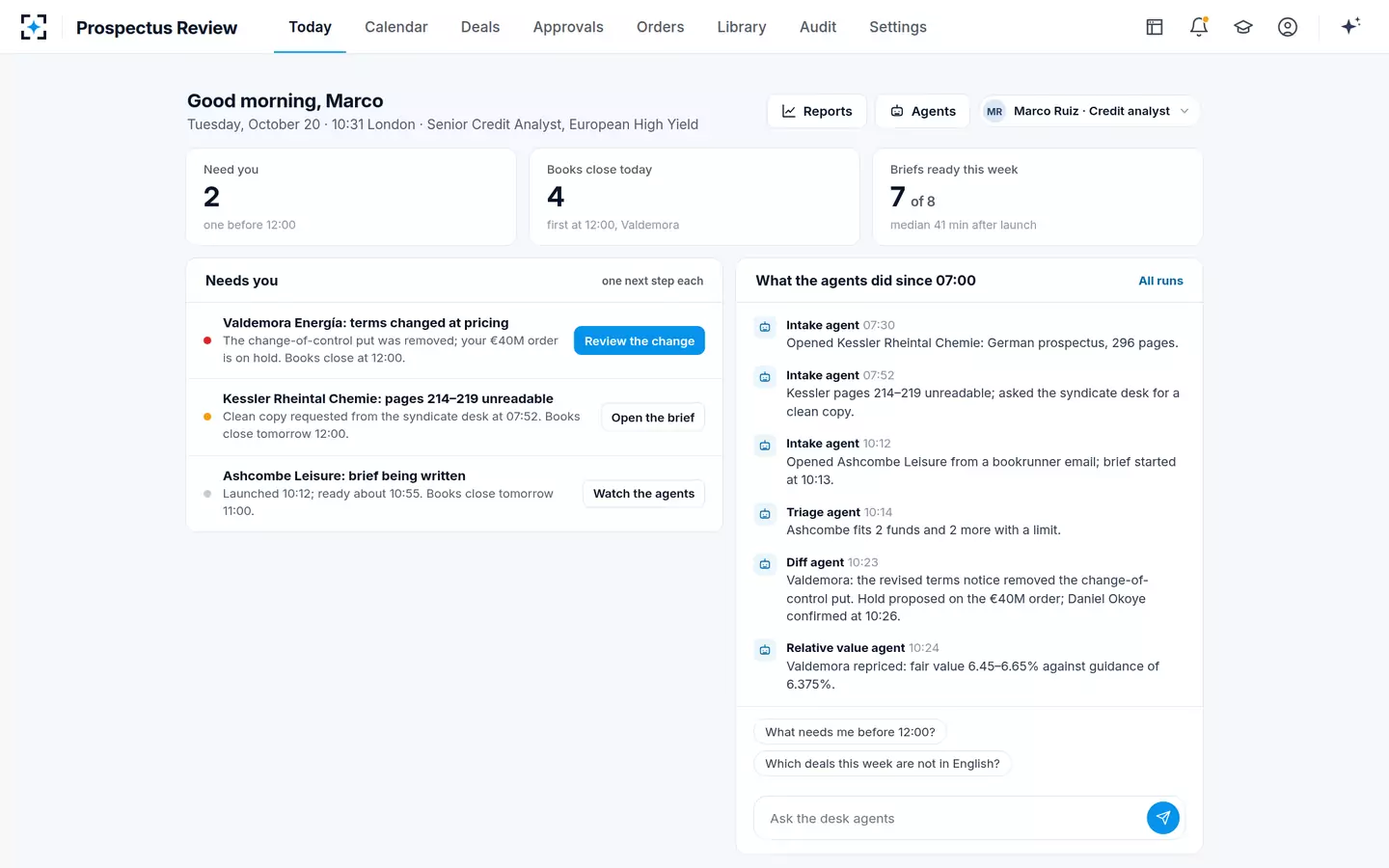
Three waits must not be shortened. The recommendation is the analyst's, with a reason code; the approval is the portfolio manager's, and only for their own funds; the order is the trader's, and never above the approved size. When the terms move, the decision goes back to the people. It matters legally too: under the SEC's time-of-sale rule for its offering liability provisions, information that reaches a buyer only after the time of sale is ignored (Rule 159), so a change at pricing has to reach the decision before the order stands — the subject of what changed at pricing.
The portfolio manager approves what changed, with the change beside it
A desk's IPT-to-close routine, in the order the waits occur
- At launch: fit first
Which funds may hold it, how much headroom each has, and why the others cannot. Minutes, not the last hour.
- Within the hour: a note you can check
Business, capital structure, guarantors and collateral, covenants, risk factors, relative value — every line with its page.
- Before guidance: questions sent
Gaps in the memorandum go to the bookrunners while there is time for an answer.
- Before the PM deadline: recommendation and sizes
Set the deadline back from books close so the approval and the order fit inside the window.
- On every new version: a clause-by-clause comparison
Revised terms and the final memorandum against the preliminary; a weakened protection reopens the decision.
- After allocation: the file
Which version each person relied on, when, and why — the record compliance will ask for.
The route of the deal shapes the start of this clock too, because a fund that cannot hold a 144A or Reg S bond should drop out before anyone reads; Rule 144A vs Reg S sets out why. To see the clock run on your own deals, start from Prospectus Review.
Questions people ask
What is IPT in bonds?
IPT stands for initial price talk: the first yield or spread range the bookrunners give for a new bond when they open the books, such as "6.25–6.50% area" or "T+260 area". It is an invitation to place orders, not a price. Guidance and the final pricing usually follow within hours or days.
What is price guidance in a bond offering?
Guidance is the bookrunners' update after IPT, normally tighter, as the order book fills: in the sample deal IPT of 6.25–6.50% area became guidance of 6.375% area, plus or minus 12.5 basis points. Research on corporate bonds finds the update from initial to final price is large on average and smaller for lower-rated deals.
What is a bookrunner?
The bank, or one of several, that runs the order book for a new issue: it markets the deal, collects orders, sets IPT and guidance with the issuer, and recommends the allocation. Under MiFID II a bookrunner placing securities must have an allocation policy and record a justification for each investor's final allocation.
What is a new issue allocation?
The amount of bonds each investor actually receives after pricing, which is often less than it ordered when a deal is oversubscribed. Research on 2002–2014 insurer data found allocations of underpriced US corporate bonds generated about $41 billion of first-day profits for investors, with more going to investors that traded more with the underwriters.
What is a revised terms notice?
A short notice from the bookrunners, sent before pricing, that changes the terms described in the preliminary memorandum: a coupon range, a call schedule, a covenant basket or a put. In the sample deal a four-page Spanish notice removed the change of control put and raised a restricted payments basket from €50 million to €75 million, 100 minutes before books closed.