The description of notes is the section of an offering memorandum that sets out the terms of the bonds — maturity, interest, redemption, ranking, guarantees, security, the covenants, events of default and amendment — as a summary of the indenture the notes will be issued under. It is usually the longest single section of a high-yield memorandum and the one a credit view depends on most. It is also only a summary: the indenture governs, the definitions sit elsewhere, and between the indenture and the sentence an analyst finally relies on there are several restatements, each a chance for a threshold, an exception or a number to drift. Botminds' Prospectus Review is built around that problem: every line of its one-page credit note carries the page it came from in the original language, and a second agent re-finds each line on its page before the analyst sees it.
The covenant traced below comes from a fictional sample deal, Valdemora Energía's €500 million senior secured notes, as read by the solution for a fictional desk, Quillfield Capital.
One covenant, traced hop by hop: the change of control put from indenture to decision
- 1
The indenture
Signed at closingSection 4.14 and the definitions it uses
The contract. Everything after it is a summary, and the indenture governs if they differ.
- 2
Description of notes, preliminary circular
Mon 08:02, at launchp. 241, in Spanish
A summary of the indenture, which governs where they differ; definitions may sit in a separate section pages away.
- 3
Summary of the offering
Same documentFront of the circular
A summary of the summary. Thresholds and exceptions are the first things it drops.
- 4
Line in the credit note
Mon 08:41Cited to p. 241
Written in English from the Spanish original, scored against the house checklist.
- 5
Independent re-check
Mon 08:41Re-found on p. 241, original wording
A second agent looks for the line on its page; a line it cannot find is withdrawn and shown.
- 6
Revised terms notice
Tue 10:20Notice p. 3: "[Reservado]"
The clause is removed. Every downstream line that relied on p. 241 is now wrong until updated.
- 7
Comparison with a peer deal
Tue 10:31Notice p. 3 against the peer note
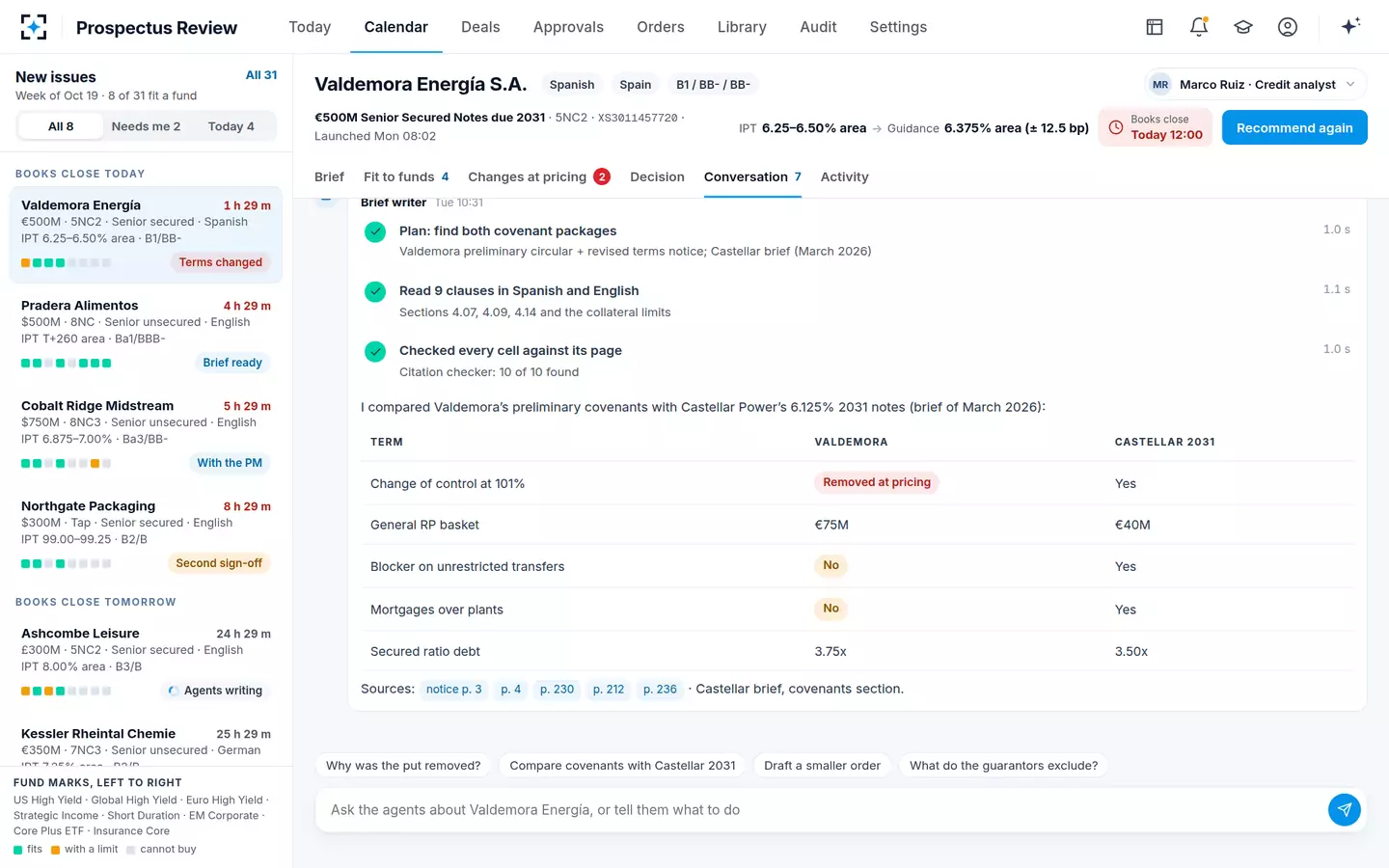
A table cell, "Removed at pricing", each cell checked against its page: 10 of 10 found.
- 8
Final offering memorandum
After pricingTo be compared when it arrives
Must match what was conveyed; compared clause by clause with the preliminary again.
What is the description of notes section?
It is the memorandum's statement of the contract, written as a summary. For registered debt the SEC lists what such a description must outline, from "provisions with respect to maturity, interest, conversion, redemption" to "provisions restricting the declaration of dividends", "provisions restricting the incurrence of additional debt", "the general type of event that constitutes a default" and "provisions relating to modification of the terms" — and states the limit plainly: "A complete legal description of the securities need not be given" (Regulation S-K Item 202(b)).
A high-yield description of notes goes much further than that list, because its readers price the covenants. But the principle holds: it is a description, and the memorandum normally says the summary is qualified by the indenture. When the two differ, the indenture wins. What each of those covenants promises, and how its baskets are priced, is set out in high yield bond covenants, basket by basket.
What is a description of the notes in a 144A offering?
The same section, under a different legal frame. A registered bond's indenture must be qualified under the Trust Indenture Act; a 144A bond's need not be, because the qualification provisions "shall not apply ... to any of the transactions exempted from the provisions of section 5 of the Securities Act of 1933 ... by section 4 thereof" (15 U.S.C. 77ddd(b)). No SEC line-item rule shapes it either. Its contents are what the issuer, the banks and the buyers' expectations make them.
Two practical differences follow. The reporting covenant matters more, since Rule 144A requires a non-reporting issuer to make available only minimal information to holders and buyers unless the indenture promises more (17 CFR 230.144A). And the description is the most detailed statement of the terms a buyer sees before the indenture is signed, so its accuracy carries more weight than in a registered deal where the indenture is filed.
Where the covenants sit in a description of notes, and the question each answers
| Part of the description | What it settles | Read it with |
|---|---|---|
| Ranking, security and guarantees | Who the notes rank with and ahead of; what collateral and which guarantors stand behind them | Capitalization, as adjusted; the guarantor financials |
| Optional redemption and change of control | When the issuer can call, and whether holders can put at 101% on a sale | Definitions of change of control and permitted holders |
| Restricted payments | How much can leave as dividends, buybacks and investments | Consolidated net income and the builder; every general basket |
| Incurrence of debt and liens | How much more debt, and how much of it secured, can be added | The ratio definitions and the permitted debt and liens lists |
| Asset sales and unrestricted subsidiaries | What can be sold or moved outside the covenants | Designation conditions; any blocker on transferring material assets |
| Reporting, defaults and amendments | What holders will be told, what triggers acceleration, what a majority can change | Rule 144A(d)(4) for non-reporting issuers; the amendment thresholds |
Where are covenants in an offering memorandum?
In the description of notes, usually under a heading such as "Certain Covenants", with the defined terms they depend on in a separate definitions section. A summary version appears near the front, in "The Offering". In the sample deal the covenants a credit view turns on were spread across the back third of the circular: liens on page 212, unrestricted subsidiaries on page 230, restricted payments on page 233, change of control on page 241.
The summary at the front is the least reliable place to read them. The SEC's instruction for registered prospectus summaries is that a summary "should not contain, and is not required to contain, all of the detailed information in the prospectus" (Item 503). Thresholds, carve-outs and the "greater of" clauses that size a basket are what a summary leaves out first, and they are what the analyst needs. How the description fits among the other sections is set out in the preliminary offering memorandum, annotated.
One covenant, traced hop by hop
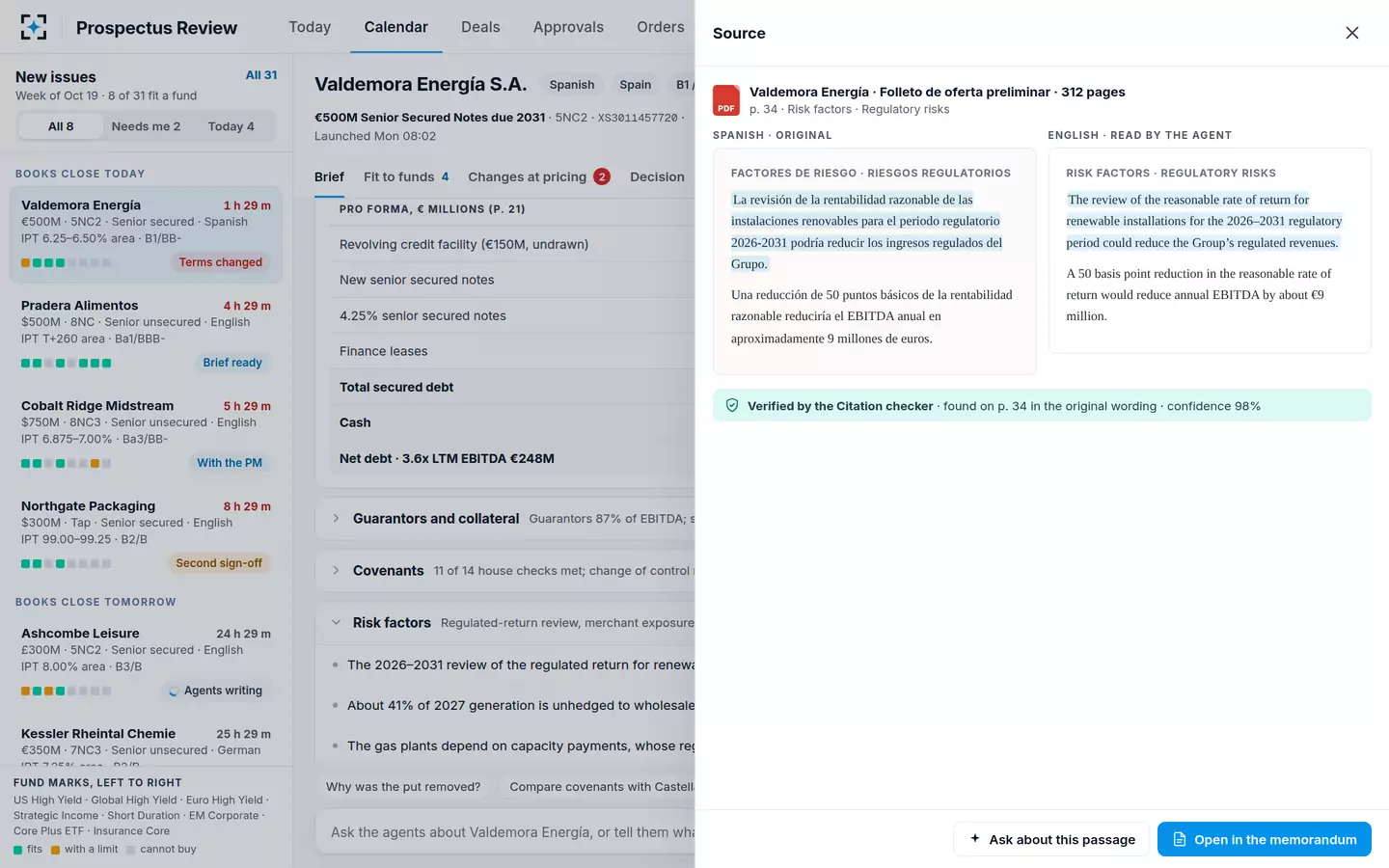
The change of control put in the sample deal passed through six hops in about 26 hours, with the final memorandum still to come. It began as section 4.14 of the indenture, summarised on page 241 of the Spanish preliminary circular: each holder could require the issuer to repurchase its notes at 101% of principal plus accrued interest. The agents' note cited it to page 241 at 08:41 on Monday, and the Citation checker re-found it there in the original wording.
On Tuesday at 10:20 the bookrunners' revised terms notice replaced the clause with one word, "[Reservado]". From that moment every downstream statement relying on page 241 was wrong: the note's covenants line, the house checklist score, the relative value, the approved order. The Diff agent compared the notice with the circular three minutes later, so the change reached the people while the order could still be revised — the sequence covered in what changed at pricing. At 10:31 the analyst asked for a comparison with a peer deal, and each cell of the resulting table, including "Removed at pricing", was checked against its page.
A comparison the analyst asked for, every cell checked against its page
Where numbers drift: five failure points between indenture and note
A covenant changes most often not where it is written but where it is restated. The five places below are where a credit note can end up stating a term the indenture does not contain.
Five places a covenant drifts on its way into a credit note
| Hop | What goes wrong | The check that catches it |
|---|---|---|
| Indenture to description | A threshold or exception summarised away; a defined term paraphrased | Read the covenant with its definition; flag any "substantially" or "generally" in the summary |
| Description to front summary | The "greater of" clause reduced to one number; a carve-out dropped | Never cite the summary for a covenant; cite the description page |
| Original language to English | A removal softened; a conditional made absolute | Keep the original sentence beside the English and check against the original |
| Document to note | A plausible term carried over from another deal | An independent re-check of every line on its page; withdraw what is not found |
| Preliminary to final terms | The note still states a protection removed at pricing | Compare every new version clause by clause; reopen the lines that depend on a changed clause |
How do you verify an AI summary of a prospectus?
Line by line, against the page each line cites, by something other than the system that wrote it. Citations alone are not enough: a study of four widely used generative search engines found that, on average, only about half of their sentences were fully supported by the citations given, and only about three in four citations supported the sentence they were attached to (Liu, Zhang and Liang, Findings of EMNLP 2023). A benchmark of citation quality found the strongest models lacked full citation support for half their answers on one question set (Gao et al., EMNLP 2023); the AI credit analyst's citation checker shows the check that answers both findings.
"Fluent and appear informative, but frequently contain unsupported statements and inaccurate citations."
Liu, Zhang and Liang, 'Evaluating Verifiability in Generative Search Engines', Findings of EMNLP 2023
Those studies tested answers to open web questions, not offering memoranda, and both date from 2023; the lesson is about the method. A citation is a claim that a sentence is on a page, and it needs checking like any other claim. On the sample desk the Citation checker re-found 146 of 148 lines on their pages in the original wording and withdrew two, which the analyst sees as withdrawn with the reason; each section of the note carries a confidence score, and any section under 90% is marked for a person to review.
The checks on one sample note
146of 148
note lines re-found on their cited page in the original Spanish
10of 10
cells of a covenant comparison checked against their pages
90%
section confidence below which a person must review
How to cite a prospectus page in a credit note
Cite the version, the page and, for a foreign-language document, the original sentence. "p. 241" is not enough on its own once a revised notice and a final memorandum exist, because page 241 of which document is the question compliance will ask. The sample desk's note cites each line to its page in the version it came from, keeps the original Spanish sentence beside the English, and stores every document version with its SHA-256 hash, so a citation made on Monday still opens the page that was read on Monday.
A cited line opened at its source, with the original wording
A citation standard for new-issue credit notes
- Cite the description of notes, never the summary, for a covenant
And the definition the covenant relies on, if it changes the meaning.
- Name the document version
Preliminary, revised terms notice, pricing term sheet or final memorandum, with its date.
- Keep the original sentence for a foreign-language document
So a translation choice can be seen and challenged.
- Re-check every line independently
By a second reader or agent that did not write it, against the cited page.
- Show what was withdrawn
A line that failed the check stays visible as withdrawn, with the reason, rather than disappearing.
- Reopen dependent lines when a clause changes
A revised notice that changes page 241 invalidates every line cited to it.
Measuring accuracy you can defend
Measure the share of lines found on their cited page, the lines withdrawn and why, and the covenant points your analysts flagged that the note missed. No regulator or independent study publishes an accuracy rate for AI on offering memoranda, so the only defensible number is one measured on the desk's own documents. ESMA expects firms using AI to "implement sufficiently frequent ex-post controls to monitor and evaluate any process that involves the delivery of information directly or indirectly through AI-driven mechanisms" (ESMA public statement on AI, May 2024).
The useful test re-runs past deals whose covenants the desk already knows. For each, count the lines on their page, the lines that should have been withdrawn and were not, and the changes at pricing caught before books close; the design target on the sample desk is that every term change announced before books close is compared clause by clause and flagged. How to run that test on a quarter of launches is set out in replay last quarter's launches before you buy, and what the agents do when the description itself is silent is covered in agents that ask the bookrunners. To see a description of notes read and cited on your own deals, start from Prospectus Review.
Questions people ask
What is a covenant summary?
A short restatement of a bond's covenants, usually in the front of the memorandum or in a credit note, listing what the issuer may and may not do. It is useful as a map and unreliable as a source, because thresholds, carve-outs and definitions are the first things it drops; cite the description of notes or the indenture instead.
How accurate are prospectus summaries?
The SEC expects a registered prospectus summary to be a brief overview that does not repeat the body, so by design it leaves detail out. ESMA's machine reading of EU prospectuses found heavy duplication and generic language, which makes the detail harder to find, not easier. Treat any summary as a pointer to the pages that settle the term.
How to check a credit note against the prospectus?
Open each line's cited page, read the sentence in the original language, and confirm the line says what the page says and no more. Then check that the version cited is the latest one: a revised terms notice or final memorandum can change a page the note still relies on.
Is the indenture available before pricing?
Often only as the description of notes; the final indenture is signed at closing. That makes the description the working statement of the terms during the deal, which is why its accuracy and every later change to it need to be checked before the order stands.
What does "qualified in its entirety by reference" mean in a description of notes?
That the description is a summary and the indenture's own wording controls if they differ. It is a reminder that a credit note built from the description is two steps from the contract, and that a covenant point that matters to the order should be read in the full clause and its definitions.