An offering memorandum is the disclosure document for securities sold privately — for most new corporate bonds in the US, a Rule 144A offering to qualified institutional buyers — while a prospectus is the document of a registered public offering, filed with the SEC and public on EDGAR, or in Europe approved by a national authority and published. For a bond buyer the label matters less than what comes with it: a prospectus carries the SEC's line-item rules, plain-English rules and strict issuer liability under section 11; an offering memorandum carries only the antifraud rules and whatever the market expects, is reviewed by no regulator, and reaches only the buyers the banks send it to. Botminds' Prospectus Review is built for the credit desk that has to read both kinds before books close: agents read each preliminary offering memorandum or prospectus in its own language into a one-page credit note, every line tied to its page, so the analyst knows what the document says before deciding whether to buy.
The examples below follow a fictional sample desk, Quillfield Capital, as it runs through the solution. The rules come from the regulators' own texts and the courts, linked where they are cited.
Prospectus vs offering memorandum, row by row, for a US corporate bond
Registered prospectus: Registration statement under section 5 of the Securities Act; the prospectus is part of it.
Rule 144A offering memorandum: A sale to the banks under section 4(a)(2), then resale to qualified institutional buyers under Rule 144A.
Registered prospectus: Anyone.
Rule 144A offering memorandum: Only a qualified institutional buyer: broadly, an institution owning and investing at least $100 million in unaffiliated securities.
Registered prospectus: Filed with the SEC; the staff may review and comment before effectiveness.
Rule 144A offering memorandum: None. No regulator sees the document before the sale.
Registered prospectus: Regulation S-K items: summary, risk factors under Item 105, description of the debt under Item 202, financial statements.
Rule 144A offering memorandum: For a non-reporting issuer, the rule asks only for a very brief business description and recent financial statements, on request. The rest is market practice.
Registered prospectus: Required for the cover, summary and risk factors (Rule 421(d)).
Rule 144A offering memorandum: Not required.
Registered prospectus: EDGAR, free to anyone; the final prospectus within two business days of pricing.
Rule 144A offering memorandum: The bookrunners' deal site and the inboxes of invited buyers.
Registered prospectus: Section 11 for the registration statement; section 12(a)(2) for the prospectus; antifraud rules.
Rule 144A offering memorandum: Antifraud rules: Rule 10b-5 and section 17(a). The Supreme Court's reading of "prospectus" keeps section 12(a)(2) to public offerings.
What is the difference between an offering memorandum and a prospectus?
The difference is the offering, not the paper. A prospectus describes a public offering: the issuer registers the securities with the SEC, and the Securities Act then attaches a statutory prospectus with prescribed contents, filing deadlines and liabilities. An offering memorandum describes a private one: the issuer sells under an exemption from registration, and the document is whatever the issuer and its banks decide to put in front of eligible buyers.
Section 4(a)(2) of the Securities Act exempts "transactions by an issuer not involving any public offering" (15 U.S.C. 77d). Rule 144A then lets the banks that bought the bonds resell them to large institutions without registration. The SEC's own economists describe how the two are stitched together: "By its terms, Rule 144A is available solely for resale transactions. However, market participants use it to facilitate capital‐raising by issuers by means of a two‐step process," a primary sale to intermediaries followed by "a resale to 'qualified institutional buyers' in reliance on Rule 144A" (SEC DERA white paper, August 2018).
In practice the two documents look alike. A high-yield offering memorandum usually borrows the shape of a registered prospectus — summary, risk factors, use of proceeds, capitalization, business, management's discussion, description of notes, financial statements — because the people who draft it also draft prospectuses, and because the antifraud rules punish an omission whatever the document is called. What differs is who checks it, who can be sued over it, and who can get hold of it.
Is an offering memorandum a prospectus? What the Supreme Court decided
Not for the purposes that matter most to a buyer's lawyer. In Gustafson v. Alloyd Co. the Supreme Court read the word in section 12(2), now 12(a)(2), the provision that lets a buyer rescind for a misstatement without proving fraud or reliance, and tied it to public offerings.
"In sum, the word 'prospectus' is a term of art referring to a document that describes a public offering of securities by an issuer or controlling shareholder."
Gustafson v. Alloyd Co., 513 U.S. 561 (1995)
The case concerned a private contract for the sale of a company, not a bond memorandum, but its reasoning is about the word itself: a "prospectus" is the document the registration provisions require. A Rule 144A memorandum is distributed in an offering that by design is not public, so on Gustafson's reading the buyer of a 144A bond should not expect the section 12(a)(2) remedy that comes with a registered bond. Section 11, which makes the issuer liable for a misstatement in a registration statement almost regardless of fault, does not reach it either, because there is no registration statement (15 U.S.C. 77k).
What remains is fraud law. Rule 144A's own preliminary note says the rule "relates solely to the application of section 5 of the Act and not to antifraud or other provisions of the federal securities laws." Rule 10b-5 forbids any untrue statement of a material fact, or omission that makes the statements made misleading, "in connection with the purchase or sale of any security" (17 CFR 240.10b-5), and Gustafson itself calls section 17(a) "the one provision of the Act that extends coverage beyond the regulation of public offerings". A private 10b-5 claim is harder to win: asked in 1976 whether a damages claim lies "in the absence of any allegation of 'scienter'", the Supreme Court concluded "that it will not" (Ernst & Ernst v. Hochfelder), whereas section 12 gives buyers "a right to rescind, without proof of fraud or reliance". The practical consequence is that the buyer of a 144A bond carries more of the burden of reading carefully, because less of the risk of a bad document is shifted back to the issuer by statute.
Which liability reaches which document
| Provision | What it covers | Registered prospectus | 144A offering memorandum |
|---|---|---|---|
| Securities Act §11 | Misstatements in an effective registration statement; issuer liable without proof of fault | Yes | No: no registration statement |
| Securities Act §12(a)(2) | Misstatements in a prospectus or oral communication; rescission | Yes | Not on Gustafson's reading of "prospectus" |
| Securities Act §17(a) | Fraud in the offer or sale of securities (an SEC enforcement tool) | Yes | Yes: reaches beyond public offerings |
| Exchange Act §10(b), Rule 10b-5 | Fraud in connection with any purchase or sale | Yes | Yes |
Why are high-yield bonds sold under Rule 144A?
Because a private sale to institutions is faster and leaves the issuer with fewer obligations, and the buyers who matter in high yield are institutions anyway. A registered deal needs a registration statement the SEC may review, and it makes the issuer a reporting company with periodic filings. A 144A deal can launch when the market is open, with a document the banks control, and sell the same day to the funds, insurers and advisers who would have bought most of a registered deal.
The SEC's staff counted the result. In 2017 there were 2,099 Rule 144A offerings against 1,846 public debt offerings, and "Rule 144A offerings are predominantly debt offerings" (SEC DERA, 2018). Those counts include financial issuers and asset-backed deals, so they say the private route is as busy as the public one, not what share of high yield it carries. The indenture changes too: the Trust Indenture Act's requirement that an indenture be qualified does not apply to transactions exempted by section 4 (15 U.S.C. 77ddd(b)), so a 144A indenture is not a qualified one.
Three rules that set the difference
$100M
invested on a discretionary basis in unaffiliated securities: the test most kinds of institution must pass to be a qualified institutional buyer
2
business days after pricing, at most, to file the final registered prospectus with the SEC and so on EDGAR
10years
that an approved EU prospectus must stay public online; a 144A memorandum has no such rule
What the law asks an offering memorandum to contain: very little
Rule 144A itself requires almost nothing. For an issuer that does not file reports with the SEC, the buyer must have the right to obtain, on request, "a very brief statement of the nature of the business of the issuer and the products and services it offers; and the issuer's most recent balance sheet and profit and loss and retained earnings statements, and similar financial statements for such part of the two preceding fiscal years as the issuer has been in operation" (Rule 144A(d)(4)). For an issuer that already reports, not even that.
Everything else in a 300-page memorandum is there because the market demands it and because antifraud liability punishes omissions. That has two consequences for a reader. First, no rule fixes the order or the headings, so a description of notes may sit on page 171 of one memorandum and page 230 of the next. Second, the plain-English rule does not apply: Rule 421(d)'s plain-English duties — short sentences, active voice, no jargon — bind only the cover, summary and risk factors of a registered prospectus (17 CFR 230.421), and Item 105's instruction to put generic risks last under "General Risk Factors" binds only registrants (Item 105). A preliminary offering memorandum, annotated section by section, shows where a credit view's answers usually sit.
Who can buy 144A bonds: the qualified institutional buyer
A 144A bond can be sold only to a qualified institutional buyer, or to a buyer the seller reasonably believes is one. The core test is size: an entity that "in the aggregate owns and invests on a discretionary basis at least $100 million in securities of issuers that are not affiliated with the entity", with a list of eligible entity types that includes "any investment company registered under the Investment Company Act", insurance companies, registered investment advisers and employee benefit plans (Rule 144A(a)(1)). Dealers qualify at $10 million.
Since 23 September 2013 the restriction has applied to the sale, not the offer. Implementing the JOBS Act, the SEC amended the rule so that it "will require only that the securities be sold to a QIB or to a purchaser that the seller and any person acting on behalf of the seller reasonably believe is a QIB" (Release 33-9415). A bank may now advertise a 144A deal; it still may not sell the bonds to a retail investor. For a fund manager the useful consequence is that the 144A label alone does not make a bond ineligible for a registered fund, which is a qualified buyer; whether that fund may hold it depends on its own prospectus and liquidity rules, the subject of Rule 144A vs Reg S.
What is an offering circular? Offering circular vs prospectus
"Offering circular" is mostly a regional synonym for offering memorandum. Issuers in Europe, Asia and Latin America often title their private-placement document an offering circular, and in Spanish deals the preliminary version may be a folleto de oferta preliminar. The content is the same family: business, risks, capital structure, terms of the notes, financial statements.
One US meaning is different. Under Regulation A, the small public offering exemption, the disclosure document filed with the SEC is formally called an offering circular, and it "must include the information required by Form 1-A for offering circulars" (17 CFR 230.253). That document is filed and public, which a 144A offering circular is not. When a search for a bond's offering circular finds nothing on EDGAR, the reason is usually that it was never filed.
Does an offering memorandum have SEC review? No — and in Europe the answer depends on the route
No US regulator reviews a 144A memorandum before the sale. The staff of the SEC's Division of Corporation Finance can review a registration statement before it goes effective; nothing equivalent exists for a private offering, so the only reviewers are the issuer's counsel, the banks' counsel and the buyer.
In the EU, a prospectus is needed for a public offer or for admission to trading on a regulated market, and the competent authority approves it. The Prospectus Regulation exempts offers made only to qualified investors, and offers of securities in units of €100,000 or more, from the obligation to publish one (Regulation (EU) 2017/1129, Article 1(4)). Admission to an EU regulated market still needs an approved prospectus even when the bonds are sold only to institutions, while a bond listed on an exchange-regulated market, or not listed at all, may come with an offering memorandum alone; which applies has to be read on the cover of each deal. The UK moved to a new regime on 19 January 2026, with a single disclosure standard for bonds "based on the UKPR's wholesale standard" (FCA PS25/9).
The same reading, whatever the document is called
What the difference changes for the analyst on launch day
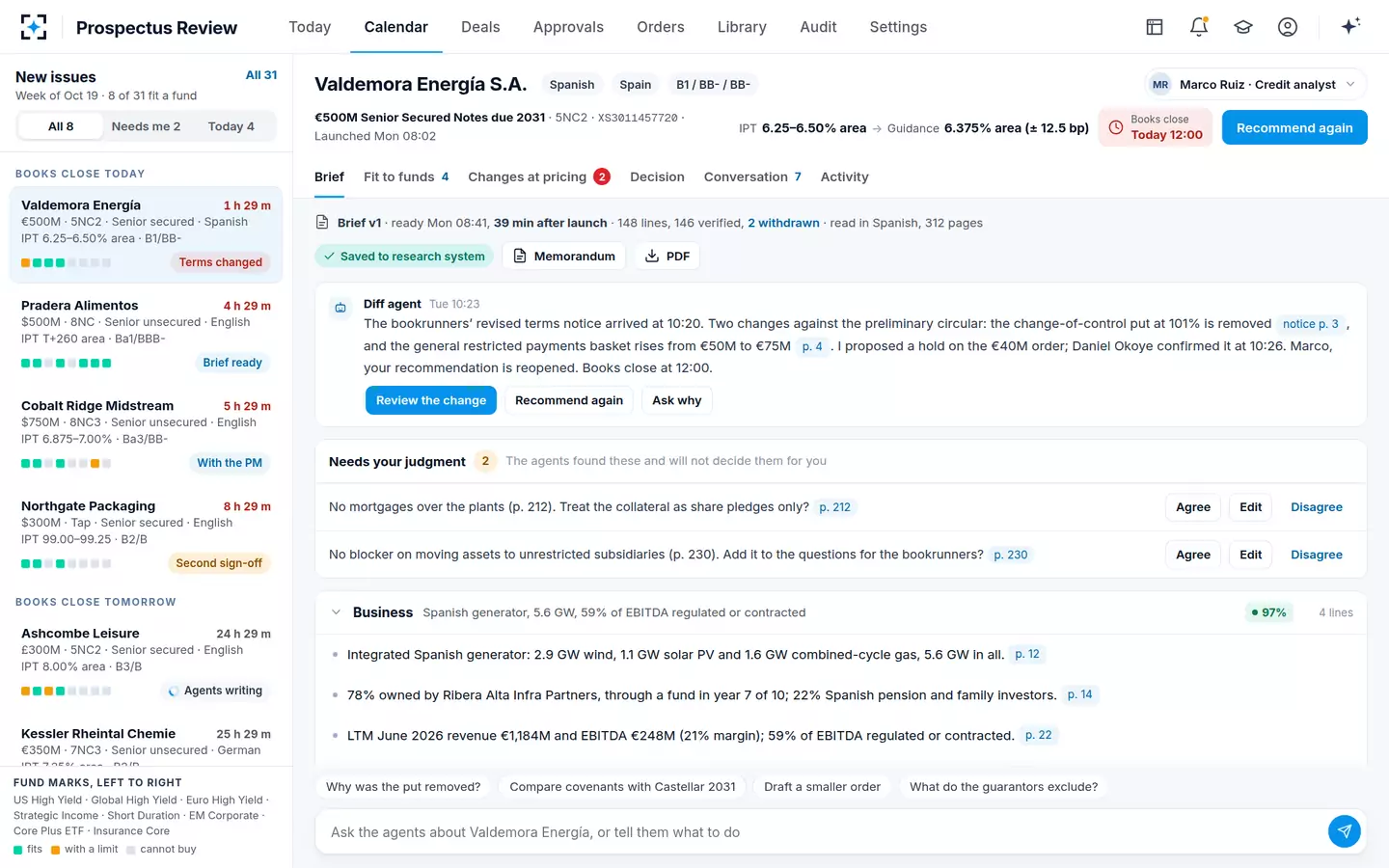
Three things change, and each lands on the buyer. The document arrives from a bookrunner rather than a public database, so finding it and every later version is the desk's job. It has no prescribed order and no plain-English duty, so the first reading is slower and the risk of missing a clause is higher. And because the statutory remedies are narrower, the reading carries more of the protection: what the analyst does not catch before the sale is harder to recover after it.
That is the work the solution is built around. At the sample desk, a Spanish issuer, Valdemora Energía, launched €500 million of senior secured notes at 08:02 on a Monday with a 312-page preliminary offering circular. The agents opened it from the bookrunners' email, checked it against the rules and holdings of 212 portfolios within four minutes, and had a one-page note ready at 08:41, every line tied to its page in the Spanish original. The analyst still decides; the agents never recommend, approve or send an order.
Every line opens the page it came from, original beside English
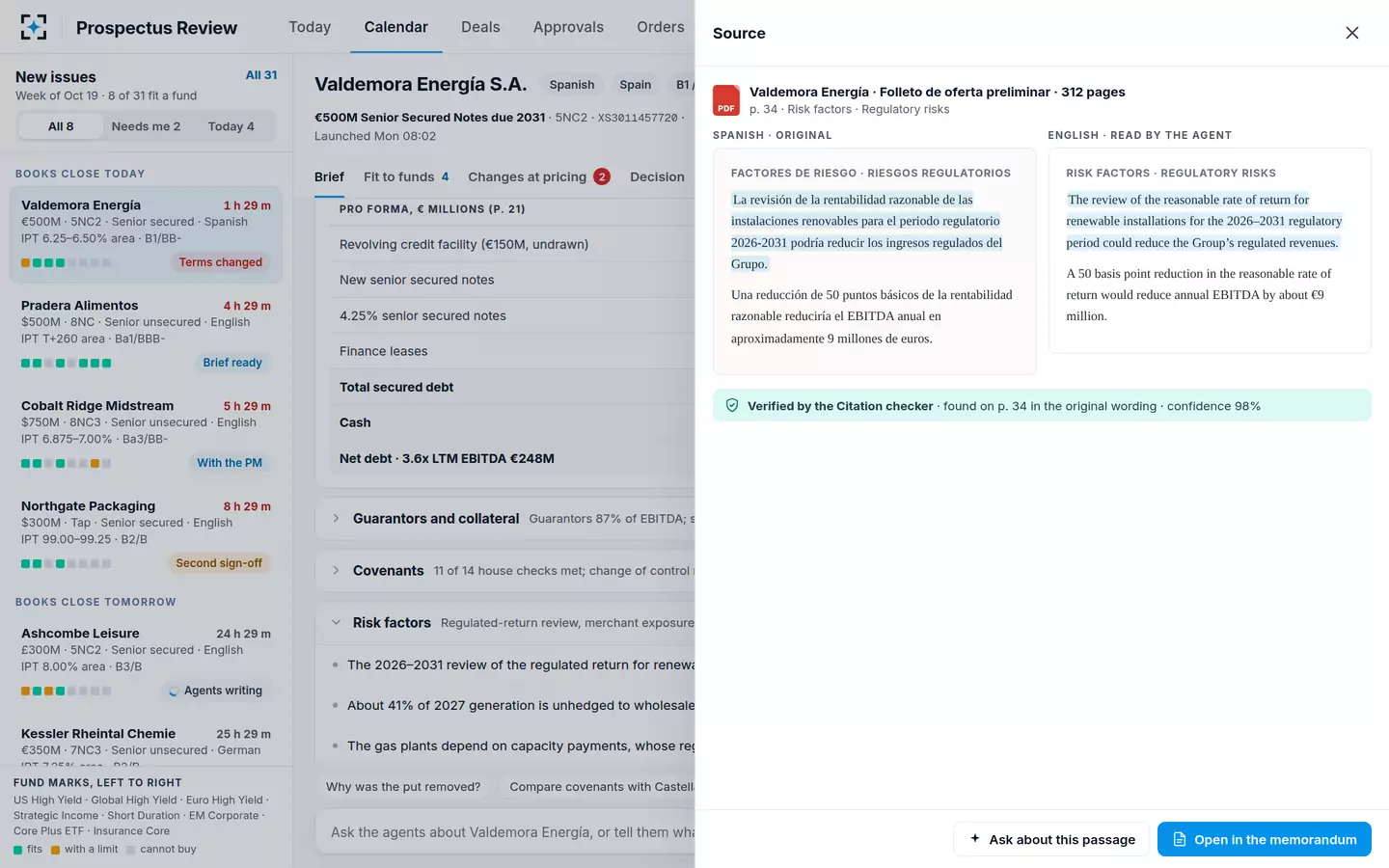
Because a 144A memorandum is not on EDGAR, the desk's own archive becomes the only place a past deal can be found again; why 144A deals are not in EDGAR covers what a usable archive keeps.
Five things a prospectus would have settled that an offering memorandum leaves to you
- Where the document is, and which version
No public filing: keep every preliminary, revised terms notice and final memorandum the bookrunners send, with the time it arrived.
- Whether you may buy it
The 144A, Regulation S or EU route decides eligibility before credit does; check the legend on the cover against each fund's rules.
- Where the terms of the notes sit
No rule fixes the order. Find the description of notes and the definitions before you read the summary's version of them.
- Which risk factors are specific
No Item 105 discipline. Separate the issuer's own risks from the boilerplate a reader can skip.
- What changed after you read it
Only what you were told by the time of sale counts. Compare every later version with the one you approved, clause by clause.
The last point is where many desks are weakest, and it is the subject of what changed at pricing. To see the reading, the fit check and the comparison of versions on one deal, start from Prospectus Review.
Questions people ask
Is a private placement memorandum the same as an offering memorandum?
In bonds the terms overlap: both describe a sale made under an exemption rather than a registration. "Private placement memorandum" is more common for smaller deals sold under Regulation D to accredited investors, while large high-yield bonds sold to institutions under Rule 144A usually come with an "offering memorandum" or "offering circular". The legal question is the exemption used, not the title on the cover.
Does an offering memorandum need audited financial statements?
Rule 144A asks a non-reporting issuer only for recent balance sheet and income statements, and for two prior years, audited "to the extent reasonably available". What a high-yield memorandum actually carries is set by what buyers and the banks' own diligence demand, not by the rule, so read the auditor's report and the wording on any interim figures rather than assuming either is there.
Can a retail investor buy a bond sold under an offering memorandum?
Not in the 144A sale itself: the bonds may be sold only to qualified institutional buyers. A retail investor can end up holding the same issuer's bonds through a fund that is a qualified buyer, or after a registered exchange offer turns the 144A bonds into registered ones.
Is an offering memorandum filed with the SEC?
No. A 144A memorandum is delivered privately by the bookrunners to invited buyers and is not filed. If the issuer later registers an exchange offer, a registered prospectus for the exchange notes appears on EDGAR, usually months after the original sale.
Why do offering memoranda look like prospectuses?
Because the same lawyers draft both, the banks need the same diligence, and Rule 10b-5 punishes a misleading omission whatever the document is called. Copying the registered format is the issuer's defence. The format is a habit, not a rule, so sections can move between deals.