Rule 144A and Regulation S are the two US exemptions most international bond deals use side by side: Rule 144A lets the banks resell the bonds inside the United States to qualified institutional buyers, and Regulation S covers the part sold outside the United States in "offshore transactions", with no selling effort aimed at the US. One deal, one offering memorandum, two tranches with different buyers and transfer rules. For a fund manager the route matters before any credit question, because it decides whether a given fund may buy at all, what document it will get and whether the bond will later be easy to sell. Botminds' Prospectus Review checks each new deal against every portfolio's rules within minutes of launch, and the offering route is the first line of that fit check.
The examples follow a fictional sample desk, Quillfield Capital, and its 212 portfolios as they run through the solution. The rules are quoted from the eCFR, EUR-Lex, FINRA and the FCA.
Five routes a new bond can take, and what each means for the buyer
Rule 144A
Who may buyQualified institutional buyers only: broadly $100M or more invested in unaffiliated securities
DocumentOffering memorandum, private
Where it isBookrunners' deal site and inboxes; not filed
ResaleFreely to other qualified buyers; to anyone else only under another exemption
Regulation S
Who may buyBuyers outside the US in an offshore transaction; no US persons during the 40-day period for most corporate debt
DocumentThe same memorandum, offshore legends
Where it isAs 144A; an EU or UK listing adds a public document
ResaleOffshore under Rule 904; into the US after the period only under an exemption
SEC-registered
Who may buyAnyone
DocumentRegistered prospectus
Where it isEDGAR, public
ResaleUnrestricted
EU public offer or regulated market
Who may buyAnyone, or qualified investors where an exemption is used
DocumentApproved prospectus; final terms under a programme
Where it isIssuer site, national authority, ESMA register; public for 10 years
ResaleUnrestricted in the EU
EU wholesale exemption
Who may buyQualified investors, or units of €100,000 or more
DocumentOffering memorandum; no approved prospectus unless admitted to a regulated market
Where it isPrivate, unless listed
ResaleWithin the same exemptions
What is the difference between Rule 144A and Reg S?
Rule 144A governs who may buy inside the United States; Regulation S governs when a sale counts as outside it. Rule 144A lets a bank resell to a buyer it reasonably believes is a qualified institutional buyer — for most institutions, one with at least $100 million invested on a discretionary basis in securities of unaffiliated issuers (17 CFR 230.144A). Regulation S does not register anything or exempt anything in the usual sense: it treats an offer or sale as outside the United States, and so outside section 5, when it is made "in an offshore transaction" and "no directed selling efforts are made in the United States" (Rule 903(a)).
An offshore transaction needs two things: "the offer is not made to a person in the United States", and the buyer is, or is reasonably believed to be, outside the United States when the order is placed (Rule 902(h)). Directed selling efforts include anything "that could reasonably be expected to have the effect of conditioning the market in the United States" for the securities. That is why a combined deal runs two books of the same notes, keeps US marketing to the 144A side and settles the two tranches as separate notes.
Rule 144A vs Regulation S on the same deal
Rule 144A tranche: Exempts the banks' resale to qualified institutional buyers.
Regulation S tranche: Deems the sale to occur outside the United States, so US registration does not apply.
Rule 144A tranche: A qualified institutional buyer, or one the seller reasonably believes is.
Regulation S tranche: A buyer outside the United States; for Category 2 and 3 debt, no US person until the 40-day period ends.
Rule 144A tranche: May be advertised since 2013; may be sold only to qualified buyers.
Regulation S tranche: No directed selling efforts in the United States.
Rule 144A tranche: The seller must take "reasonable steps" to make the buyer aware it may rely on Rule 144A.
Regulation S tranche: Dealers get a confirmation repeating the restrictions; Category 3 debt sits in a temporary global note until the 40 days end and owners certify.
Rule 144A tranche: To other qualified buyers at any time.
Regulation S tranche: Offshore under Rule 904; into the US only under another exemption.
What is a Reg S bond, and what is the 40-day period?
A Reg S bond is the offshore tranche, and how tightly it is ring-fenced depends on its category. Category 1 has no extra conditions and covers, among others, an issuer with no "substantial U.S. market interest" in its debt, which for debt means all three of these hold: 300 or more US holders of record, $1 billion or more held by US persons, and 20% or more held by US persons. Category 2 covers "debt securities of a reporting issuer or of a non-reporting foreign issuer". Category 3 covers everything else, which in practice includes the debt of a US issuer that does not file reports with the SEC.
In Categories 2 and 3 a sale of debt "if made prior to the expiration of a 40-day distribution compliance period, is not made to a U.S. person or for the account or benefit of a U.S. person (other than a distributor)" (Rule 903(b)(2) and (3)). Category 3 adds a physical lock: the notes must be "represented upon issuance by a temporary global security which is not exchangeable for definitive securities until the expiration of the 40-day distribution compliance period", and then only after the holder certifies it is not a US person or bought in an exempt transaction.
Regulation S categories for corporate debt, and what each asks of the deal
| Category | Typical issuer | Conditions on the offshore sale |
|---|---|---|
| 1 | Foreign issuer whose debt has no substantial US market interest; some single-country offerings in a foreign currency | Offshore transaction and no directed selling efforts; nothing more |
| 2 | An SEC-reporting issuer, or a non-reporting foreign issuer | Offering restrictions; no sale to US persons for 40 days; confirmations to dealers repeating the restriction |
| 3 | Everything else, such as a non-reporting US issuer | As Category 2, plus a temporary global note until the 40 days end and ownership is certified |
Can US investors buy Reg S bonds?
Not at issue in Category 2 or 3, and the definition of "US person" decides who that is. A partnership or corporation organised under US law is a US person, and so is "any discretionary account ... held by a dealer or other fiduciary organized, incorporated, or (if an individual) resident in the United States". The rule then carves out the case that matters most to asset managers: a discretionary account "held for the benefit or account of a non-U.S. person by a dealer or other professional fiduciary" in the United States is not a US person (Rule 902(k)).
So a New York portfolio manager running a Luxembourg fund may, subject to that fund's own rules, buy the Reg S tranche for it on day one, while the same manager's US mutual fund must buy the 144A tranche. After the 40 days, a US buyer can acquire Reg S notes only through a transaction that is itself exempt, one more reason a US fund's order goes into the 144A book. The fit check has to know, for each account, its domicile, its manager and whether it is a qualified buyer, not just its credit limits.
Rule 144A vs Rule 144: resale on day one, or after a holding period
The two are often confused because both concern resales of restricted securities, but they solve different problems. Rule 144A allows an immediate resale, to qualified institutional buyers only. Rule 144 is a safe harbour for resales to anyone after a holding period: "a minimum of six months" when the issuer has been an SEC reporter for at least 90 days, and "a minimum of one year" when it has not (17 CFR 230.144(d)(1)).
For a high-yield fund the practical point is liquidity. A 144A bond from a non-reporting issuer can trade among qualified buyers from the first day, but it does not become freely tradable to the wider market for a year, and only if the other conditions of Rule 144 are met. Rule 144A also excludes securities "of the same class as securities listed on a national securities exchange", one reason the SEC's economists found 144A offerings to be mostly debt (SEC DERA, 2018).
What is 144A for life?
"144A for life" is market shorthand for a 144A deal with no promise to register the notes later. Where a deal carries registration rights, the issuer undertakes to file a registered exchange offer that swaps the restricted notes for identical registered ones, which brings a public prospectus onto EDGAR and usually makes the issuer an SEC reporter. Where it does not, the notes stay restricted for their whole life and trade only among qualified buyers, unless Rule 144's holding period frees them.
Two things follow for the reader. The offering memorandum is the only full disclosure document the bonds will ever have, so it matters more that the desk keeps every version. And if the issuer does not report, the bondholder's right to information is the one in Rule 144A(d)(4) and in the indenture's reporting covenant; reading that covenant is part of reading the deal, as the description of notes, traced hop by hop, shows.
Does a 144A bond trade on TRACE?
Yes. FINRA has disseminated Rule 144A trades in corporate bonds since 30 June 2014, when amendments approved by the SEC took effect "to provide for the dissemination of transactions in TRACE-eligible securities that are effected pursuant to Securities Act Rule 144A" (FINRA Regulatory Notice 13-35). Before a new issue trades, the underwriter must tell FINRA, among other things, "whether Securities Act Rule 144A applies" and "the time that the new issue is priced", and the notice "must be provided to FINRA Operations prior to the execution of the first transaction of the offering" (FINRA Rule 6760).
Corporate bond trading reported to TRACE in September 2026, 144A included
3.02M
trades in corporate bonds, excluding convertibles
$1.26T
par value traded in the month
143,786
trades on an average day
So the price of a 144A bond is public once it trades, while the document that describes it is not. That asymmetry is the subject of why 144A deals are not in EDGAR.
The EU and UK routes in 2026: €100,000, qualified investors and a new format
In Europe the question is not whether a sale is offshore but whether a prospectus is required. The Prospectus Regulation exempts from the obligation to publish one an offer "addressed solely to qualified investors" and an offer of securities "whose denomination per unit amounts to at least EUR 100 000" (Regulation (EU) 2017/1129, Article 1(4)). Admission to a regulated market still needs an approved prospectus, and once approved it must "remain publicly available in electronic form for at least 10 years".
The EU Listing Act, Regulation (EU) 2024/2809, changes the format. From 5 June 2026 a prospectus is to be "a document of a standardised format" with information "presented in a standardised sequence", set by delegated acts the Commission was told to adopt "by 5 June 2026"; a page limit applies only to shares, and the Act says a page limit "would not be appropriate" for non-equity securities (Regulation (EU) 2024/2809). For the typical 144A/Reg S deal listed in the EU, one derogation matters most: when securities admitted to an EU regulated market are "simultaneously offered to or privately placed with investors in a third country where an offering document is prepared under law, rule or market practice", the standardised format and sequence do not apply. The memorandum the US buyers read can keep its own shape. The same Act lengthened investors' right to withdraw after a supplement from two working days to three.
The UK replaced its retained version of the EU regime on 19 January 2026, when the FCA's new prospectus rules for admission to a regulated market took effect. For bonds the FCA removed the old split between "retail" and "wholesale" disclosure, which had turned on a denomination of €100,000, and made "a single disclosure standard for non-equity securities based on the UKPR's wholesale standard" (FCA PS25/9).
Five dates that changed how new bonds are offered and seen
| Date | What changed | Why a bond desk cares |
|---|---|---|
| 23 Sep 2013 | Rule 144A offers may be made by general solicitation; sales still only to qualified buyers | A 144A deal can be announced publicly; the buyer list does not widen |
| 30 Jun 2014 | FINRA disseminates 144A trades in TRACE-eligible securities | Secondary prices of 144A bonds become public |
| 4 Dec 2024 | EU Listing Act in force; withdrawal right after a supplement becomes three working days | More time to walk away from a public offer when a supplement changes the picture |
| 19 Jan 2026 | UK prospectus rules for regulated markets in force; one disclosure standard for bonds | Low-denomination UK bonds no longer need retail-level disclosure |
| 5 Jun 2026 | EU standardised prospectus format and sequence apply | EU prospectuses become easier to compare, except where a parallel 144A/Reg S memorandum is used |
Fund fit starts with the offering route
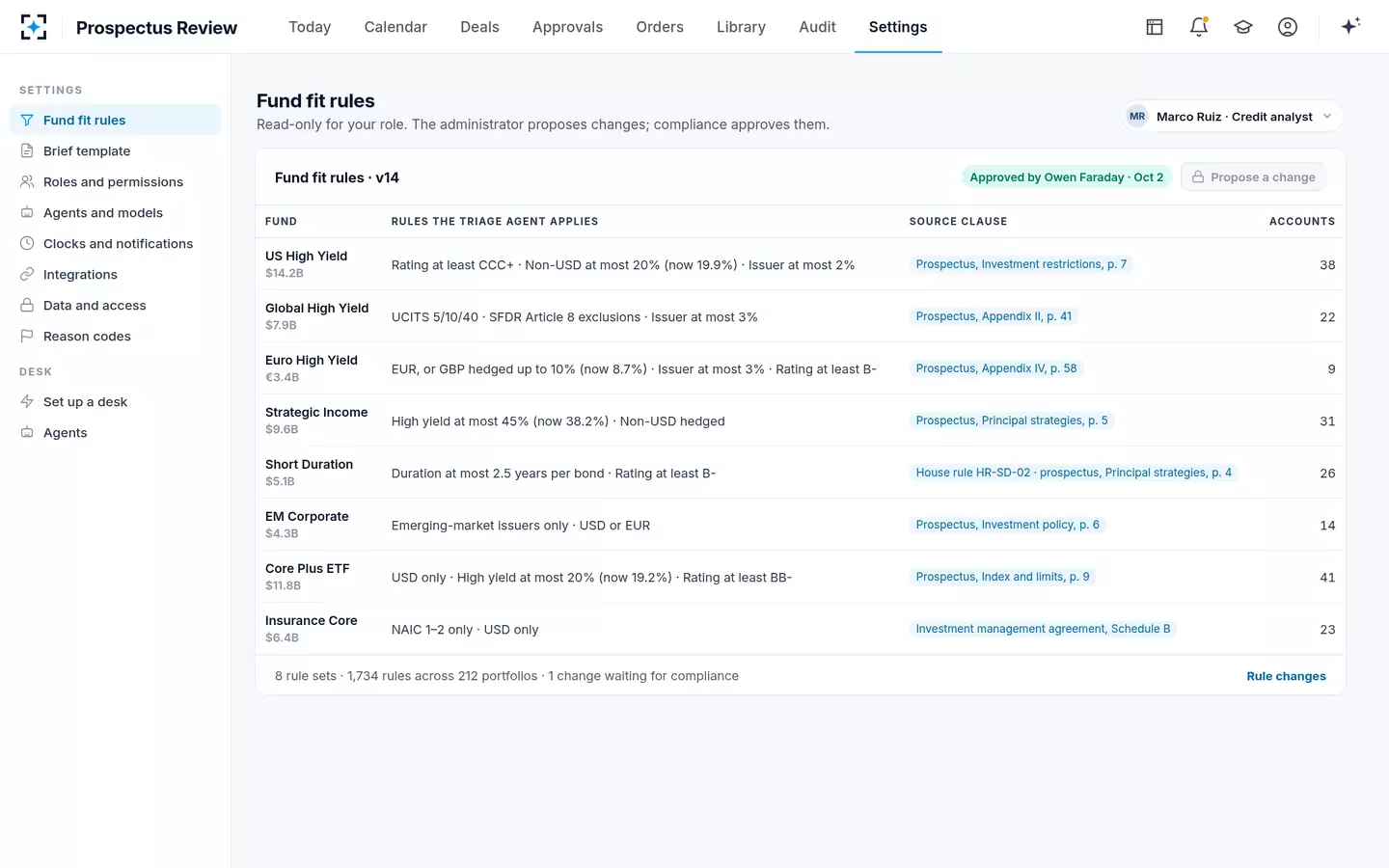
A fund's own rules turn the route into a yes or no. A UCITS may hold "recently issued transferable securities" only if "the terms of issue include an undertaking that an application will be made for admission to official listing" and the admission "is secured within a year of issue"; otherwise the bond falls into the bucket of at most 10% of assets for other securities (Directive 2009/65/EC, Article 50). A US registered fund is a qualified institutional buyer under Rule 144A, but its own prospectus may cap restricted or illiquid holdings. An insurer's mandate may turn on the bond's NAIC designation rather than its route at all.
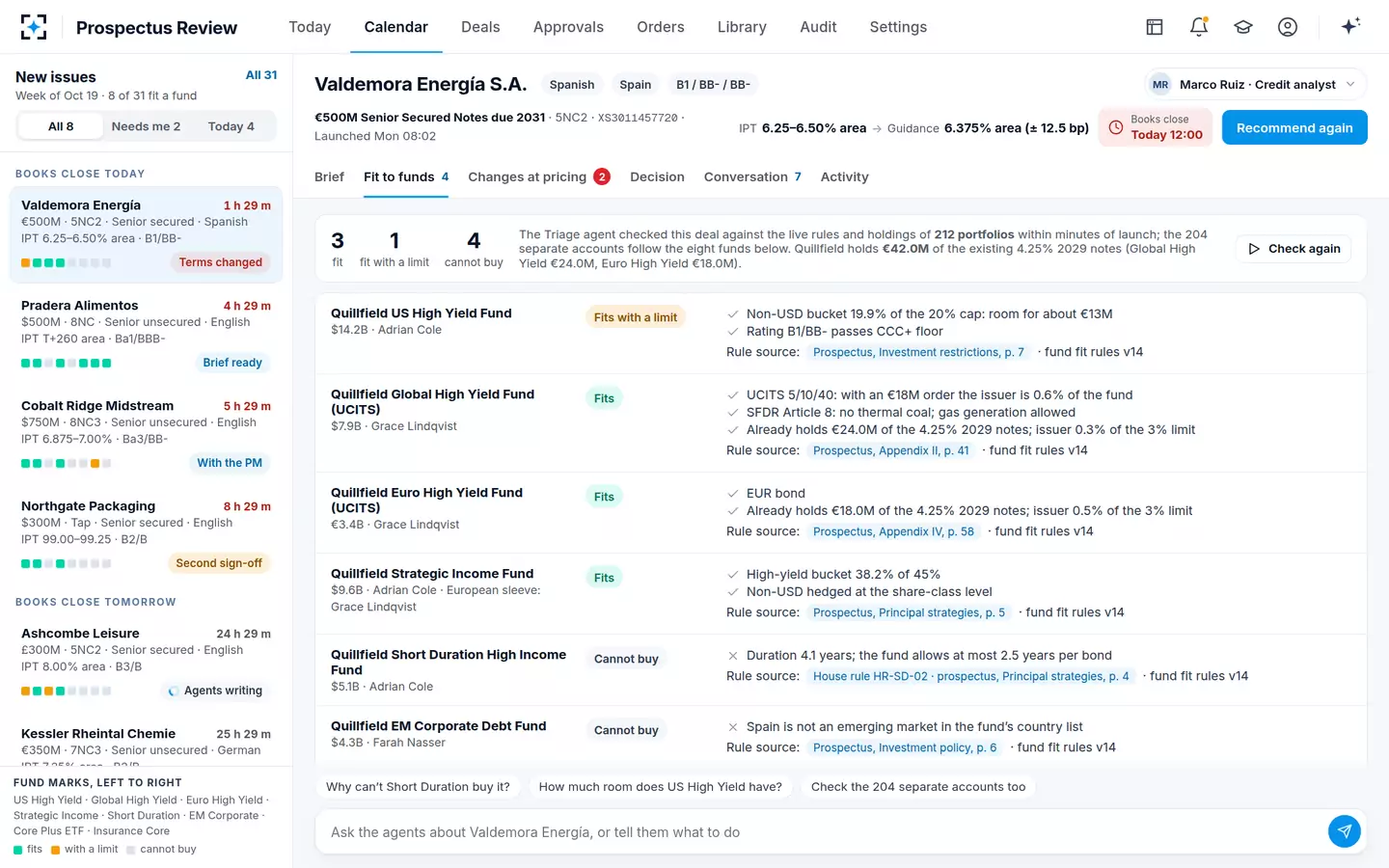
At the sample desk the Triage agent checks each launch against the live rules and holdings of every portfolio, and each rule cites the clause of the fund document it comes from. When Valdemora Energía, a fictional Spanish issuer, launched €500 million of senior secured notes, three funds fitted, one fitted with a limit — its non-US-dollar bucket was at 19.9% of a 20% cap, room for about €13 million — and four could not buy, each with the reason and the page.
Fit to funds at launch: every portfolio, with the rule and the clause it comes from
The rules each fund is checked against, and where each comes from
Six route questions to answer before the credit question
- Which tranche is this fund buying: 144A, Reg S or both?
Read the cover legend and the notice to investors, not the term sheet's summary of them.
- Is the account a US person under Rule 902(k)?
Domicile and the beneficiary decide it, not where the portfolio manager sits.
- Is the fund a qualified institutional buyer?
Registered funds and large advisers usually are; separate accounts need checking.
- Will the bond be listed, and when?
A UCITS needs an undertaking to list and admission within a year, or room in its 10% bucket.
- Is this 144A for life?
No exchange offer means no later public prospectus and a narrower resale market.
- What does the fund's own document say about restricted securities?
The binding limit is often in the fund's prospectus or the client agreement, not in the securities rules.
Once the route is settled, the timing question begins: from initial price talk to books closed, who has to wait on whom. To see the fit check, the cited note and the comparison of versions together, start from Prospectus Review.
Questions people ask
What is a 144A/Reg S offering?
One deal sold through two routes at once: the US tranche to qualified institutional buyers under Rule 144A and the international tranche to buyers outside the United States under Regulation S. Both share one offering memorandum and one indenture but settle as separate notes with their own legends and transfer rules.
What is the EU Listing Act?
Regulation (EU) 2024/2809, published on 14 November 2024, amends the Prospectus Regulation, the Market Abuse Regulation and MiFIR. For bond buyers its main effects are a three-working-day withdrawal right after a supplement, in force since December 2024, and a standardised prospectus format and sequence from 5 June 2026.
Can a 144A bond be sold to a non-US fund?
Yes, if the fund is a qualified institutional buyer or the sale is made offshore under Regulation S. The non-US fund's own rules then decide whether it may hold an unlisted restricted security; a UCITS, for example, needs listing within a year or room in its 10% bucket.
What is the distribution compliance period?
The period during which Regulation S securities in Category 2 or 3 may not be sold to US persons. For debt it is 40 days, starting when the securities are first offered to persons other than distributors or at closing, whichever is later.
Does the EU Listing Act cap the length of a bond prospectus?
No. The 300-page cap applies to prospectuses for shares; the Act says a page limit would not be appropriate for non-equity securities. What applies to bonds from 5 June 2026 is the standardised format and sequence, with an exception for listings that run alongside a third-country offering document such as a 144A memorandum.