AI offering memorandum review means software agents reading a bond's offering memorandum — often 300 pages or more, sometimes in Spanish, German or French — and producing a credit summary an analyst can act on before books close. Reading is the easy part for today's models. The hard part is the gaps: a guarantor list that does not match the summary, a basket whose size depends on a defined term found eighty pages later, six pages that came through as an unreadable scan. A tool that writes a fluent sentence over a gap is worse than none, because the analyst cannot tell which sentences to doubt. Botminds' Prospectus Review is built the other way round: its agents tie every line of the one-page credit note to its page, withdraw any line a second agent cannot find, and put what the document does not settle in front of the analyst, with a question drafted for the bookrunners that only the analyst can send.
The examples come from a fictional sample desk, Quillfield Capital, as it runs through the solution. Research figures come from peer-reviewed studies and regulators' publications, linked where they are cited.
When the memorandum is silent, the agents ask and a person decides
Agent
Intake agentOpens the deal from the calendar feed or a bookrunner email, fetches every document version and checks each page is readable.
Never: accepts private-side material, or opens a deal without a document.
Agent
Note writerReads the whole memorandum in its own language and writes the one-page note to the house template, every line with its page.
Never: writes a line without a page, or recommends.
Agent
Citation checkerRe-finds every line on its page in the original wording and withdraws any it cannot find, with the reason shown.
Never: edits an analyst's own lines.
Agent
Note writerLists what the document leaves open under "Needs your judgment" and drafts a question for the bookrunners where an answer would settle it.
Never: sends a question itself.
A person decides
Credit analystAgrees, edits or disagrees with each open point, and sends the questions worth sending while books are still open.
A person decides
BookrunnersAnswer, or decline to; either way the answer, or its absence, becomes part of what the desk knew before ordering.
Can AI read an offering memorandum?
Yes, but long financial documents remain a hard test, and length is where the errors gather. The DocFinQA benchmark, presented at ACL 2024, was built because "financial professionals often interact with documents that are hundreds of pages long, but most financial research datasets only deal with short excerpts". It extended 7,437 questions to their full source documents, "from under 700 words in FinQA to 123k words", and found the task "a significant challenge for even state-of-the-art systems", with models that "particularly struggle" on the longest documents (Reddy et al., ACL 2024).
Position matters as well as length. A study of how language models use long inputs found they do best when the fact they need sits at the start or the end, and markedly worse when it sits in the middle, even models designed for long inputs (Liu et al., Transactions of the ACL, 2024; FinanceBench and the defensible answer quotes the finding). In a 312-page memorandum the change of control clause sits around page 241 and the definitions it depends on somewhere else again — the middle, in both senses.
One sample memorandum, read and checked
312pages
of a Spanish preliminary offering circular, read in the original
39min
from launch to a one-page note with every line cited
2of 148
lines withdrawn because a second agent could not find them on their page
How fast can AI review a 300-page prospectus, and what is the speed worth?
Fast enough that the question becomes what to do with the time. On the sample desk the agents produced checked notes on seven of the week's eight eligible deals a median 41 minutes after launch, and the desk's setting asks for a note at least two hours before books close, or within 60 minutes for a deal launched closer than that. Those are a design target and sample results, not a promise for every document: a scanned or partly unreadable memorandum takes as long as getting a clean copy.
The value is in what the analyst can do earlier. By our estimate, reading a 300-page memorandum properly and writing the one-page note takes an analyst about six hours by hand and about half an hour of checking with the solution. The hours saved matter less than when they fall: a note ready before guidance means the questions go out while the bookrunners still have a reason to answer them, and the portfolio manager approves on a reading rather than on a headline. The cost of reading too late is priced in the new issue concession guide.
What goes wrong when AI summarizes a bond prospectus
The characteristic failure is a sentence that sounds right and is not in the document. FINRA's 2026 oversight report defines a hallucination plainly, as output that is inaccurate or misleading but presented as fact (FINRA, 2026 Annual Regulatory Oversight Report). Summaries are especially prone. A large human evaluation of abstractive summarisation systems found them "highly prone to hallucinate content that is unfaithful to the input document".
"Our human annotators found substantial amounts of hallucinated content in all model generated summaries."
Maynez, Narayan, Bohnet and McDonald, 'On Faithfulness and Factuality in Abstractive Summarization', ACL 2020
In a credit note the dangerous hallucination is rarely invented from nothing. It is an asset the issuer does not own, a guarantor carried over from a comparable deal, a basket size from the summary that the description of notes contradicts. In the sample deal one of the two withdrawn lines claimed hydro concessions the circular never describes — plausible for a Spanish power generator, absent from the document, and caught only because a second agent went looking for it on its page and could not find it.
What happens when an offering memorandum is ambiguous?
A good reader marks the ambiguity and asks; a bad one resolves it silently. Memoranda leave three kinds of gap. Some are silences: no mortgage over the main assets, no restriction on moving assets to unrestricted subsidiaries. Some are ambiguities: a definition that could be read two ways, a summary that does not match the body. Some are physical: pages that did not convert, a missing annex, a scan in the wrong order.
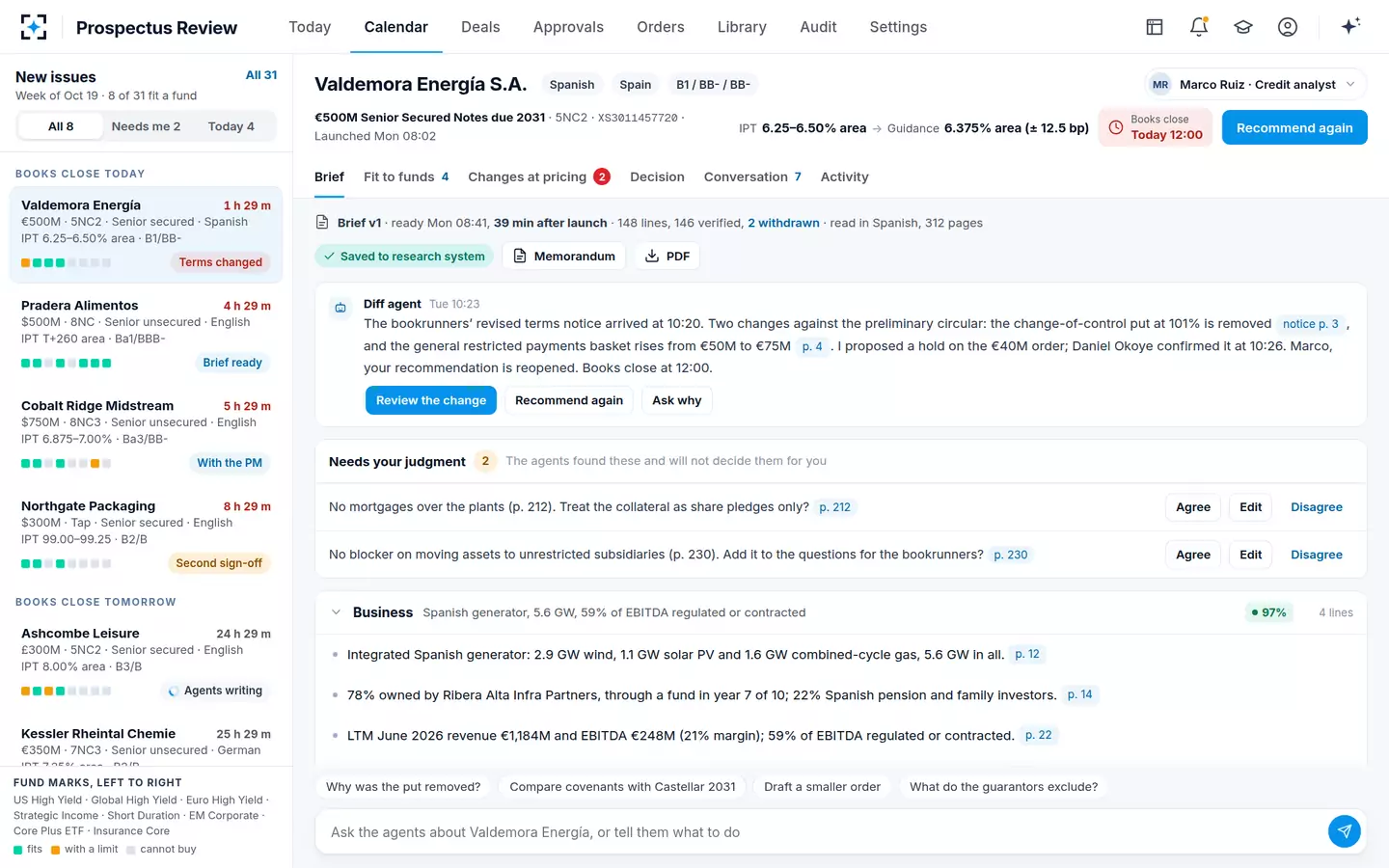
Each needs a person, but not the same person. At the sample desk, when six pages of a German chemicals issuer's 296-page prospectus came through unreadable, the Intake agent asked the syndicate desk for a clean copy at 07:52 rather than writing around them. When the Valdemora circular gave the plants no mortgage and placed no blocker on unrestricted subsidiaries, the agents did not call either good or bad; they put both under "Needs your judgment", the second with an offer: "Add it to the questions for the bookrunners?"
Three kinds of gap, and what an agent should do with each
| Gap | Example from the sample desk | What the agent does | Who decides |
|---|---|---|---|
| Physical: the text is not there | Pages 214–219 of a 296-page German prospectus unreadable | Stops short of those pages, flags them, asks the syndicate desk for a clean copy | Analyst, once the copy arrives |
| Silence: the protection is not there | No blocker on moving assets to unrestricted subsidiaries (p. 230) | States what the document says and does not say, with the page; drafts a question for the bookrunners | Analyst: agree, edit, disagree; send or not |
| Ambiguity: two readings are possible | No mortgages over the plants (p. 212): is the collateral share pledges only? | Shows both readings and what each would mean; does not pick one | Analyst, with counsel if it matters |
| Unsupported line | A line on hydro concessions the circular never describes | Withdraws the line and shows the reason | Analyst sees it as withdrawn |
What the agents found and will not decide: two points, each with its page
What questions to ask bookrunners on a new issue
Ask what the document does not settle and an answer would change your order. Questions sent late are worthless, so the timing matters as much as the content: before guidance, the bookrunners have reason to answer; in the last hour they do not. Time-of-sale law points the same way. For the SEC's offering liability provisions, information that reaches the buyer only after the time of sale is left out of account (Rule 159), so an answer that arrives after the order is not part of what the buyer relied on.
Questions worth sending before guidance
- Gaps in protection
Is a blocker on transfers to unrestricted subsidiaries intended? Will the collateral include mortgages over the operating assets?
- Numbers that do not tie
Which EBITDA figure do the covenant ratios use, and how does it reconcile to the audited one?
- Bracketed terms
Where is the general basket or the call premium expected to land, and what drives it?
- Ownership and exit
When does the sponsor's fund need to sell, and does the change of control definition catch the likely buyers?
- Missing or unreadable pages
Request a clean copy before reading around them.
- Anything you would otherwise assume
If the answer would change the size or the limit, it is worth a question.
Can AI check fund mandate fit?
Yes, and it is the part of new-issue work most suited to automation, because fit is rules applied to data. Each fund's limits — rating floor, currency, duration, issuer concentration, UCITS limits, exclusions, insurance designations — are written in its prospectus or investment management agreement, and its holdings are in portfolio accounting. An agent that has both can say within minutes which funds fit, which fit with a limit and which cannot buy, with the rule and the clause for each. At the sample desk the Triage agent did that for 212 portfolios four minutes after launch.
The safeguards matter more than the speed. The agent that applies the rules must never change them: at the sample desk each fund rule cites its source clause, is versioned, and changes only when the administrator proposes and investment compliance approves. And it must never set a size; the order drafter sizes within headroom only after the analyst has recommended and before the portfolio manager approves.
Does AI replace the credit analyst on new issues?
No, and a tool built to do so would fail the regulators' tests. ESMA lists over-reliance among AI's risks: firms and clients leaning on AI for decisions and neglecting human judgment (ESMA public statement on AI in investment services, May 2024; ESMA's words are quoted in AI stock alerts: what agents may decide). FINRA lists data sensitivity among the risks of AI agents, an agent storing, disclosing or misusing confidential information without meaning to (FINRA, 2026 Annual Regulatory Oversight Report) — a direct concern for a credit desk that must keep public-side reading apart from anything private-side.
What changes is how the analyst spends the window. Instead of reading 300 pages to find the twenty that matter, the analyst checks a one-page note against its pages, decides the open points, sends the questions and makes the call. On the sample desk the agents never recommend, approve, send, change or cancel an order; the analyst recommends with a reason code, the portfolio manager approves for their own funds, and the trader executes no more than the approved size.
A note that sounds complete vs a note that marks its gaps
Sounds complete: "Secured by substantially all assets."
Marks its gaps: "No mortgages over the plants (p. 212); the collateral may be share pledges only." Needs your judgment.
Sounds complete: Not mentioned.
Marks its gaps: "No blocker on moving material assets to unrestricted subsidiaries (p. 230)." Question drafted for the bookrunners.
Sounds complete: "Diversified across wind, solar, gas and hydro."
Marks its gaps: Hydro line withdrawn: not found in the circular.
Sounds complete: Written around; nobody knows which pages were skipped.
Marks its gaps: Pages 214–219 flagged; clean copy requested before reading.
Sounds complete: Trusts it, or re-reads 300 pages.
Marks its gaps: Checks the cited lines, decides two points, sends one question.
How to evaluate an AI offering memorandum tool — and where Prospectus Review fits
Test it on documents you have already read, and score the gaps, not the prose. ESMA expects "thorough testing of algorithms and their outcomes for accuracy" and controls both before and after use, including "robust controls ... to ensure – ex-ante – the accuracy of information supplied to and/or utilised by AI systems". A vendor demonstration on a clean English memorandum shows none of that.
Eight tests for an AI offering memorandum tool, run on your own past deals
- Does every line open its page?
In the original language, for a Spanish, German or French document, not a translation of a translation.
- Is every line re-checked by something other than the writer?
And are lines that fail shown as withdrawn, not silently dropped?
- What does it do with an unreadable page?
Plant one. The right answer is to stop and ask, not to summarise around it.
- Does it list what the document does not say?
Missing blockers, missing mortgages, silent definitions: these are the findings that change orders.
- Does it compare every new version with the preliminary?
Revised terms and the final memorandum, clause by clause, before books close.
- Does fit come from your fund documents?
With the clause cited, and rule changes approved by compliance.
- Can it act on its own?
It should not be able to recommend, approve, send or cancel anything.
- What will compliance get?
Who decided, on which document version, when and why, exportable per deal.
The solution fits public-side buy-side credit desks that read new high-yield and crossover deals for several funds and need fit, a cited note and a version comparison before books close. It does not fit where the desk wants an automated buyer: the agents never place or size an order on their own. It does not read private-side material, so lender-only information stays out of it. And it is only as good as the fund rules and house template a desk gives it, which is why setup starts by proposing fit rules from each fund's documents for compliance to approve. How to prove it on your own deals is set out in replay last quarter's launches before you buy; how a single cited line can drift on its way from the indenture is traced in the description of notes, hop by hop. To see it on a deal of your own, start from Prospectus Review.
Questions people ask
Can AI summarize a bond prospectus accurately?
It can summarise one quickly; accuracy depends on whether every sentence is checked against the page it came from. Peer-reviewed work finds hallucinated content in summaries from every system tested, and long documents are harder still, so a usable summary needs a second, independent check of each line and a visible record of lines withdrawn.
What should an AI tool never do on a new issue?
It should never recommend, approve, send, change or cancel an order, never change a fund's rules, and never take in private-side material. On the sample desk a hold on a standing order is proposed by an agent and confirmed by the trader, and every fund rule change needs investment compliance's approval.
How accurate is AI on offering documents?
No regulator or independent study publishes an accuracy rate for AI on bond offering memoranda. Benchmarks on long financial documents find state-of-the-art systems struggle, especially on the longest ones, so measure a tool on your own past memoranda: the share of lines that are on their cited page, and the gaps it found that your analysts had flagged.
Can AI read an offering memorandum in Spanish, German or French?
Models can read them, but a credit desk needs the original wording beside any English line, so a translation error can be seen. On the sample desk each line opens the original page with the passage highlighted, and the second agent checks the line against the original, not the translation.
Should AI send questions to the bookrunners itself?
No. A question to the syndicate is a communication from the buyer and can signal interest or concern; it should leave only when the analyst decides to send it. On the sample desk the agents draft the question and the analyst sends it or does not.