A preliminary offering memorandum is the draft offering document that the bookrunners send to investors when a bond deal launches: complete except for the final price, coupon and sometimes size, which a pricing term sheet adds later. For a high-yield bond it commonly runs to 300 pages or more and follows the shape of a registered prospectus — a summary, risk factors, use of proceeds and capitalization, the business, a description of the notes and the financial statements — although no rule fixes its order. A credit analyst does not need to read it front to back; the credit view depends on eight sections, each answering one question. Botminds' Prospectus Review reads every page of the memorandum in its own language and writes a one-page credit note with each line tied to its page, so the analyst starts from the answers and checks them at the source.
The page references below come from a fictional sample deal, Valdemora Energía's 312-page Spanish preliminary offering circular, as read by the solution for a fictional desk, Quillfield Capital. The research on prospectus length and language comes from ESMA and peer-reviewed studies, linked where cited.
The preliminary offering memorandum, annotated: which question each section answers
Cover, notice to investors, legends
Can my fund buy this at all?
Look forThe 144A and Regulation S legends, selling restrictions by country, the "subject to completion" wording
In the sampleFront pages
Summary and "The Offering"
What is being sold, ranked where, guaranteed by whom?
Look forIssuer, amount, maturity, call schedule, ranking, guarantors, collateral, change of control in one place
In the sampleFront of the circular, before the risk factors on p. 34
Risk factors
What could break this credit that the numbers do not show?
Look forIssuer-specific risks with a figure attached; skip the generic ones
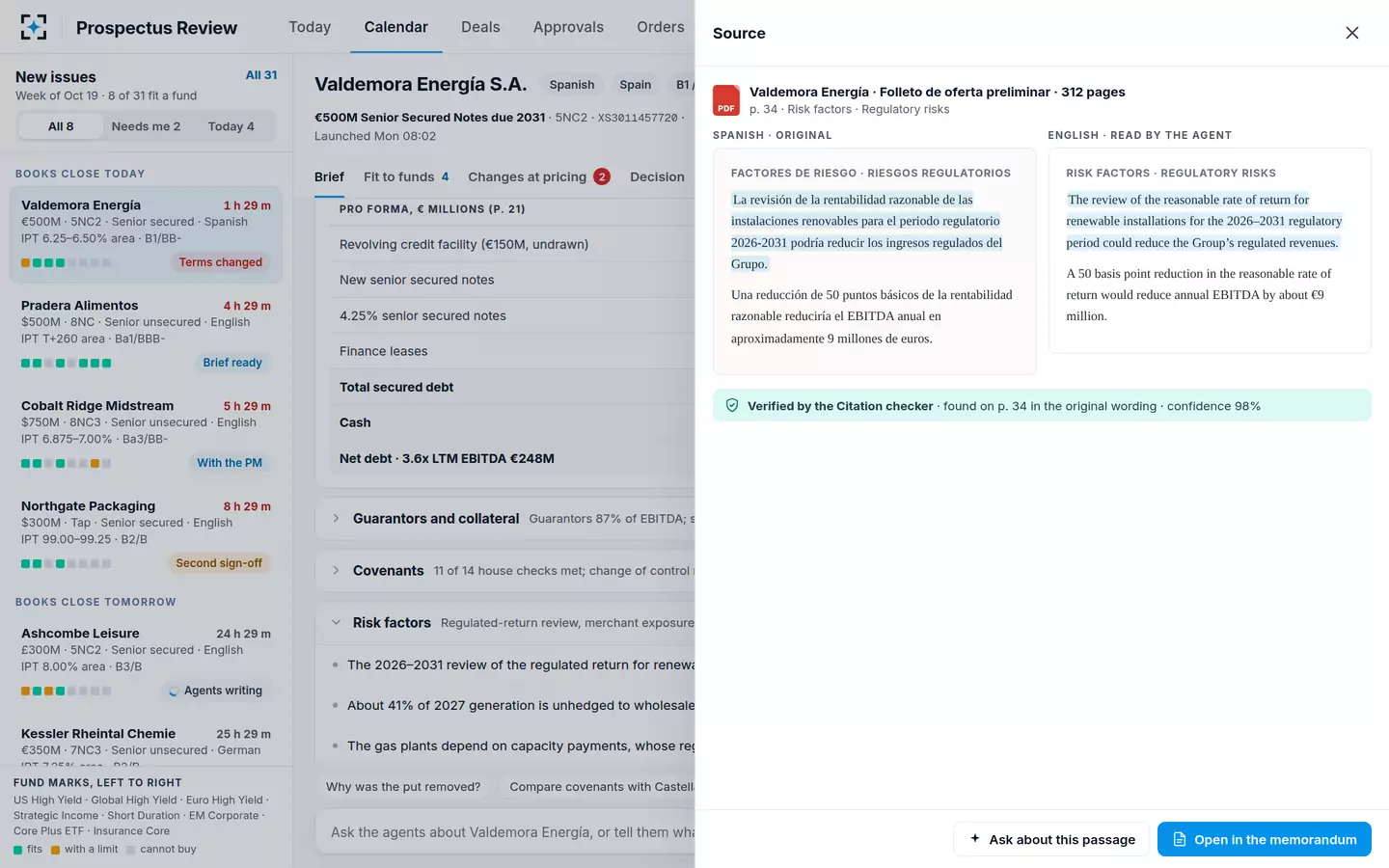
In the samplep. 34: a 50 bp cut in regulated return ≈ €9M of EBITDA
Use of proceeds and capitalization
Where does the money go, and what does the balance sheet look like after?
Look forThe "as adjusted" column: total and secured debt and leverage after the deal
In the samplep. 21: net debt 3.6x LTM EBITDA of €248M
Business, ownership, financial review
How does this company make and keep its cash?
Look forSegments, contracted or regulated share, the owner and its exit horizon
In the samplep. 12: 5.6 GW; p. 14: owner's fund in year 7 of 10
Description of other indebtedness
What sits beside or ahead of these notes?
Look forRevolver size and priority, intercreditor terms, maturities before ours
In the sampleRevolver €150M, undrawn (capitalization, p. 21)
Description of notes
What protects me, and what can the issuer do without asking?
Look forDefinitions first, then change of control, restricted payments, debt and liens, asset sales, unrestricted subsidiaries
In the samplep. 212 liens; p. 230 unrestricted subsidiaries; p. 233 payments; p. 241 change of control
Financial statements
Do the numbers in the summary tie to audited ones?
Look forAudit opinion, the period of any interim figures, the reconciliation of adjusted EBITDA
In the sampleF-pages at the back
What is a preliminary offering memorandum?
It is the private-offering counterpart of a preliminary prospectus: the document investors read and order on before the deal prices. The banks circulate it with the launch announcement, often with a roadshow or investor call, and it stays the working document until a pricing term sheet fixes the coupon, the issue price and any changed terms. Everything a buyer relies on before pricing comes from this document or from what the bookrunners say and send alongside it.
Two consequences follow. Anything a revised terms notice or the pricing term sheet changes overrides the preliminary memorandum, so the version the analyst read is not necessarily the deal the fund buys. And the final memorandum that arrives after pricing is the one the bonds are actually issued under; it should be compared with the preliminary, not assumed identical — a comparison what changed at pricing walks through.
What is a red herring prospectus, and does an offering memorandum carry the same warning?
A red herring is a preliminary prospectus in a registered offering, and its defining feature is a warning. Regulation S-K requires a prospectus used before the price is set to say, in substance, "The information in this prospectus is not complete and may be changed", that the securities may not be sold until the registration statement is effective, and that it is not an offer where an offer would be unlawful (Item 501(b)(10)).
A preliminary offering memorandum for a Rule 144A deal is not bound by that item, but typically carries a similar warning, because it is equally incomplete: the coupon, the issue price, sometimes the size and the call premiums are blank or bracketed until pricing. Read the bracketed items as open questions. A call schedule written as "[•]% of principal" or a basket written as "the greater of €[•] and [•]% of total assets" is a term the issuer and banks have not yet fixed, and the place a change at pricing is most likely to appear.
How long is an offering memorandum?
Long, and not because the credit needs it. The most systematic public measurement comes from the EU. ESMA's economists ran text-mining tools over every prospectus approved in the EU between late November 2020 and January 2022, "approximately 593,000 pages of text" in 3,220 documents, 1,229 of them for debt securities. Prospectuses ran to "an average of approximately 200 pages, but also up to as many as 1,000 pages" (ESMA, Parsing prospectuses, November 2022).
What ESMA found when it read every EU prospectus by machine
593,000
pages read across 3,220 prospectus documents, November 2020 to January 2022
10%
more rating disagreement, relative to the average, for each additional 100 pages from the same issuer
85%
of distinct links to documents inside prospectuses that still worked
Length is not information. ESMA found that "an additional length of 100 pages for a prospectus by the same issuer increases the rating disagreement by 10% of its average value", that in some documents, securities notes above all, more than half the sentences are duplicates, and that duplication "can lead to reader fatigue and the risk of key provisions being overlooked".
"Longer prospectuses may not only fail to provide additional clarity, but can also be associated with increased ambiguity."
ESMA, 'Parsing prospectuses: A text-mining approach' (2022)
Peer-reviewed work in the US points the same way. Bonsall and Miller found that "less readable financial disclosures are associated with less favorable ratings (higher default risk), greater bond rating agency disagreement, and a higher cost of debt capital" (SSRN working paper, 2016; published in Review of Accounting Studies, 2017). For the reader of a memorandum, the lesson is to read for the eight answers, not for coverage.
Which sections of a bond prospectus matter most?
For a credit view, the description of notes and the capitalization table matter most, with risk factors and the business close behind. The description of notes is the contract; the capitalization table is the balance sheet the contract will live on; the risk factors and the business say what could make the cash flow fall short. The summary is a map, not a source: the SEC's own instruction for registered prospectuses says a summary "should not merely repeat the text of the prospectus but should provide a brief overview" (Item 503), which means it leaves things out by design.
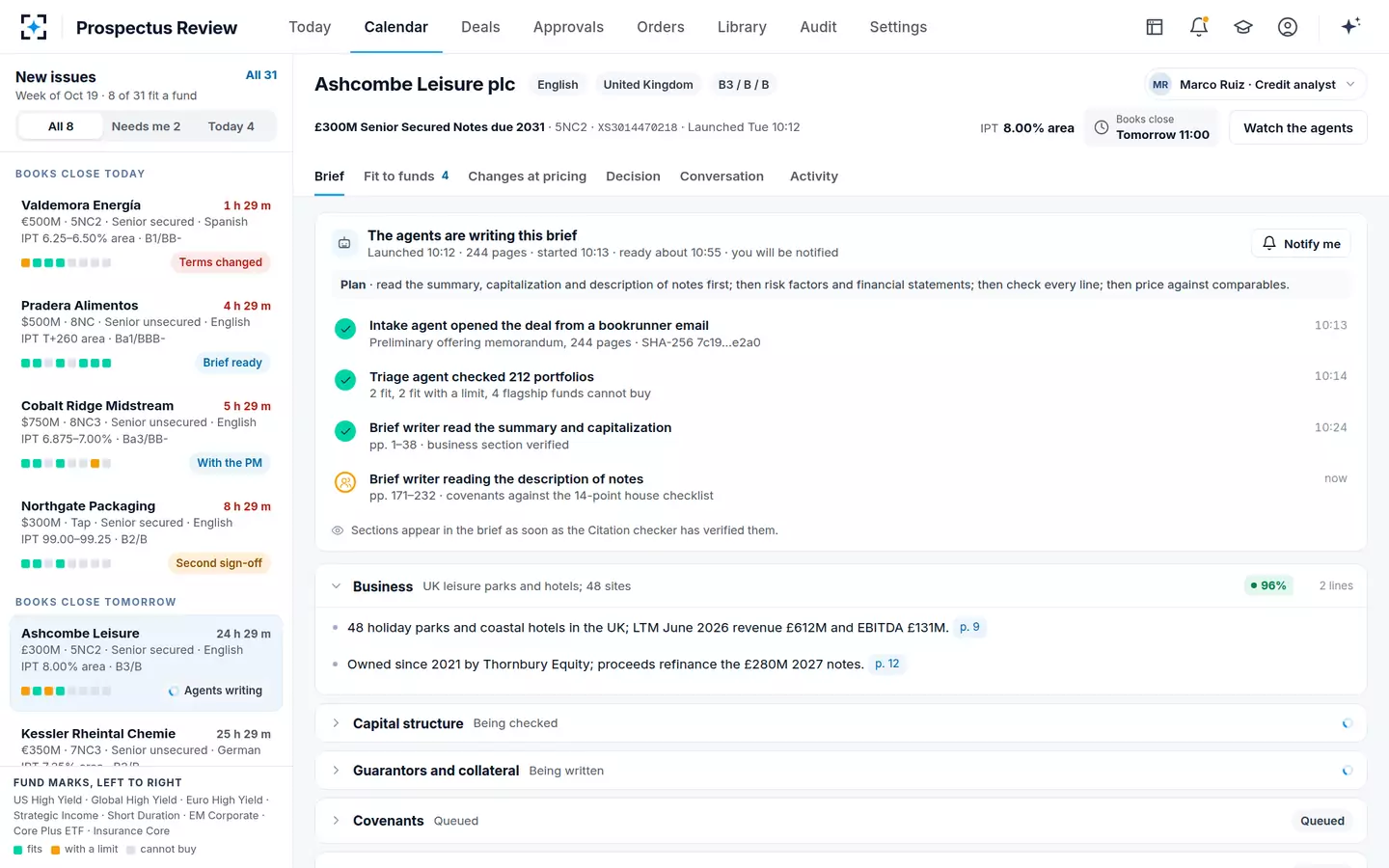
The order the solution's agents read in reflects that. On the sample desk, when a UK leisure issuer launched a £300 million deal with a 244-page memorandum, the agents' plan read: "read the summary, capitalization and description of notes first; then risk factors and financial statements; then check every line; then price against comparables." The description of notes ran from page 171 to page 232, more than a quarter of the document.
The agents' reading plan, shown as they read a new memorandum
What are risk factors in an offering memorandum, and which ones are generic?
Risk factors are the issuer's own list of what could make the investment fail, and most of the reader's work is separating the specific from the generic. For registered offerings the SEC requires "a discussion of the material factors that make an investment in the registrant or offering speculative or risky", says "the presentation of risks that could apply generically to any registrant or any offering is discouraged", puts generic ones at the end under "General Risk Factors", and requires a two-page bullet summary when the section runs past 15 pages (Item 105). The EU rule is stricter in principle: risk factors "shall be limited to risks which are specific to the issuer and/or to the securities and which are material for taking an informed investment decision" (Prospectus Regulation, Article 16(1)).
Practice falls short of both. ESMA extracted 90,701 risk factors from 2,482 prospectuses and compared every pair across different issuers. Language "highly similar across issuers" appeared in 63% of the documents that discussed interest rate risk and 48% of those that discussed liquidity risk. A 144A memorandum, bound by neither rule, has less reason to be specific.
How often EU prospectuses reuse another issuer's risk factor wording, by topic
The specific ones usually carry a number. In the sample deal, page 34 of the Spanish circular said a 50 basis point cut in the regulated return for renewables in the 2026–2031 period would reduce annual EBITDA by about €9 million — against EBITDA of €248 million, roughly 3.6%, a figure an analyst can put straight into a downside case.
A specific risk factor, opened at its page in the original language
What is a capitalization table in a prospectus?
It is the table that shows the issuer's debt and equity before and after the offering — the single most useful page for a credit analyst. The SEC's form for foreign registrants describes it precisely: "a statement of capitalization and indebtedness (distinguishing between guaranteed and unguaranteed, and secured and unsecured, indebtedness) ... on an actual basis and, if applicable, as adjusted to reflect the sale of new securities being issued and the intended application of the net proceeds therefrom" (Form 20-F, Item 3.B).
Read the "as adjusted" column, not the actual one. In the sample deal the pro forma table on page 21 showed the €150 million revolver undrawn, the new senior secured notes, existing 4.25% senior secured notes and finance leases, and net debt of 3.6 times last-twelve-months EBITDA of €248 million. The questions it answers — how much debt ranks with or ahead of these notes, and how much more can be added under the covenants — lead straight into the description of notes.
What is in a description of notes?
The terms of the bonds, in summary: maturity, interest, redemption and call schedule, ranking and security, guarantees, the covenants, events of default, and how the terms can be amended. For registered debt the SEC's list of what to outline runs from maturity and redemption to limits on dividends and new debt, events of default and how the terms can be modified (Regulation S-K Item 202(b)). The indenture governs; the description is its summary, and a high-yield one goes well beyond the SEC's list.
That is why a careful reader starts with the definitions section and reads the covenants against it. In the sample deal the agents flagged two points they would not decide for the analyst: no mortgages over the plants (page 212) and no blocker on moving assets to unrestricted subsidiaries (page 230). How one clause travels from the indenture into a credit note, and where it can go wrong on the way, is traced in the description of notes, hop by hop, and the change of control clause in particular in the 101% put that needs two triggers.
How to read an offering memorandum quickly: an order that works
Read in the order of the questions, not the pages. The plain-English rule, which applies only to registered prospectuses, asks for "short sentences", "active voice" and "no legal jargon or highly technical business terms" in the cover, summary and risk factors (Rule 421(d)) — sections a fast reader leans on. In a private memorandum none of that is guaranteed, so a fixed order of reading does the work the rule would have done.
A reading order for a 300-page preliminary memorandum
- Cover and legends: can each fund buy it?
Route, selling restrictions and the "subject to completion" warning. Stop here for any fund that cannot hold it.
- The Offering summary: the term sheet in prose
Write down ranking, guarantors, collateral, call schedule and change of control; you will check each against the description of notes.
- Capitalization, as adjusted
Total and secured leverage after the deal; what ranks ahead.
- Description of notes, definitions first
Then change of control, restricted payments, debt and liens, asset sales, unrestricted subsidiaries. Note every basket in currency.
- Risk factors with numbers
Keep the issuer-specific ones with a figure; skip the paragraphs any issuer could have written.
- Business and ownership
Contracted or regulated share of cash flow; who owns the company and when they need to sell.
- Financial statements
Tie the summary's EBITDA to the audited figures and the reconciliation; check the period of any interim numbers.
- Questions for the bookrunners
Anything silent, ambiguous or unreadable, sent while there is still time for an answer.
The last item is where agents earn their keep or do harm: a reader that guesses past a gap produces a confident wrong note. AI offering memorandum review covers what a useful agent does instead. For the difference between this document and a registered prospectus, see offering memorandum vs prospectus; to see a whole memorandum read and cited on your own deals, start from Prospectus Review.
Questions people ask
What is the difference between a preliminary and a final offering memorandum?
The preliminary memorandum circulates at launch with the price, coupon and sometimes size left blank; the final one is dated after pricing and fills them in, folding in any terms changed by a revised terms notice or pricing term sheet. The bonds are issued under the final memorandum, so it should be compared with the preliminary rather than assumed identical.
Is a preliminary offering circular the same as a preliminary offering memorandum?
Yes, for practical purposes: "offering circular" is the name many European and Asian issuers use for the same private-placement document. A Spanish deal may call it a folleto de oferta preliminar, as the sample deal did; the structure and the reading are the same.
Why do offering memoranda repeat so much text?
Partly because the summary restates the body and the description of notes restates the indenture, and partly drafting habit. ESMA found that longer documents carry more duplicated sentences and that some securities notes duplicate more than half of theirs, which raises the risk of a key provision being overlooked.
What is a "general risk factor"?
A risk that could apply to any issuer or offering, such as a broad economic downturn. The SEC discourages them in registered prospectuses and, where used, requires them at the end of the section under that heading; the EU requires risk factors to be specific to the issuer or the securities.
Can a preliminary memorandum be relied on if the final one differs?
What counts is what the buyer was told by the time it committed. A change made before pricing, in a revised terms notice or pricing term sheet, becomes part of what the buyer knew; a difference that appears only in the final memorandum after the sale is a different matter, and one to raise with counsel.