A change of control put is the bondholder's right, written into a high yield indenture, to require the issuer to buy back the notes — typically at 101% of principal plus accrued interest — when control of the issuer changes. It is the covenant meant to protect holders in a buyout, but whether it protects them depends on two sets of definitions read together: what counts as a change of control (and who is excluded as a permitted holder), and, in many bonds, whether a ratings decline must follow before the put arises. A sale can therefore change everything about a credit and still leave the put asleep. Botminds' Bond Covenant Analysis quotes the trigger, every carve-out and the ratings test with their pages and scores the clause alongside the rest of the covenant package, so an analyst knows before books close which buyouts would pay holders and which would not.
The deal examples use sample data on fictional companies — Dunmore Cinemas Holdings' $650 million of 7.25% senior notes due 2031, owned by the fictional sponsor Halberd Ridge Partners — as they run through the solution. Research, regulation and the Delaware Court of Chancery are quoted from their own texts.
What a change of control put is worth, in three numbers
101%
of principal plus accrued interest: the usual price at which the issuer must offer to buy the notes
21bp
higher yield, on average, on bonds without event-risk covenants than on the same firm's bonds with them
20days
the minimum a tender offer must stay open: twenty business days under SEC Rule 14e-1
What is a change of control put?
A change of control put is a promise by the issuer that, if a defined change of control happens, it will offer to buy every holder's notes at a fixed price, usually 101% of principal plus accrued and unpaid interest. Holders choose whether to accept. The point is to let creditors leave at par plus a small premium when the company they lent to is replaced by a different one — typically a more leveraged one.
In the leveraged buyout wave of the late 1980s such provisions were known as "poison puts". A Journal of Finance study of 1988–1989 issues found that "'poison put' covenants affect stockholders negatively and outstanding bondholders positively, while debt issued without such covenants has no effect," and read the result as consistent with a "mutual interest hypothesis": issuing such debt "protects managers and, coincidentally, bondholders, at the expense of stockholders" (Cook and Easterwood, 1994). The same tension runs through every modern definition: the more the put deters a buyout, the more an owner wants to narrow it.
What is a 101 change of control offer, and when must the issuer make it?
A "101 change of control" is shorthand for the offer itself: within a set number of days after the change of control (and, in a double-trigger bond, the ratings decline), the issuer must send holders an offer to purchase their notes at 101% of principal. The indenture fixes the deadline for sending the offer, the purchase date and what happens to notes not tendered.
Because it is an offer to buy notes from all holders, it may also have to follow the SEC's tender offer rules; where it is run as a tender offer, Rule 14e-1 says no one may "Hold such tender offer open for less than twenty business days from the date such tender offer is first published or sent to security holders" (17 CFR 240.14e-1). For an SEC-reporting issuer, the 8-K's Item 5.01, "Changes in Control of Registrant," requires disclosure within four business days of a change in control as the securities laws define it (Form 8-K) — which is not the same test as the indenture's defined "Change of Control". The analyst reads the indenture's definition, not the press release.
The definitions that decide whether a buyout fires the put
Whether a sale triggers the put is decided less by the change of control covenant than by four definitions it relies on: who is a permitted holder, what counts as a continuing director, whether a leverage-based exception lets a sale bypass the definition, and how a ratings decline is measured. The decision tree below runs five buyout scenarios through those definitions.
Five ways control can change, and which ones pay holders 101%
ScenarioA strategic buyer rated investment grade acquires the issuer
Trigger testChange of control: yes. Ratings decline: no — the ratings rise.
Result for holdersNo put under a double trigger, though the notes may gain from a stronger owner.
ScenarioA new sponsor buys the issuer with more debt
Trigger testChange of control: yes. Ratings decline within the window: likely.
Result for holdersPut at 101% of principal plus accrued interest, if both triggers fire.
ScenarioThe sponsor sells to a fund it manages
Trigger testBuyer is a "Permitted Holder": no change of control.
Result for holdersNo put, however much the new owner borrows next.
ScenarioShareholders replace most of the board in a proxy fight
Trigger testDepends on "Continuing Directors" — and whether the old board may approve the new ones.
Result for holdersPossibly no put: the old board may be able to approve the new directors.
ScenarioA buyout that meets a leverage test at closing
Trigger testSome indentures let a sale skip the definition if pro forma leverage is low enough.
Result for holdersNo put, if the test is met on the closing date.
What is a permitted holder?
A permitted holder is a person or group, named in the definitions, whose acquisition of control does not count as a change of control — usually the current sponsor, its affiliated funds and management. If the issuer is sold to an entity within that list, the put never arises, even if the buyer then adds debt. The width of the list, and whether it can grow, is the first thing to read in a sponsor-owned issuer such as the sample deal's.
The four definitions to read with any change of control put
| Definition | What to check | How it narrows the put |
|---|---|---|
| Permitted Holders | Who is named; whether affiliates, related funds and future co-investors count; whether the list can be added to | Sales within the group never trigger the put |
| Continuing Directors | Whether directors "approved" by the incumbent board count as continuing, and whether that includes dissident nominees | A board can approve its replacements and keep the put asleep |
| Leverage-based exception | Whether a sale is excluded if pro forma leverage on the closing date is below a stated ratio | Buyouts that meet the test pass without a put |
| Rating Decline | Agencies named, notches, window length, extension during a review, and what happens if a rating is withdrawn | A buyout can harm the credit without the second trigger firing |
What is a double trigger change of control?
A double trigger change of control requires two events before the put arises: a change of control as defined, and a ratings decline — typically a downgrade by a set number of notches, or below investment grade, by the rating agencies named in the indenture within a set period after the deal is announced or completed. If the ratings hold or rise, holders have no put, whatever else changed.
Single trigger and double trigger, read against the same buyout
Single trigger: A change of control, as defined.
Double trigger: A change of control and a ratings decline within the stated window.
Single trigger: Put arises, though holders rarely want to sell bonds that just improved.
Double trigger: No put: ratings rise, so the second trigger never fires.
Single trigger: Put arises at closing.
Double trigger: Put arises only if the downgrade lands inside the window — read how the window is measured and whether a pending review extends it.
Single trigger: The change of control definition and its carve-outs.
Double trigger: Both definitions, the agencies named, the notch test, the window, and what happens if an agency stops rating the notes.
The double trigger is reasonable on its face: holders are protected against a buyout that hurts their credit, not one that helps it. Its weakness is timing and wording. A window measured from public announcement can close before a buyer finishes its financing; a test requiring a downgrade by two named agencies fails if one of them withdraws its rating. Each of those is a sentence in a definitions section, which is where the put is won or lost.
Does a change of control put protect bondholders in an LBO? The evidence
It protects them when it fires, and the market prices that protection. In a 2020 study, Eisenthal-Berkovitz, Feldhütter and Vig found "leveraged buyouts (LBOs) to be a significant concern for bondholders," showing that "intra-industry credit spreads increase upon an LBO announcement" and that "yields on bonds without event risk covenants are, on average, 21 basis points higher than those on same-firm bonds with such covenants" (Journal of Financial Economics). The impact, they report, "is strongest in expansion periods and for bonds with maturities of 10–20 years."
The Federal Reserve's manual for examiners of trading activities lists the same risk: "Examples of event risk include leveraged buyouts, corporate restructurings, or court rulings that affect the credit rating of a company" (Federal Reserve, Trading and Capital-Markets Activities Manual, section 4045.1). The protection is real; its reach is set by the definitions. A put whose permitted holders include every fund the sponsor manages, or whose ratings window is short, prices like a narrower covenant than its heading suggests.
The put's heading says "Change of Control". Its value is in the definitions of who is excluded and what a ratings decline means.
Continuing directors and the proxy put: what a Delaware court said
A change of control definition often includes a board test: the put arises if "Continuing Directors" stop being a majority of the board. In San Antonio Fire & Police Pension Fund v. Amylin Pharmaceuticals (Del. Ch. 2009), the Court of Chancery described what was at stake when shareholders ran a proxy fight against a company whose notes had such a clause: "if a majority of the board at any time are not 'continuing directors,' holders of the notes gain the right to put their notes to the corporation at face value" (983 A.2d 304).
The indenture trustee argued that the board could not "approve" as continuing directors the nominees it publicly opposed. The court disagreed: "the board may approve the stockholder nominees if the board determines in good faith that the election of one or more of the dissident nominees would not be materially adverse to the interests of the corporation or its stockholders." It also warned that a provision with "an eviscerating effect on the stockholder franchise would raise grave concerns." For a bondholder, the lesson is that a board-based trigger may not survive the moment it matters, and the analyst should read it as conditional protection, not a certainty.
What happens if the issuer cannot fund the put?
If too many holders accept and the issuer cannot pay, the question becomes what the indenture says about a failed purchase and what the issuer's other debt allows. Read whether failing to buy tendered notes is an event of default, whether the senior credit agreement forbids or must first be repaid before the purchase, and whether the buyer has committed financing for the offer. Together these decide whether the put is a real exit or a claim against a company that has just become more leveraged.
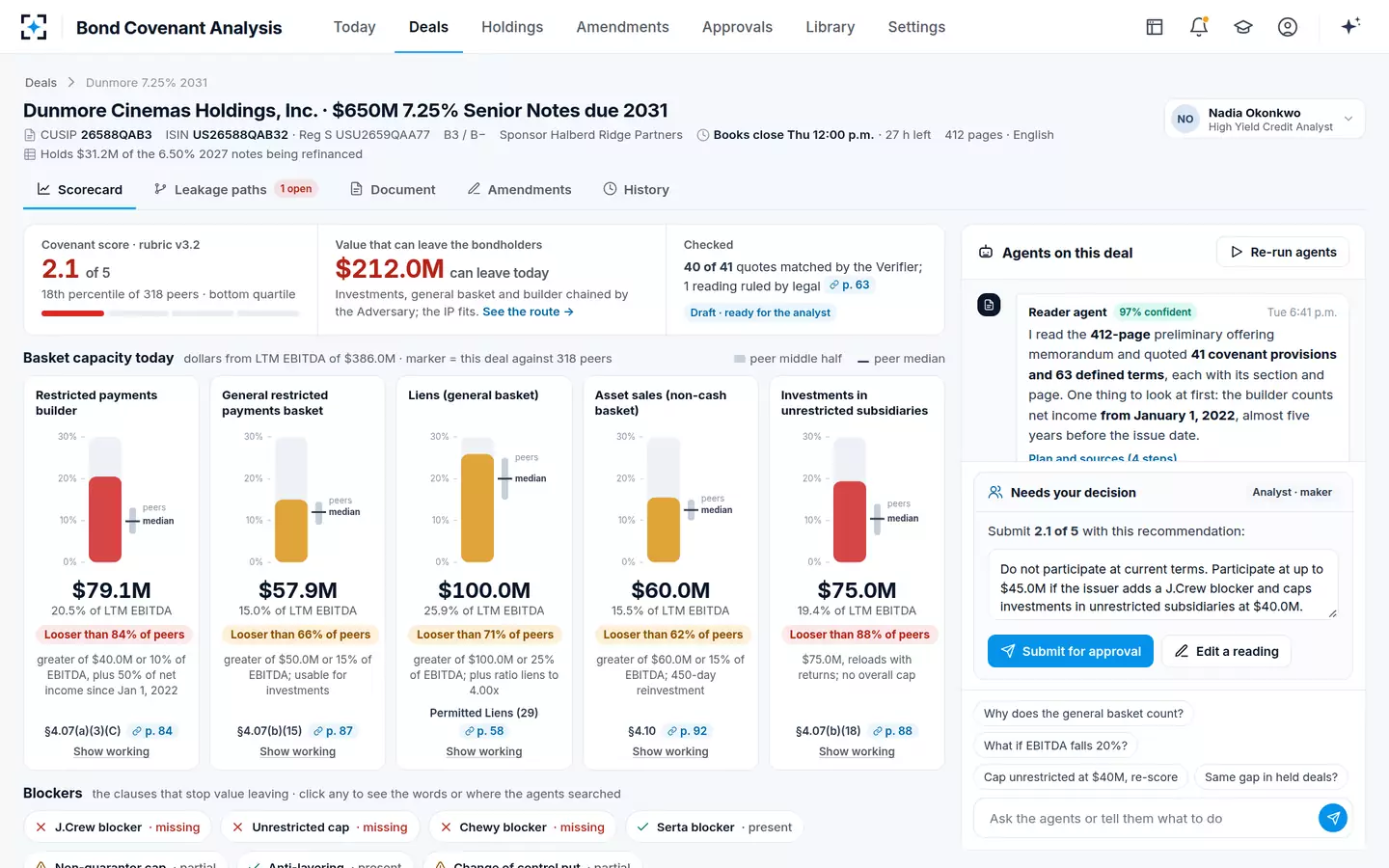
That is also why the put is only one line of a covenant score. In the sample firm's rubric, change of control carries 5% of the weight, against 20% each for restricted payments and investments: a buyout is one event, while the baskets decide what happens to value every day. The full high yield covenant package and the leakage routes it leaves open usually matter more to recovery than the put alone.
Reading the change of control put in a new issue with Bond Covenant Analysis
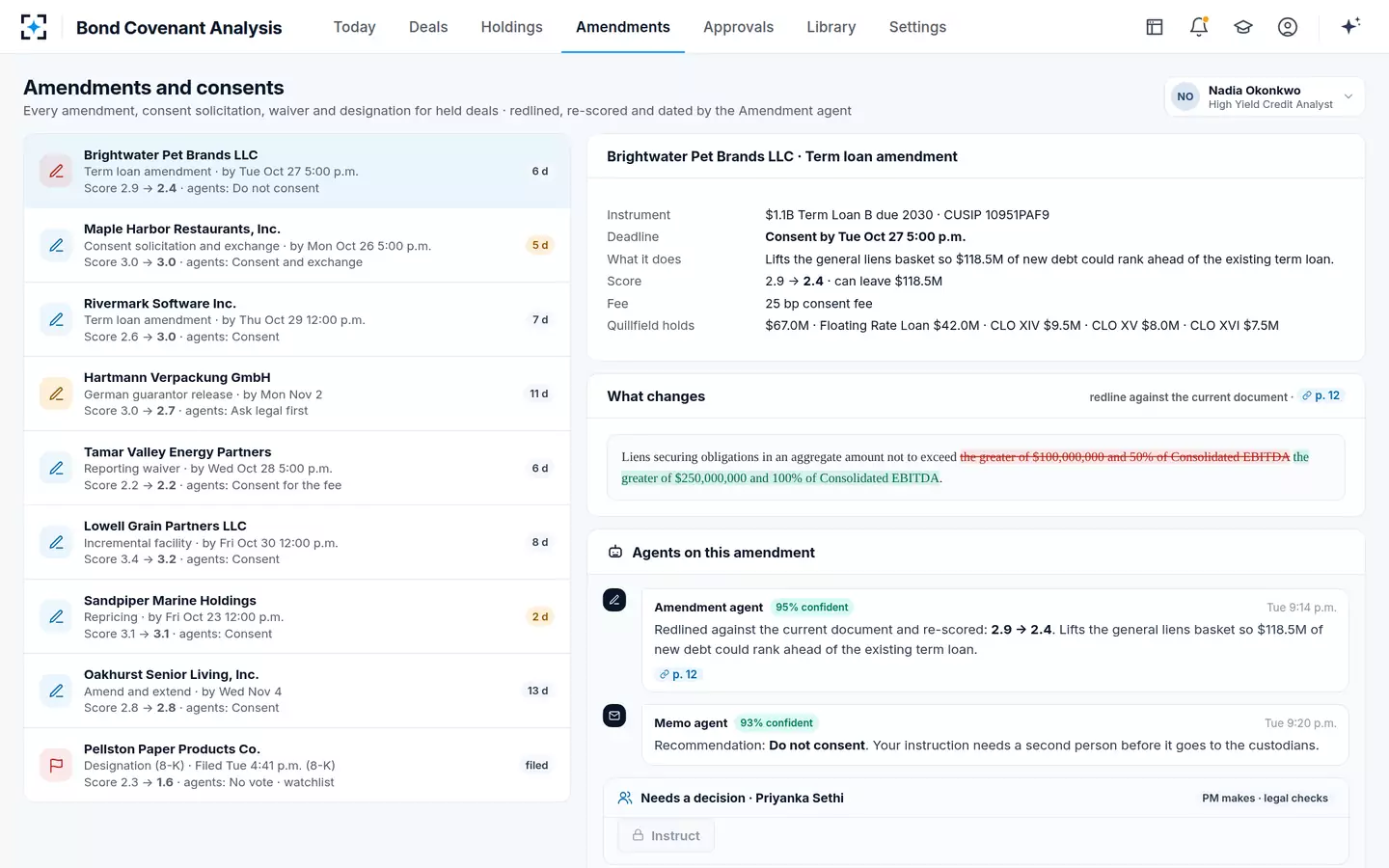
In a new issue, the agents quote the change of control covenant, the definitions of change of control, permitted holders, continuing directors and rating decline, and any leverage-based exception, each with its page, and show the put on the scorecard as present, partial or missing beside the blockers. On the sample deal it is marked partial, and the analyst opens the clause and the definitions behind that mark before she signs.
For a sponsor-owned issuer the question the portfolio manager asks is concrete: if the sponsor sold tomorrow, would we get 101? The analyst can ask the agents exactly that, and the answer cites the definitions it depends on. If the answer turns on a disputed reading — whether a fund counts as an affiliate, whether a window was extended — the dispute goes to counsel rather than being settled by the agents. Consent solicitations are where an issuer can ask holders to loosen these definitions after the fact.
Where a narrowed put would arrive: amendments and consents on held bonds
Bond Covenant Analysis: the put on the scorecard, beside the blockers
Questions people ask
Why is the change of control price 101% and not 100%?
The 1% premium over par is a market convention for the put, set in the indenture; it gives holders a small payment for the early exit. It is not a measure of the loss a buyout can cause, which is why the definitions and the ratings test matter more than the price.
What is a ratings decline trigger?
It is the second condition in a double-trigger put: a downgrade of the notes by a defined amount, by named rating agencies, within a defined period around the change of control. If the ratings do not fall far enough inside that window, holders get no put. Read how the window starts, whether a ratings review extends it, and what happens if an agency withdraws its rating.
Is a change of control in an 8-K the same as in the indenture?
No. Form 8-K Item 5.01 requires an SEC-reporting company to disclose a change in control of the registrant under the securities laws' meaning. The indenture's "Change of Control" is a contract term with its own thresholds, carve-outs and permitted holders, and only that definition decides the put.
What is change of control portability?
Portability is a leverage-based exception: a sale that would otherwise be a change of control is excluded if the issuer's pro forma leverage on the closing date is below a stated ratio. A buyer that meets the test takes the bonds with it and holders get no put. Read the ratio, how EBITDA is defined for it and whether the exception can be used more than once.
Can an issuer remove a change of control put by consent?
It depends on the amendments section: unless the put is listed among the terms that need every affected holder's consent, holders of the stated majority can amend or waive it. Read the amendments section before a buyout is announced: the threshold decides whether a majority can waive the put that the minority relied on.