Covenant leakage is value that can legally leave the group of companies that supports a bond — moved to an unrestricted subsidiary, paid out to shareholders, or pledged to new lenders who rank ahead — through the baskets and exceptions in the indenture. It is hard to see because no single basket is large enough to alarm anyone: the leak appears only when two or three baskets and a defined term are chained together, and chaining is the step an analyst skips when three new issues price in one week. Botminds' Bond Covenant Analysis gives that step to an adversary agent that plans routes the way a sponsor's counsel would, a second agent that tries to break each one, and a price in dollars for every route that survives.
The worked examples are sample data on fictional people and companies, as they run through the solution: Quillfield Capital's credit desk and the $650 million of 7.25% senior notes due 2031 that Dunmore Cinemas Holdings is marketing. Where we estimate a cost, we say so and show the arithmetic. Research and court decisions are linked where they appear.
Leakage Bond Covenant Analysis found in one sample indenture, and what research finds
$212.0M
can leave through three chained baskets in the sample deal — more than the $171.4M brand assets it would take with it
70%+
of leveraged loan contracts studied let the borrower later add senior secured debt above 5x EBITDA
4hours
of an analyst's 20 on a new issue go to chaining baskets into routes, by hand (Botminds estimate)
What is covenant leakage?
Covenant leakage is the gap between what a bondholder thinks the covenants protect and what the baskets actually allow to leave. The term covers any route by which assets, cash or priority move away from the notes without breaching a covenant: an investment in an unrestricted subsidiary, a dividend funded from a builder basket, a drop-down of assets into a subsidiary that does not guarantee the notes, or new debt secured on collateral the notes thought was theirs.
It is measured in dollars, not adjectives. A covenant described as "a general investments basket of the greater of $50 million and 15% of EBITDA" is a sentence; the same covenant read with today's EBITDA, the amount already used, and the definition that lets restricted payment capacity count as investment capacity is a number. Leakage analysis is the discipline of turning every such sentence into a number and then adding the numbers that can be used together.
How does value leak to unrestricted subsidiaries? Three doors in one indenture
Value leaks to an unrestricted subsidiary when the indenture lets the issuer put assets into a subsidiary, designate that subsidiary unrestricted, and treat the designation as an investment that fits inside its baskets. Once designated, the subsidiary is outside every covenant: it can borrow against the assets, pledge them and pay its own dividends, and the bondholders have no claim on any of it.
In the sample indenture the route has three steps. Step one: the definition of "Permitted Investments" lets the issuer put the trademarks and a loyalty platform, carried at $171.4M, into a new subsidiary, because an investment in a company that becomes a restricted subsidiary is permitted (page 62). Step two: the designation covenant lets the board designate that subsidiary unrestricted, so long as the deemed investment fits the baskets the issuer chooses (page 101). Step three: three baskets pay for it together — $75.0M for investments in unrestricted subsidiaries, $57.9M from the general restricted payments basket, which may fund investments, and $79.1M from the builder.
Where the $212.0M of leakage capacity comes from, and what four asks would leave
As offered · $212.0M
- Unrestricted subsidiary basket $75.0M · 35.4%
- General restricted payments $57.9M · 27.3%
- Builder $79.1M · 37.3%
With the four asks · $137.9M, IP route closed
- Unrestricted cap $40.0M · 29%
- General restricted payments $57.9M · 42%
- Builder from issue date $40.0M · 29%
None of the three baskets is unusual on its own. The general basket is a common size; the builder is a standard formula; the unrestricted subsidiary basket is loose, at 19.4% of EBITDA against a peer median of 10.4%, but not extreme. The leak is in the definitions that let them be used together and in the absence of a clause stopping material intellectual property from leaving — the protection the market calls a J.Crew blocker, explained in the liability management series.
Chained, three ordinary baskets pass the value of the brand
What is a drop-down transaction, and which other routes do analysts test?
A drop-down transaction moves valuable assets out of the companies that guarantee the notes — into a non-guarantor restricted subsidiary or an unrestricted one — so that new financing can be raised against them, structurally ahead of existing creditors. It is one of several routes an analyst should test on every indenture; the adversary agent in the sample firm tested eleven on Dunmore and found one open, one to watch and nine blocked.
The routes a leakage review tests, and the clauses that decide each one
| Route | How value leaves | Clauses to read together | What usually blocks it |
|---|---|---|---|
| Designation | Assets move into a subsidiary that is then designated unrestricted. | Designation covenant; investments and restricted payments baskets; "Restricted Payment" and "Permitted Investments" definitions. | A cap on unrestricted investments; a blocker on material IP. |
| Drop-down | Assets move to a non-guarantor subsidiary that borrows against them. | Investments in non-guarantors; guarantor release conditions; asset sales. | A non-guarantor investment cap; tighter guarantor release. |
| Priming | New debt is secured ahead of the notes on the same assets. | Debt and liens covenants; ratio debt; intercreditor terms. | Anti-layering; limits on liens securing ratio debt. |
| Guarantor release | A guarantee falls away when the guarantor stops being wholly owned. | Guarantee release clause; definition of wholly owned subsidiary. | Release only when the guarantor stops being a subsidiary at all. |
| Uptier | A majority of lenders exchange into new debt that ranks ahead of the rest. | Amendment thresholds; pro rata sharing; open-market purchase language. | Making subordination a right each holder must consent to. |
| Payout | Cash leaves as dividends or buybacks. | Builder start date; general basket; ratio-based payments. | Builder from the issue date; a leverage test on large payouts. |
The uptier row is where courts have recently spoken. In In re Serta Simmons Bedding, the Fifth Circuit (December 31, 2024, revised February 14, 2025) rejected the 2020 uptier as an "open market purchase" under the credit agreement (opinion); the Serta fight and liability management exercises in general are covered in that series. On a bond, the first question is the same: which amendments need every holder's consent and which a majority.
What does covenant leakage cost bondholders? The research
The research says leakage is large, concentrated in the actions that hurt creditors most, and not fully priced when the debt is issued. Ivashina and Vallée found the weakening clauses "economically large and … concentrated on the actions with more direct impact on loan value: re-pledging the collateral and issuing additional debt." At origination about half the firms in their sample had total debt below 5x EBITDA, "however, through use of deductibles and carve-outs, over 70% of contracts allow the borrower to issue later on additional senior secured debt in excess of 5x EBITDA" (NBER w27316).
Their event study around the 2017 J.Crew transaction tested whether, once one company had used such clauses, the market repriced other borrowers whose contracts leaned heavily on them. It did. "The value transfer from lenders towards shareholders indicates that the incremental risk for creditors resulting from these clauses is not fully priced in at issuance." The sample is leveraged loans; the mechanism is the same for bonds that carry the same baskets.
The Federal Reserve's May 2026 Financial Stability Report describes the setting in which those clauses get used: while the volume-weighted default rate on leveraged loans stayed below its historical median, "defaults including distressed exchanges—which reflect distressed loans that have been renegotiated between the borrower and the lender—remained relatively high" (Federal Reserve). Negotiated outcomes are where the baskets matter, because they decide each creditor's bargaining position.
The route nobody chained is not a footnote to the credit view. It is the credit view, priced in somebody else's favour.
Four hours against a $45 million order: the arithmetic of a missed route
The cost of skipping the chaining step is small in hours and large in money. By Botminds' estimate, chaining baskets into routes takes about four of the twenty hours a new issue needs by hand. At the median wage for financial analysts, $49.79 an hour in 2025 (Bureau of Labor Statistics), four hours cost about $200 of salary. The sample desk was weighing an order of up to $45.0M in the Dunmore notes; a single point of price on that position is $450,000.
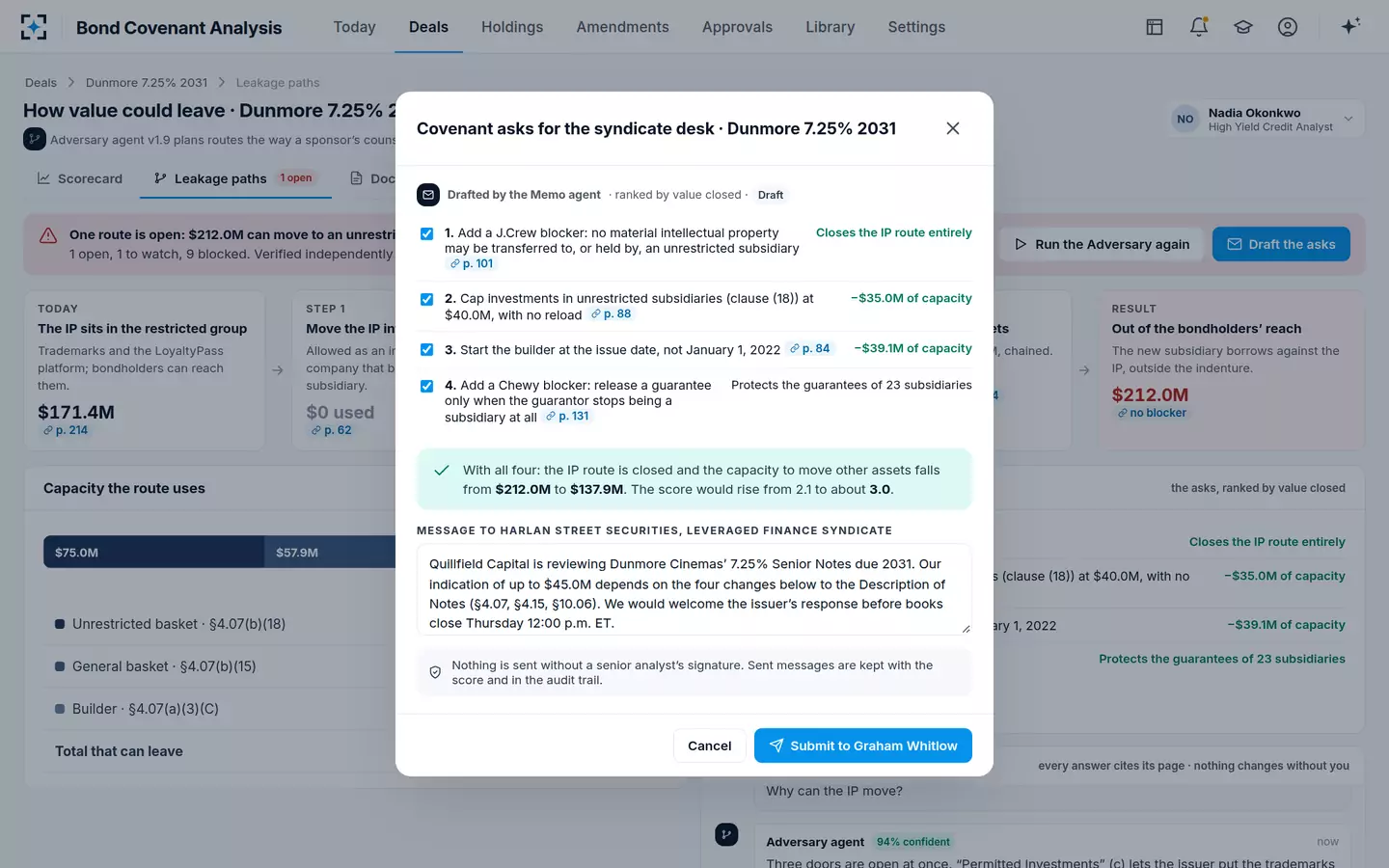
That comparison is deliberately crude — it ignores overhead on one side and the probability of a route being used on the other — but it shows why leakage work cannot be the step that gives way under time pressure. A missed route need not be used to cost money: it moves the price at which a better-informed buyer would hold the bond, and the analyst who missed it pays that difference in the new issue. The route also shapes the asks: on the sample deal, the four changes the desk asked for would close the IP route and cut the capacity to move other assets from $212.0M to $137.9M.
Leakage in the held book: when an issuer uses a route you flagged
Leakage does not stop at issuance; it waits. Ivashina and Vallée note that in the J.Crew case "the deductible on liens was written nearly five years before it got used." A firm that finds a route at the new issue and then never looks again has done half the job. The other half is knowing, across every held bond, where the same gap sits and when an issuer starts to use it.
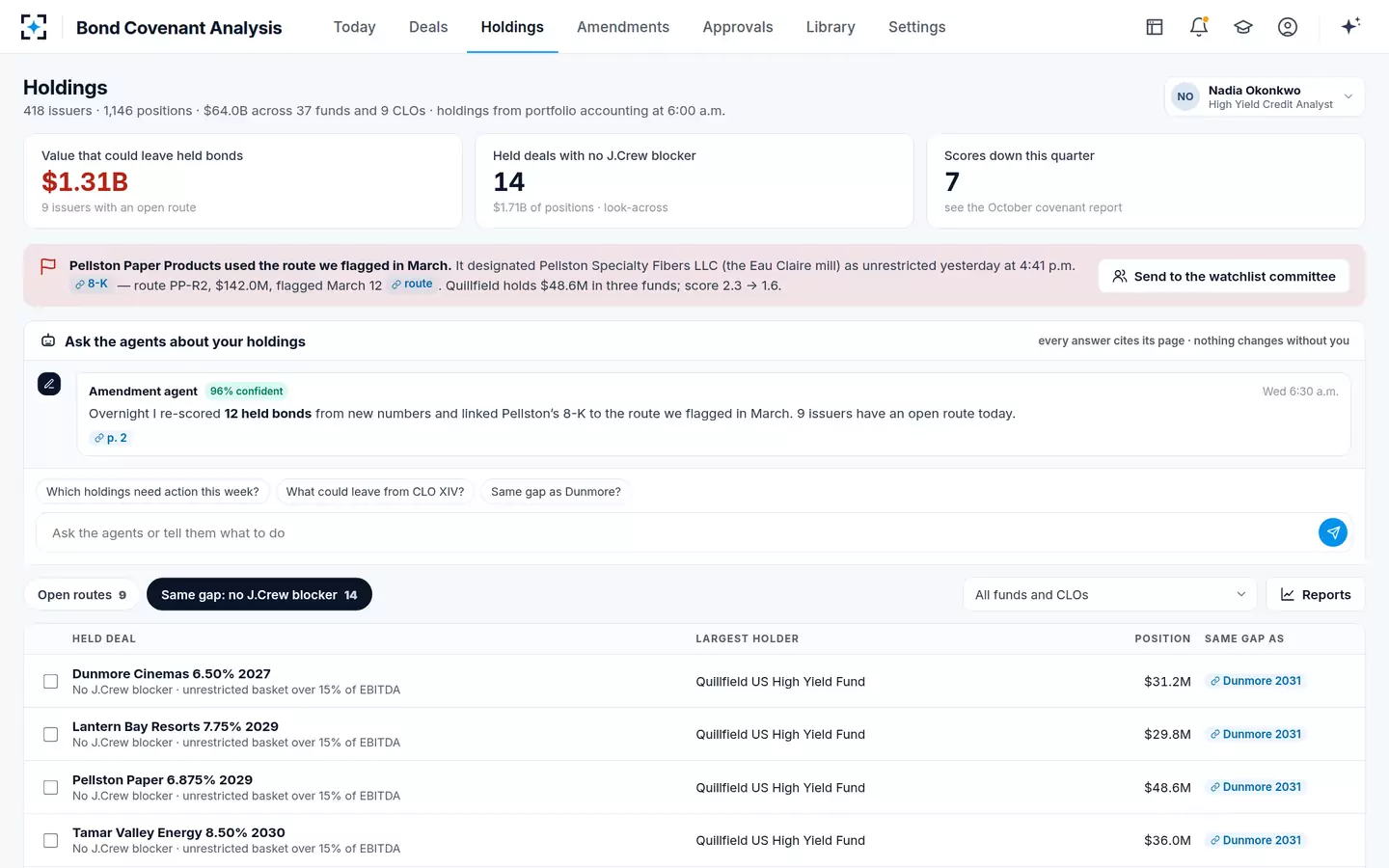
In the sample book, held bonds across 418 issuers and 1,146 positions carried $1.31B of value that could leave, through open routes at nine issuers. On the morning of the Dunmore review, Pellston Paper filed an 8-K designating a mill subsidiary unrestricted — the route the adversary had flagged in March — and its score fell from 2.3 to 1.6, with $48.6M held in three funds. One filter listed the 14 held deals with Dunmore's gap: no J.Crew blocker and an unrestricted basket above 15% of EBITDA, $1.71B of positions.
Holdings: value that could leave, and the issuer that just used a flagged route
Can bondholders stop asset transfers after the indenture is signed?
Mostly not: once the indenture is signed, a transfer the baskets permit is permitted, and the statute that protects bondholders' payment rights does not reach it. The Second Circuit's 2017 decision in Marblegate involved a restructuring in which, the court wrote, "though not a single term of the Indenture was altered and Noteholders therefore retained a contractual right to collect payments due under the Notes, the foreclosure would transform the EDM Issuer into an empty shell" (Marblegate Asset Management v. Education Management Finance Corp., 846 F.3d 1). The court read Section 316(b) of the Trust Indenture Act as protecting the payment terms themselves, not a holder's practical ability to collect, and the transaction stood outside it.
That leaves three moments of leverage. Before books close, a buyer can ask for changes and size the order to the answer. At an amendment or consent solicitation, holders can refuse consent or demand protections in return, which is why the consent solicitation process matters to leakage. And in between, a holder can sell before a route is used, if it is watching. Each one depends on having found the route first.
How Bond Covenant Analysis finds leakage before books close
The solution runs the route search on every new issue and every held deal rather than on the ones an analyst has time for; the design target is 100% of both, each step quoted. The adversary agent plans routes, the verifier tries to break them, and only routes both agree on are shown as open, with the asks that would close each one ranked by the dollars they remove.
The output is written for the people who act on it. The analyst sees the route step by step with its pages; the senior analyst signs the asks before they go to the syndicate desk; and after pricing, the agents compare the final offering memorandum with the asks to show which were won. The restricted payments covenant guide takes the builder and general baskets apart line by line, and the agents guide explains why the agent that finds a route is never the one that confirms it.
Asks for the syndicate desk, ranked by the leakage each closes
Questions people ask
What is a permitted investment basket?
It is a list of investments the issuer may make without using its restricted payment capacity, defined in "Permitted Investments" — typically cash equivalents, investments in restricted subsidiaries, and a general amount. In the sample indenture it is the first door of the leakage route, because an investment in a company that becomes a restricted subsidiary is permitted before that company is designated unrestricted.
How do baskets combine in a leakage route?
They combine when the definitions let one basket be used for another's purpose, and when the indenture lets the issuer choose which baskets fund a deemed investment. In the sample deal, the general restricted payments basket can fund investments because a restricted payment includes a restricted investment, so $57.9M joins the $75.0M investment basket and the $79.1M builder.
How do you find leakage in an indenture?
Start from an outcome a sponsor might want — move an asset, prime the notes, release a guarantee — and search for every clause that permits a step toward it, then add the dollars of the baskets that can be used together. Read the definitions of restricted payment, permitted investments and unrestricted subsidiary first; most routes run through them.
Is covenant leakage only a high yield problem?
It is mostly a leveraged credit problem, in high yield bonds and leveraged loans, because their baskets are numerous and sized to earnings. The research cited here measured leveraged loans; the same techniques appear in bond indentures. Investment grade bonds carry fewer covenants and baskets, so there is less to chain and less to leak.
What is a covenant leakage test?
A leakage test asks, for one indenture on one date, how much value could leave the restricted group through each route and whether anything blocks it. Its output should be a set of routes with their dollar capacity, each step quoted, and the clause changes that would close them. It has to be re-run when EBITDA changes, because grower baskets move with it.