A restricted payments covenant is the part of a high yield indenture or loan agreement that limits how much value the issuer may send to its shareholders and outside the restricted group: dividends, share buybacks, early payments on junior debt and investments that are not otherwise permitted. It works by prohibition plus permission. Everything is forbidden unless a basket allows it, and an indenture typically has several baskets — a builder that grows with net income, a general basket sized to EBITDA, payments allowed while a leverage ratio is low, and capacity that can be moved in from other covenants. The capacity that matters is their sum, in dollars, on the day the issuer wants to use it. Botminds' Bond Covenant Analysis computes each basket from the latest twelve-month numbers, shows every line with its page, and adds them up the way an issuer's counsel would.
The worked example is sample data on fictional companies, as it runs through the solution: Dunmore Cinemas Holdings' $650 million of 7.25% senior notes due 2031, with twelve-month adjusted EBITDA of $386.0M to June 30, 2026. Research is linked where it appears.
One restricted payments covenant, added up
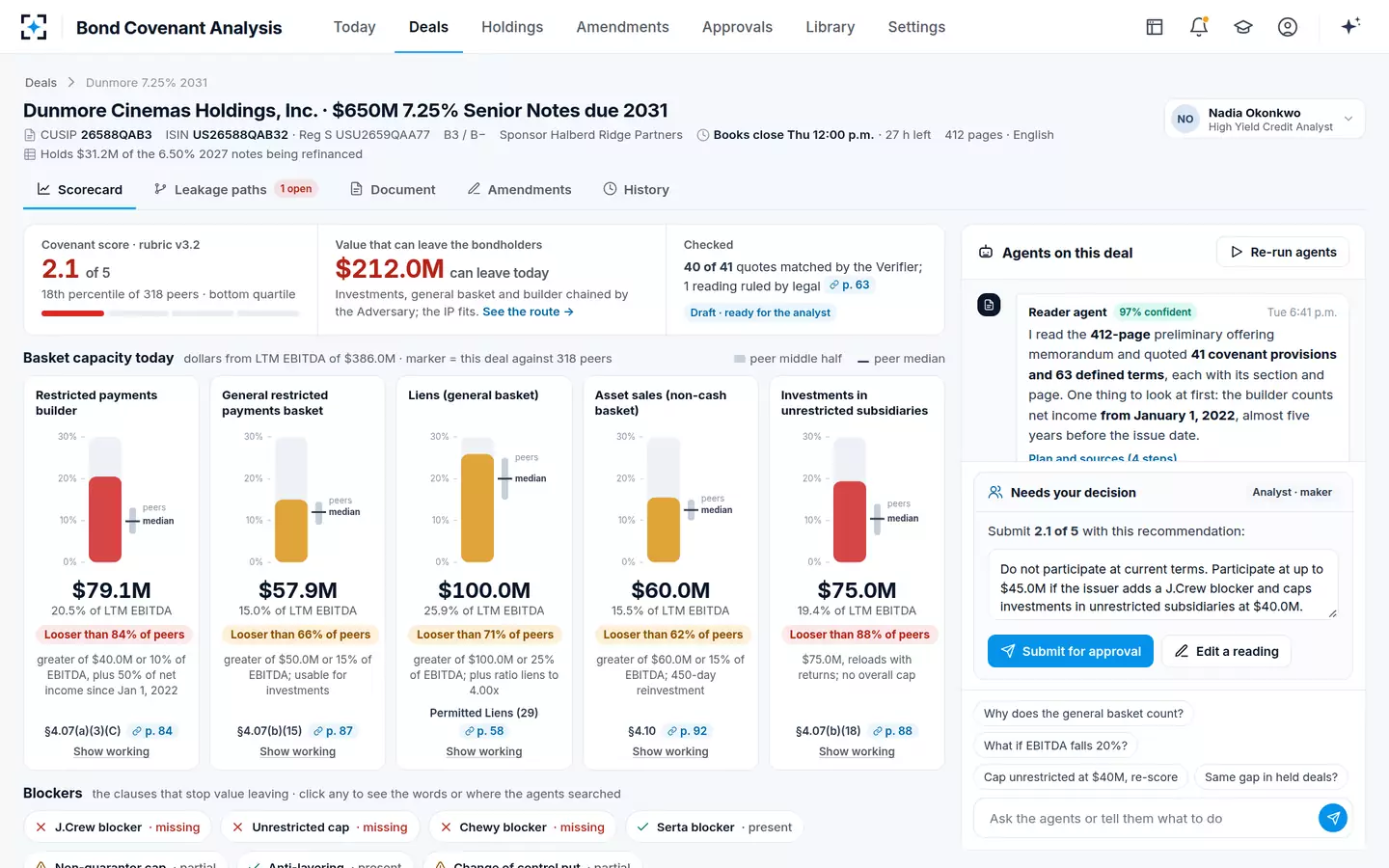
$79.1M
builder basket on day one — $40.0M starter plus $39.1M of net income counted from almost five years before issue
$57.9M
general restricted payments basket: the greater of $50.0M and 15% of EBITDA
$137.0M
available for dividends from those two baskets alone, before any ratio-based payment
What is a restricted payments covenant?
A restricted payments covenant is a limit on cash and value leaving the issuer for anyone other than its creditors. Its purpose is stated simply in the research on loan agreements: "Restrictions on payments limit certain types of cash outflows, typically dividend payments, to focus the cash flows towards debt repayment" (Ivashina and Vallée, NBER w27316). The SEC's investor bulletin on high yield bonds gives it as a first example of what covenants do: they "could restrict the company's ability to pay shareholder dividends or limit it from taking on more debt" (SEC Office of Investor Education and Advocacy).
In the research on incurrence covenants it is also the restriction that appears most often. In a hand-collected sample of leveraged loan incurrence covenants, Bräuning, Ivashina and Ozdagli found that "among incurrence covenants with leverage thresholds, the most common type of restriction (184 covenants) involves payments to equity holders if the leverage ratio is too high." They tie the pattern to the view, from Tirole's work, that "the restricted actions are intended to realign incentives of shareholders with those of their creditors as financial performance deteriorates" (NBER w29888).
How to calculate restricted payment capacity: stacking the baskets in dollars
To calculate restricted payment capacity, compute each basket in dollars from current numbers, subtract what has been used, decide which baskets can be used together for the purpose in question, and add them. Payout capacity and investment capacity are different sums, because some baskets only fund one of them.
Restricted payment capacity stacks: $137.0M for dividends, $212.0M for an investment
Ratio-based payments are the open-ended part. Where an indenture allows unlimited restricted payments while a leverage ratio, recomputed on the payment date, stays under a stated level, the capacity is not a dollar figure but a condition, so the analyst reports it as such — "unlimited while leverage is below the test" — and models the ratio under stress rather than adding a number that does not exist.
The investment sum is the one that turns into leakage. The $212.0M figure is the route the adversary agent found for moving the brand into an unrestricted subsidiary; the covenant leakage guide follows it step by step, and the covenant package overview shows where restricted payments sit among the other covenants.
What counts as a restricted payment? The definitions decide
A restricted payment is whatever the definition says, and in most high yield indentures that is more than dividends: buybacks, payments on subordinated debt before maturity, and any "Restricted Investment" — an investment that is not on the list of permitted investments. That last item is the one that turns a payout limit into an investment limit, and a dividend basket into a way to fund an unrestricted subsidiary.
Five defined terms that decide a restricted payments covenant
"Restricted Payment"
Dividends and distributions, buybacks of shares, early payments on subordinated debt — and any Restricted Investment.
"Restricted Investment"
Any Investment that is not a Permitted Investment. So restricted payment capacity is also investment capacity.
"Permitted Investments"
Investments that use no basket at all — including, in the sample deal, investment in a company that becomes a restricted subsidiary.
"Consolidated Net Income"
The builder's fuel: what is added back, what is excluded, and from which date it accumulates.
"Unrestricted Subsidiary"
Designation is treated as an investment, paid for from the baskets the issuer chooses.
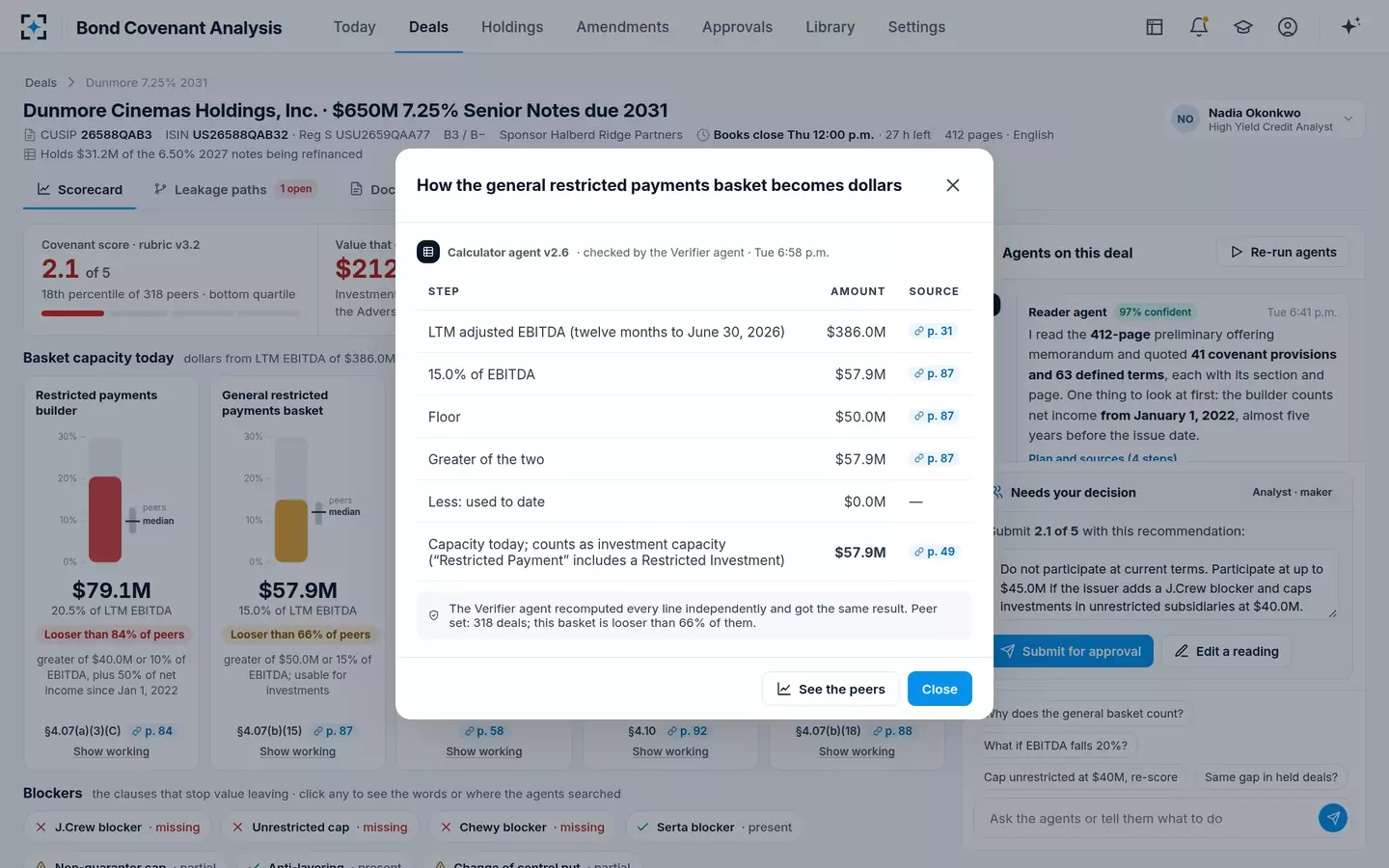
In the sample indenture, the general basket allows any "Restricted Payment" up to the greater of $50.0M and 15% of EBITDA (§4.07(b)(15), page 87), and the definition of "Restricted Payment" includes any Restricted Investment (page 49). An investment in an unrestricted subsidiary is a Restricted Investment, so the full $57.9M can fund one. A summary that lists the general basket under "dividends" misses half of what it does.
What is a builder basket, and when does it start?
A builder basket — sometimes called the cumulative credit or available amount — lets restricted payment capacity grow over time, typically by a percentage of consolidated net income (50% in the sample deal) plus items such as equity proceeds, from a start date written in the indenture. When it starts is the question that matters most: a builder that begins at the issue date starts near zero; one that begins years earlier arrives full.
The sample deal's builder is the second kind. It is the greater of $40.0M and 10% of EBITDA as a starter, plus 50% of net income from January 1, 2022 — almost five years before the notes are issued. On day one that gives $79.1M: the $40.0M starter (10% of EBITDA would be $38.6M) and $39.1M of accumulated net income. The Reader agent flagged it as the first thing to look at, and the Calculator shows retroactive build dates separately from the rest of the working.
The sample builder in Bond Covenant Analysis, term by term
Starter amount
Greater of $40.0M or 10% × $386.0M
10% of EBITDA is $38.6M, so the $40.0M floor applies
§4.07(a)(3)(C), page 84
Net income since the build date
50% × net income from January 1, 2022
$39.1M — about five years of earnings, most of them before the notes existed
Flagged: build date before issue
Used to date
Less payments already made under the builder
Nil in the sample deal
Issuer's compliance reports
Builder capacity today
$40.0M + $39.1M − $0
$79.1M, or 20.5% of EBITDA; looser than 84% of 318 peers
Recomputed by a second agent
Builder basket vs grower basket: one grows with profits, the other with size
A builder basket grows with cumulative earnings and other credits over time; a grower basket is a fixed amount that rises with the company's size, written as "the greater of" a dollar figure and a percentage of EBITDA or total assets. The builder rewards profits retained since its start date; the grower moves with the latest twelve months whether the company retained anything or not.
Builder basket vs grower basket, side by side
| Builder basket | Grower basket | |
|---|---|---|
| How it is written | A starter amount plus a share of consolidated net income (and other credits) from a start date | The greater of a fixed amount and a percentage of EBITDA or total assets |
| What makes it bigger | Retained earnings over time; sometimes equity raised | Growth in EBITDA or assets in the latest period |
| What makes it smaller | Losses (if they count), and payments made under it | A fall in EBITDA, down to the fixed floor |
| The clause to read first | The start date and the definition of net income | The metric, its definition and the floor |
| In the sample deal | $79.1M: $40.0M starter + $39.1M of net income since January 1, 2022 | $57.9M: the greater of $50.0M and 15% of $386.0M |
Neither is safe by type. A builder with a start date years before issue is a pre-loaded basket; a grower with a high percentage and a floor gives capacity even when earnings fall. The research shows why borrowers fight for both: Ivashina and Vallée report that "Discussions with several financial sponsors suggest that it is hard, even for sophisticated issuers, to predict which clause will actually be used," so issuers "most likely try to figure out what covenants they can drop from the credit agreement, and what carve-outs and deductibles they might include without substantially driving the cost of debt up."
The general restricted payments basket, and why it often funds investments
The general basket is a fixed-size permission to make any restricted payment, and its reach is set by the definition of "Restricted Payment". In the sample deal, 15% of EBITDA is $57.9M against a $50.0M floor, nothing has been used, and because restricted payments include restricted investments the full amount counts as investment capacity. It sits looser than 66% of the 318 peer deals.
Show working: the general basket from EBITDA to dollars, every line cited
What happens to restricted payment capacity when EBITDA falls?
Grower baskets shrink with EBITDA until they hit their floors; builders keep what they have already accumulated. The floors are what keep capacity alive in a bad year. In the sample deal, if EBITDA fell 20% to $308.8M, the general basket would drop to its $50.0M floor and the builder's starter would stay at $40.0M, while the $75.0M investment basket is fixed. The route would still carry $204.1M, 96% of today's capacity.
That is the counter-intuitive part of grower baskets: they are drafted to grow with the business, but their floors mean they barely shrink when the business weakens, which is when a sponsor is most likely to use them. An analyst who reads "15% of EBITDA" as a cushion that tightens in stress is reading half the clause.
Restricted payment capacity in a held bond moves every quarter
For a bond already in the portfolio, restricted payment capacity is not a number fixed at issuance: the builder accumulates with every quarter's net income, grower baskets follow the latest twelve months of EBITDA, and every payment made uses some of it up. An analyst who sized the baskets at the new issue and never again is holding a figure that was true once.
The practical answer is to recompute when the inputs change. In the sample firm, held bonds are re-scored when new quarterly numbers arrive; one overnight run re-scored 12 held bonds and found that a leakage route at another sample issuer, Lantern Bay, had opened at $164.0M. The same kind of run is what links an issuer's 8-K to a route flagged months earlier. A restricted payments covenant is a moving limit, and the monitoring has to move with it; what a missed route costs is the reason to keep watching.
The asks that shrink restricted payment capacity before books close
The most valuable change an investor can ask for is usually the builder's start date. In the sample deal, starting the builder at the issue date rather than January 1, 2022 removes $39.1M of capacity; capping investments in unrestricted subsidiaries at $40.0M with no reload removes another $35.0M. With a J.Crew blocker and a Chewy blocker added, the four asks take the capacity to move assets other than the brand from $212.0M to $137.9M.
The Memo agent drafts the asks ranked by the dollars each closes, a senior analyst signs them before they reach the syndicate desk, and after pricing the agents compare the final offering memorandum with the asks. How the agents read and check each basket explains why the reader that sized it is never the agent that confirms it.
Bond Covenant Analysis: five baskets on one scorecard, each in dollars against the peers
Questions people ask
What is a grower basket?
A grower basket is a basket sized as the greater of a fixed dollar amount and a percentage of a metric, usually EBITDA or total assets, so it grows with the company. In the sample deal the general restricted payments basket is the greater of $50.0M and 15% of EBITDA, $57.9M on $386.0M of EBITDA. Its floor means it does not fall below $50.0M however weak earnings become.
When does the builder basket start?
On the date the indenture specifies, which may be around the issue date or well before it. A start date before the issue date means the builder counts earnings from before the bonds existed. In the sample deal it starts January 1, 2022, adding $39.1M of capacity on day one.
Can the general restricted payments basket be used for investments?
If the definition of "Restricted Payment" includes restricted investments, yes. That makes the general basket a source of investment capacity, including investment in unrestricted subsidiaries. Read the definition, not the basket's heading.
Do losses reduce the builder basket?
It depends on the definition: some builders count 50% of consolidated net income or, where the period shows a loss, minus 100% of it, so losses reduce the basket; others count only positive income. Read how a cumulative loss is treated and whether it can make the builder negative.
Is a restricted payments covenant the same in loans and bonds?
The structure is similar: a prohibition with builder, general and ratio-based permissions. Leveraged loan agreements may add maintenance covenants and tighter lender consent rights, and the research cited here studied loans. The arithmetic of stacking the baskets is the same.