High yield bond covenants are the promises in a high yield indenture that limit what the issuer may do while the notes are outstanding: how much more debt it may take on, how much it may pay to shareholders, which assets it may pledge or sell, and how much value it may move to subsidiaries the bondholders cannot reach. They are incurrence covenants, tested only when the issuer acts, and every one of them comes with exceptions, called baskets, that are often sized as the greater of a dollar amount and a share of earnings. That makes a covenant package hard to read in the few days a new issue is marketed. Botminds' Bond Covenant Analysis is a set of agents that quote every covenant, basket and defined term with its page, turn each basket into dollars and score the package against a firm's own library of past deals, so a credit analyst reads the exceptions rather than the headings.
The worked examples on this page are sample data on fictional people and companies: the credit desk at Quillfield Capital and the $650 million of 7.25% senior notes due 2031 that Dunmore Cinemas Holdings is marketing, as they run through the solution. Research figures come from the Federal Reserve and peer-reviewed or working-paper research, linked where they appear.
Why the exceptions, not the covenants, decide what bondholders hold
$1.77T
high-yield and unrated US corporate bonds outstanding at the end of 2025, up 4.7% in a year
96%
of 1,240 leveraged loan agreements had at least one deductible ("basket") weakening a covenant
8
baskets in the median agreement, across all of its covenants
What are high yield bond covenants, and why do bonds need them?
High yield bond covenants exist because shareholders and bondholders want different things from the same company, and a sub-investment-grade issuer has more room to favour its owners. A shareholder gains from a riskier bet, a bigger dividend or a new lender who ranks ahead; a bondholder with a fixed coupon gains nothing from any of them and can lose principal. The covenants turn that conflict into a contract.
The research names the conflicts the covenants answer. In their study of 1,240 leveraged loan agreements, Ivashina and Vallée explain that "Restrictions on liens prevent the borrower from re-pledging its assets in other secured transactions. Restrictions on indebtedness limit borrower's ability to incur additional debt. Both these restrictions aim at preventing claim dilution" (NBER w27316). Payout limits keep cash inside the company; asset-sale limits keep the collateral and the business that supports the bonds; affiliate limits stop value moving sideways to the owner.
The need rises with risk. A Journal of Finance study that built covenant-protection indices for public bonds found that "covenant protection is increasing in growth opportunities, debt maturity, and leverage" (Billett, King and Mauer, 2007). Highly levered issuers with long bonds are exactly the high yield market, which is why its indentures run to dozens of pages of covenants and hundreds of defined terms.
What are the typical high yield bond covenants? Eight limits, each with its own doors
A typical high yield indenture carries eight negative covenants: limits on debt, restricted payments, liens, asset sales, investments and unrestricted subsidiaries, affiliate transactions, mergers, and a change of control offer. The headings barely change from deal to deal; what changes is the size and wording of the baskets inside each one, and the defined terms they lean on.
The eight covenants of a high yield indenture, and where each one usually leaks
1
Limitation on indebtedness
LimitsNew debt at the issuer and its restricted subsidiaries.
Usual basketsRatio debt while a coverage or leverage test is met; a credit facilities basket; a general basket; debt of acquired companies.
Where it leaksDebt that can be secured ahead of the notes through the liens covenant.
2
Restricted payments
LimitsDividends, buybacks, payments on junior debt and restricted investments.
Usual basketsA builder that grows with net income; a general basket; ratio-based payments; named carve-outs.
Where it leaksA definition of "Restricted Payment" that lets the general basket fund investments.
3
Liens
LimitsSecurity granted over the issuer's assets to other creditors.
Usual basketsPermitted liens, often a long list, plus a general liens basket and liens securing ratio debt.
Where it leaksLiens on the assets that support the notes, given to new lenders who rank ahead.
4
Asset sales
LimitsWhat must happen to the cash when assets are sold.
Usual basketsA reinvestment window, permitted uses of proceeds, and an offer to repurchase notes only above a threshold.
Where it leaksA long reinvestment window and a high threshold before any offer to holders.
5
Investments and unrestricted subsidiaries
LimitsMoney and assets sent outside the restricted group.
Usual basketsPermitted investments, an unrestricted subsidiary basket, and restricted payment capacity used as investment capacity.
Where it leaksDesignating a subsidiary unrestricted and moving valuable assets into it.
6
Transactions with affiliates
LimitsDealings with the sponsor and related companies.
Usual basketsArm's-length terms, with board approval or a fairness opinion above set sizes.
Where it leaksFees and services to the owner paid on terms nobody tests.
7
Merger and sale of substantially all assets
LimitsWho may become the obligor, and on what conditions.
Usual basketsA successor must assume the notes and usually meet a debt test after the deal.
Where it leaksAsset transfers sized just below "substantially all".
8
Change of control
LimitsA sale of the company or of control of its board.
Usual basketsAn offer to buy the notes at 101% of principal, often only if a ratings decline follows.
Where it leaksPermitted holders and double triggers that keep a buyout from firing the put.
Two more provisions sit beside the eight and change how they work. A designation covenant lets the board move a subsidiary outside the covenants altogether, as an unrestricted subsidiary. A reporting covenant obliges the issuer to provide financial statements, which is the only way a holder can see whether ratio baskets are open. Many indentures also contain a suspension clause; where one exists, the analyst has to read which covenants stop applying if the notes are rated investment grade, and whether they come back if the rating is lost.
Incurrence covenants vs maintenance covenants: the test runs only when the issuer acts
High yield covenants are incurrence tests: nothing happens if earnings fall, but the issuer may not take a restricted action — borrow, pay a dividend, invest — unless the test is met at that moment. A maintenance covenant, the bank-loan kind, must be met every quarter, and a breach hands control to the lender. The difference decides when a bondholder's protection starts to work.
A 2022 NBER paper by Bräuning, Ivashina and Ozdagli puts it precisely: "high-yield debt is characterized by incurrence covenants, which do not shift control rights to creditors, but instead restrict some actions of the borrower if the covenant threshold is crossed" (NBER w29888). Their example sets two companies side by side with the same 5x net debt to EBITDA limit. A sharp fall in EBITDA puts the company with a maintenance covenant in technical default, while the other "will remain in compliance as long as it does not incur 'restricted actions' specified in its loan agreement."
Two ways to write the same 5x leverage limit
Maintenance covenant (bank loans): Every quarter, on the compliance certificate, whatever the borrower does.
Incurrence covenant (high yield bonds): Only when the issuer wants to take a restricted action: borrow, pay out, invest, merge.
Maintenance covenant (bank loans): An event of default: the lender can accelerate or, in practice, renegotiate.
Incurrence covenant (high yield bonds): No default. The action is simply not permitted unless a basket covers it.
Maintenance covenant (bank loans): The lender, the moment earnings fall far enough.
Incurrence covenant (high yield bonds): The issuer, which keeps control and can still act through baskets the ratio does not touch.
Maintenance covenant (bank loans): The ratio definitions and the cushion each quarter.
Incurrence covenant (high yield bonds): The ratio test and every basket that lets the action happen anyway, in dollars.
The bank-loan side of the comparison, with its quarterly certificates and headroom, has its own discipline; covenant headroom on a maintenance covenant is a different measurement from anything on this page. For a bondholder, the incurrence structure means the question is never "is the issuer in compliance?" but "what could the issuer do tomorrow, and through which door?"
A covenant is the sum of its exceptions: carve-outs, deductibles and baskets
A covenant's real strength is what is left after its exceptions, and the exceptions are where the drafting effort goes. Practitioners call them baskets; the research separates two kinds. "A deductible therefore puts a threshold on the amount before the restriction is applied, whereas a carve-out is not capped, but applies to a specific type of action," Ivashina and Vallée write (NBER w27316).
Their data shows how ordinary the exceptions are. "Deductibles are frequent: 96% of credit agreements include at least one kind of deductible," and "virtually all credit agreements (99%) with negative covenants exhibit at least one carve-out per category of covenants." The median agreement had eight baskets across its covenants. The sample is leveraged loans, which in the high yield era borrowed the bond technique; the arithmetic of a bond basket is the same.
A high yield covenant is not a wall with one door. It is a list of doors, and the protection is whatever wall is left between them.
Because every basket is an exception to a prohibition, they add up. A general restricted payments basket, a builder basket and a basket for investments in unrestricted subsidiaries are three separate permissions, and an issuer may use all three for the same purpose if the definitions allow it. That is the arithmetic behind restricted payment capacity no single basket shows, and behind every route by which value leaves a bond.
Grower baskets in dollars: why a percentage alone misleads
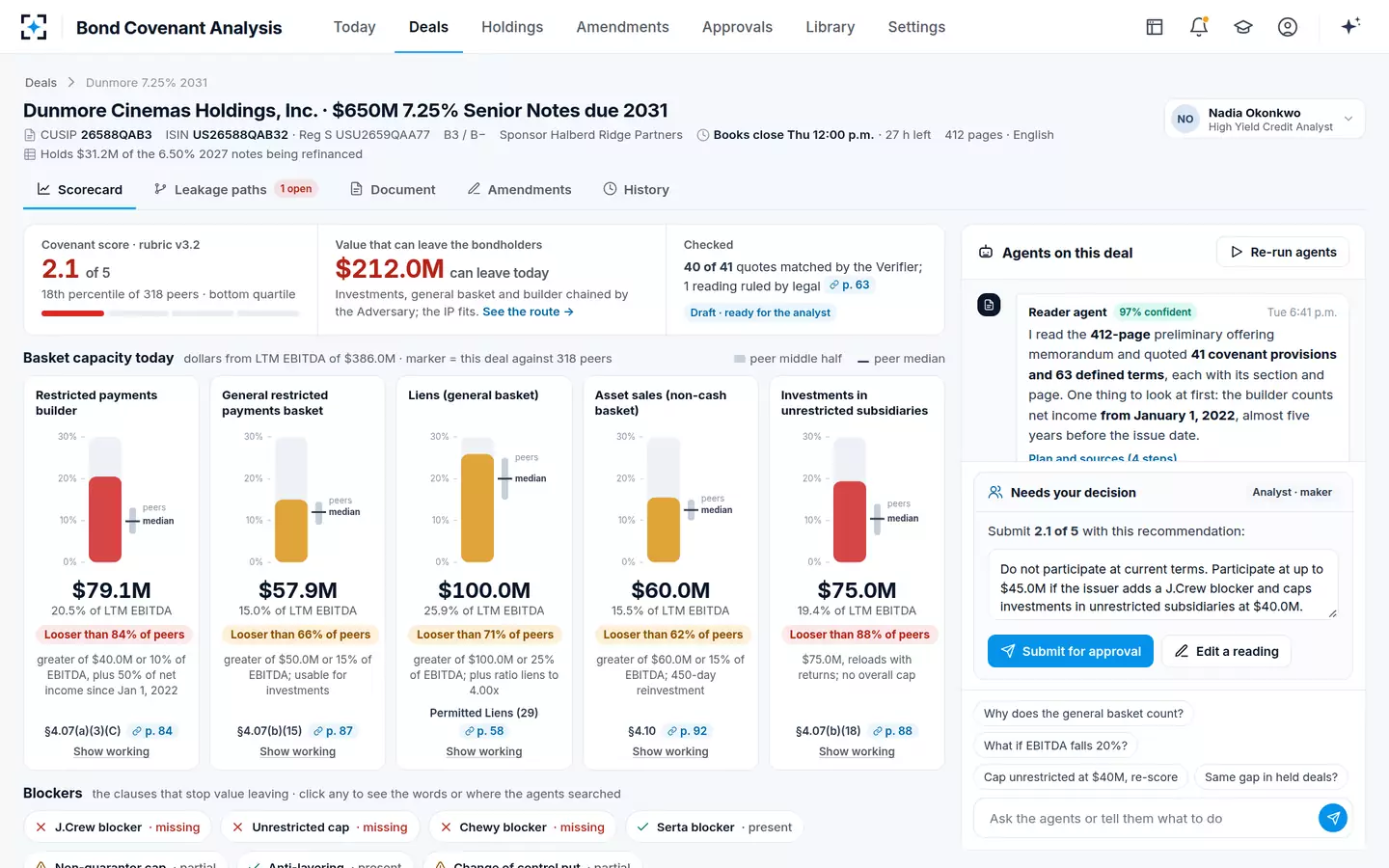
A grower basket is written as "the greater of" a fixed amount and a percentage of EBITDA or total assets, so its size moves with the company and has to be recomputed from current numbers to mean anything. Reading "15% of EBITDA" tells an analyst nothing about whether the basket is large; multiplying it by twelve-month EBITDA, comparing it with the floor and subtracting what has been used does.
Five of Dunmore's baskets, from the words in the indenture to dollars today
| Basket | How the indenture writes it | Dollars today | Share of EBITDA |
|---|---|---|---|
| Restricted payments builder | Greater of $40.0M or 10% of EBITDA, plus 50% of net income since January 1, 2022 | $79.1M | 20.5% |
| General restricted payments | Greater of $50.0M or 15% of EBITDA; usable for investments | $57.9M | 15.0% |
| General liens | Greater of $100.0M or 25% of EBITDA, plus ratio liens to 4.00x | $100.0M | 25.9% |
| Asset sales (non-cash) | Greater of $60.0M or 15% of EBITDA; 450-day reinvestment | $60.0M | 15.5% |
| Investments in unrestricted subsidiaries | $75.0M, reloads with returns; no overall cap | $75.0M | 19.4% |
Two lines in that table are worth a second look. The general restricted payments basket is "usable for investments", which means it is not only a dividend allowance: the definition of a restricted payment includes a restricted investment, so the same $57.9M can fund a subsidiary. And the builder counts net income from January 1, 2022, almost five years before the notes are issued, so it starts the bond's life already full. Neither shows up in a covenant summary that lists headings.
Bond Covenant Analysis: the five baskets as capacity meters
Restricted and unrestricted subsidiaries: who the covenants actually bind
High yield covenants bind the issuer and its restricted subsidiaries; an unrestricted subsidiary is outside them entirely, free to borrow, pledge and pay as it likes, and its assets do not support the notes. The board can usually designate a subsidiary unrestricted if the investment that designation is deemed to make fits within the issuer's baskets. That one sentence is the hinge of most value-transfer cases.
In the sample deal, the agents traced exactly that hinge: the trademarks and a loyalty platform, carried at $171.4M, could be moved into a new subsidiary, designated unrestricted, and paid for from three baskets together worth $212.0M. The covenant headings all looked normal. The market's response to routes like this is a blocker clause named after the J.Crew case; what a J.Crew blocker covers is explained in the liability management series, and what a missed route costs a bondholder is worked through on its own page.
High yield vs investment grade covenants: what is missing at the top of the market
Investment grade bonds carry covenants too, but fewer and lighter ones, because the risk they guard against is smaller. The SEC's investor bulletin on high yield bonds says it directly: "Covenant protections are often more extensive, and may take on greater importance, for high-yield bonds because they generally present a higher risk of default." It adds the warning every buyer of new issues knows: "when high-yield bonds are in strong demand, some companies may include fewer covenant protections" (SEC Office of Investor Education and Advocacy).
So the line between the two markets is not a list of headings but a negotiation, and it moves with demand. Research on bond pricing shows the trade runs both ways inside high yield too. A 2021 study of covenant-lite high yield bonds, whose contracts leave out some covenants — "The excluded covenants often are those that use accounting performance measures" — found that such bonds "have a higher trading turnover and lower yield spreads" (Gietzmann, Isidro and Raonic, Journal of Accounting, Auditing & Finance). Covenants are priced, which is why an analyst who misreads them misprices the bond.
How Bond Covenant Analysis reads a covenant package before books close
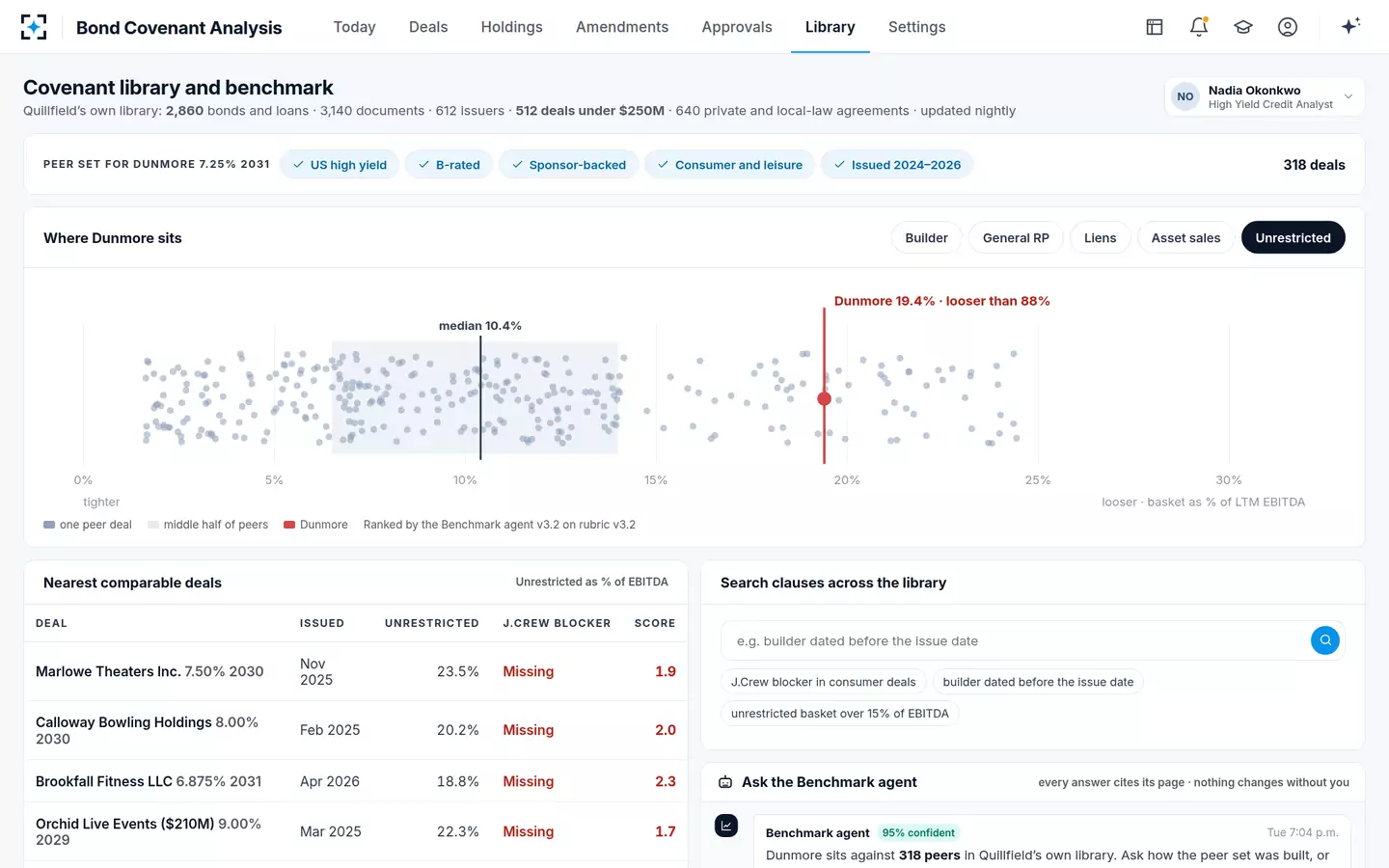
The solution reads the package the way a careful analyst would if there were time: every covenant, basket and definition quoted with its section and page, each basket recomputed in dollars from current numbers, and each one ranked against the firm's own past deals. On the sample deal, a 412-page preliminary offering memorandum arrived at 6:05 p.m. and the agents had quoted 41 covenant provisions and 63 defined terms by 7:22 p.m.
What the agents produce is a draft for a person, not a verdict. A second agent re-reads every quote and recomputes every dollar; where the two readings differ, legal counsel decides, and the analyst submits a score that a senior analyst must approve. That chain is the subject of why the reader is never the checker.
Every basket against the firm's own peers
Questions people ask
What is a negative pledge in a bond?
A negative pledge is a promise not to grant security over the issuer's assets to other creditors, or to secure the bonds equally if it does. In a high yield indenture it appears as the liens covenant, with a list of permitted liens and usually a general basket. The study of loan agreements cited above found liens restrictions in 92% of them, and only 14% of those had no collateral open to a deductible.
What is a ratio debt basket?
It is permission to borrow any amount as long as a financial ratio, typically fixed charge coverage or leverage, is met after the new debt on a pro forma basis. It sits beside fixed-size baskets, so total debt capacity is the ratio debt plus every other basket. Because the test is pro forma, the definitions of EBITDA and of the charges behind it decide how much it allows.
What is covenant suspension?
Covenant suspension is a clause under which some covenants, often debt, restricted payments and asset sales, stop applying while the notes hold investment grade ratings. Whether they spring back on a downgrade, and what the issuer did while they were suspended, depends on the exact wording. An analyst reads it as carefully as the covenants themselves.
Do high yield bonds have financial maintenance covenants?
Generally not: their financial tests are incurrence tests that apply when the issuer takes an action. The NBER paper by Bräuning, Ivashina and Ozdagli found incurrence thresholds averaging 3.61x leverage in its loan sample, tighter than the maintenance thresholds in the same sample. For loans carrying both kinds, a firm that crossed the incurrence trigger took another 3.9 quarters on average to breach the maintenance covenant, if it ever did.
Why do high yield bond covenants matter if the issuer never defaults?
Because they decide what a bondholder owns before any default: which assets support the notes, who can rank ahead, and how much cash can leave. Ivashina and Vallée found that both loan and stock prices moved when the market learned how such baskets could be used, which means the value at stake is priced long before a bankruptcy.