A J.Crew blocker is a credit agreement provision that prevents a borrower from transferring material assets to an unrestricted subsidiary — an entity outside the group that guarantees and secures the loans — so that those assets cannot be used to raise debt the existing lenders have no claim on. It is named after the retailer whose 2016 transfer of its trademarks made the route famous, and the name is the problem: two agreements can both be said to contain a J.Crew blocker and offer their lenders completely different protection. LME Protection Review is Botminds' agentic solution for telling those two apart, reading every agreement as amended and grading each blocker strong, weak or missing with the clause quoted beside the grade.
The reason a narrow blocker fails is in the original transaction's structure. J.Crew did not simply hand its trademarks to an unrestricted subsidiary. It routed them through an intermediate entity to use a second basket, and it took back an exclusive licence so the business could keep operating. A clause drafted against the headline — assets must not go to an unrestricted subsidiary — stops the version in the headline and none of the variations. The sample findings on this page come from a fictional book inside the solution; the fund, borrowers and sponsors named in them are invented. The 2016 figures come from an academic study of syndicated credit agreements, linked where they appear.
What a J.Crew blocker is built to stop
The blocker exists because of a structural fact about leveraged credit agreements: an unrestricted subsidiary is, by design, outside the covenant package. Its assets are not collateral, its debts are not counted, its earnings are usually excluded from the ratios, and the negative covenants that bind the rest of the group do not bind it. That is sometimes useful — a joint venture, a regulated entity, a project financing. It is also, if the borrower can move enough value into one, a complete escape hatch.
So a J.Crew blocker restricts the movement of value across that boundary. The strong versions do four things at once: they name a broad class of assets, not one asset type; they catch designation as well as transfer, because designating an entity that already holds the asset achieves the same result as moving the asset; they follow the value by any route, including through entities that are inside the group but do not guarantee; and they are protected by a voting threshold a simple majority cannot clear. A clause that does only the first of those is still called a J.Crew blocker in a term sheet.
How the original 2016 transaction worked
The pressure came from above the borrower, not inside it. J.Crew's operating company had roughly $1.5 billion of term loans secured on its assets; above it, the holding company through which the sponsors owned the business had about $500 million of unsecured payment-in-kind notes that were due to mature before the term loans. The operating company's performance and its own covenants made dividends to the holding company difficult, so the notes looked hard to repay. The noteholders had no direct claim on the operating company, but they could wipe out the sponsors' equity. Moving valuable assets somewhere new debt could be issued against them, and exchanging that new debt for the notes, solved the sponsors' problem without solving anybody else's.
In December 2016 the trademarks moved. "It had $250 million of capacity to invest in unrestricted subsidiaries and had received an opinion valuing its intellectual property at $347 million," the study by Buccola and Nini records; "J. Crew thus transferred downstream what it called 72% of an undivided interest in the IP; 72% of $347 million is just under $250 million" (Buccola and Nini, The Loan Market Response to Dropdown and Uptier Transactions). The arithmetic is worth pausing on: the transfer was sized precisely to the room the agreement allowed, and the undivided-interest device existed so that an asset worth more than the basket could be moved in a portion that fitted it.
The business then carried on using the trademarks it no longer owned. The new owner "offered an exclusive license of its rights back to an affiliate of the old owner for a $59 million annual payment" — a detail that matters to anyone drafting a blocker today, because a licence is not a transfer, and a clause that restricts transfers says nothing about one.
From the announcement to the new borrowing, and what sat in between
- IP moved; exclusive licence taken backDec 2016
- Declaratory action; lenders counterclaimIn between
- Supermajority settles; new debt issuedJun 2017
What is the J.Crew "trap door", exactly?
The trap door is not the unrestricted subsidiary. It is the indirect route to it. The study's own description of the structure is the clearest statement of the mechanism: "J. Crew arranged a series of transfers that moved IP from a loan party, through a non-guarantor restricted subsidiary, to the unrestricted subsidiary that would eventually issue new debt. The transaction was so arranged to take advantage of what is sometimes called a 'proceeds' basket."
A proceeds basket is a permission to invest the proceeds of a disposition or of an earlier investment. Used in sequence with the ordinary investment basket, it compounds: value goes from the loan party into a restricted subsidiary that is not a guarantor, using one permission, and from there into the unrestricted subsidiary, using another. Neither step exceeds its own limit. The combination exceeds what either would have allowed on its own.
The proceeds basket: how $250M of capacity became $250M of IP
The study puts the size of the gain in one sentence: "The proceeds basket in effect allowed J. Crew to transfer more to its unrestricted subsidiary via an indirect method than it could have transferred directly ($250 million instead of $100 million)." The direct route was capped at $100 million. The two-step route moved two and a half times as much, without amending anything and without asking a lender.
The two-step route, and why each step was inside its own limit
| Step | What moved, and where | The permission it used |
|---|---|---|
| 1. Out of the credit group, but not yet out of reach | Intellectual property leaves a loan party for a restricted subsidiary that is not a guarantor. | The basket for investments in restricted subsidiaries. The entity is still inside the covenant package, so the step looks unremarkable. |
| 2. Across the boundary | The same intellectual property leaves the non-guarantor for the unrestricted subsidiary. | A proceeds basket, measured separately from the direct investment basket and not consumed by step 1. |
| 3. Sized to fit | A 72% undivided interest in intellectual property valued at $347 million, so that just under $250 million moved. | Capacity of $250 million for investments in unrestricted subsidiaries — against $100 million available on the direct route. |
| 4. The business keeps using the asset | An exclusive licence of the trademarks back to an affiliate of the old owner, for $59 million a year. | No transfer restriction is engaged at all: a licence is not a disposition, and the cash leaves the credit group as an operating expense. |
Step 4 is the one a blocker drafted only against transfers still misses. A fund that has policed ownership has not necessarily policed use. If the borrower can grant an exclusive, perpetual, royalty-bearing licence of the same asset to an entity the lenders cannot reach, the economic result is close enough to a transfer that the distinction will not comfort anybody at the recovery stage.
Why the lenders settled instead of litigating it out
They did litigate, briefly, and then they were bought. J.Crew sought a declaratory judgment vindicating the transfer so that the unrestricted subsidiary could borrow without a cloud on the asset; the lenders counterclaimed that the agreement forbade the transfers and that they were a fraudulent conveyance in any case. Then, as the study records: "Ultimately, J. Crew persuaded a supermajority of the lenders to settle: for their explicit ratification of the transaction, the consenting lenders would be allowed to sell $150 million of their loans, which were trading at around 70 cents on the dollar, at par."
Read that as a price. Consenting lenders were offered roughly thirty cents on every dollar they sold, on $150 million of paper, in exchange for ratifying a transaction the whole syndicate had objected to. It worked because the lenders were not a bloc: those who could exit at par had a different interest from those who could not. A blocker that can be waived or amended by a supermajority is therefore worth less than it reads, because the borrower can buy the supermajority with a liquidity option the minority never sees.
Does a J.Crew blocker cover all Material Assets, or only IP?
That is the first question to ask of any blocker you hold, and the most common place a grading exercise finds a weakness. Intellectual property was the asset in 2016, so a generation of clauses was drafted against intellectual property. For a retailer with trademarks, that is the crown jewel. For a services business it is almost irrelevant.
The same clause family, two different grades
Narrowed to intellectual property: A defined term such as Material Intellectual Property, often with its own threshold and its own carve-outs.
Covering all material assets: Any asset material to the business, by value or by function, however the asset is classified in the accounts.
Narrowed to intellectual property: Management services agreements, customer contracts and joint-venture interests are not intellectual property, so none of them is restricted.
Covering all material assets: Caught, because the test is materiality to the credit rather than the asset class.
Narrowed to intellectual property: Usually silent. An exclusive licence of the protected asset is not a transfer of it.
Covering all material assets: Strong versions restrict exclusive and perpetual licences alongside transfers, for the same reason.
Narrowed to intellectual property: Often absent. The borrower may designate an entity that already holds the asset as unrestricted, with the same effect as moving it.
Covering all material assets: A designation prong: an entity holding material assets may not be designated unrestricted while it holds them.
Narrowed to intellectual property: Direct transfers to an unrestricted subsidiary only.
Covering all material assets: Any route, including through a restricted subsidiary that is not a guarantor, and including proceeds of an earlier permitted investment.
A blocker graded weak in LME Protection Review, with its reason and clause
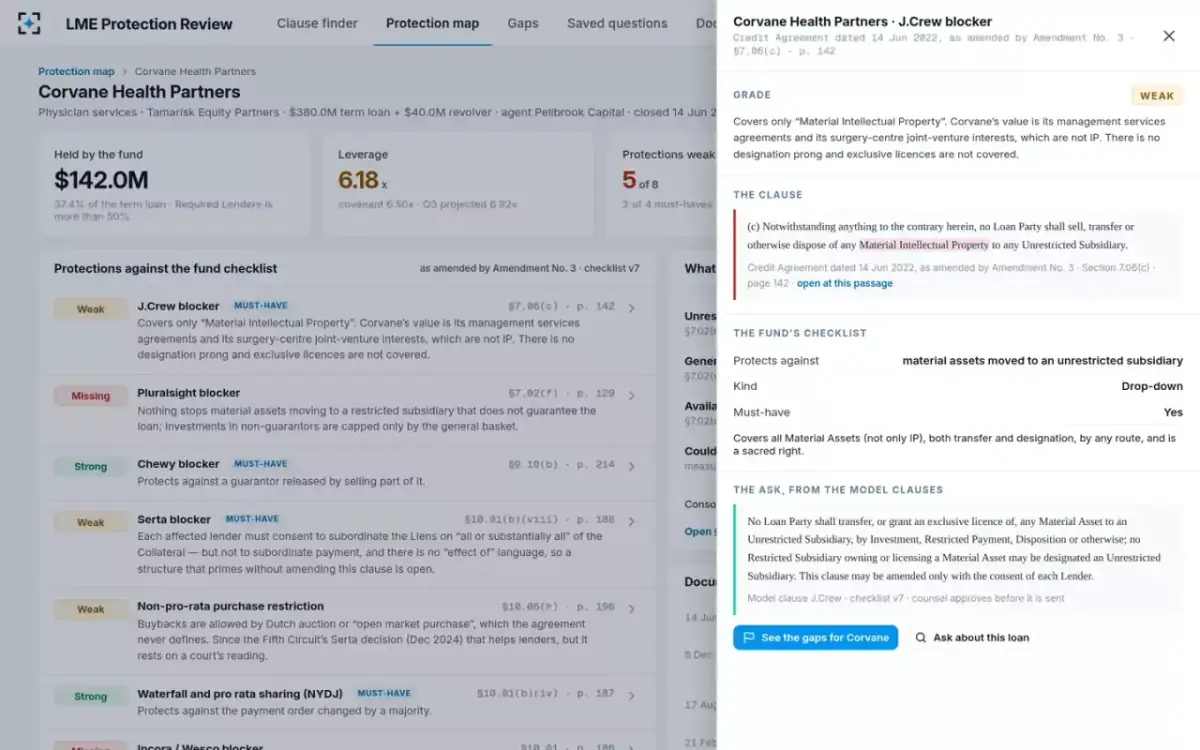
Strong, on this fund's checklist, means the clause “covers all Material Assets (not only IP), both transfer and designation, by any route, and is a sacred right”.
What is an unrestricted subsidiary designation, and who can make one?
An unrestricted subsidiary designation is a notice the borrower gives, usually to the administrative agent, declaring that a subsidiary sits outside the covenant package. In most agreements it is the borrower's own act, subject to conditions: no default, pro forma compliance, and an investment basket large enough to absorb the deemed investment in the entity being designated, measured at the book value of what it holds.
The designation route is what makes a transfer-only blocker porous. If the asset is already held by a subsidiary, nothing has to move at all: designate that subsidiary unrestricted and the boundary moves instead. A blocker without a designation prong is therefore one amendment, or one reorganisation, away from being irrelevant — and the reorganisation does not need lender consent either.
Measurement is the second trap. Where investments are counted at book value, an asset carried at a fraction of what it is worth consumes a fraction of the basket. The borrower moves far more value than the number in the covenant suggests, and the covenant is not breached.
Why the loan market left the dropdown route open after J.Crew
Because the flexibility is worth something to borrowers and, apparently, to lenders pricing it. Buccola and Nini measured adoption after the transaction and found the market largely unmoved: "contracts are just as likely now as before J. Crew to allow borrowers to create (and transfer assets free and clear of liens to) unrestricted subsidiaries." They contrast this with the rapid repapering that followed the uptier that made the other route famous.
For a lender the implication is practical, not philosophical. Drop-down exposure is not a legacy-vintage problem that time will solve: the study's sample of syndicated agreements ran to September 2021 and found drop-down room as available at the end as before J.Crew, so it cannot be assumed to sit only in old paper. And because a drop-down needs no amendment and no consent, there is no moment at which the lender is asked — which means the only point of control is the day the agreement is signed, and the only point of detection is a review of what was signed.
A cap struck through: how a blocker gets weaker without being deleted
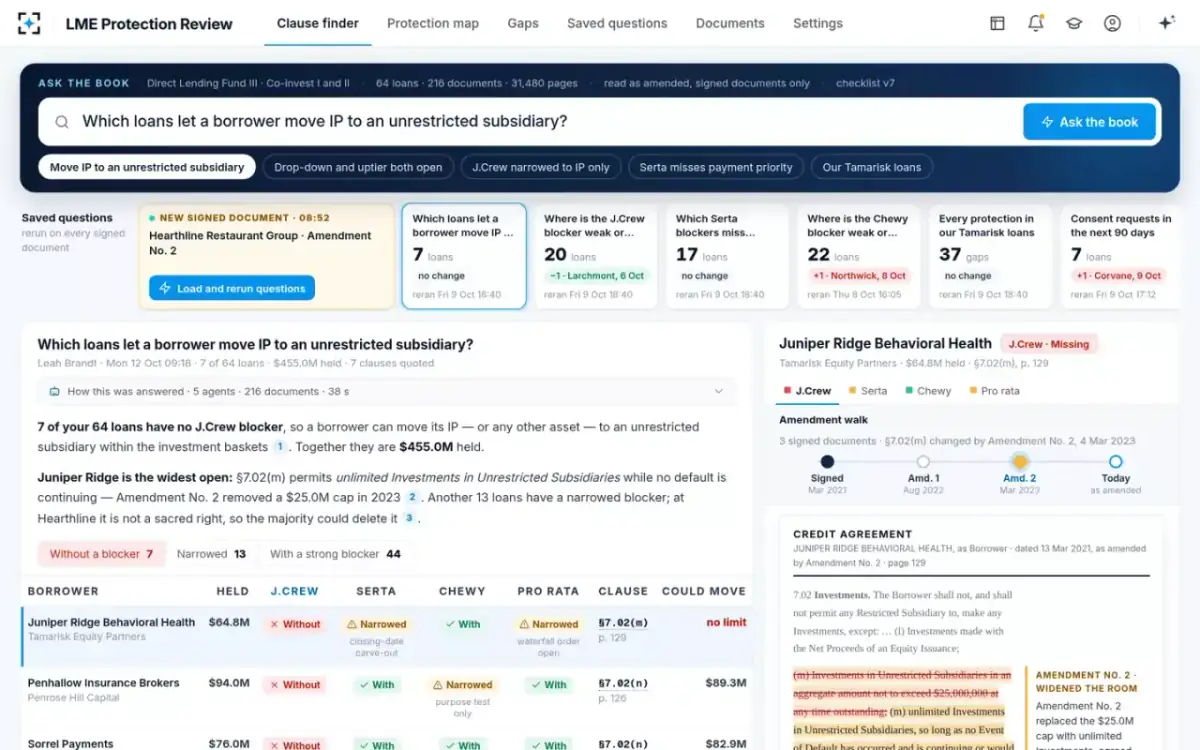
That screen is the second reason a blocker review has to read amendments rather than the original agreement. A J.Crew blocker can survive untouched while the basket it depends on is quietly made unlimited, and the loan then behaves exactly as if the blocker had been deleted. The slow drift of an agreement away from what was signed is the subject of amendment risk and the cap nobody remembers.
Grading a J.Crew blocker: the designation prong and the indirect route
Grading means testing the clause against the mechanism rather than the name. The checklist below is the shape of the test; what counts as strong is a matter for each fund's counsel, and on the sample book it is version 7 of the fund's own standard, not a market consensus document.
Seven questions LME Protection Review puts to a J.Crew blocker
- Which assets does it name?
Material assets by value and by function, or one asset class the 2016 transaction happened to use. For a services borrower the second is close to no protection at all.
- Does it reach designation, not just transfer?
Without a designation prong, the borrower can move the boundary instead of the asset, and needs nobody to agree.
- Does it follow the value by any route?
Through a restricted subsidiary that is not a guarantor, and through the proceeds of an earlier permitted investment — the two steps that turned $100 million of direct room into $250 million.
- Does it cover exclusive licences?
A licence is not a transfer. The 2016 structure licensed the trademarks straight back for $59 million a year.
- How is the value measured?
Book value lets an asset worth far more than the basket fit inside it. A fair-value test closes that gap.
- What vote changes it?
If the Required Lenders can amend the blocker or the baskets it depends on, the borrower only has to buy a majority.
- What do the amendments say today?
The clause as signed is not the clause in force. Grade the agreement as amended, in the order the amendments took effect.
On the sample book, applying those questions to one borrower produces a finding rather than a score: the blocker exists, it is in the right section, and it protects the wrong things. Five of that borrower's eight protections come back weak or missing, and the cheapest moment to fix any of them is while the borrower is asking for something — which, on that loan, is a waiver request due in eleven days.
The same discipline applies to the other half of the problem. A borrower that cannot move assets out of reach can still move other lenders in front of you, which is what an uptier transaction does, and what grades a clause strong or weak in the first place is set out in sacred rights and the grading rubric. To see the clause drawer and the amendment walk on your own agreements, start from LME Protection Review.
Questions people ask
How much IP did J.Crew move?
A 72% undivided interest in intellectual property that an opinion valued at $347 million, which came to just under the $250 million of capacity the agreement allowed for investments in unrestricted subsidiaries. The size was not a coincidence: the undivided interest was the device that let an asset worth more than the basket be moved in a portion that fitted it.
Can a J.Crew blocker be narrow?
Very easily, and most of the weak grades on a typical book are narrowness rather than absence. The common narrowings are an asset definition limited to intellectual property, silence on designation, silence on exclusive licences, a route restriction that only names direct transfers, and measurement at book value. Any one of them reopens the 2016 route; a clause with all five is a blocker in name only.
What is a designation prong?
The part of a blocker that stops the borrower designating a subsidiary as unrestricted while that subsidiary holds material assets, or that requires those assets to come back before a designation takes effect. It matters because designation achieves the drop-down result without moving anything, and because designation is normally the borrower's own act rather than something lenders vote on.
Is a non-guarantor restricted subsidiary the same as an unrestricted subsidiary?
No, and the difference is what the two-step route exploited. A non-guarantor restricted subsidiary is still inside the covenant package — it is bound by the negative covenants — but it has not guaranteed the loans and its assets are usually not collateral. It makes an excellent waypoint: moving value there looks like an ordinary intra-group investment, and from there a different basket carries the value across the boundary.
Does a J.Crew blocker stop an uptier?
No. The two protect against different things. A J.Crew blocker is about where assets may go; an uptier leaves the assets alone and changes who gets paid first. A loan can have a strong drop-down blocker and no protection against priming at all, which is why a protection review grades each one separately rather than asking whether a loan is "protected".
Did the J.Crew lenders get their money back?
Not as such. A supermajority ratified the transaction in exchange for the right to sell $150 million of loans at par when they were trading at around 70 cents on the dollar, which let the unrestricted subsidiary borrow without a cloud on the asset. The lenders who ratified were paid for the ratification; the ones who did not were left with the transaction and without the option.