The Serta uptier ruling is the decision, filed on 31 December 2024 and revised on 14 February 2025, in which the United States Court of Appeals for the Fifth Circuit held that a 2020 priming exchange was not permitted by the credit agreement it relied on, because the exchange was not an "open market purchase" within the meaning of the 2016 Agreement. The court reversed a bankruptcy court that had reached the opposite conclusion on the same words. The lesson for a lender is narrower and more useful than the headline: the transaction did not fail because it was aggressive, it failed because the exception it was built on carried an ordinary meaning the parties had never bothered to define. LME Protection Review is Botminds' agentic solution for finding that exact weakness across a book — reading every agreement as amended, grading the priming protection, and quoting the exception language behind each grade.
Everything in this guide about the case comes from the court's own published opinion, linked where it is quoted; the market figures come from an academic study of syndicated credit agreements. The sample findings come from a fictional book inside the solution, where the fund, borrowers and sponsors named are invented. The remand that followed the reversal is not covered here: no primary source for its outcome was available for this guide, and a figure repeated from commentary would not be worth the paragraph.
What the Fifth Circuit actually decided
One sentence carries the holding: "We hold that the 2020 Uptier was not a permissible open market purchase within the meaning of the 2016 Agreement, cleanly resolving the appeal in 23-20181. We REVERSE the bankruptcy court's contrary ruling" (In re Serta Simmons Bedding, No. 23-20181, 5th Cir., 31 December 2024, revised 14 February 2025).
What the court did not decide is as important. It did not hold that uptiers are unlawful, that priming is a breach of the implied covenant of good faith, or that ratable treatment is a rule of law. It decided a question of contract interpretation under New York law: what the phrase "open market purchase" means when a credit agreement uses it without defining it. The answer was supplied by dictionaries, New York precedent and commercial usage, not by any view about creditor-on-creditor conduct.
That is why the ruling is a drafting lesson rather than a shield. A lender whose agreement contains the same undefined term is in the same position the excluded lenders were in: holding an argument, not a protection, and waiting years for a court to tell it whether the argument was good.
How Serta's 2020 uptier was put together
The structure had four deliberate parts, and the court set out each one. First, the vote: the consenting lenders held a bare majority of the outstanding first-lien debt, and the borrower and that group amended the 2016 Agreement to allow the transaction. Second, the money: the group provided $200 million of new financing in exchange for first-out super-priority debt, and traded about $1.2 billion of its existing first- and second-lien loans for roughly $875 million of second-out super-priority debt.
Third, the label. The parties called the exchange an open market purchase — "one of the contracts that formed the basis for the 2020 Uptier was termed the 'Open Market Purchase and Cashless Exchange Agreement'", the court noted, adding that they did so "apparently in recognition that the 2016 Agreement's ratable-sharing provision would otherwise bar the 2020 Uptier". Fourth, the insurance: the borrower agreed to indemnify the participating lenders for losses, claims, damages and liabilities arising from their participation, whether future litigation was based in "contract, tort or any other theory".
The four parts of the transaction, and what each one was for
| Part | What was done | What it was for |
|---|---|---|
| The vote | The consenting lenders held a bare majority of the outstanding first-lien debt and amended the 2016 Agreement with the borrower to permit the transaction. | To clear the amendment threshold without the rest of the syndicate. |
| The money | $200 million of new financing for first-out super-priority debt; about $1.2 billion of existing loans exchanged for roughly $875 million of second-out super-priority debt. | Cash for the borrower, a better place in the queue for the consenting lenders, a smaller nominal claim as the price. |
| The label | The exchange was documented as an open market purchase, one of the two exceptions to pro rata sharing in the agreement. | To bring a non-rateable repayment inside an exception, because ratable sharing would otherwise forbid it. |
| The indemnity | The borrower agreed to indemnify the participating lenders for losses, claims, damages and liabilities from their participation, payable within 30 days of a written demand. | To make participation safe for the consenting group whatever a court later said. |
Four and a half years from the exchange to the answer
- The 2016 Agreement is signed2016
- The 2020 Uptier closes2020
- Chapter 11; bankruptcy court rules for the borrowerJan–Jun 2023
- Fifth Circuit reversesDec 2024
Why did the bankruptcy court first rule for Serta?
Because it thought the words were obvious. In the adversary proceeding the borrower and the participating lenders asked for a declaration that the transaction was permitted. The bankruptcy court granted partial summary judgment to them, holding that the term "open market purchase" was "clear and unambiguous" and that the 2020 Uptier was a valid open market purchase under the exception to pro rata sharing. It later sided with them again on the remaining counterclaims after trial.
That first ruling is the part of the story a credit committee should sit with longest. A federal judge, reading a heavily negotiated agreement, found the disputed phrase so plain that no trial was needed on its meaning — and an appellate panel then found the same phrase plain in the opposite direction. When a term is undefined, "clear and unambiguous" is not a safe harbour. It is a coin that two courts can call differently, less than two years apart, with the priority of every excluded lender's loans resting on the result.
What does "generally open to participation" mean?
It is the court's definition of the word everybody had skipped over. The panel held that the phrase turns on the noun, not the adjective.
As numerous sources confirm, an "open market" is a specific market that is generally open to participation by various buyers and sellers.
U.S. Court of Appeals for the Fifth Circuit, In re Serta Simmons Bedding
From there the reasoning is short. An open market purchase "takes place on such a market as is relevant to the purchased product". The product here was first-lien debt issued under the 2016 Agreement, and the market for that product is the secondary market for syndicated loans — a market that exists, that is generally open to buyers and sellers, and whose prices are set by competition. The court gathered dictionaries, New York cases about open market purchases of stock, and the Federal Reserve's own open market operations, all pointing the same way: "open market" names a place, not a mood.
The borrower's definition failed because it dropped the noun. It argued that an open market purchase means "to acquire something for value in competition among private parties". The court's answer was that if that were right, "the § 9.05(g) term could be 'open purchase', not 'open market purchase'." The participating lenders tried to put the word back — a market "where prices are set by competitive negotiations between private parties" — and the court rejected that too: "An open market is a designated market, not merely the background concept of free competition that characterizes much of modern American commerce."
Why a privately negotiated exchange failed the test
Because of where it happened. The relevant market existed and the borrower did not use it. "So if SSB wished to make a § 9.05(g) open market purchase and thereby circumvent the sacred right of ratable treatment, it should have purchased its loans on the secondary market," the court wrote. "Having chosen to privately engage individual lenders outside of this market, SSB lost the protection of § 9.05(g)."
The court also disposed of the objection that a market cannot be open if only certain parties may transact. "In an open market, while anyone can participate, not anyone can participate in every transaction," the panel observed; sellers cannot sell what they do not have, buyers cannot buy without money, and contracts and laws restrict particular parties all the time. The question "is not whether the open market purchase contemplated by § 9.05(g) was open to anyone, but whether such a purchase took place on a market that was generally open to anyone."
The second exception nobody used: the Dutch auction
The agreement gave the borrower two ways out of ratable sharing, and the existence of the unused one decided the meaning of the used one. The provision allowed any lender to assign its term loans to an affiliated lender on a non-pro-rata basis "(A) through Dutch Auctions open to all Lenders holding the relevant Term Loans on a pro rata basis or (B) through open market purchases".
The two exceptions to ratable sharing, and why only one was used
Dutch auction: Off market, run by the borrower under the procedures the agreement sets out.
Open market purchase: On the secondary market for the loans themselves, as the court read it.
Dutch auction: All lenders holding the relevant term loans, notified of the borrower’s intent.
Open market purchase: Whoever is in that market — the borrower buys from whoever will sell at the price competition sets.
Dutch auction: Notice to all relevant lenders, a minimum purchase of at least $10 million, and the procedures in the agreement.
Open market purchase: None stated in the agreement, which is precisely the problem the appeal had to solve.
Dutch auction: It would have offered every lender the same exit, which defeats the purpose of choosing a favoured group.
Open market purchase: It carried no stated procedure, so it looked like the flexible one — until a court supplied the meaning.
Dutch auction: That the two exceptions must mean different things, since the agreement sets them out as alternatives.
Open market purchase: That an expansive reading would swallow the auction exception and render it superfluous.
The argument from surplusage is the one a drafter should take away. If an open market purchase were merely an acquisition for value in competition among private parties, then a completed Dutch auction would also be an open market purchase, and the auction exception "does no work". New York law does not read contracts that way. The two exceptions sit side by side precisely because they are different roads, and a reading that collapses them is wrong before anyone looks at the facts.
Was the 2020 Uptier an open market purchase?
No — on the court's construction, it was not even close. It was a privately negotiated exchange with a group of lenders chosen in advance, executed off the secondary market, at prices set between the borrower and that group rather than by competition among buyers and sellers. Every element the term requires was absent, and the parties' choice to name the agreement after the exception did not supply any of them.
The practical consequence for the excluded lenders was that the protection they thought they had, the ratable-sharing provision, turned out to be intact all along: the exception had never applied, so the transaction was never permitted. The practical consequence for everyone else is the four and a half years it took to establish that.
What the ruling changes for a credit agreement with an undefined exception
Three things, in rising order of usefulness. First, in the Fifth Circuit the ordinary meaning of "open market purchase" is now settled, and a borrower proposing a privately negotiated exchange under that label has a much harder case. Second, the reasoning is New York contract interpretation applied to terms used across the loan market, so it is persuasive well beyond the circuit even though it binds only within it. Third, and most useful: a defined term is better than a good precedent.
What LME Protection Review looks for in open-market purchase language
- Is the term defined at all?
If the agreement defines open market purchase, the argument the appeal turned on never arises. If it does not, you are relying on a court to supply the meaning later.
- Does the definition name a market?
The decisive move in the opinion was reading open market as a place. A definition that says where the purchase must happen closes the route a definition about competition leaves open.
- Is the auction exception still intact?
An auction open to all lenders is the honest version of the same flexibility. Keep it, keep its notice and minimum-size conditions, and the contrast helps construe everything around it.
- Does the pro rata protection cover payment as well as liens?
The exception only mattered because ratable sharing would otherwise have barred the exchange. A provision that protects liens alone leaves the payment route open regardless of how the exception reads.
- What vote can change any of this?
If the Required Lenders can amend the exception, the borrower can widen it first and use it second. Protection that a majority can rewrite is a timing problem, not a protection.
- What do the amendments say today?
Grade the agreement as amended, in the order the amendments took effect. A defined term added at closing can be deleted by a later amendment nobody on the current deal team was in the room for.
One borrower, eight protections, and the two that would matter first
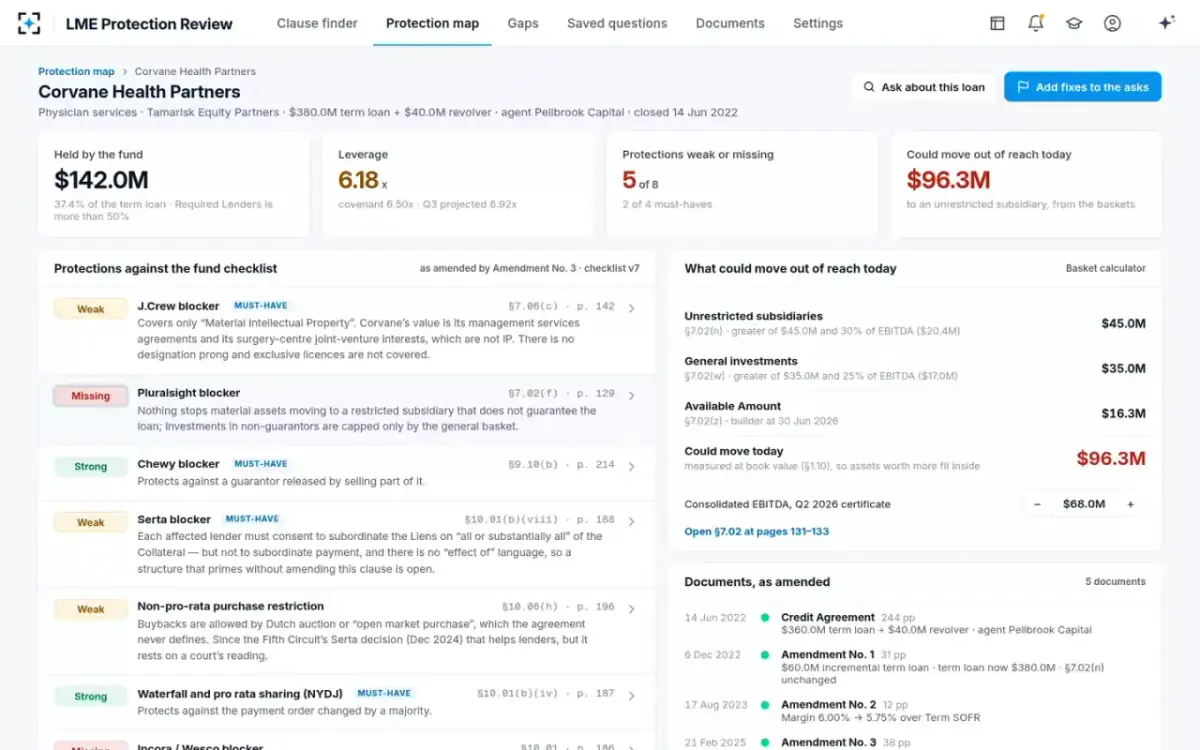
A protection that stops a lien subordination and says nothing about payment priority is the gap the 2020 exchange was built around. It is graded weak, with the clause quoted, rather than counted as present.
Reading the open-market purchase language before the next consent request
The cheapest moment to fix an exception is when the borrower wants something. A waiver request, an incremental facility, a change to a covenant level: each is a moment when the lenders' consent has a price, and defining a term that is currently undefined costs the borrower nothing it values. The expensive moment is after a transaction has closed, when the only remedy is the one the excluded lenders spent half a decade pursuing.
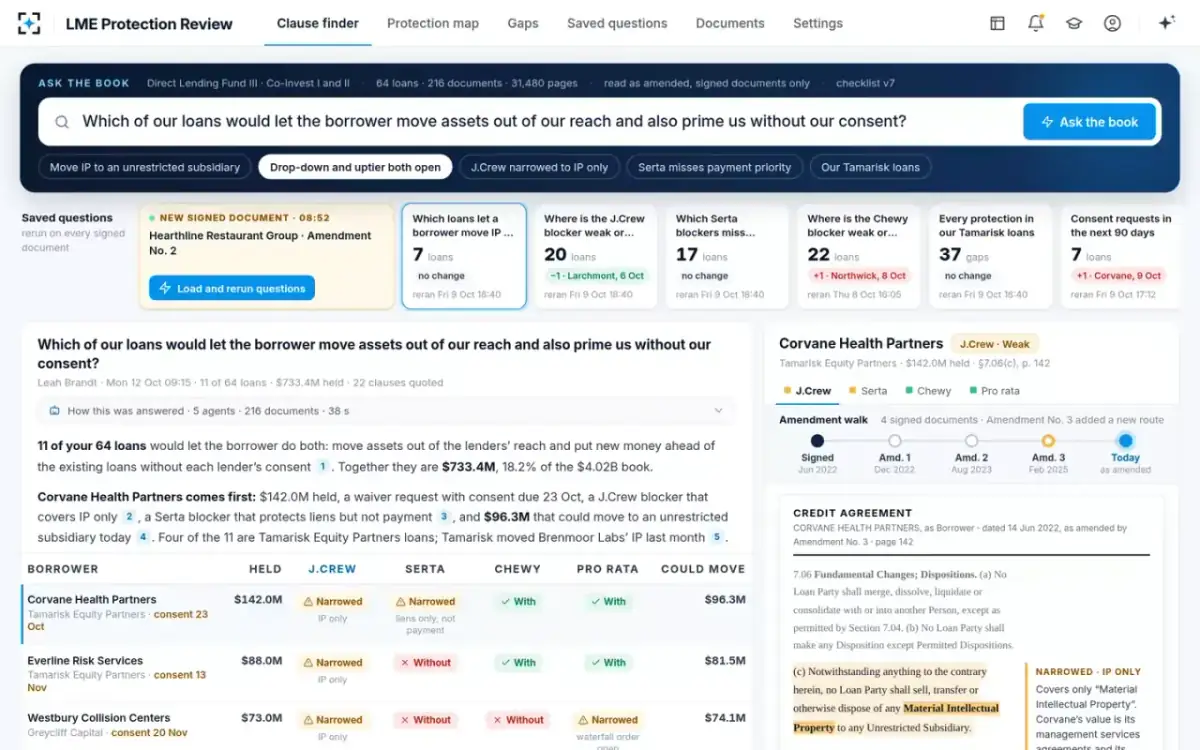
Doing that across a book is a reading problem before it is a negotiating one. Which of your agreements contain a repurchase exception; which of those define it; which protect payment priority as well as liens; and which of those protections can be amended by the Required Lenders. On the sample book that is 64 loans, 216 documents, 31,480 pages and 129 amendments to apply in order, and the answer is stale the next time a document is signed.
LME Protection Review: the same question asked once, across the book
The grading standard behind those words — what makes a protection strong rather than merely present — is set out in sacred rights and the blocker grading rubric, and the mechanics of the transaction this case concerned are in what an uptier transaction is. To see the clause behind each grade on your own agreements, start from LME Protection Review.
Questions people ask
What is an open market purchase exception?
It is a carve-out from a credit agreement's ratable-sharing rule, permitting the borrower or an affiliate to buy back loans other than proportionally, when the purchase is made on the open market. It usually sits in the assignment provisions beside a Dutch auction alternative. In the agreement the Fifth Circuit construed, the two exceptions were the only ways the borrower could repay its loans non-rateably.
Does the Serta ruling apply outside the Fifth Circuit?
It binds only within the Fifth Circuit, but it travels further than that in practice. The decision applies New York contract interpretation to language that recurs across the syndicated loan market, and it reasons from dictionaries, New York precedent and commercial usage rather than from anything local. A court elsewhere is free to disagree; it will have to engage with the reasoning to do so. The durable answer is still to define the term rather than rely on either outcome.
What happened to the Dutch auction option in Serta?
Nobody used it, and that is why it mattered. An auction would have been open to all lenders holding the relevant loans on a pro rata basis, with notice and a minimum purchase of at least $10 million — which would have given every lender the same exit the favoured group received. Its presence in the agreement let the court reject a reading of the other exception that would have made the auction superfluous.
Did the ruling make the uptier itself unlawful?
No. The court decided a contract question: whether this transaction fitted the exception the parties relied on. An uptier structured under an agreement that permits it, or agreed to by every affected lender, is not touched by the decision. What the ruling removes is the ability to reach an undefined exception and assume it is wide enough.
Why does an undefined term in a credit agreement matter so much?
Because the borrower's advisers read the agreement first, and an undefined term is where a reading can be stretched without amending anything. The cost of the stretch falls on whoever has to litigate it: here, a bankruptcy court held the phrase clear and unambiguous in the borrower's favour, and it took an appellate reversal nearly five years after the exchange to settle it the other way.
How do we find this exposure across a whole loan book?
By grading each agreement as amended against a written standard rather than by memory. The questions are mechanical: does this agreement contain a repurchase exception, is it defined, does the ratable-sharing protection cover payment as well as liens, and what vote can change either. On a sample book of 64 loans, grading the eight protections that way finds 24 loans where the priming protection exists but does not survive the questions — the ones a presence-and-absence checklist records as covered.