Who reviews credit agreements for lender protections? At most private credit funds, five people do part of it and nobody does all of it: the portfolio manager who decides what to raise with a borrower, the in-house counsel who owns the protection checklist and approves every ask, the approver who watches exposure across the whole book, the workout head who reads what could move before a default, and the underwriting director who writes the standard into the next vintage of loans. LME Protection Review, Botminds' software for private credit funds, grades every loan against the fund's own checklist and quotes the clause behind each grade — but the decisions stay in those five seats, and so does the risk.
The people and the fund on this page are fictional sample data from inside the solution: Marrowstone Credit Partners, 64 loans and $4.02 billion held across Direct Lending Fund III and two co-invest vehicles. The occupational figures come from the U.S. Bureau of Labor Statistics and are linked where they appear.
Five seats, one question: who reviews credit agreements for lender protections?
The question that exposes the split is a plain one, and it arrives on a deadline: a borrower has asked for a waiver, its sponsor moved another company's assets out of reach last month, and someone needs to say which of the fund's loans would let the same thing happen here. Answering it requires a reading of the documents, a judgement about what to raise, a view on the fund's standard, a sense of what the sponsor will concede, and the authority to spend relationship capital. No single seat has all five.
The same consent request, as five seats see it
Today
Watches 64 loans and $4.02B held, and waits weeks for a reread of the agreements every time a borrower wobbles.
With agents
Asks the book in plain words, gets the loans with and without each blocker in under a minute, and decides which gaps to raise.
Still theirs: What to raise, with whom, and when.
Today
“Show me the clause, not a score.” Gets summaries she has to check against the agreement herself.
With agents
Every grade quotes its clause with document, section and page.
Still theirs: The checklist, and approval of every ask before a borrower sees it.
Today
“Tell me where we are exposed before the sponsor tells us.” Builds the watch list from memory and old memos.
With agents
Sees all 64 loans graded on eight protections and exports the map for the committee.
Still theirs: Concentration, and what the committee is told.
Today
“By the time it reaches me the assets have usually already moved.”
With agents
Reads, loan by loan, how much could move out of reach today and through which basket, before the consent event.
Still theirs: The restructuring strategy once a credit turns.
Today
“We fixed this in the 2024 vintages. The 2021s are another story.”
With agents
Writes the same checklist into new deals and sees, by vintage, which older loans still miss it.
Still theirs: What the fund will and will not sign.
Read down the “keeps” column and the design principle appears on its own: every decision that costs money, credibility or a relationship stays with a person. What moves is the reading — and the reading is what used to make the question unanswerable inside a consent deadline.
What does a portfolio manager at a private credit fund decide?
The portfolio manager owns the loan and the relationship, which means they own the decision to raise something. That decision has more inputs than the clause: how the credit is performing, what the sponsor has done elsewhere, what else the fund wants from this borrower, and whether spending a consent on documentation is better value than spending it on economics.
On the sample book, Leah Brandt's version of the decision looks like this. Corvane Health Partners has asked for Amendment No. 4 — waive the third-quarter leverage test, two more quarters of interest paid in kind, consent due 23 October. The answer table in front of her says 11 of 64 loans would let a borrower both move assets out of reach and prime the existing lenders, $733.4 million held, 18.2% of the book, with 22 clauses quoted. Corvane is first on the list: $142.0 million held, a blocker that covers intellectual property only, and $96.3 million that could move to an unrestricted subsidiary today. What she decides is not whether the clause is weak. It is which of six possible asks is worth the consent she is about to give.
What she does not decide is the drafting. The asks are drafted from the fund's model clauses and go to counsel before anything reaches the borrower, the administrative agent or the sponsor.
Why counsel owns the checklist, and what in-house counsel reviews before a loan amendment
The checklist is the fund's definition of what a strong protection looks like — eight protections, each with the elements that have to be present, and a subset marked must-have. Whoever owns that document owns the grade of every loan in the book, because a grade is only ever a comparison against a standard. Putting it with counsel rather than with the portfolio team keeps the standard independent of the person who has a reason to want a loan to look fine.
Before a loan amendment, in-house counsel reviews three things: whether the drafting does what the ask intended, whether it fits the agreement's defined terms as they currently read, and whether anything else in the proposed instrument moves a protection the fund relies on. The third is the one most easily skipped under deadline, and it is where a basket quietly widens.
Six asks in LME Protection Review, drafted from the fund's model clauses and waiting on counsel
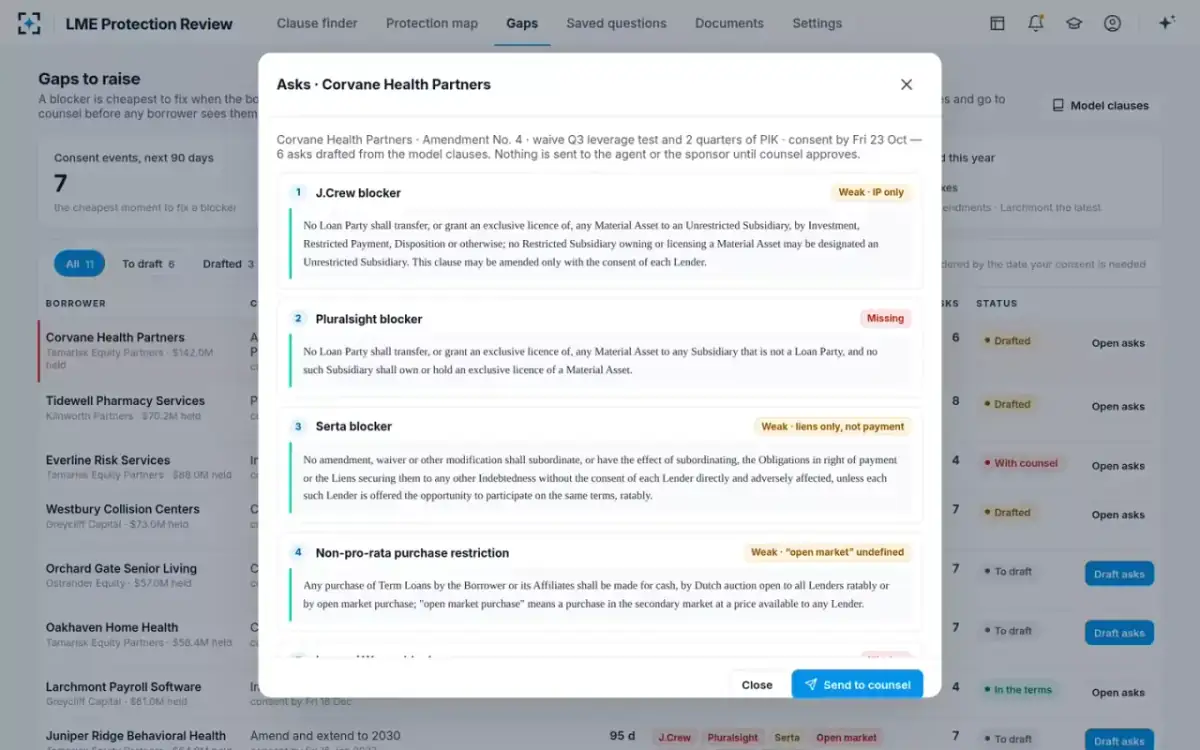
Counsel's veto is also a versioning job. When the checklist changes — a new element added to a blocker, a protection promoted to must-have — the version is kept and the whole book is regraded against it, so the fund can tell the difference between a loan that got worse and a standard that got stricter. How those elements are written, and why a clause can be strong in one agreement and weak in the next, is the subject of the grading rubric.
What the approver watches that no single loan file shows
The head of portfolio management is reading for concentration, and concentration is invisible from inside any one loan. Four of the 11 loans open to both moves on the sample book share one sponsor. That is not a drafting fact about any of the four; it is a pattern across them, and it changes what the fund should do — because a sponsor that has used a drop-down at one portfolio company has shown it is willing, and the documents that permit it elsewhere are now a live question rather than a theoretical one.
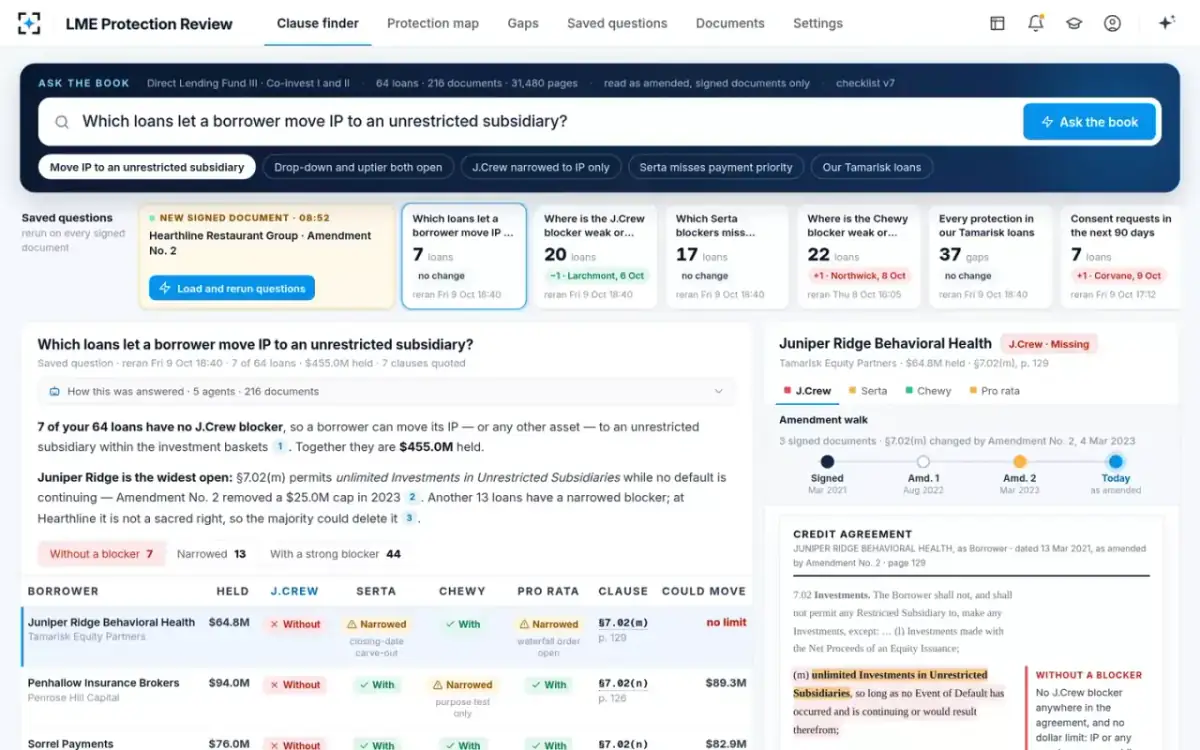
The approver's other reading is the committee's. A protection map that grades all 64 loans on eight protections — 44 strong, 13 weak and 7 missing on the first of them — is a page the investment committee can act on; a memo saying “we reviewed the agreements” is not. The map exports with every clause referenced, which is what makes it defensible when somebody asks how a grade was reached.
What does a financial examiner do, and how much do they make?
There is no occupational code for “LME protection reviewer”, and it is worth saying so plainly rather than implying a tidier market than exists. The closest published occupations are two, and the U.S. Bureau of Labor Statistics tracks both. Financial examiners “ensure compliance with laws that govern institutions handling monetary transactions”. Financial analysts “research and evaluate financial data, forecast future trends, and prepare reports containing recommendations for businesses and investors”. The seats described on this page sit between the two, in a market — private credit — that neither category was drawn around.
The two published occupations closest to this work, and what they pay
$94,160
median annual wage for financial examiners, May 2025
$102,740
median annual wage for financial and investment analysts, May 2025
9%
projected growth in financial examiner employment, 2025 to 2035 — much faster than the average for all occupations
The scale point the wage figures make is about the cost of the reading, not the cost of the people. If one protection question across a 64-loan book means rereading 216 documents and 31,480 pages in the order they took effect, as it does on the sample book, then the fund is choosing, every quarter, between asking the question and doing the rest of the job. Most funds choose the rest of the job, and find out about the weak clause from the consent request.
Why workout reads a loan differently than underwriting does
Give the same credit agreement to the head of workouts and the underwriting director and they will read for opposite things. Underwriting reads forward from a blank page: what should this document say so that, if everything goes wrong, we are not the ones left behind? Workout reads backward from a bad ending: given what this document actually says, what can the borrower and its sponsor still do to us, and how fast?
The same agreement, read by the seat that writes it and the seat that lives with it
Underwriting, at the term sheet: Does this draft meet our standard, and which elements will the sponsor concede?
Workout, before the default: Which route out of our reach is still open on this document as it reads today?
Underwriting, at the term sheet: The protection sections, against the checklist and the model clauses.
Workout, before the default: The investment, restricted-payment and disposition baskets, and the definitions they depend on.
Underwriting, at the term sheet: Strong, weak or missing, element by element.
Workout, before the default: A number: how much value could move, through which basket, at today's earnings.
Underwriting, at the term sheet: After signing. A protection not written is rarely given away later for nothing.
Workout, before the default: After the assets move. The route closes only when the amendment doing it is signed.
Underwriting, at the term sheet: Tell workout which loans were signed to the older standard.
Workout, before the default: Tell underwriting which clause actually failed, and how.
On the sample book, the workout reading of Corvane produces a figure rather than a grade: $96.3 million could move to an unrestricted subsidiary today, out of three baskets measured at the latest certified earnings of $68.0 million, and because investments are counted at book value under the agreement's own measurement clause, assets worth more than that could fit inside the same capacity. That is the number that gets a workout head's attention before a default, not after.
What does underwriting owe the next vintage of loans?
Underwriting owes the fund two things: the same standard applied to new deals, and an honest map of where the old ones fall short of it. Both are harder than they sound, because the market standard itself has moved. The academic record of the post-2020 period shows protections being added in response to specific transactions rather than in a steady drift, and the pressure is uneven across borrower types: in the Buccola and Nini sample, “20% of our sample borrowers are backed by a private equity sponsor”, and those sponsored borrowers were less likely to face a dropdown blocker than the rest.
That is the vintage problem in one sentence: a fund that tightened its checklist recently is still holding loans underwritten to an earlier standard, and the loans least likely to carry a drop-down blocker are the sponsored ones, whose owners have the most to gain from the room. The underwriting director's contribution to LME protection is therefore not only the next term sheet; it is the list of older loans whose documents should be upgraded when the chance comes.
Who decides whether to raise a gap with the borrower
The portfolio manager decides, counsel approves the drafting, and nothing leaves the fund before both have happened. Written as a chain it looks bureaucratic; in practice it is the only arrangement that survives a deadline, because it fixes in advance who is allowed to say something to the other side.
From a question to an ask: who does what, and what never happens
Agent
Six specialist agentsStack every document as amended, trace the defined terms, grade each protection against the checklist and measure what could move today.
Never: contact a borrower, an administrative agent or a sponsor
A person decides
Portfolio managerReads the graded answer with its quoted clauses and decides which gaps are worth raising on this consent.
A person decides
Deputy general counselApproves the drafting of every ask against the fund's model clauses, and owns the checklist version behind the grades.
A person decides
The fund, to the agent and the sponsorSends the approved asks as part of the amendment negotiation.
Where the handoffs between these five seats break down
Weak blockers rarely survive because someone read a clause and got it wrong. They survive because the reading and the decision sat with different people at different times.
Four handoffs, and what falls through each of them
| Handoff | What should pass | How it fails | What closes it |
|---|---|---|---|
| Underwriting → portfolio management | Which protections this loan has, and which the fund conceded to win the deal. | The concession is in a term-sheet email and the closing file; two years later nobody on the loan remembers it. | A grade per protection, held against the loan rather than in anyone's memory. |
| Portfolio management → counsel | The gap worth raising, with the clause and the reason. | The ask arrives as “can we tighten the J.Crew language”, and counsel has to reread the agreement to find out what is actually weak. | The ask drafted from the model clause, with the quoted clause attached. |
| Counsel → the next amendment | The protections to fix when the borrower next needs something. | The consent request arrives on a Friday with a Tuesday deadline, and the list has to be rebuilt from scratch. | A standing list of loans with a consent event, ordered by the date consent is needed. |
| Everyone → workout | What the documents permit, before the credit turns. | Workout inherits the file at the point of default and discovers the room the same week the assets move. | The basket figure kept current on every loan, not computed when it is already too late. |
The gaps list is the clearest case. On the sample book, 11 loans have a consent event approaching, ordered by the date the fund's consent is needed, with the weak and missing protections on each. That list is not new information — every fact in it existed somewhere — but it existed in four places and nobody owned the assembly.
LME Protection Review: one question box over the whole book, and the standing questions beneath it
Who should never be in this chain: the agents, and what they may not do
The sixth participant in this work is not a person, and the limits on it are deliberate. The agents read, trace, grade and calculate. They never contact a borrower, an administrative agent or a sponsor. They never grade without quoting the clause, never apply an unsigned document, and never mark a gap closed until the amendment that closes it is signed and effective. Every question, grade change and ask is on the audit trail with who or what did it.
Those limits are not modesty about what software can do; they are about where accountability has to sit. A fund that lets a reading tool talk to a sponsor has moved a negotiating position outside the five seats that answer for it. What the agents may and may not do, and why current model-risk guidance does not settle the question on its own, is set out in the guide to the agents and their limits. To see the five seats working one consent request end to end, start from LME Protection Review.
Questions people ask
Should LME protection review sit with the investment team or with legal?
With both, split by decision type. The standard — what counts as a strong protection — belongs with counsel, because a grade is a comparison against a standard and the standard should not move with commercial pressure on a single loan. The decision about what to raise, and when, belongs with the portfolio manager who owns the relationship. Funds that put both with one seat usually find the standard drifting toward whatever the current deal can get.
Does a small fund need five separate people for this?
No. It needs the five decisions to be distinguishable, which is different from needing five headcount. At a smaller platform one person often holds the portfolio-management and approver roles, and outside counsel holds the checklist. What does not work is leaving the standard undefined, because then every grade is an opinion formed at the moment it is needed.
What does a workout professional do before a default?
Reads the documents for routes rather than for compliance. The questions are what assets can still leave the credit group, through which baskets, at what measured value, and which lender votes would be needed to subordinate the existing debt. Doing that early is the difference between negotiating from a known position and discovering the position after a transaction has closed.
Who approves an ask before it reaches a sponsor?
In the arrangement described here, the portfolio manager decides that an ask will be made and counsel approves its drafting; only then does it go into the amendment negotiation. The sequence matters because a drafting request is a negotiating position: once a specific wording has been put to the other side, withdrawing it costs more than never having asked.
How does the underwriting team use the same information?
Two ways. It writes the fund's checklist into new term sheets, so the next vintage starts at the standard rather than at whatever the sponsor's counsel drafts, and it reads the book by vintage to see which older loans still fall short — which is the list of upgrades to seek whenever one of those borrowers needs a consent.
Is there a job title for this work?
Not a standard one. The U.S. Bureau of Labor Statistics publishes financial examiners and financial analysts as the nearest adjacent occupations, and neither was drawn around private credit documentation. In practice the work is a slice of several existing roles, which is precisely why it falls between them.