An uptier transaction is an amendment that lets a borrower issue new super-priority debt and allows the lenders who consented to the amendment to exchange their existing loans into it, leaving the lenders who were not asked in the same facility and behind. Nothing leaves the group of companies, no collateral is released and no asset is sold. What changes is the order of payment and the rank of the liens — which is why the manoeuvre is also called priming, and why it can be done with a simple majority when a drop-down needs nobody at all. LME Protection Review is Botminds' agentic solution for finding out whether your own agreements permit it: it reads each credit agreement as amended, grades the clause that would stop a priming exchange, and quotes the words it relied on.
The protection is unusually measurable, because the academic record shows exactly which drafting choice the market reached for once it decided to close the route. The sample grades on this page come from a fictional book inside the solution — 64 loans, $4.02 billion held — and the fund, borrowers and sponsors named are invented. The market figures come from a study of syndicated credit agreements, and the contract language from a federal appellate opinion; both are linked where they appear.
How fast a market can repaper itself, and what it changed
~40%
of syndicated loans blocked uptiers before the Serta transaction
~75%
blocked them a year later
Nearly all
of that change came from one drafting move: making loan priority a term that needs unanimous consent
What an uptier transaction actually moves
It moves rank. Before the transaction, a syndicate of first-lien lenders shares in payments and in the collateral according to how much of the loan each holds. After it, some of those lenders hold new debt that sits ahead of the facility they came from, and the rest hold what they always held, now behind debt that did not exist the month before. The borrower has new money; the consenting lenders have a better claim on a worse credit; the excluded lenders have the same claim, worth less.
Three things make that possible. The amendment provisions of most credit agreements let the Required Lenders change most terms, which supplies the vote. An exception to pro rata sharing — a permission to buy back loans other than rateably — supplies the mechanism for the exchange. And the borrower supplies the inducement, by offering the consenting group better paper than it currently holds. Remove any one of the three and the transaction does not happen.
That is also the order in which to read your own agreement. Not "is there a Serta blocker", but: what vote changes priority, what exception permits a non-rateable repurchase, and what the borrower would have to offer to buy the vote.
The two generic ways a contract can block an uptier
The study that measured the market's reaction also catalogued the drafting. "There are two generic ways a loan contract can block an uptier," Buccola and Nini write. "It can prohibit the borrower or its affiliates from repurchasing loans on a discriminatory basis (that is, from favored creditors only) or it can require supermajority or unanimous consent for the borrower to subordinate the lien and payment priority of existing loans" (Buccola and Nini).
Two routes to the same protection, and what each one misses
Ban discriminatory repurchases: The borrower and its affiliates may not buy back loans from some lenders and not others — the pre-crisis norm, which simply forbade non-pro-rata repurchases.
Make priority a unanimous-consent term: Lien priority and payment priority may not be changed without the consent of every affected lender, whatever the Required Lenders decide.
Ban discriminatory repurchases: The assignment and repurchase provisions, usually alongside the Dutch auction and affiliated-lender mechanics.
Make priority a unanimous-consent term: The amendment section, in the list of terms singled out for a higher vote.
Ban discriminatory repurchases: The exceptions. A repurchase ban with an open-market purchase carve-out is only as strong as the meaning of that carve-out.
Make priority a unanimous-consent term: Scope. A clause that protects liens but says nothing about payment leaves the borrower free to change the order in which money is applied.
Ban discriminatory repurchases: Amend the ban itself, if the ban is an ordinary term. Protection that a majority can delete is protection with a price on it.
Make priority a unanimous-consent term: Nothing to that term, by definition — which is why this is the version the market adopted at scale.
Ban discriminatory repurchases: Weak where an exception swallows it; strong where the ban is unqualified or its exceptions are defined.
Make priority a unanimous-consent term: Weak where it covers liens only, or where the Required Lenders can amend the voting provision itself; strong where both priorities are named.
What does priming a lender mean?
Priming means putting a new claim ahead of an existing one over the same collateral or in the same payment order. A primed lender has not lost its security; it has lost its place. In a liquidation the primed claim is paid after the new super-priority debt, so the recovery depends on whether the estate is big enough to reach it, and in a going-concern negotiation the primed lender has correspondingly less to bargain with.
There are two separate things to prime, and this is the distinction most weak clauses miss. Lien priority decides who is paid first from the collateral; payment priority decides who is paid first from everything else, whether or not it was pledged. A blocker that protects one and not the other invites the transaction that uses the other. Ratable sharing is a third, related protection: it stops the borrower paying some lenders in a class and not the others. The appellate opinion on the best-documented uptier turns on exactly this pairing, describing a ratable-sharing provision under which the borrower "cannot choose to pay its obligations to one lender while offering nothing to the rest — the favored lender would have to share the payment with the other lenders" (In re Serta Simmons Bedding, 5th Cir. 2025).
How the 2020 Serta uptier worked, in outline
The transaction that triggered the repapering is the one the court record describes in most detail. The borrower had issued first-lien and second-lien syndicated loans in a 2016 refinancing. In 2020 it agreed an uptier with some, but not all, of those lenders. That group provided $200 million of new financing in exchange for first-out super-priority debt, and exchanged about $1.2 billion of its existing first-lien and second-lien loans for roughly $875 million of second-out super-priority debt.
The exchange was at a discount to face, because the loans were trading far below par; the consenting lenders accepted a smaller nominal claim in return for a better place in the queue. The borrower got cash and a lower debt load. The lenders who were not in the group kept their original claim, now behind $1 billion or so of new senior paper. The amendment that permitted all of this was passed because the consenting group held a bare majority of the outstanding first-lien debt. What happened when that structure reached a court is the subject of the Serta ruling and the open-market purchase fight.
The route, step by step, and the clause that stops each step
| Step | What the borrower needs | What stops it |
|---|---|---|
| 1. Find the vote | Enough consenting lenders to clear whatever threshold the amendment section sets for the change it wants. | Nothing, if priority is an ordinary term. Everything, if priority needs unanimous or affected-lender consent — the step where most strong protection lives. |
| 2. Amend the agreement | Permission to incur new debt that ranks ahead of the existing facility, and to grant it the liens it needs. | A debt covenant with no super-priority capacity, and a lien covenant whose permitted-liens list does not reach a priming lien. |
| 3. Buy the consenting lenders out of the old paper | An exception to pro rata sharing, because repaying some lenders and not others is exactly what ratable treatment forbids. | A flat ban on non-pro-rata repurchases, or an exception narrow and defined enough that a privately negotiated exchange does not fit inside it. |
| 4. Close before anyone objects | Speed, and a syndicate that cannot organise. The excluded lenders usually learn of the transaction when it is announced. | Knowing in advance which of your loans are open, so the gap is raised at the last consent request rather than discovered at this step. |
Why loan priority became a "sacred right" almost overnight
Because it is the one change that cannot be bought. A ban on discriminatory repurchases is an ordinary covenant, so the same majority that wants to do the transaction can amend the ban first and the transaction second. A term that requires unanimous or affected-lender consent cannot be reached that way: the lender being primed is, by definition, affected, and its consent is the thing the borrower is trying to do without.
The market worked that out quickly. "Nearly all of the change was attributable to an increase in the frequency of contracts that made loan priority a 'sacred right' requiring unanimous approval to change," the study reports of the year after the transaction. That is a remarkable sentence to read as a lender: an entire market moved from one drafting technique to another, in roughly twelve months, because only one of them survives contact with a motivated majority.
The 2016 Agreement protects the sacred right of pro-rata sharing.
U.S. Court of Appeals for the Fifth Circuit, In re Serta Simmons Bedding
The phrase is not decorative. In the agreement the court was reading, ratable sharing sat in one section and the requirement that it be changed only with unanimous consent sat in another — and the protection was the combination, not either clause alone. A grading standard that marks a loan protected because it has a ratable-sharing provision, without reading the voting section, is marking the wrong thing. That pairing is taken apart clause by clause in what sacred rights are and how a grader uses them.
Uptier vs dropdown: what is different, and why the market reacted differently to each
A drop-down takes the assets and leaves the claim; an uptier takes the claim's place in the queue and leaves the assets. A drop-down generally needs no lender vote, because it runs on baskets the borrower already has; an uptier needs a majority, because it needs an amendment. And the damage shows up differently: after a drop-down the collateral package is visibly smaller, while after an uptier the collateral package is identical and only the waterfall has changed.
The market's response differed just as sharply. Uptier protection spread to roughly three-quarters of loans within a year. Drop-down protection barely moved — the same study found the frequency of loans blocking drop-downs, and the exposure in those that do not, changed little in the years after the transaction that made the route famous. A fund that treats "LME protection" as one thing will therefore be well covered on one route and open on the other, usually without knowing which. What a liability management exercise is sets both routes out side by side.
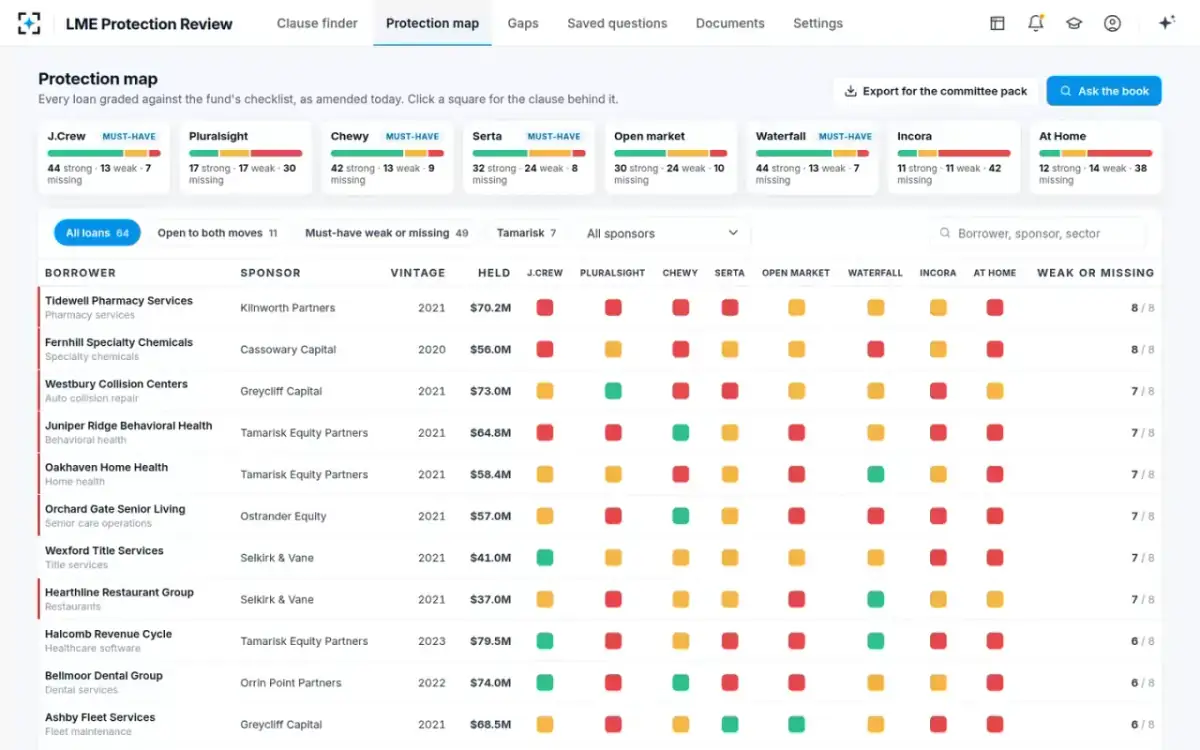
Two protections, one book: how unevenly the same 64 loans are drafted
The interesting number in that figure is 24, not 8. Eight loans with no priming protection at all are easy to find and easy to argue about. Twenty-four with a clause that reads like protection and does not survive the grading questions are the ones that produce an unpleasant surprise, because the committee pack has been recording them as covered.
Can a majority of lenders prime the minority without their consent?
Under many agreements, yes — and that is the honest answer a credit committee should be given. If the amendment section lets the Required Lenders permit new super-priority debt, and if an exception lets the borrower repurchase loans non-rateably, then a bare majority plus the borrower can do the whole transaction without the minority being asked. The minority's remedies afterwards are contractual: argue that the amendment exceeded what the Required Lenders could do, or that the exception relied on does not mean what the parties said it meant.
Where the agreement makes priority an affected-lender term, the answer changes completely. The lender being subordinated must consent to its own subordination, and no amount of majority support substitutes for that. Everything in between — a supermajority threshold, a sacred right that covers liens but not payment, a ban with a wide exception — is a question of degree, and degree is what a grading standard exists to record.
Every loan, every protection: the LME Protection Review map
What a non-pro-rata loan repurchase is, and why it needs an exception to work
A non-pro-rata loan repurchase is the borrower, or an affiliate of the borrower, buying back some lenders' loans without offering the same deal to everyone. The default rule in a syndicated agreement forbids it, because ratable treatment is the norm that keeps a syndicate a syndicate: if the borrower could choose whom to repay, the majority could always arrange to be chosen.
So the exchange leg of an uptier has to find an exception. Agreements commonly contain two: an auction open to all lenders on the same terms, and a purchase of loans in the market. Both are exceptions a borrower can use honestly. Both are also the place a priming transaction will claim to live, because the alternative is conceding that the exchange was simply a non-rateable repayment. The strength of the protection therefore depends less on the ban than on how tightly the exceptions are written — and whether the key term inside them is defined at all.
Reading for the exception, not just the blocker
A protection review that stops at the blocker will mark loans safe that are not. The questions that follow the blocker are: which exceptions to pro rata sharing does this agreement contain; is each one defined, or left to ordinary meaning; does the amendment section protect payment priority as well as lien priority; and can the Required Lenders amend the protection itself? Each of those is a reading task over a document that has usually been amended several times, with the answer depending on defined terms that may themselves have been amended.
That is the work the solution automates and the part it refuses to guess at. Agreements are read as amended by signed and effective documents only — a borrower's pending request is held, not applied — every defined term is followed to its definition rather than inferred, and no grade is given without the clause quoted beside it. On the sample book of 64 loans and 216 documents, one question of this kind was answered in 38 seconds; by hand it means rereading every one of those documents in the order it took effect.
Inside LME Protection Review: following the defined terms, not the headings
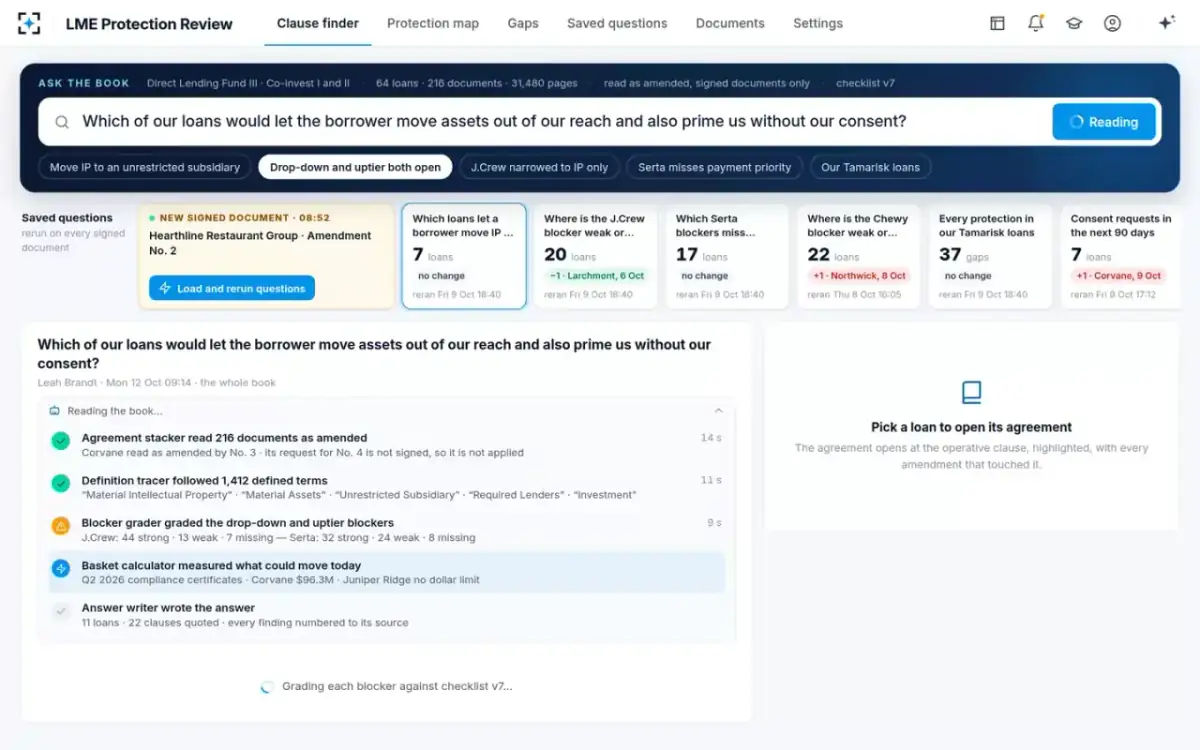
The term most often left undefined in these agreements is the one the best-documented uptier turned on, and a federal appeals court eventually had to supply its meaning. To see the protection map and the clause behind each grade on your own agreements, start from LME Protection Review.
Questions people ask
How does an uptier work in practice?
The borrower lines up a group of lenders holding enough of the facility to pass an amendment, amends the agreement to permit new super-priority debt, takes new money from that group, and lets the same group exchange its existing loans into the new senior paper under an exception to pro rata sharing. In the best-documented example the group provided $200 million of new financing and exchanged about $1.2 billion of existing loans for roughly $875 million of super-priority debt, on the strength of a bare majority of the first-lien loans.
What is the difference between an uptier and a drop-down?
A drop-down moves assets out of the lenders' reach using baskets the borrower already has, and generally needs no vote. An uptier leaves every asset where it is and moves a chosen group of lenders ahead of the rest, and needs an amendment and therefore a vote. One shrinks what you can claim against; the other leaves that untouched and puts someone in front of you.
Why did uptier blockers spread so fast after 2020?
Because the fix was cheap, visible and provably effective. Making loan priority a term that requires unanimous consent is a single change to the amendment section, it is easy to ask for in a negotiation, and it closes the route completely rather than narrowing it. Within a year, loans blocking uptiers went from roughly 40% to roughly 75% of the syndicated loans Buccola and Nini studied, and nearly all of that was this one drafting move.
Does a strong blocker mean a borrower can never prime us?
It means they cannot do it with a majority under that agreement. A borrower can still negotiate a priming transaction that every affected lender agrees to, and a court-supervised restructuring can grant priming liens on its own terms. What a strong clause removes is the version where the first you hear of it is a press release and the vote that authorised it belonged to lenders who were paid to give it.
What is loan priority as a sacred right?
It is a drafting convention: a short list of terms in the amendment section that the Required Lenders cannot change on their own, each needing unanimous or affected-lender consent. Adding lien and payment priority to that list is what turns a ratable-sharing provision from a default rule into protection, because the provision is then beyond the reach of the majority that would otherwise rewrite it.
Can the exception itself be amended by a majority?
In many agreements, yes, and it is worth checking separately. If the repurchase exceptions sit in an ordinary section, a majority can widen them before using them, and a blocker that depends on their narrowness is only as durable as that vote. Where the exceptions are themselves protected, or where the pro rata sharing provision is an affected-lender term regardless of which exception is invoked, the protection holds.