How long does it take to review a credit agreement? Long enough that the honest answer is a question back: review it as of when? A credit agreement is not one document. It is the original agreement plus every amendment, waiver, consent and joinder, applied in the order each took effect, and the cap a lender read at closing may have been struck out two years later by a document nobody on the deal team has opened since. LME Protection Review, Botminds' software for private credit funds, reads each loan as amended by its signed documents and shows the clause, the document and the page behind every finding — so the question it answers is not what an agreement says, but what it says today.
The worked examples below come from a fictional sample book inside the solution: Marrowstone Credit Partners, 64 loans, $4.02 billion held, 216 documents and 129 amendments across Direct Lending Fund III and two co-invest vehicles. The borrowers, funds and sponsors are invented. The research figures are from regulators and peer-reviewed work, linked under each figure.
Protections move over a loan market's life, and the movement is measurable
6pts
rise in the frequency of IP blockers in the period after the J.Crew transaction
45pts
further rise in the period after the Serta transaction
15%
of the contracts that allow investments in unrestricted subsidiaries carried an IP blocker at all
Why a credit agreement is a sequence, not a document
Lenders talk about “the credit agreement” as though one PDF governed the loan. It does not. The document that governs is the original agreement as modified by every instrument that has taken effect since: amendments that change the words, waivers that suspend them for a period or an event, consents that permit a single act, and joinders that add a borrower, a guarantor or a lender to the existing terms. Each one is dated, each one has an effective date that may not be its signature date, and each one applies on top of the ones before it.
That ordering is not a technicality. A basket raised by Amendment No. 1 and then reset by Amendment No. 3 is at the Amendment No. 3 number; a protection deleted by Amendment No. 2 is not restored because the original still sits in the data room with its section heading intact. Reading the stack out of order — or reading only the amendments whose cover pages mention the section you care about — produces a confident answer to a question nobody asked.
What 216 documents on a 64-loan book actually are
Marrowstone Credit Partners · every document behind the book
- Credit agreements (64) · 29.6%
- Amendments (129) · 59.7%
- Intercreditor agreements, waivers and joinders (23) · 10.7%
Two documents in three on this book are not an original agreement. That ratio is what makes the review question a sequencing problem before it is a reading problem: the work is not finding §7.02, it is establishing which §7.02 is in force, and on what date it became so.
How long does it take to review a credit agreement by hand?
No regulator or academic study publishes a benchmark for it, and a figure quoted by a software seller is a claim about its own demonstration. The honest way to size the job is from the stack itself: count what has to be read, in what order, and how many defined terms each answer depends on, then apply your own team's reading rate. On the sample book the stack for one protection question looks like this.
The size of one protection question on a 64-loan book
| What has to be done | On the sample book | Why it cannot be skipped |
|---|---|---|
| Match every document to its loan and order it by effective date | 216 documents: 64 agreements, 129 amendments, 23 intercreditor agreements, waivers and joinders | An amendment applied out of order gives the wrong clause with total confidence. |
| Read the agreements as amended | 31,480 pages, about 490 a loan | The section that matters may have been rewritten in a document filed under another heading. |
| Follow each defined term to its definition | 1,412 defined terms | A blocker is only as wide as the definitions it uses, and definitions get amended too. |
| Grade each protection against the fund’s standard | 8 protections × 64 loans = 512 grades | A presence-and-absence tick records a weak clause as cover. |
| Decide what to raise, and have counsel review the asks | The loans with a gap and a consent event coming | This is judgement, and it does not get faster. |
The shape of that table matters more than any total. Four of the five rows are mechanical: pulling documents, applying them in order, following defined terms, and comparing clauses with a written standard. One row, deciding what to raise with a borrower and counsel's review of the wording, is judgement, and it does not shrink. That is the division this software is built around, and it is the same division the five seats that carry LME risk already draw informally. On the sample book the agents did the four mechanical rows for one question in 38 seconds; the fifth stays with people.
The table also shows why the question is usually not asked. At any reading rate a credit team would recognise, more than thirty thousand pages is weeks of one analyst's time for a single answer, and the answer expires the next time a document arrives. Most funds therefore ask it about the loan in front of them, not about the book, which is exactly the sampling problem a consent request exposes.
How many amendments does a typical leveraged loan collect?
Nobody publishes a clean market average, and it is worth being precise about why. Amendment counts live in the documents, not in a database with harmonised fields, and the most complete academic sample of credit agreements had to treat amendments as something to remove rather than to count: Buccola and Nini began with 4,182 contracts filed between January 2016 and September 2021 and excluded 649 of them because they were marked as amendments to existing agreements, leaving 3,533 original contracts to study.
Read the other way round, that exclusion is itself a figure: roughly one filed credit-agreement document in six, over a five-and-three-quarter-year window, was an amendment rather than a new deal — and that is only the subset that reaches a public filing. In private credit, where there is no filing obligation of that kind, the amendments stay in the fund's own files. On the fictional sample book, 129 amendments across 64 loans averages a shade over two per loan.
Why do credit agreements get amended so often?
Because the agreement is a forecast and the business is not. Most amendments do routine work: adding a guarantor after a bolt-on acquisition, permitting an incremental facility, changing a reporting date, replacing a benchmark rate, or raising a basket that was sized for a smaller company. Others are negotiated under pressure — a covenant waiver, a leverage step-down deferred, interest allowed to accrue instead of being paid in cash.
That last category is growing, and it is visible in supervisory work. The Federal Reserve's May 2026 Financial Stability Report notes that “in private credit markets, loan defaults remained at relatively low levels, but the elevated usage of payment-in-kind (PIK) provisions indicates some borrowers may face repayment difficulties” (Federal Reserve, Financial Stability Report). The Financial Stability Board puts a number on the same feature: PIK “is utilised in approximately 12% of loans, with toggles accounting for about half of those cases”, and the use of both PIK notes and PIK toggles “has risen significantly since 2022”.
A PIK toggle, a deferred step-down and a waived test all arrive by amendment. Each one is an occasion on which the document is reopened, the sponsor's counsel proposes the drafting, and a protection three sections away can be adjusted in the same instrument. Nobody has to be acting in bad faith for the book to drift; the drafting is simply done by the party with the most reason to widen it.
What is the difference between a waiver, an amendment and a joinder?
They change the agreement in different ways, and a review that treats them alike will misread the stack.
Four instruments, four different effects on what the agreement says today
| Instrument | What it does | How long it lasts | What a reviewer must do with it |
|---|---|---|---|
| Amendment | Changes the words of the agreement — strikes text, inserts text, restates a definition or a number. | Permanent, from its effective date, until another amendment changes it again. | Apply it in order and read the section as it now stands, not as the original reads. |
| Waiver | Agrees not to enforce a provision for a stated period, test date or event. The words stay. | For the period or event stated, and no further. | Note what was waived and when the waiver ends, then read the original words again afterwards. |
| Consent | Permits one specific act the agreement would otherwise prohibit — a disposal, a designation, a transaction. | For that act only. | Check whether the act has happened and whether the consent carried conditions that are still live. |
| Joinder | Brings a new borrower, guarantor or lender under the existing terms, usually without changing them. | Permanent, from its effective date. | Update who is bound — a guarantor added by joinder changes which entities a protection actually covers. |
The distinction that catches people out is the waiver that behaves like an amendment. A waiver granted “for the fiscal quarter ending 30 June and each quarter thereafter until the Leverage Ratio is below 5.00x” has no end date on its face; whether the original words are back in force depends on a test result nobody has recalculated. Until that is established, the agreement has two readings, and a protection review has to say which one it used.
How a basket cap widens three amendments after everyone stopped reading closely
Here is the shape the drift usually takes, on the sample book's Juniper Ridge Behavioral Health. At closing, §7.02(m) permitted investments in unrestricted subsidiaries up to $25.0 million. By the time anyone asked whether Juniper Ridge's lenders could be left behind by a transfer of assets, the cap was gone: Amendment No. 2 struck the figure through and put “unlimited Investments in Unrestricted Subsidiaries” in its place.
The amendment walk in LME Protection Review: one clause, at each stop in its history
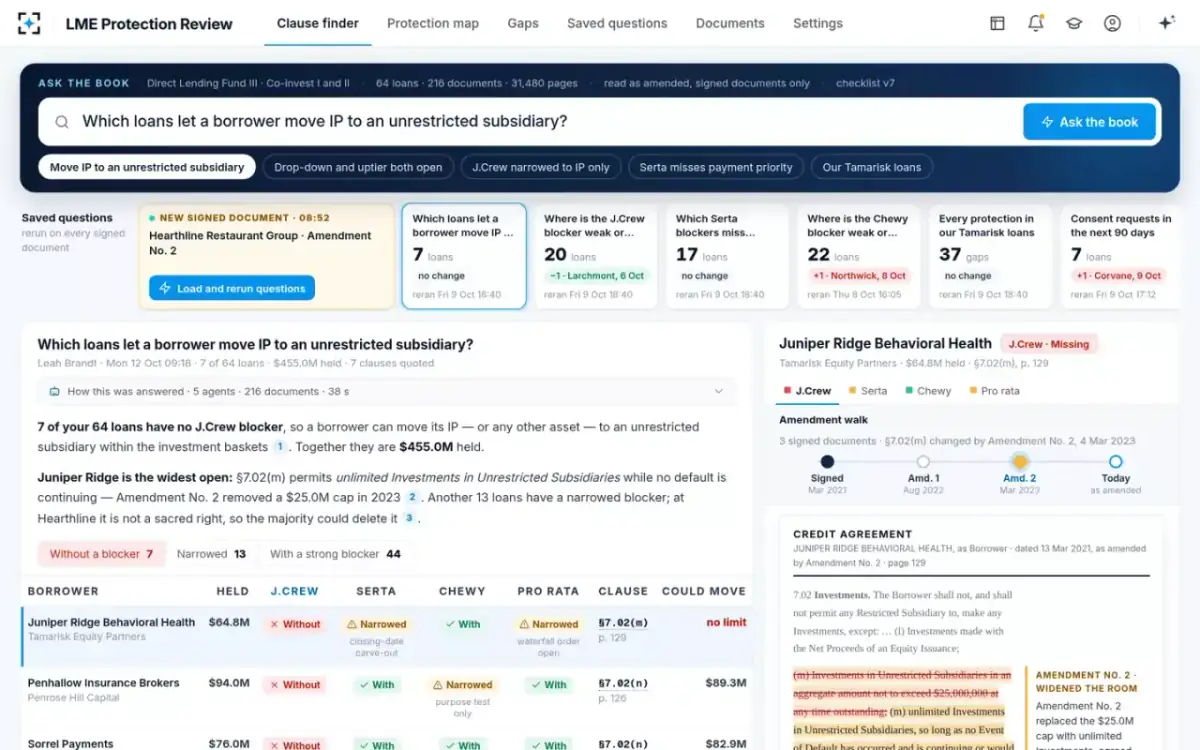
Three things about that example are worth separating. The first is that nothing was hidden: Amendment No. 2 was signed by the lenders who had the votes to sign it. The second is that the amendment's subject was not the investment basket — the widening travelled alongside something else the lenders wanted done. The third is that from the day it took effect, the loan had no meaningful limit on what could be moved to a subsidiary outside the lenders' reach, and the J.Crew blocker that was supposed to close that route was not there to catch it. Juniper Ridge is one of seven loans on this book with no J.Crew blocker at all, $455.0 million held between them.
The practical lesson is about where to look. A protection review that reads the agreement's protection sections and stops will find §7.06's blocker intact and report the loan as covered. The capacity that matters was changed in §7.02, in a document filed under a different cover page, in a year when the credit was performing.
Why the market's own protections drift over a book's life
Drift is not only a within-loan phenomenon; the market's drafting standard moves too, which is why vintage matters as much as borrower. The clearest evidence is the intellectual-property blocker — the clause that stops a borrower moving IP into an unrestricted subsidiary. Buccola and Nini find that “IP blockers were non-existent before the J. Crew transaction”, that for a long period afterwards their use “barely budged”, and that the real increase began in the second half of 2020: an estimated 6 percentage points in the post-J.Crew period, and a further 45 points after Serta.
Their summary of the direction is narrow and worth quoting exactly: “we do find evidence that contracts entered since 2020 have become more likely to prohibit the dropping down of intellectual property (IP) assets specifically.” Not every asset. IP. A fund whose 2019 and 2020 vintages were underwritten before that shift is holding loans drafted to a different standard from the ones it signed last year, and no amendment will retrofit them — a protection only improves when a lender asks for it at a moment the borrower needs something. Which protections are worth asking for, and how to tell a narrow clause from a strong one, is the subject of the grading rubric.
What “read as amended” has to mean in practice
“Read as amended” is easy to claim and specific to do. These are the conditions that make the phrase mean something, and each one is a question worth putting to any team or tool that claims it.
Six conditions before an answer about a clause can be trusted, and how LME Protection Review meets them
- Every document is matched to its loan, and ordered by the date it took effect
Signature date and effective date differ often enough that ordering by the wrong one changes the answer.
- Only signed and effective documents are applied
A borrower's request for an amendment is read and held as pending. It is not the agreement until it is signed.
- Defined terms are followed to their definitions as amended
A clause that protects “Material Assets” is only as wide as the definition in force, and definitions get amended too.
- Waivers carry their expiry, and consents carry their conditions
A protection suspended until a ratio recovers is not the same as a protection deleted, and the file should say which.
- Every finding quotes the clause, with document, section and page
A grade without its source cannot be checked by counsel, which means it cannot be relied on in a negotiation.
- When a new signed document arrives, the standing answers are run again
An answer that was true in March is a claim about March, not about the book.
The last condition is the one that changes behaviour most. On the sample book, Hearthline Restaurant Group's Amendment No. 2 deletes §6.17 — its J.Crew blocker — with the Required Lenders' consent. When that signed document is loaded, the loan is restacked and regraded and the saved questions run again: the standing answer to “which loans would let the borrower move IP to an unrestricted subsidiary” moves from 7 loans to 8, $492.0 million held, with Hearthline marked new that day. Nobody had to remember to re-ask.
Why opacity, not dishonesty, is the real amendment problem in private credit
It is tempting to read clause drift as sharp practice. Mostly it is not. It is the predictable result of a market whose documents are private, whose terms are bespoke, and whose records are held loan by loan rather than field by field. The Financial Stability Board, reviewing vulnerabilities in private credit in May 2026, put the structural version of the point plainly.
Challenges in monitoring private credit arise due to a lack of harmonised definitions and granular data, as well as opacity, complex valuation practices, and intricate and varied funding structures.
Financial Stability Board, Report on Vulnerabilities in Private Credit, 6 May 2026
The FSB is describing supervisors' difficulty in seeing the market. The same sentence describes a fund's difficulty in seeing its own book: no harmonised definitions, because every agreement defines its own terms; no granular data, because the terms live in prose. The FSB's own survey of national data sources is telling on the point: among the metrics it records for the United States is “amendments to private credit loans” — the fact that a loan has been changed is treated as a figure worth assembling, and it is one most funds hold only as a pile of PDFs.
A fund cannot fix the market's transparency. It can fix its own, and the unit of the fix is not a spreadsheet of covenant levels. It is the agreement as amended, kept current, with every finding traceable to the clause that produced it.
Catching drift before the next consent request, not after
Amendment risk is cheapest to deal with at exactly one moment: when the borrower wants something. A fund that knows, before it answers a waiver request, which of its protections in that loan are narrow or missing can price its consent in drafting rather than in basis points. A fund that discovers the gap afterwards is asking a borrower who needs nothing to give something back.
Every document behind the book, in the order it took effect
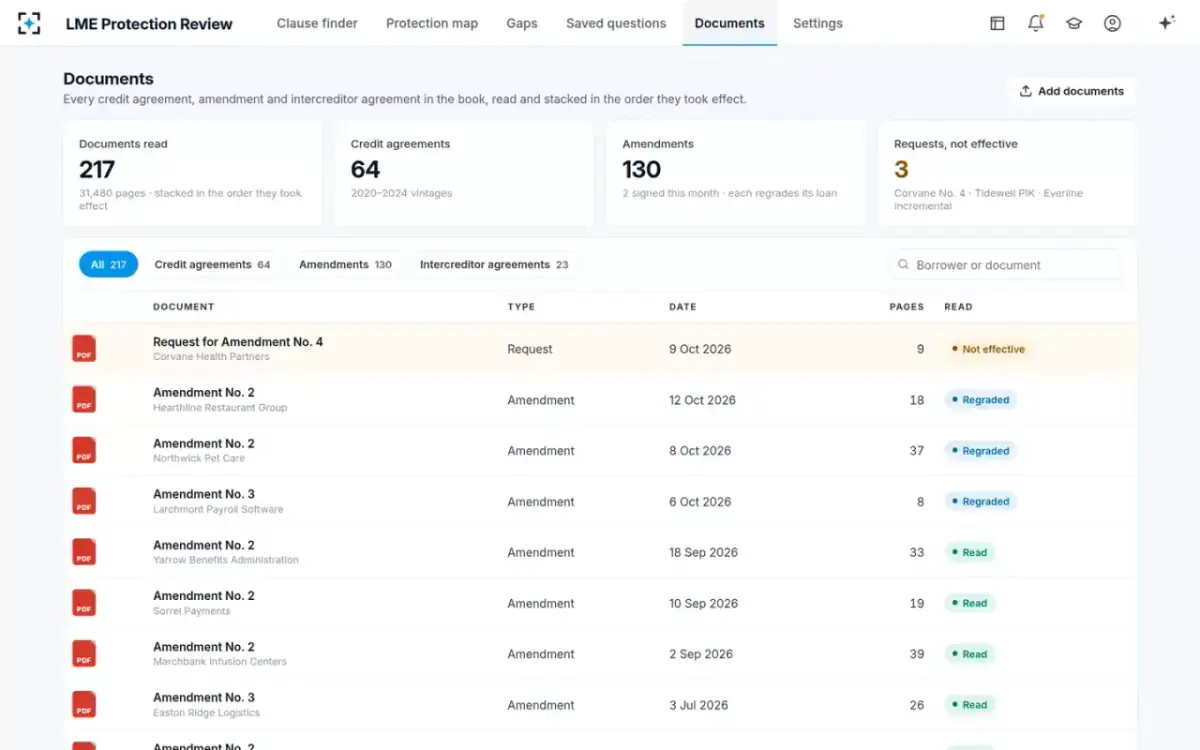
That is the whole argument of this page in one screen. The stack is the asset; the agreement is a view of it on a date. Keep the stack current and the question “which of our loans are open?” is a minute's work. Let it age and the answer you give the investment committee is a statement about the book as it was when someone last read it. To see the stack, the walk and the regrade on a sample of your own agreements, start from LME Protection Review.
Questions people ask
Can an amendment weaken a lender protection without anyone noticing?
Yes, and it usually does not take concealment. An amendment negotiated for one purpose — an incremental facility, a waiver, a new guarantor — can carry a change to an investment basket or a blocker's scope in the same instrument, approved by the lenders whose votes were needed. On the fictional sample book, Amendment No. 2 to Juniper Ridge's agreement replaced a $25.0 million cap on investments in unrestricted subsidiaries with unlimited capacity, and the loan's file still contained the original cap.
What is an amendment and restatement, and when is one used?
An amendment and restatement reissues the entire credit agreement as one consolidated document rather than striking and inserting text in the original. Parties reach for one when the changes are extensive, or when so many amendments have accumulated that reading the agreement requires assembling several documents. For a reviewer it is good news and a trap: the restated document is authoritative from its effective date, but anything dated before it still matters for what was permitted, waived or done in the meantime.
Do all amendments need every lender's consent?
No. Most credit agreements let a simple majority of lenders — the Required Lenders — amend most provisions, and reserve a short list of terms that need every affected lender, or every lender, to agree. Those reserved terms are the ones commonly called sacred rights. Whether a protection sits inside that list or outside it is the difference between a clause a majority can delete and one it cannot.
Does a borrower's request for an amendment change the agreement?
No. A request, a draft or a term sheet is not an operative document, and reading one as though it were is how a review ends up describing a loan that does not exist. In LME Protection Review a request is read and held as pending: it raises a consent alert for the portfolio manager and counsel, and the agreement continues to be graded as amended by signed, effective documents only.
How do private credit funds keep amendment history current?
In most funds, by discipline rather than by system: the deal team files each executed amendment, and whoever next reads the loan reassembles the sequence. That works until the question is asked across the book at once, or until the person who negotiated the amendment has moved on. The alternative is to treat the stack as the record — every document matched to its loan and ordered by effective date — so that the current agreement is derived rather than remembered.
What should a fund do about loans drafted to an older standard?
Catalogue them by vintage and wait for leverage. A protection that was not written at closing is rarely given away for nothing, so the practical plan is to know which loans are weak, keep the model clause ready, and raise it when the borrower next needs a consent, a waiver or an incremental facility. Across the sample book, 11 loans have a consent event approaching, which makes them the loans where an ask costs least.