Sacred rights in a credit agreement are the handful of terms that the Required Lenders cannot change on their own: amending them needs unanimous consent, or at least the consent of every lender the change affects. They are not a legal category and no statute creates them. They are a drafting convention — a list in the amendment section — and the whole of their force comes from the vote they require, not from the words of the clause they protect. That distinction is what separates a protection that survives a determined borrower from one that does not, and it is the first thing LME Protection Review grades when it reads a credit agreement: not whether a blocker exists, but what vote can take it away.
Credit analysts and counsel reach for this question when they own the fund's protection checklist and need a defensible answer to why one blocker is strong and another, which looks almost identical, is weak. The grading standard on this page is a fictional sample fund's own, version 7, approved by its own counsel; it is not a market standard and no two funds write it the same way. The contract language comes from a federal appellate opinion and the market figures from an academic study, both linked where they appear.
What a sacred right actually protects
It protects a term from the majority, and nothing else. A sacred right does not make a covenant wider, does not add a remedy and does not stop the borrower doing anything the covenant already permits. What it does is move one provision out of the ordinary amendment machinery, so that a lender who would be worse off after a change has to agree to it personally.
The list is usually short and usually contains the economics a lender cannot afford to have rewritten without being asked: the principal amount and the interest rate, the maturity date, the pro rata sharing of payments, the release of all or substantially all of the collateral or the guarantees, and — since 2020 — the priority of liens and payments. Everything else is in the gift of whatever threshold the agreement sets for the Required Lenders, which is often a bare majority by amount.
Read that list again from a borrower's side. Every manoeuvre described in this series is an attempt to achieve something on the list by means of something not on it. A drop-down does not release collateral; it moves the asset out from under the collateral. An uptier does not change the interest rate; it changes who gets paid first. The list is the map of where the pressure goes.
Sacred right vs an ordinary covenant: the voting threshold is the whole difference
The same words, two places in the amendment section
An ordinary covenant: The Required Lenders — in many agreements a bare majority by amount of the loans then outstanding.
A sacred right: Every lender, or every lender the change affects. There is no majority large enough to substitute.
An ordinary covenant: Assemble a majority. If the majority wants something, it can be offered something: better paper, a fee, an exit at par.
A sacred right: Persuade the lender who would lose by the change. A lender being primed or stripped is, by definition, that lender.
An ordinary covenant: As much as the borrower would have to pay for the vote, which in a distressed credit is often less than the clause is worth to the minority.
A sacred right: Its face value. The clause cannot be bought away from the people it protects.
An ordinary covenant: Identical. Nothing in the covenant itself says which it is; the answer is in a different section entirely.
A sacred right: Identical. Which is why a review that reads the covenant without reading the amendment section grades the wrong thing.
An ordinary covenant: At best weak, however well the covenant is drafted, where the manoeuvre it defends against can be reached by amendment.
A sacred right: Strong, where the covenant also covers the right assets, the right routes and the right priorities.
This is why presence-and-absence checklists mislead. Two agreements can contain word-for-word the same ratable-sharing provision; in one it is on the unanimous-consent list and in the other it is not, and only one of them protects anybody. The clause looks the same in both. The protection differs completely.
What loan terms typically require unanimous consent?
There is no standard list, but there is a strong convention, and the research shows it moving. Buccola and Nini, studying how syndicated credit agreements changed after the best-documented priming transaction, found that the surge in protection came almost entirely from one addition: "Nearly all of the change was attributable to an increase in the frequency of contracts that made loan priority a 'sacred right' requiring unanimous approval to change" (Buccola and Nini). A market added one item to the list, and three-quarters of loans ended up blocking a manoeuvre that forty per cent of them had blocked a year before.
What usually sits on the list, and what a borrower can do if it does not
| Term | Why it is normally protected | What a majority could do if it were not |
|---|---|---|
| Principal, interest and maturity | The core economics of the loan; a lender cannot be made to lend more, for longer, for less, without agreeing. | Extend the maturity past the point where a minority lender could exit, or cut the rate it is paid. |
| Pro rata sharing of payments | The rule that keeps a syndicate a syndicate: the borrower may not choose whom to repay. | Permit the borrower to repay a favoured group in full while others wait. |
| Lien and payment priority | The addition the market made after 2020; the one change that reliably closes the priming route. | Authorise new super-priority debt and allow the consenting group to exchange into it. |
| Release of all or substantially all collateral or guarantees | A release of everything is economically the same as cancelling the security. | Release the guarantees of the subsidiaries that hold the value, leaving a claim on a holding company. |
| The definition of Required Lenders itself | Without it, the threshold can be redefined before it is used. | Lower the threshold, or add lenders whose only purpose is to carry the vote. |
| The sacred-rights list | A list a majority can shorten is not a list. | Delete an item, then do the thing the item prevented. |
The last two rows are where a careful reader earns their fee. A sacred-rights list that can be amended by the Required Lenders is a two-step problem rather than a defence, and a Required Lenders definition that can be changed by the Required Lenders is the same problem wearing a different hat.
How the Fifth Circuit read one sacred right, clause by clause
The clearest judicial description of how the pairing works comes from the appellate decision on a 2020 priming exchange. The court did not treat the ratable-sharing provision as self-executing protection; it read it together with the voting provision that guarded it.
To further protect the sacred right of pro-rata sharing, §9.02(b)(A) generally requires unanimous consent of any affected lender to waive, amend, or modify §2.18 in any way that would "alter the pro rata sharing of payments… required thereby."
U.S. Court of Appeals for the Fifth Circuit, In re Serta Simmons Bedding
And then the sentence that states the structure in general terms: "while most provisions of the 2016 Agreement can be changed with the approval of SSB and a simple majority of its lenders, the ratable sharing provision in §2.18 is singled out for special protection" (In re Serta Simmons Bedding, 5th Cir., 14 February 2025).
Two sections, one protection: what each half contributes
The substance
The ratable-sharing provision
Each borrowing, each payment or prepayment of principal, each payment of interest and each conversion is allocated among the lenders in proportion to what each holds. As the court put it, the borrower "cannot choose to pay its obligations to one lender while offering nothing to the rest".
On its own: a default rule, amendable like any other term.
The threshold
The unanimous-consent requirement
The amendment section singles the ratable-sharing provision out, requiring the consent of any affected lender to waive, amend or modify it in any way that would alter the pro rata sharing of payments it requires.
Together with the substance: a protection a bare majority cannot sell.
Three ways a sacred right still fails: scope, route, and carve-out
A term on the unanimous-consent list can still leave the lender exposed, and the failures fall into three groups. Scope: the protected provision does not reach the thing the borrower does. A sacred right over lien priority says nothing about the order in which cash is applied, so a borrower that changes payment priority has not touched the protected term at all.
Route: the provision reaches the result but not the path. A blocker on transfers to an unrestricted subsidiary does not reach a transfer to a restricted subsidiary that is not a guarantor, and it does not reach designating an entity that already holds the asset. The protected term is intact; the value has gone anyway.
Carve-out: the provision reaches the result and the path, and an exception lets the borrower through. This is the failure the appellate decision above turned on — ratable sharing was protected, and the transaction claimed an undefined exception to it. The protection was never breached; it was routed around, and establishing that took four and a half years. The detail of that argument is in the Serta ruling and the open-market purchase fight.
What makes a blocker "weak" instead of "missing"?
Missing is an easy finding and a comfortable one: there is no clause, nobody is confused, and the gap goes straight onto the list of things to ask for. Weak is the finding that does the work. A weak blocker is a clause that exists, sits in the right section, uses the right vocabulary — and fails at least one of the questions the fund's standard asks of it.
The three grades LME Protection Review gives, and what each means on a loan
| Grade | What it means | What it looks like in practice |
|---|---|---|
| Strong | The clause meets every element of the fund’s standard for that protection, and the vote needed to change it is unanimous or affected-lender. | A drop-down blocker covering all material assets, both transfer and designation, by any route, that a majority cannot amend. |
| Weak | The clause exists but is narrowed in scope, route or carve-out, or it is not a sacred right. | A drop-down blocker limited to intellectual property with no designation prong; a priming blocker that protects liens but not payment; any of them amendable by the Required Lenders. |
| Missing | There is no clause of that family in the agreement as amended. | Nothing to grade. The loan goes onto the gap list, and the ask is drafted from the fund’s model clause. |
The practical value of the middle grade is that it is actionable. "Missing" tells a portfolio manager to ask for a clause. "Weak, because the definition covers only intellectual property and this borrower's value is in its services contracts" tells them what to ask for, in what words, and why the borrower's counsel will say the existing clause is adequate.
A weak grade in LME Protection Review, with the reason and the model clause
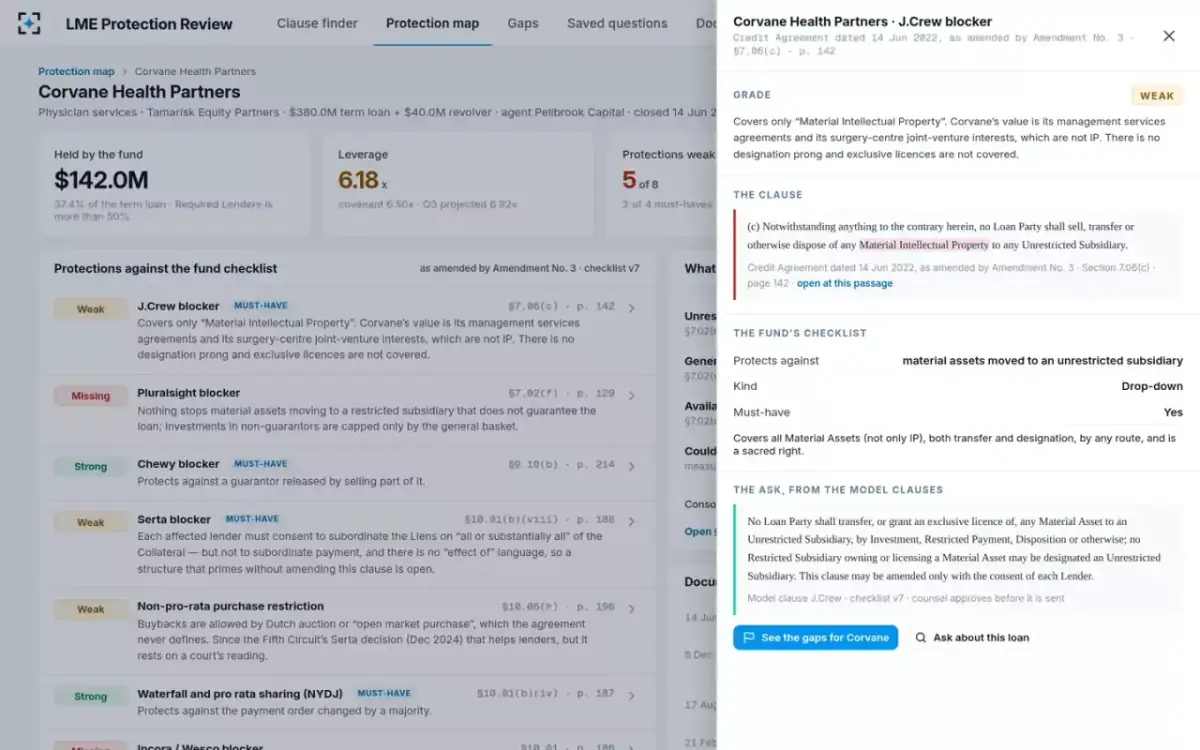
This is the first failure in the list above — narrowed in scope. The clause is in the right place and does the wrong job.
Can a majority of lenders waive a sacred right the minority relies on?
Not for the lenders it affects, which is the whole point of the device. A waiver of an affected-lender term by the Required Lenders alone is not effective against the lenders who did not consent; their position under that provision is unchanged. That is why the drafting convention spread so fast once the market decided to close the priming route.
Two qualifications belong next to that answer. First, a majority can usually waive or amend anything else, including the provisions a sacred right depends on to function — which is why the rubric asks what vote protects the protection. Second, a lender who takes the money and signs the amendment has consented, whatever it says afterwards; a supermajority can be assembled by offering the lenders who will accept something the rest are not offered, and that is a commercial fact a voting threshold does not change.
Building a grading rubric instead of a yes/no checklist
A rubric is a written standard that produces the same grade whoever applies it, and it is worth the effort for one reason: a protection review is only useful if last quarter's grades can be compared with this quarter's. Four things make a rubric work. Each protection is defined by what a strong version must contain, element by element, so that strong is a test rather than an impression. Each grade carries its reason in the same vocabulary as the elements. Every grade quotes the clause it rests on, with document, section and page. And the standard is versioned, owned by counsel, and regrades the whole book when it changes.
The fund's own standard, versioned and owned by counsel
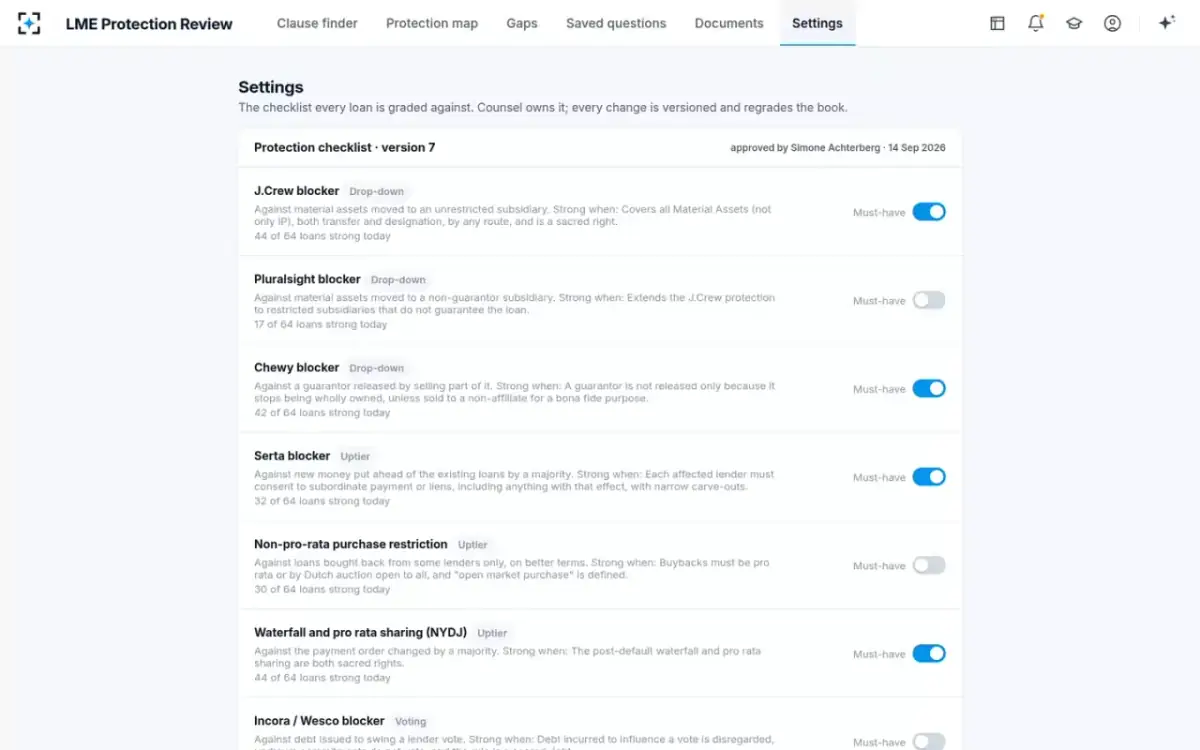
That ownership matters more than it sounds. The Financial Stability Board's 2026 review of private credit observed that "valuation practices and limited data transparency pose challenges" in this market and that "the relative opacity of private credit cannot be easily resolved" (FSB, Vulnerabilities in Private Credit). A grading standard that is written down, versioned and applied identically across a book is one of the few things a manager can do about opacity in its own portfolio, which is a reason to treat the rubric as a governance document rather than a convenience.
Why the same clause can be strong in one agreement and weak in the next
Because the clause is not the unit of protection. Four things outside it decide what it does: the defined terms it uses, which may be narrower in this agreement than in the last one; the vote that can change it, which lives in a different section; the exceptions that sit beside it, which may swallow it; and the amendments signed since, which may have widened a basket the clause depends on without touching the clause itself.
There is a fifth, and it is the borrower. A drop-down blocker limited to intellectual property is a genuine protection for a business whose value is its brands and close to worthless for one whose value is its contracts. A grading standard that ignores what the borrower actually owns will record both as the same, and the one that matters will be wrong.
So the grading question is always a sentence, never a tick: does this clause, as amended, with these defined terms, protected by this vote, and against this borrower's assets, stop the move it is named after? The J.Crew blocker and the uptier are the two cases where the answer matters most. To see the grades, the clause behind each one and the standard they are measured against, start from LME Protection Review.
Questions people ask
Are sacred rights a legal term?
No. They are market shorthand for the short list of provisions a credit agreement singles out for a higher amendment threshold, and the phrase appears in the documents and the case law only by way of description. The Fifth Circuit used it that way when it said an agreement "protects the sacred right of pro-rata sharing" — it was describing where the provision sat in the voting structure, not applying a rule of law.
What is the difference between majority and unanimous consent clauses?
A majority-consent clause lets the Required Lenders — often a bare majority by amount — amend or waive a term on behalf of everyone, including lenders who voted against. A unanimous-consent clause requires every lender, or every lender affected by the change, to agree. The first is a term a borrower can buy; the second is one it has to negotiate with the person who would lose by it.
How do you grade a protection as strong, weak or missing?
Against a written standard that says what a strong version of that protection must contain. Strong means every element is met and the term cannot be changed by a majority. Weak means the clause exists but is narrowed in scope, route or carve-out, or is not a sacred right. Missing means there is no clause of that family in the agreement as amended. Each grade carries its reason and the clause it rests on, so the grade can be argued with rather than believed.
What is a carve-out in a credit agreement?
An express exception to a covenant or a restriction — a basket, a permitted-lien category, a repurchase exception. Carve-outs are ordinary and necessary; a credit agreement with no exceptions would stop the borrower operating. They become a grading problem when one of them is wide enough, or vague enough, that the restriction it sits under no longer restricts anything, which is how a protection can fail without ever being breached.
Can a blocker be strong and still leave us exposed?
Yes, in two ways. A strong drop-down blocker does nothing about priming, and a strong priming blocker does nothing about assets leaving the group — the protections are independent and have to be graded separately. And a protection that is strong today can be weakened tomorrow by an amendment to a basket or a definition it depends on, which is why a grade is only as current as the last document applied to the agreement.
Who should own the grading standard?
Counsel, with the portfolio team. The standard is a legal reading of what a clause must contain, so it needs a lawyer's sign-off; it is also a statement of the fund's risk appetite, so it needs the people who own the book. On the sample fund here the checklist is version 7, approved by its deputy general counsel, with five of the eight protections marked as must-haves — and every earlier version kept, because a grade means nothing without knowing which standard produced it.