A liability management exercise, or LME, is a transaction in which a borrower in trouble improves its own position at some of its lenders' expense, using permissions its credit agreement already contains. No court approves it, no bankruptcy is filed, and in most cases no lender outside the consenting majority is asked. The two common shapes are the drop-down, which moves valuable assets to a subsidiary the lenders have no claim on, and the uptier, which puts new money ahead of the existing loans. Whether either one is available is not a question of fairness or market practice; it is a question of what the agreement, as amended, happens to permit. LME Protection Review is Botminds' agentic solution for that question: it reads every credit agreement in a book as amended, grades the clauses that block each manoeuvre, and shows the clause and page behind every grade.
That is the part practitioners find hardest. The defences are a handful of named clauses — the J.Crew, Pluralsight, Chewy, Serta, Incora and At Home blockers, the open-market purchase language and the waterfall — and each can be drafted tightly, narrowed until it does almost nothing, or left out altogether. Knowing which of your loans are open means rereading every agreement and every amendment in order, following every defined term to its source. The sample figures on this page come from a fictional book inside the solution: Marrowstone Credit Partners, 64 loans, $4.02 billion held. The people, funds, borrowers and sponsors named are invented. The research figures come from academic and court sources, linked where they appear.
What the loan market did after each manoeuvre
40→75%
of loans blocking uptiers, in the year after the Serta transaction
Little
change in the frequency of loans blocking drop-downs in the years after J.Crew
$1.5–2tn
private credit lending outstanding at the end of 2024, on the Financial Stability Board estimate
What a liability management exercise actually is
Strip away the label and an LME is a borrower exercising contractual permissions in a sequence nobody drafting the agreement expected to see used together. Each step, taken alone, is ordinary: designating a subsidiary, making an investment in it, amending a definition with the consent of the Required Lenders, repurchasing loans under an exception to pro rata sharing. Strung together under pressure, the same steps move the economics of the credit from one group of lenders to another.
Three features distinguish an LME from the restructurings that came before it. It is consensual on its face — the borrower points at a clause rather than at a statute. It is non-unanimous — it needs a majority or a supermajority, not everyone. And it is pre-insolvency: it happens while the borrower still controls the documents and the timetable, which is precisely when a lender's leverage is lowest. The Financial Stability Board, surveying private credit in 2026, noted that default rates among private credit borrowers "are low but are showing an upward trend when using broader measures, such as selective defaults and distressed exchanges" (FSB, Vulnerabilities in Private Credit). An LME is one of the manoeuvres that sits inside that broader measure and outside the narrow one.
For a lender the practical consequence is uncomfortable. By the time an LME is announced, the argument about whether it was permitted is already an argument about documents signed years earlier, and the lender holding the weaker paper has lost before the discussion starts.
The two shapes an LME takes: drop-down and uptier
Almost every LME is one of two moves, or both in sequence. A drop-down attacks the collateral: value leaves the group of companies the lenders can reach. An uptier attacks the priority: the lenders keep their claim on the same assets but find other claims sitting in front of them. The distinction matters because the clauses that stop each one live in different parts of the agreement and are negotiated by different people.
A drop-down and an uptier, side by side
Drop-down: Assets. Intellectual property, contracts, joint-venture interests or whole business lines leave the credit group for an unrestricted or non-guarantor subsidiary.
Uptier: Priority. The loans stay where they are; new super-priority debt, and a chosen subset of the existing loans, move ahead of everyone else.
Drop-down: Usually nobody outside the borrower. The investment, designation and disposition baskets are self-executing capacity the borrower already has.
Uptier: A majority, or whatever vote the amendment provisions require. The borrower buys that majority by letting it exchange into the new senior paper.
Drop-down: The investment covenant, the definition of Unrestricted Subsidiary, the designation mechanics and any proceeds or Available Amount basket.
Uptier: The amendment and waiver section, the pro rata sharing provision, and any exception that lets the borrower buy back loans non-rateably.
Drop-down: A blocker that covers all material assets, both direct transfer and designation, by any route — and that cannot be amended by a simple majority.
Uptier: Either a ban on discriminatory loan repurchases, or lien and payment priority written as a term that needs unanimous consent to change.
Drop-down: A claim on a group of companies that no longer owns the thing that made the credit worth lending against.
Uptier: The same claim, now structurally and contractually behind debt that did not exist last month.
What is a drop-down transaction?
A drop-down transaction is the transfer of assets out of the group of companies that guarantee and secure the loans, into a subsidiary that does neither, so that the transferred assets can support new borrowing on which the existing lenders have no claim. The vehicle is usually an unrestricted subsidiary: an entity the credit agreement lets the borrower designate as outside the covenant package, so that its assets, debts and earnings sit beyond the lenders' reach.
The capacity to do it is ordinary investment room. Credit agreements permit investments in subsidiaries up to stated baskets, and they permit the borrower to designate subsidiaries as unrestricted subject to conditions. Neither permission looks dangerous on its own. The danger appears when a valuable, hard-to-value asset is the thing invested, and when a second basket can be used to carry value through an intermediate entity rather than directly.
The transaction that gave the move its name did exactly this in December 2016. Buccola and Nini record that J.Crew "announced the transfer of its trademarks to an unrestricted subsidiary in December 2016. It had $250 million of capacity to invest in unrestricted subsidiaries and had received an opinion valuing its intellectual property at $347 million" (Buccola and Nini). The detail of how the capacity was assembled, and why a blocker drafted only against direct transfers does not stop it, is worked through in the J.Crew blocker, and the trap door it was built to close.
What is an uptier transaction?
An uptier transaction is an amendment that creates new super-priority debt and lets a consenting subset of the existing lenders exchange into it, leaving the non-consenting lenders in the same facility but behind. Nothing physically moves. The borrower amends the credit agreement to permit the new debt, and the lenders who agreed to the amendment are the lenders who get to participate in it.
The Fifth Circuit described the mechanics plainly when it came to review one: "The borrower amends the terms of a credit facility to allow the issuance of new super-priority debt. Because a majority of lenders in the existing facility must typically consent to such an amendment, the borrower purchases consent by allowing these lenders to exchange their existing debt for new super-priority debt, often at an above-market price" (In re Serta Simmons Bedding, 5th Cir. 2024). The court added the consequence: "The costs of an uptier transaction are born [sic] entirely by the minority lenders, who end up with subordinated debt worth less than before."
The full mechanics, including the exception a borrower has to find before it can repurchase loans non-rateably at all, are set out in what an uptier transaction is, and how priming works.
Why sponsors reach for an LME before a bankruptcy filing
Bankruptcy is expensive, public and slow, and it takes control of the timetable away from the owner. An LME does none of those things. It needs no court, it can close in weeks, and the sponsor keeps the equity it would otherwise be asked to write off. The Fifth Circuit's survey of the academic literature is blunt about the attraction: the borrower "needs only majority (versus unanimous) consent", which means it "can play lender groups off of each other and avoid the expense of dealing with holdouts", and it can raise fresh liquidity "that might otherwise be available only in and through bankruptcy".
There is a second, quieter reason. Inside a bankruptcy, transfers made while the company was insolvent can be attacked, and the lenders' committee has investigative tools it does not have outside. Doing the transaction while the company is still paying its bills converts a fight about fraudulent transfer into a fight about contract interpretation — and a contract interpretation fight is one the borrower chose the ground for, because the borrower's advisers read the agreement first.
That asymmetry is the whole argument for reading your own documents before the sponsor does. The portfolio manager who already knows which of her loans have a weak blocker is negotiating; the one who finds out from a press release is reacting.
One question across the whole book, instead of one agreement at a time
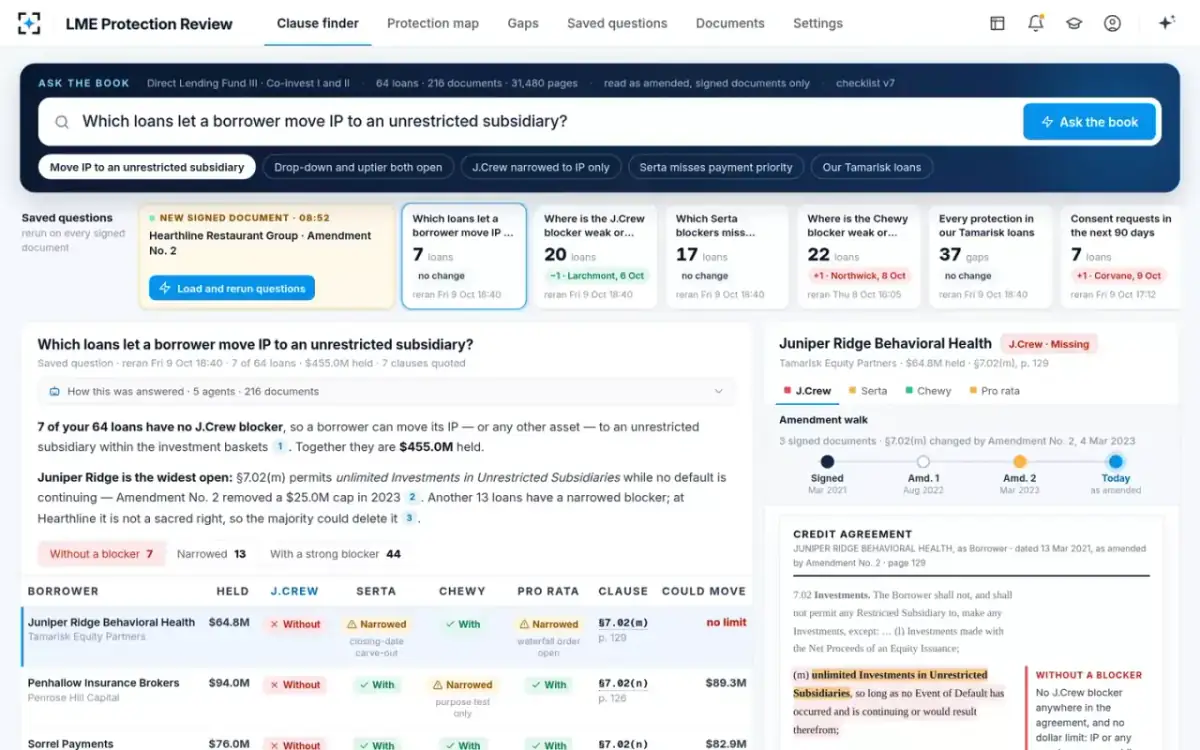
On this sample book the answer to “which of our loans would let the borrower move assets out of our reach and also prime us?” is 11 of 64 loans, $733.4M held, 18.2% of a $4.02B book, with 22 clauses quoted.
Did the loan market fix this after J.Crew and Serta?
Partly, and the asymmetry in which parts got fixed is the single most useful empirical fact a lender can carry into a negotiation. Buccola and Nini studied syndicated credit agreements before and after each transaction and found two very different reactions. After Serta, protection spread fast: "In the year following the Serta transaction, the frequency of loans that block uptiers increased from about 40% to about 75%, suggesting that syndicated loan contracts can adjust rapidly to curtail borrower flexibility if market participants perceive it to be value-destructive."
After J.Crew, almost nothing happened. "Conversely, the frequency of loans that block dropdowns — and the magnitude of vulnerability in loans that do not — changed little in the years following J. Crew," the same paper reports. The authors read the muted reaction as evidence that the flexibility underlying a drop-down is worth something to borrowers and lenders both, even though it can be used badly — and the magnitude of the exposure in the loans that do not block it did not shrink either.
Nine years, two manoeuvres, and one appellate answer
- After J.Crew: dropdown blockers barely moveDec 2016
- After Serta: uptier blockers go 40% to 75%Jun 2020
- Fifth Circuit reverses on open market purchaseDec 2024
Read together, the two findings say something a lender should act on. In the syndicated agreements the study covers, uptier protection was repriced quickly, so the gap is concentrated in paper written before the market reacted. Drop-down protection was not repriced, so the gap can sit in recent paper as easily as in old. Private credit agreements were outside the study, which is a reason to read them rather than assume either result carries over. A fund that assumes both were solved by the market's reaction is wrong about one of them, and it is wrong about the one that is harder to see, because a drop-down leaves the credit agreement untouched while it happens.
The named blockers lenders wrote in response
The defences acquired the names of the transactions that exposed the gaps. The naming is useful shorthand and a trap at the same time: two agreements can both be said to have a J.Crew blocker and protect their lenders to completely different degrees. A checklist that records presence rather than strength is a checklist that will be wrong in the only situation it exists for.
The eight protections LME Protection Review grades, and what each defends
| Protection | The move it defends against | The question that decides whether it works |
|---|---|---|
| J.Crew blocker | Transferring material assets to an unrestricted subsidiary. | Does it cover all material assets or only intellectual property, and does it reach designation as well as transfer? |
| Pluralsight blocker | Routing the same value through a non-guarantor restricted subsidiary instead. | Does it follow the asset by any route, or only the one route the drafter had in mind? |
| Chewy blocker | Releasing a subsidiary’s guarantee by making it no longer wholly owned, for example by transferring a minority stake in it. | Does a guarantor stay bound when it merely ceases to be wholly owned, or only when it is sold outright? |
| Serta blocker | Subordinating the existing loans in a non-pro-rata exchange. | Does it protect payment priority as well as lien priority? |
| Open-market purchase language | Using a repurchase exception to buy back loans from a chosen few. | Is the term defined in the agreement, or left to a court to construe? |
| Waterfall | Rewriting the order in which proceeds are applied. | Can the order be changed by the Required Lenders, or does it need everyone? |
| Incora blocker | Adding new lenders solely to manufacture the vote the amendment needs. | Does debt issued to swing a vote get to vote? |
| At Home blocker | Combining the above into a single, staged transaction. | Is each prong independent, so defeating one does not open the rest? |
Only two of the eight have the public record this guide can rest on: the drop-down route J.Crew used, documented in the academic study above, and the uptier route Serta used, now the subject of an appellate opinion. The other six are named after transactions that practitioners discuss but that are not described in any court record or academic study, so they appear here as clause families on a checklist, not as case studies.
What "creditor on creditor violence" means, and why the name stuck
The phrase describes the defining feature of an LME: the value does not come out of the sponsor's pocket or the borrower's operations, it comes out of the other lenders. In a conventional restructuring, creditors as a class give something up to a company that cannot pay. In an LME, one group of creditors is made better off exactly to the extent another group is made worse off, and the borrower's role is to supply the document that lets it happen.
The Fifth Circuit collected the names the literature has given the practice: critics call uptiers a zero-sum game of "lender-on-lender violence", "a cannibalistic assault by one group of lenders … against another", "hostile restructurings", "acts of financial war" and "unthinkable under pre-pandemic commercial norms". The court recorded the epithets without adopting them, which is the right posture for a lender too. The name is a description of the economics, not a legal test, and a clause does not become unenforceable because the result it permits is ugly.
What the name does usefully capture is who is in the room. An LME is decided between the borrower and the lenders who are asked; everyone else learns about it afterwards. Whether a fund is asked depends on the size of its position and on how quickly it can say what it holds and what its documents permit — which is a reason to know the answer before the phone rings.
Reading the clause instead of waiting for a court to read it for you
The Serta appeal shows how long the alternative takes. The transaction closed in June 2020. The bankruptcy court held that the term "open market purchase" was clear and unambiguous and that the exchange qualified. The Fifth Circuit disagreed, holding on 31 December 2024, in an opinion revised on 14 February 2025, that "the 2020 Uptier was not a permissible open market purchase within the meaning of the 2016 Agreement" and reversing. Between the exchange and the answer sat nearly five years, a Chapter 11 case and an appeal — and the answer binds only within one circuit. What the Fifth Circuit actually decided, and why an open market has to be open, takes the reasoning clause by clause.
The practical alternative is to grade every agreement you hold, now, against a written standard, and to know which gaps matter. That is mechanical work of a specific kind: apply every amendment in the order it took effect, follow each defined term to its definition, compare the clause as it now reads against what the fund says a strong version must contain, and quote the clause behind every conclusion. On the sample book that means 64 loans, 129 amendments, 216 documents and 31,480 pages, each amendment applied in the order it took effect. It is the work LME Protection Review does with specialist agents and a named person deciding what to raise.
Inside LME Protection Review: reading 216 documents as amended
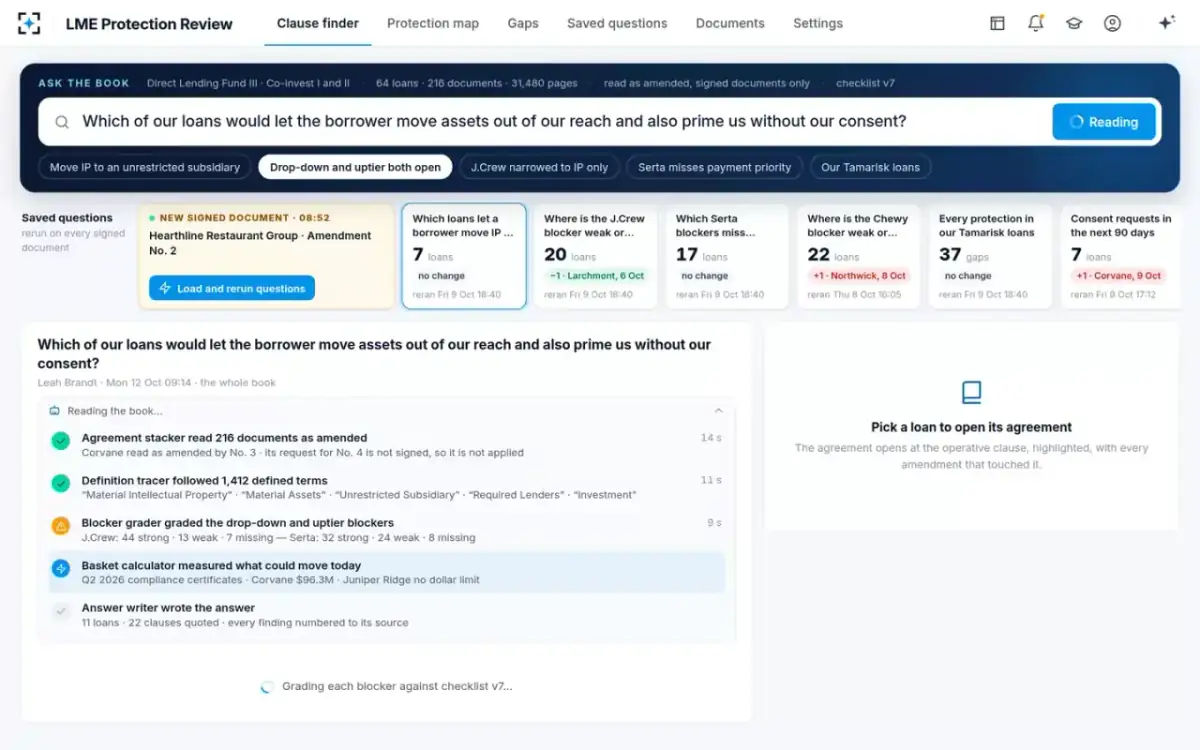
The grading is the fund's own, not ours, and it belongs to counsel — which is the subject of sacred rights, and how a grader tells a strong blocker from a weak one. To see the clause finder, the protection map and the amendment walk on real documents, start from LME Protection Review.
Questions people ask
What does LME mean in finance?
LME stands for liability management exercise: a transaction in which a borrower restructures its debt outside bankruptcy using permissions its existing credit agreement already contains. In the leveraged loan and private credit markets it almost always means a drop-down, an uptier, or the two combined. It is unrelated to the metals exchange of the same initials.
Is a liability management exercise the same as a default?
No, and that is the point of doing one. An LME is structured so that each step is permitted by the agreement, so there is no event of default to declare and no acceleration right to exercise. A rating agency may treat a particularly coercive exchange as a distressed exchange, and the Financial Stability Board notes that such broader measures show private credit default rates trending upward even while narrow measures stay low — but the lender who was left behind usually has a contract claim to argue, not a default to call.
How common are liability management exercises?
No regulator or independent study counts them directly, and the figures circulating in trade press cannot be checked against one, so this guide does not repeat them. What the academic record does establish is that the market treated the risk as real enough to repaper itself: uptier blockers went from roughly 40% to roughly 75% of syndicated loans within a year of the Serta transaction. Lenders do not rewrite three-quarters of a market's documents over a hypothetical.
Can a majority of lenders authorise an LME without the rest?
For an uptier, usually yes — that is why the manoeuvre exists. Most terms of a credit agreement can be amended by the Required Lenders, and the borrower buys that majority by letting it exchange into the new senior debt. The exceptions are the terms the agreement singles out as needing unanimous or affected-lender consent, which is why where pro rata sharing and lien priority sit in the voting structure matters more than any other drafting question in an uptier.
Does a drop-down need lender consent at all?
Often none. A drop-down generally uses capacity the borrower already has: an investment basket, the right to designate a subsidiary as unrestricted, and sometimes a second basket that lets value travel indirectly. If the blockers are narrow, the first a lender hears of it may be an announcement. That is the asymmetry a protection review is meant to close, by telling the lender what its own documents permit before the borrower tells it.
Why do private equity sponsors run liability management exercises?
Because the alternative usually costs them their equity. A bankruptcy filing hands the timetable and often the company to the creditors; an LME keeps both with the sponsor, raises new money, and shifts the loss onto whichever lenders were not invited. The Fifth Circuit's survey of the literature notes the same incentives from the borrower's side: majority rather than unanimous consent, no holdout premium, and liquidity that would otherwise be available only in and through bankruptcy.