Credit agreement review software implementation is less a technology project than a document and authority project. Everything the work needs already exists inside the fund — the credit agreements and their amendments, the intercreditor agreements, the position list, the compliance certificates, and counsel's own view of what a strong lender protection looks like — and the rollout is mostly the business of getting those five things into one place, agreeing who owns the standard, and proving the output on loans whose answers are already known. LME Protection Review, Botminds' software for private credit funds, is designed to go live in that order, and this guide sets out the sequence rather than a timeline, because the honest answer to “how long” depends on how your documents are filed today.
The examples come from a fictional sample book inside the solution: Marrowstone Credit Partners, 64 loans, 216 documents, 129 amendments, $4.02 billion held across one direct lending fund and two co-invest vehicles. Supervisory material is quoted from the agencies' and NIST's own publications, linked where it appears.
Credit agreement review software implementation, in the order it actually happens
The order matters more than the calendar, because each step produces the input the next one needs. Load documents before you argue about the standard and counsel will be grading in the abstract; agree the standard before the documents are in and nobody can test whether it is written precisely enough to apply.
Six stages, what each produces, and who has to be in the room
| Stage | What happens | Who is needed | What proves it is done |
|---|---|---|---|
| 1. Bring the documents | Credit agreements, amendments, waivers, consents, joinders and intercreditor agreements, matched to their loans. | Whoever holds the deal files; operations. | A coverage report: documents applied, documents held as pending, documents unmatched. |
| 2. Bring the position list | What the fund holds in each loan, by vehicle, with the loans the review is scoped to. | Operations, fund accounting. | Counts of loans can be stated in dollars held. |
| 3. Write the standard | The protection checklist: each protection, the elements that make it strong, and which are must-have. | In-house counsel, with underwriting. | A dated version, approved, with the model clause for each ask. |
| 4. Pilot on closed files | Questions whose answers the fund already knows, run against the loaded book. | Portfolio management and counsel, reading the output. | Findings reread against the agreements; disagreements explained. |
| 5. Decide the settings | Scope, which documents count, which earnings figure the baskets use, what triggers an alert. | Counsel and the head of portfolio management. | Settings recorded, with the reason for each. |
| 6. First live question | A real consent request answered from the book, with the asks going through the normal approval. | The portfolio manager who owns the loan; counsel. | An ask that left the fund, approved, with its clause attached. |
What documents do you need to start using credit agreement software?
Five inputs, and one of them is not a document at all. The list is short enough to send to the deal teams as it stands.
What a pilot needs before the first question can run
- Credit agreements and every amendment
PDFs, scans or Word. Each one matched to its loan and stacked in the order it took effect — waivers, consents and joinders included, not only the documents titled “Amendment”.
- Intercreditor agreements
Read beside the credit agreement they sit with. A priority protection in the credit agreement can be qualified by what the intercreditor says about enforcement and payment.
- The position list
What the fund holds in each loan, by vehicle. Without it the answers are counts of loans rather than exposure, and a committee cannot act on counts.
- Compliance certificates
They supply the earnings figure the basket arithmetic uses. The most recent certificate per borrower is enough to start.
- The protection checklist and model clauses
The fund's own standard for what counts as strong, and the drafting it would ask for. If it exists only in counsel's head, writing it down is stage three of the rollout.
The fifth item is the one that stalls rollouts, and it stalls them for a good reason: writing down what makes a protection strong forces decisions a fund has been making case by case. Is a blocker that covers intellectual property but not contracts strong, weak, or weak only for certain borrowers? Does a protection that is not on the list of terms requiring every lender's consent count as strong at all? Those are the questions the grading rubric works through, and answering them is worth doing whether or not software is involved.
Why the position list has to arrive with the agreements, not after
It is tempting to treat the position list as administrative tidying to be done once the interesting part works. It is not. Every output that matters is weighted by it: 11 of 64 loans open to both moves is a fact about documents, while $733.4 million held and 18.2% of the book is a fact an investment committee can act on. The same is true in reverse — a weak protection on a $4 million residual position and a weak protection on a $142 million hold are the same grade and entirely different problems.
The list also fixes the scope question. On the sample fund the answers cover Direct Lending Fund III and two co-invest vehicles, which is a decision with consequences: a loan held in a vehicle outside the scope will not appear in any count, and someone has to have decided that deliberately rather than discovered it later.
How do you load existing loans into monitoring software?
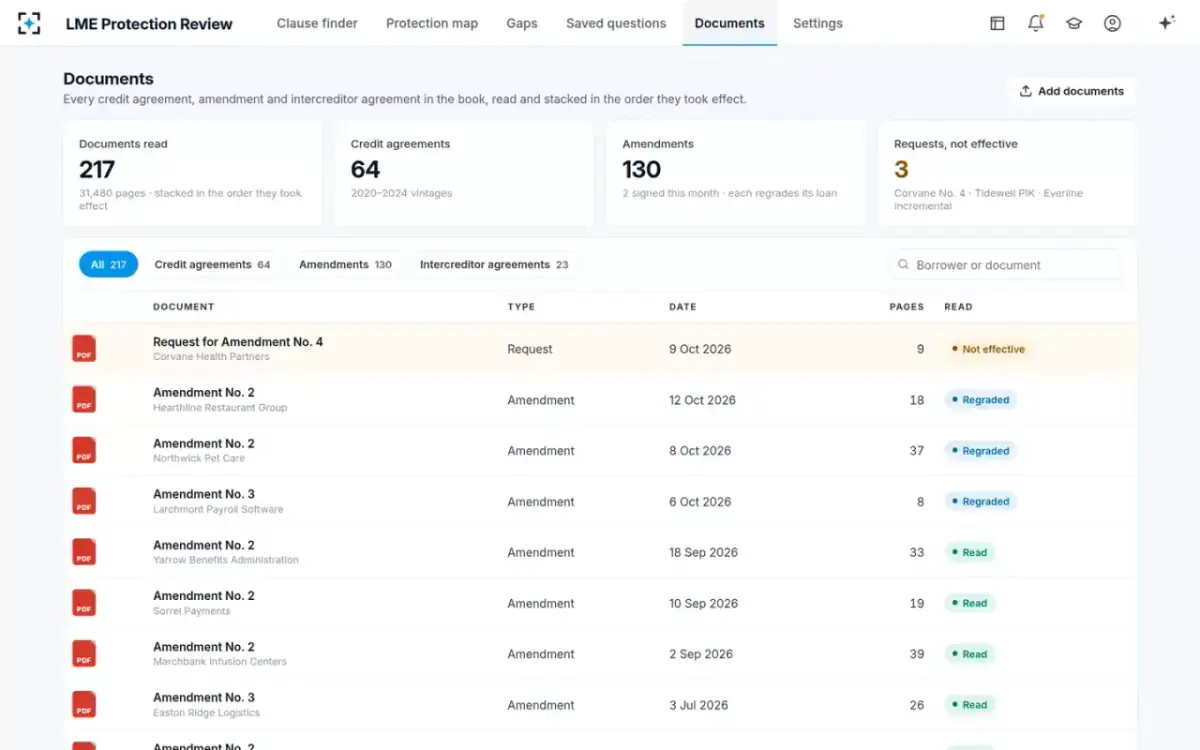
Loan by loan, document by document, with the matching visible rather than assumed. The practical sequence is to load everything the fund has for a loan — original agreement, every amendment in any order, the intercreditor agreement — and let the stacking be derived from the documents' own effective dates rather than from folder names. What comes back is a coverage statement: which documents were applied, which could not be matched to a loan, which are scanned too poorly to read, and which are requests rather than signed instruments.
That first coverage report is the most useful artefact of the whole rollout, and most funds find something in it. A missing amendment that was executed but never filed. A joinder under a borrower name that changed after an acquisition. A document stored against the wrong loan. None of those are software problems; all of them were already true, and had been silently shaping every answer anyone gave about those loans.
Loading the book into LME Protection Review: every document, with the ones not yet operative kept apart
What a pilot on your own closed files should prove
A pilot is not a demonstration with your logo on it. Its purpose is to test the tool where the answer is already known, so that a disagreement is informative. Choose loans the fund has recently worked: a consent request answered last quarter, a loan that went through a restructuring, two agreements counsel has read closely this year. Then ask the questions whose answers are on file.
NIST's framework states the general version of this requirement for any system before deployment: “The AI system to be deployed is demonstrated to be valid and reliable. Limitations of the generalizability beyond the conditions under which the technology was developed are documented.” The same framework warns that measurements taken in a controlled setting “may differ from risks that emerge in operational, real-world settings” — which is precisely why the pilot has to run on the fund's own documents, including the badly scanned ones.
Four things a pilot should establish, in order of how often they are skipped: that the clause quoted in a finding exists and says what the finding says; that the stacking is right on a loan with a restatement or an undated waiver; that the grades follow from counsel's written standard rather than from a general sense of market practice; and that a question about a protection the agreement does not contain returns an absence, not a description. The first and the last are testable in an afternoon.
Who needs to be involved in a monitoring software rollout?
Three seats are non-negotiable and the rest can be consulted. In-house counsel has to own the checklist, because every grade is a comparison against it. The head of portfolio management has to own the scope and the settings, because they determine which loans are answered for. A portfolio manager who actually holds loans has to run the pilot questions, because only someone who owns a credit can tell the difference between a finding that is technically right and one that is useful.
Operations and the deal teams are needed for stages one and two, and underwriting should be in the room for stage three — not because it owns the standard, but because the standard it writes into new term sheets should be the same one the book is graded against. Who owns what afterwards is set out in the five seats that carry LME risk.
What quality checks should pass before go-live
“Go-live” for this work has a precise meaning: the point at which an answer from the system is allowed to inform something the fund says or does externally. Before that point, a short list of conditions should be true and recorded.
Seven conditions before an answer is allowed to leave the fund
- Coverage is stated and the exceptions are closed
Every document matched to a loan, or explicitly listed as unmatched. An answer drawn from an incomplete book should say so.
- The checklist version in force is the one counsel approved
Dated, with the elements written out for each protection, and the must-have subset chosen deliberately.
- A sample of findings has been reread against the agreements
By someone who can read them. The test is whether the grade follows from the quoted clause, not whether it feels right.
- The stacking is right on the hard loans
At least one restatement, one waiver without an expiry on its face, and one loan with an unsigned request pending.
- The scope is recorded
Which vehicles and which loans the answers cover, decided rather than inherited from whatever was loaded first.
- The approval path is agreed in writing
Who decides an ask will be made, who approves the drafting, and the rule that nothing reaches a borrower, an administrative agent or a sponsor before both.
- The standing questions are set, with their alerts
The questions the fund wants re-answered whenever a document arrives, and who is told when a result changes.
How a checklist version gets approved, and then regrades the book
The checklist is a living document, and the mechanics of changing it are part of the rollout rather than an afterthought. A change — adding an element to a protection, promoting one to must-have — is proposed, approved by counsel, and saved as a new version. The whole book is then regraded against it, and the difference from the previous version is readable: these loans moved from strong to weak because the standard now requires the designation route to be covered, not because anything happened to the loans.
Keeping both facts distinguishable is the entire reason for versioning. A fund that regrades without versions loses the ability to answer the only question an investment committee will ask about a changed number: did the book get worse, or did we get stricter?
What ongoing monitoring looks like after go-live
The relationship does not end at go-live; it changes shape. The federal banking agencies, writing about any third party performing work an institution would otherwise do itself, put the principle in a sentence that transfers cleanly even though the rule does not bind a private credit fund.
Effective third-party risk management includes ongoing monitoring throughout the duration of a third-party relationship, commensurate with the level of risk and complexity of the relationship and the activity performed by the third party.
Federal Reserve, FDIC and OCC, Interagency Guidance on Third-Party Relationships: Risk Management, 88 FR 37920, 9 June 2023
In practice, after go-live the monitoring is partly the fund's and partly the system's. The fund's part is a periodic reread of a sample of findings and a log of what counsel corrected. The system's part runs continuously, and is the reason a book stays current between reviews.
What happens when a signed amendment arrives
Agent
Amendment watcherPicks up the newly signed document and places it in the loan's stack at its effective date.
Never: marks a gap closed until the amendment is signed and effective
Agent
Agreement stacker and blocker graderRestack the loan as amended and regrade every protection against the checklist version in force.
Agent
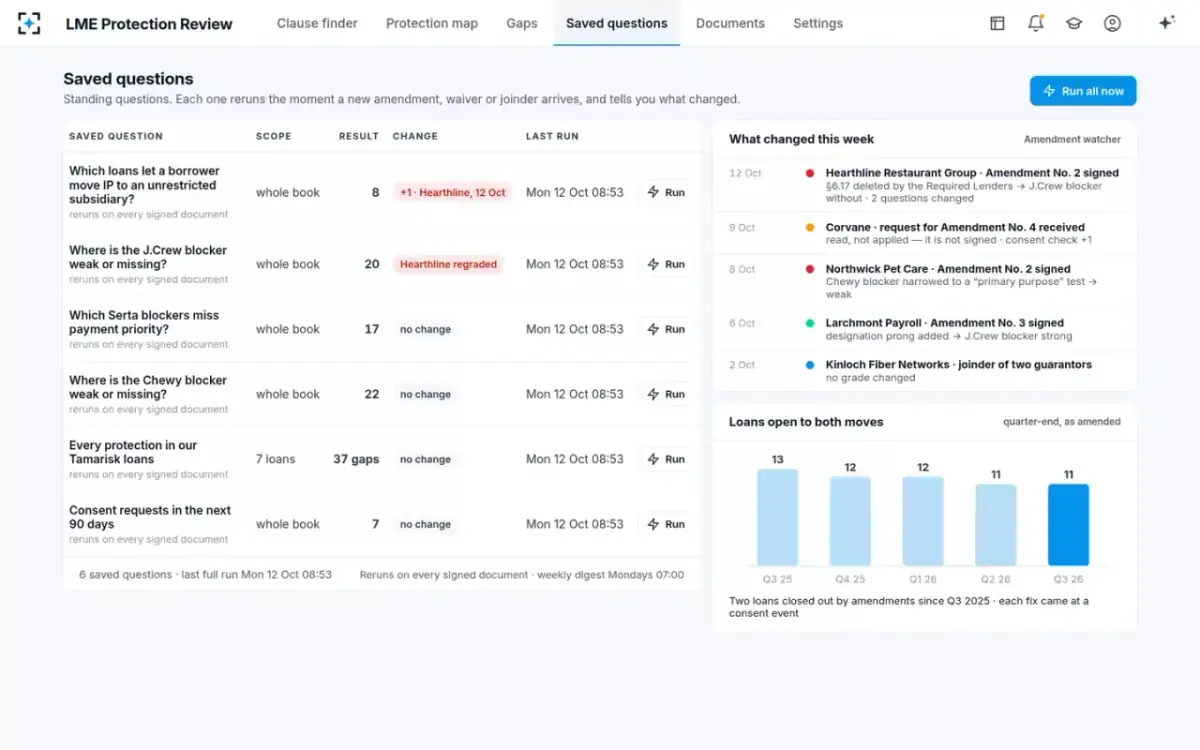
Standing questionsRun again across the whole book; the ones whose result changed are marked as changed, with what moved.
A person decides
Portfolio manager and counselRead what changed and decide whether it needs an action — a call, an ask on the next consent, a note to the committee.
Standing questions in LME Protection Review: the current answer, and what moved
What changes in week one, and what changes by month three
The early benefit and the lasting benefit are different, and setting expectations about which is which prevents a rollout being judged on the wrong one.
The first answers, and what the work becomes once the book is current
Week one, on a loaded book: One backlog question everybody already wanted answered: which of our loans lack this protection?
By the third month: Standing questions re-answered on every new document, plus whatever this week's consent request raises.
Week one, on a loaded book: Missing documents, loans whose protections nobody had graded, one or two genuine surprises.
By the third month: Drift: a loan whose grade moved because an amendment changed it, not because the standard changed.
Week one, on a loaded book: Loading, matching and arguing productively about the checklist.
By the third month: Reading what changed, and deciding what to raise on the next consent.
Week one, on a loaded book: Writes the standard down for the first time, and rereads a sample of findings.
By the third month: Approves drafting for asks, and the occasional new checklist version.
Week one, on a loaded book: A first map of the book, with the gaps and the exceptions named.
By the third month: A map that moved, with the reason for each move attached.
There is a wider reason the second column matters. Reviewing vulnerabilities in private credit in May 2026, the Financial Stability Board observed that “data gaps often hinder the monitoring of concentration in private credit and interconnectedness among private equity firms, insurance companies, and pension funds” (Financial Stability Board). Supervisors cannot close those gaps from outside the market. A fund can close its own, loan by loan, and the closing is not a one-time exercise — it is a document stack kept current.
To see the loading, the pilot and the rerun loop on a sample of your own credit agreements and amendments, start from LME Protection Review. What to ask before you choose any tool for this work, including this one, is set out in the evaluation guide.
Questions people ask
How long does it take to go live on credit agreement software?
It depends almost entirely on two things that have nothing to do with software: how your documents are filed, and how quickly counsel can write down the protection standard. A fund whose amendments are already matched to their loans and whose counsel has a checklist is a different project from one where both have to be assembled. Rather than quoting a duration, ask a vendor to describe the sequence and to tell you which stage usually takes longest for a book like yours.
Can you test the software on last quarter's questions first?
Yes, and it is the best available test. Questions already answered by hand give you a comparison where the fund — not the vendor — holds the correct answer, and a disagreement is informative either way: sometimes the tool is wrong, and sometimes the original answer was based on an agreement read without one of its amendments.
Do we have to load the whole book before we get anything?
No, but load whole loans. A loan with half its amendments loaded is worse than one not loaded at all, because it produces a confident answer from an incomplete stack. Starting with one fund, one vehicle or one vintage is sensible; starting with the original agreements and adding the amendments later is not.
What happens to the loans that have documents missing?
They are listed as exceptions and kept out of the counts until they are complete, rather than being answered from what happens to be there. That list is usually the first concrete output of a rollout, and chasing it is ordinary document work — mostly a matter of someone asking the deal team for an executed copy that was never filed centrally.
Who signs off that the system is ready for a live question?
In the arrangement described here, counsel signs off the checklist version and the head of portfolio management signs off the scope and the settings; between them that covers the standard and the population. The portfolio manager who owns the first live loan is the one who decides that an answer is good enough to act on, which is also how the decision works afterwards.
What does the fund keep if it stops using the software?
Ask the question before the contract, not after. The things worth keeping are the fund's own: the protection checklist and model clauses, the document stack with its effective-date ordering, the findings with their citations, and the audit trail of questions, grade changes and approvals. The first of those is the most valuable, because writing it down is the part of the rollout the fund does for itself.