A covenant analyst reads the indentures, offering memoranda and credit agreements behind a firm's high yield bonds and loans, works out what each covenant lets the issuer do, and turns that into a covenant score and a recommendation the portfolio managers can trade on. The score is only as useful as the signatures behind it: who read the clauses, who checked the reading, who decided the ambiguous ones and who accepted the risk. Botminds' Bond Covenant Analysis gives the covenant analyst agents that quote, price and attack every basket overnight, and then routes the score through four people, each signing for something different, so a portfolio manager knows exactly what an approved score vouches for.
The examples on this page are sample data on fictional people and companies: Quillfield Capital's credit research team scoring the $650 million of 7.25% senior notes due 2031 that Dunmore Cinemas Holdings is marketing, as they run through the solution. Professional standards and regulators' statements are quoted from their own texts and linked where they appear.
The analysts who sign covenant scores sit in a large, growing occupation
443,100
financial analyst jobs in the US in 2025, the Bureau of Labor Statistics occupation nearest to buy-side covenant work
$103,570
median annual pay for financial analysts in 2025
7%
projected growth in jobs, 2025–35: "much faster than average"
What does a covenant analyst do?
A covenant analyst decides what an indenture actually permits. On a new issue that means reading the description of notes and every defined term it leans on, sizing each basket in dollars, comparing the package with recent deals and writing the covenant section of the credit memo, often with a list of changes to ask the bookrunner for before books close. On held bonds it means reading every amendment, consent solicitation and notice, and re-scoring the deal when something moves.
Some firms have dedicated covenant specialists; in others the covenant work sits with the high yield credit analyst who covers the issuer. Either way, the analysis lands in a trade: a portfolio manager sizes an order, declines a deal or votes on a consent because of it. That is why the accountability chain matters more than the job title. The bank-loan counterpart, who tests maintenance covenants every quarter, works to a different rhythm; the covenant monitoring analyst's week is described in the lending series.
The professional standard the analyst works to is plain. CFA Institute's Standard V(A) asks members to have a reasonable and adequate basis, backed by appropriate research and investigation, for any analysis, recommendation or action (CFA Institute, Standard V(A); the standard is applied to a written thesis in how to write an investment thesis you can test every quarter). For a covenant score, the reasonable basis is the clause, the definition it relies on and the arithmetic behind the dollar figure, each one findable.
Four signatures on one covenant score, and what each one means
A covenant score that a portfolio manager can rely on passes four people: the analyst who makes it, a senior analyst who checks it, the head of credit research where the score is low or the route is large, and legal counsel whenever two readings of a clause disagree. Each signs for a different question, and none of them signs for the others.
One covenant score in Bond Covenant Analysis, from draft to publication
Agent
Reader, Calculator, Benchmark and Adversary agentsQuote every covenant and defined term with its page, turn baskets into dollars, rank them against the firm's library and plan the routes by which value could leave.
Never: publish a score, send an ask or trade
Agent
Verifier agentRe-reads every quote and recomputes every dollar independently; where its reading differs, it raises a dispute with both readings side by side.
Never: resolves its own dispute
A person decides
Legal counsel, fixed incomeRules on each disputed reading. Until she does, the score cannot be published.
A person decides
Covenant analyst (maker)Reviews the quotes, working and draft recommendation, edits any reading with a reason, and submits the score.
A person decides
Senior credit analyst (checker)Approves or returns the score; cannot approve his own work.
A person decides
Head of credit research (second approver)Signs as well when the score is below 2.5 or a route exceeds $150.0M, then the score reaches the portfolio managers.
The same new issue, seen from four seats
Today
Reads a 400-page offering memorandum inside the books window, prices baskets in a spreadsheet from day-one numbers and rarely has time to chain them.
With agents
Opens a scorecard already quoted, priced and benchmarked, asks the agents how the money could get out, and spends the time on the recommendation she signs.
Still theirs: The recommendation and the submission
Today
"I sign what I can trace. If the agents disagree, I want to see both readings."
With agents
Approves scores with every value cited, every dollar recomputed by a second agent and both readings shown when they disagreed.
Still theirs: The checker's signature
Today
Gives second approvals from a summary, because the working sits in each analyst's spreadsheet.
With agents
Signs every score below 2.5 or with a route over $150.0M, and owns the versioned rubric the scores are built on.
Still theirs: The rubric and the second approval
Today
"Give me the clause, the definitions it leans on and both readings. I'll make the call."
With agents
Gets exactly that, side by side, and the score waits for her ruling.
Still theirs: The meaning of a disputed clause
The covenant analyst signs as maker: the reading and the recommendation are hers
The analyst's signature attests that she has read the quotes and the working behind the score and that the recommendation is her own. It does not attest that the agents read every page correctly; that is what the quotes are for, and she can open each one at its page. On the sample deal she submitted at 9:05 a.m.: do not participate at current terms; participate at up to $45.0M if the issuer adds a J.Crew blocker and caps investments in unrestricted subsidiaries at $40.0M.
Being the maker includes the right to disagree. If she reads a clause differently from the agents, she edits the reading and gives a reason, and the edit and the reason stay with the score. CFA Institute's Standard V(C) is the reason to keep that trail: members must keep records that show the scope of their research and the reasons for their conclusions, and that covers reviews which leave a position unchanged as well as decisions to buy or sell (CFA Institute, Standard V(C)). A held bond re-scored after an amendment, with no trade, is exactly such a review.
Who reviews bond covenants at an asset manager? The senior analyst as checker
Under a maker-checker rule the reviewer is a senior analyst or team head who did not do the reading, and nobody approves their own work. The checker's signature attests that the score follows the house rubric, that every value in it is cited, and that any disagreement was seen and resolved, not hidden.
What makes the check real is what the checker can see. On the sample deal, Graham Whitlow approved at 9:31 a.m. a score in which a second agent had matched 40 of 41 quotes and recomputed every dollar, and the one reading that differed had been ruled on by counsel. CFA Institute's test for third-party research, that members make reasonable and diligent efforts to establish that it is sound, is a fair standard for the checker to apply to anything a tool drafted; the AI credit analyst's citation checker shows the same test applied sentence by sentence.
A checker who sees only the score can only trust it. A checker who sees both readings, the quote and the working can check it.
When does the head of credit research sign? Thresholds, not seniority
The head of credit research signs as second approver when the stakes cross a line written in advance: in the sample firm, any score below 2.5 of 5 and any route by which more than $150.0M could leave. Writing the line down matters more than where it is set. A second approval that depends on who happens to be in the office is not a control.
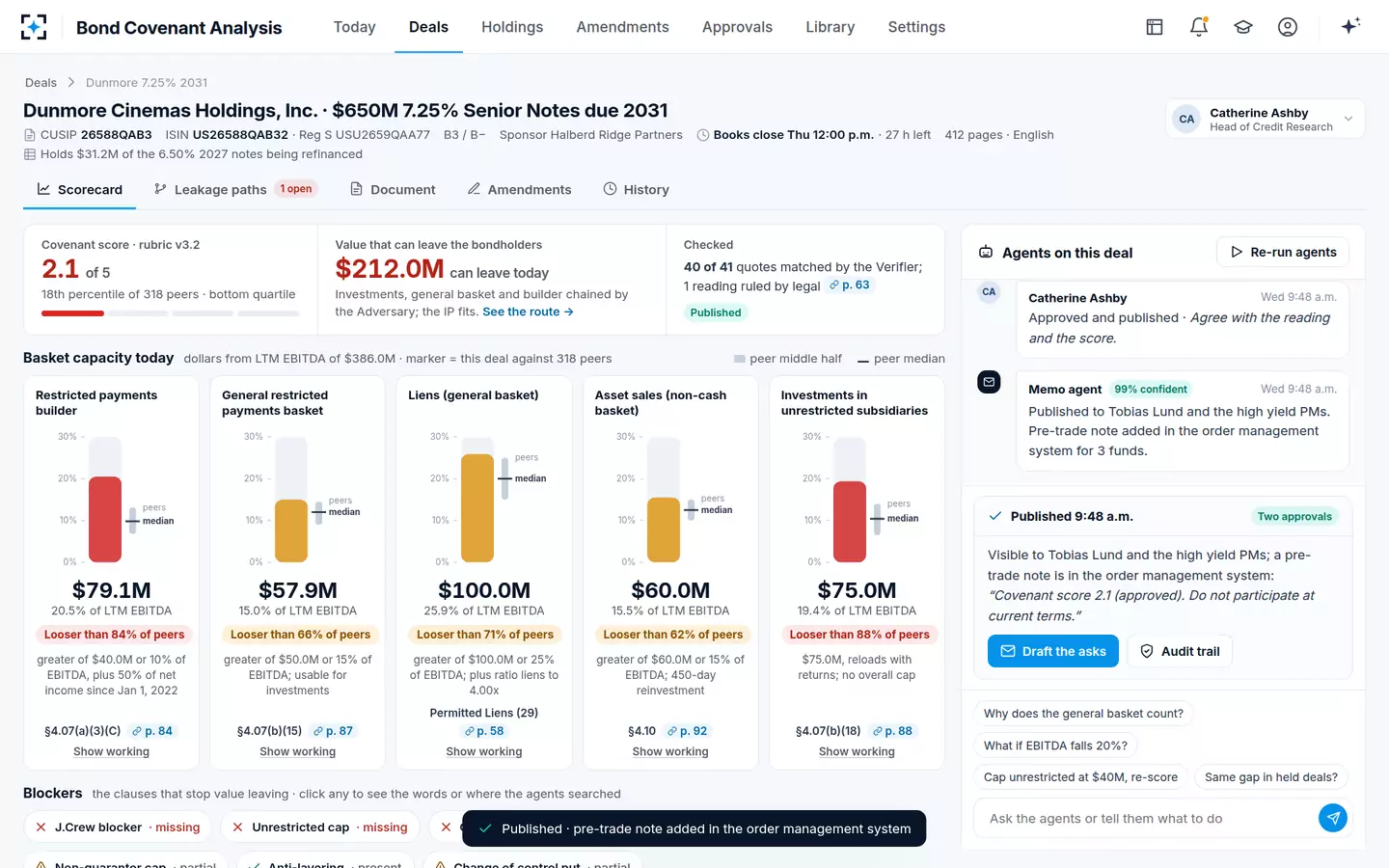
Dunmore crossed both lines: a score of 2.1 and a $212.0M route. Catherine Ashby gave the second approval at 9:48 a.m., and only then did the score reach the high yield portfolio managers, with a pre-trade note in the order management system for three funds. Her signature attests something neither analyst can: that the firm accepts this conclusion at this level of risk, under a rubric she owns. ESMA's 2024 statement on AI in investment services makes the same point about responsibility in general: a firm's management body answers for its decisions whether a person or an AI tool made them (ESMA35-335435667-5924; ESMA's wording is quoted in AI earnings call analysis: why the reader is never the checker).
Signed and published: maker, checker and second approver on one screen
When does legal review an indenture? Disputed readings, not every deal
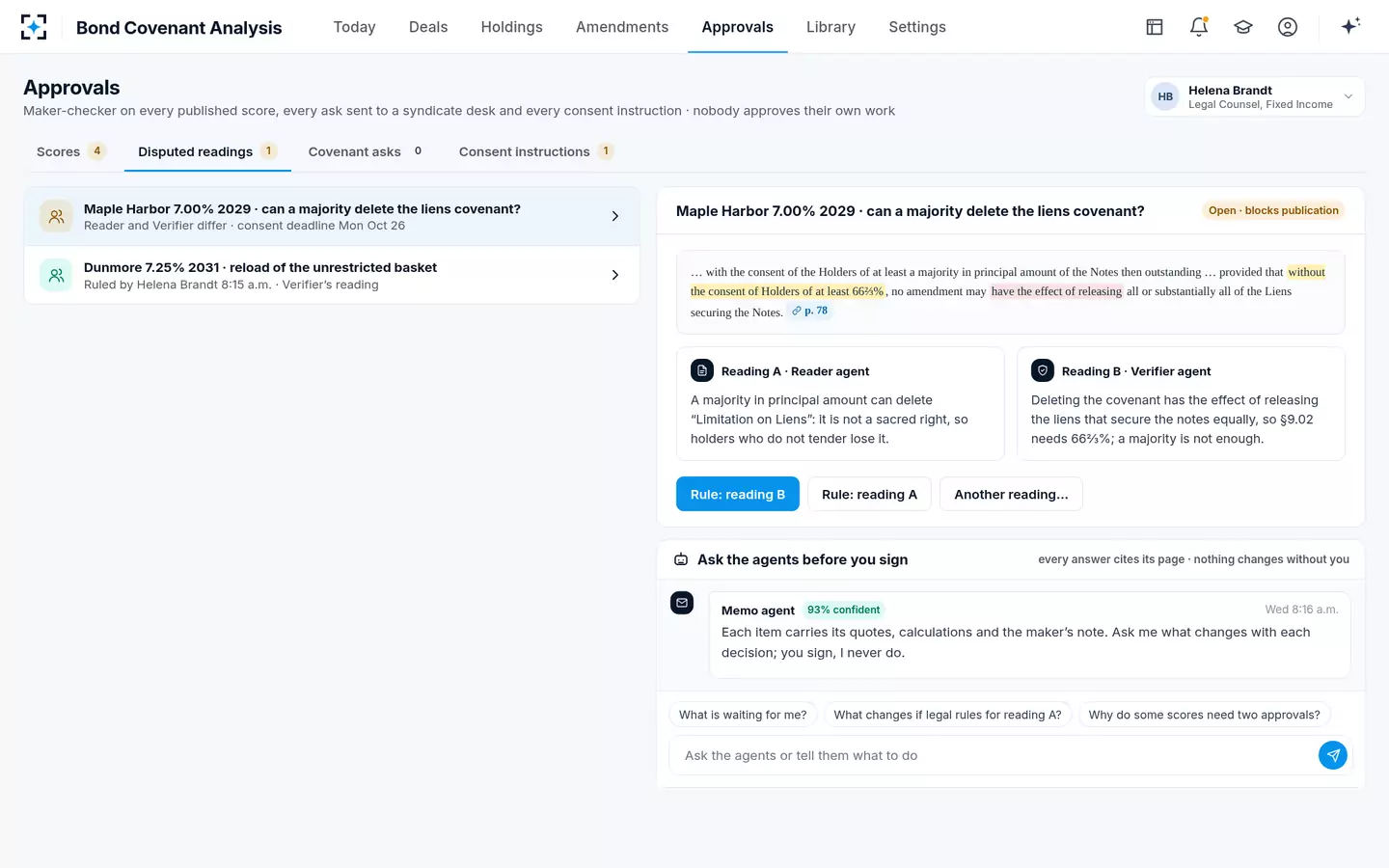
Legal counsel reviews an indenture when the words can honestly be read two ways and the difference matters, not on every deal. In Bond Covenant Analysis that moment is explicit: when the Verifier's reading differs from the Reader's, the dispute goes to counsel with the clause, the definitions it relies on and both readings side by side, and the score cannot be published until she rules.
The sample deal had one. Do returns on investments reload the $75.0M unrestricted subsidiary basket above its original size? Helena Brandt ruled for the Verifier's reading at 8:15 a.m.: returns restore the basket up to $75.0M; they do not enlarge it. The ruling changed the dollars on one route and, with them, a sentence in the memo. Another dispute was still open on a different deal: whether a simple majority of holders could delete the liens covenant when releasing the liens needs 66⅔%. That question decides how a holder votes, and what bondholders can lose by vote explains why.
Counsel's queue: the clause, reading A and reading B
A morning in the chain: 93 minutes from ruling to publication
On the sample deal, the time between counsel's ruling and publication was 93 minutes, with books closing more than a day later. The agents had finished reading the 412-page preliminary offering memorandum the evening before; the people's time went to judgement, not to finding page numbers.
Wednesday morning on the sample deal: where the 93 minutes went
- Counsel rules → analyst reviews and submits50 min
- Senior analyst checks26 min
- Head of research signs17 min
What each signature attests, and what it never covers
Writing down what each signature means is what makes the chain auditable: a reviewer later can ask each signer about their part and nothing else. The table is how the sample firm states it.
Four signatures on a Bond Covenant Analysis score, each with its own question
| Signer | Attests | Does not attest |
|---|---|---|
| Covenant analyst | She read the quotes and working; the recommendation and any edited reading are hers, with reasons. | The meaning of a clause the agents disputed; the rubric itself. |
| Senior credit analyst | The score follows the rubric, every value is cited, and every disagreement was seen and resolved. | That the firm accepts the risk at a low score or large route. |
| Head of credit research | The firm accepts this conclusion at this level of risk, under the rubric version she owns. | Each page reference; that is the analyst's and checker's work. |
| Legal counsel | What a disputed clause means, with her reason. | The score, the recommendation or the trade. |
What a signature must leave behind: a file another analyst can rebuild
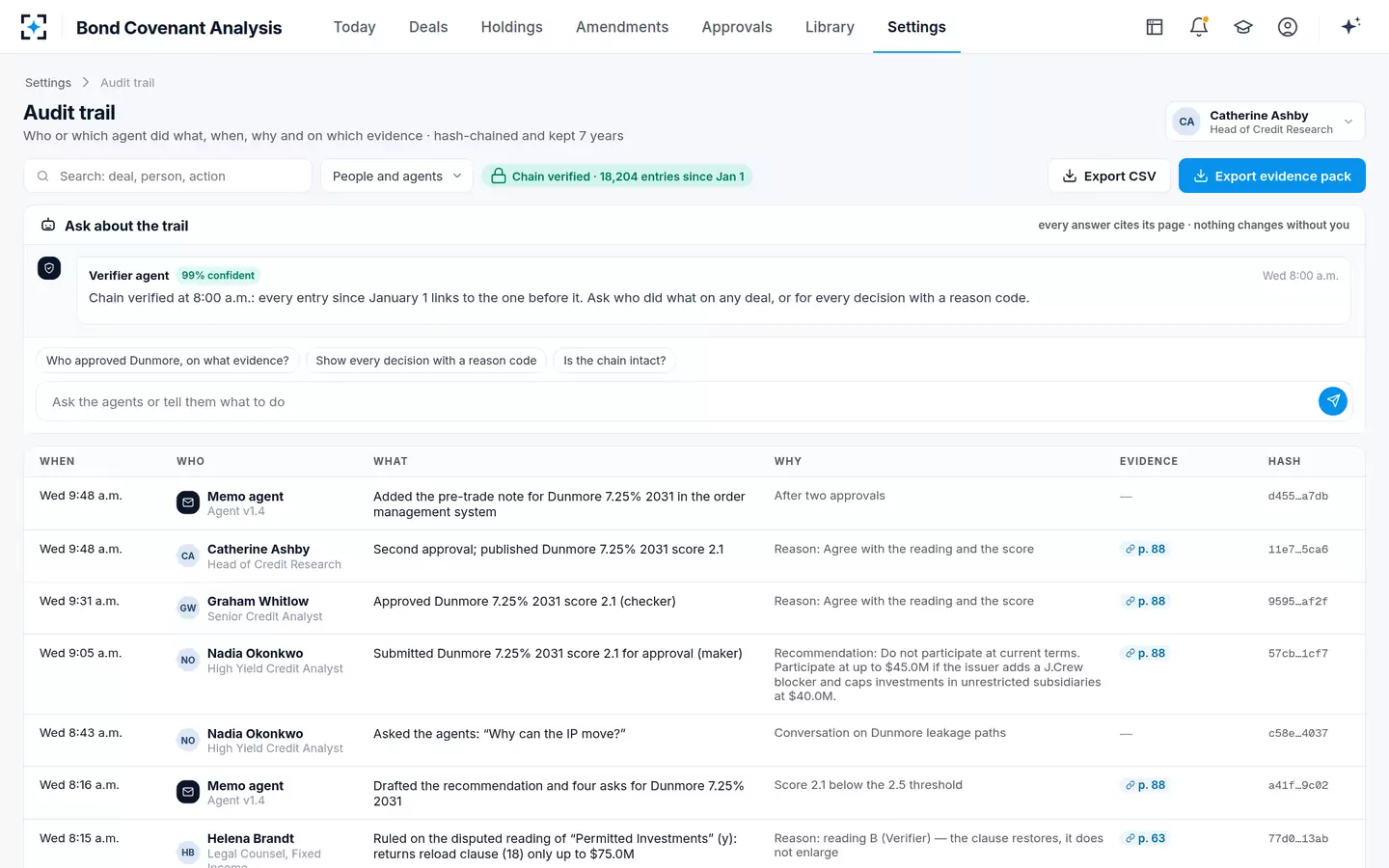
A signature is worth what a later reader can verify. For a covenant score that means the quotes with their pages and document version, the dollar working, the peer set behind every percentile, each disputed reading with its ruling, and who approved what, when and why. Without it, the next analyst re-reads the indenture from the start, and an auditor has only the conclusion.
In the sample firm, every step from the agents' first quote to the second approval sits on an audit trail kept for seven years, each entry linked to the one before, and one export gathers a deal's evidence: quotes, calculations, routes, approvals and the versions of agents, models and rubric used. Versions are what let a reviewer know which rubric and which agents produced a score signed eighteen months ago.
Who or which agent did what, when and why
Where agents fit in the chain, and why they never sign
The agents prepare everything a signer needs and sign nothing. They read, compute, rank, attack and draft; they never publish a score, send an ask to a syndicate desk, instruct a consent or trade, and any agent output below a confidence of 0.90 goes to a person before it moves on. That division is what keeps every signature meaningful: each one belongs to a named person who could have said no.
It also changes where the analyst's hours go. In Botminds' estimate for one high yield new issue with a 400-page offering memorandum, the work by hand takes about 20 hours, of which reading the covenants and their defined terms is eight; with the agents it is about two and a half, and the share spent on review and sign-off rises. How the agents check each other before anyone signs is the subject of covenant analysis with agents, and how two analysts' scores are kept consistent is in the covenant scoring system guide.
Questions people ask
What is a covenant score?
A covenant score condenses how much an indenture protects bondholders into one number on a house scale, built from weighted sub-scores for each covenant area. In the sample rubric, version 3.2, restricted payments and investments each weigh 20%, liability management blockers and debt 15% each, liens and asset sales 10% each, change of control and reporting 5% each. The number only helps if the sub-scores and their quotes travel with it.
Who approves a covenant reading when the analyst and the tool disagree?
The analyst can edit a reading and give a reason, and the checker sees both. When two independent readings of a clause still differ, the question goes to legal counsel, who rules with a reason. In the sample firm a disputed reading blocks publication until counsel decides.
What is a second approver in credit research?
A second approver is a more senior signer, usually the head of credit research, whose approval is required on top of the checker's when a score crosses a written threshold. In the sample firm the thresholds are a score below 2.5 or a route over $150.0M. The point is that the trigger is set in advance and recorded, not left to whoever is available.
What qualifications does a covenant analyst need?
The Bureau of Labor Statistics lists a bachelor's degree as the typical entry-level education for financial analysts. Covenant work adds legal reading: defined terms, cross-references and how baskets combine, usually learned on high yield or leveraged loan desks. Analysts who hold the CFA charter are also bound by its Standards V(A) and V(C), the basis-and-records test described above.
Can a covenant score be published without a lawyer?
Yes, when no reading is disputed; counsel is called for the clauses that can honestly be read two ways. On the sample deal, 40 of 41 quotes matched between two independent readings, so counsel ruled on one clause, not the whole indenture.