AI contract analysis software reads contracts and extracts what matters — clauses, parties, dates, obligations — so a reviewer can find them faster. Its public benchmarks are built from contracts filed on EDGAR and from merger agreements, where finding the clause is most of the job. A high yield indenture asks more. The question a bondholder needs answered is not "where is the restricted payments covenant?" but "how much value can leave, in dollars today, and through which combination of baskets and definitions?" That needs arithmetic from a second document, definitions read across hundreds of pages, and a search for routes no clause states. Botminds' Bond Covenant Analysis is built for that question: seven agents quote, price, rank and attack each basket, and a separate agent checks them. This guide puts three approaches — clause-extraction software, a general chatbot and covenant agents — on one 400-page indenture and five questions, and shows how to run the same test yourself.
The indenture is sample data on fictional companies: Dunmore Cinemas Holdings' $650 million of 7.25% senior notes due 2031, whose 412-page preliminary offering memorandum runs through the solution. The comparison of the first two approaches describes what each kind of tool is built to do, not a measured test of any product. Research on legal AI is linked where it appears.
Why contract AI is measured on finding clauses — and why that is not enough
0.25%
of a contract is highlighted, on average, for any one of 41 clause types in the CUAD benchmark
44.0%
precision at 80% recall: the best model's score on that benchmark in 2021
12
modifications to the standard definition of EBITDA in the average leveraged loan agreement studied
What is AI contract analysis software, and what is it built to do?
AI contract analysis software uses language models to find, label and summarise the parts of a contract a reviewer cares about, and to answer questions about them. Its core skill is retrieval: locating the clause among hundreds of pages. That matches how firms actually use generative AI; FINRA's 2026 oversight report found that the most common generative AI use among its member firms is condensing long documents and pulling specific names, relationships and facts out of them (FINRA, December 2025; the report's wording is quoted in AI earnings call analysis: why the reader is never the checker).
The research benchmarks reflect the same skill. CUAD, built "with dozens of legal experts" and "over 13,000 annotations," frames contract review as pointing a human reviewer to the passages of a contract that matter (CUAD, NeurIPS 2021). Its authors liken the task to finding needles in a haystack: labelled clauses make up about a tenth of a contract, and each kind of clause about a quarter of one per cent of it. A tool that is good at this is valuable. It is solving a different problem from covenant analysis.
Can AI read a bond indenture? Three approaches, five questions
AI can read a bond indenture, but what it can answer depends on what it was built to do. The test below runs three kinds of tool against five questions about the sample indenture, from finding a clause to deciding a disputed vote threshold. The covenant agents' answers are what Bond Covenant Analysis produced on the sample deal; the other two columns describe what each kind of tool is designed for, and are the questions a buyer should run on any product to see where it actually lands.
One indenture, three approaches, five questions
1. Quote the general restricted payments basket, with its page
Clause-extraction contract softwareBuilt for it: finds and labels the clause
General chatbot with the PDFCan find it; page references need checking
Covenant agents (reader, calculator, adversary, verifier)Quotes §4.07(b)(15), page 87
2. What is it worth in dollars today?
Clause-extraction contract softwareNot built for it: needs EBITDA from another document
General chatbot with the PDFMay compute; the EBITDA it uses may not be cited
Covenant agents (reader, calculator, adversary, verifier)$57.9M: 15% of $386.0M (page 31) vs a $50.0M floor
3. Can it fund an investment in an unrestricted subsidiary?
Clause-extraction contract softwareNot built for it: the answer is in a definition 38 pages away
General chatbot with the PDFMay answer either way, confidently
Covenant agents (reader, calculator, adversary, verifier)Yes: "Restricted Payment" includes a Restricted Investment (page 49)
4. How much value could leave to an unrestricted subsidiary?
Clause-extraction contract softwareNot built for it: requires chaining three baskets
General chatbot with the PDFRarely chains baskets unprompted
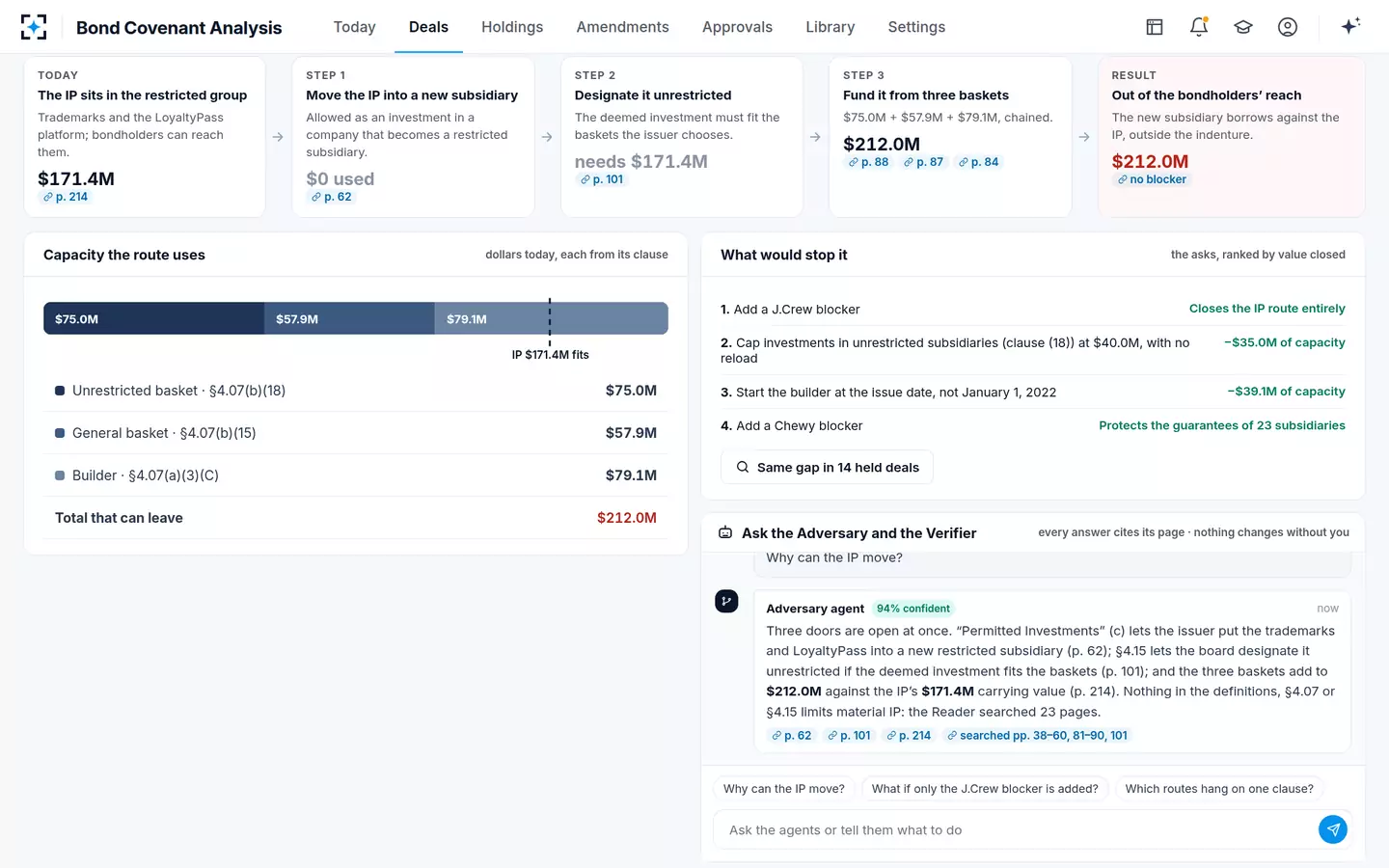
Covenant agents (reader, calculator, adversary, verifier)$212.0M through three baskets; a second agent failed to break the route
5. Can a majority delete the liens covenant?
Clause-extraction contract softwareExtracts the amendments clause
General chatbot with the PDFPicks one reading
Covenant agents (reader, calculator, adversary, verifier)Two readings differ: sent to legal counsel; publication waits
Questions 2 and 3 are where the approaches part. The general basket is the greater of $50.0M and 15% of EBITDA; to state it in dollars a tool needs twelve-month adjusted EBITDA ($386.0M, page 31) and the floor. To know whether it can fund an unrestricted subsidiary, the tool has to read the definition of "Restricted Payment" on page 49. Question 4 then needs both answers plus two other baskets — $75.0M and a $79.1M builder — chained into a $212.0M route. Question 5 is a reading on which two careful readers disagree; the right output is not an answer but a dispute for counsel.
Bond Covenant Analysis: the route question 4 asks for, step by step with its pages
Contract analysis vs covenant analysis: the difference is arithmetic and chaining
Contract analysis asks what a document says; covenant analysis asks what a document lets the issuer do, in dollars, given today's numbers and every other permission in it. The second needs three things clause extraction does not provide: numbers from outside the indenture, definitions followed across the document, and combinations of baskets that no single clause describes.
Most of a contract is not the answer: where the labelled clauses sit
Average contract in the CUAD benchmark
- Clauses labelled as important (all 41 types) · 10%
- Everything else · 90%
Covenant analysis of one basket
- The clause · 25%
- Definitions it relies on · 25%
- Numbers from another document · 25%
- Other baskets it can combine with · 25%
Contract analysis and covenant analysis, side by side
| AI contract analysis | Covenant analysis | |
|---|---|---|
| The question | Where is the clause, and what does it say? | What can the issuer do under all the clauses together, and how much? |
| Unit of output | An extracted, labelled clause or a summary | A dollar capacity per basket, a route, and a score against peers |
| Inputs | The contract | The indenture, twelve-month financials (sometimes in another language), and a library of past deals |
| The hard part | Finding the needle | Definitions: twelve EBITDA modifications in the average loan agreement; "Restricted Payment" including investments |
| What "wrong" looks like | A missed or mislabelled clause | A correct quote and a wrong total, because two baskets combine |
| Who checks | The reviewer reads the extracted clause | An independent second reading, then counsel on disputes, then a signed score |
How accurate is AI contract review? What the research measures
Accuracy depends heavily on the task, and the published benchmarks mostly measure finding and reading, not the dollar arithmetic covenant work needs. On CUAD, the best model in 2021 reached 44.0% precision at 80% recall, up from 8.2% for a 2018 model — fast progress, on a clause-finding task. MAUD, an expert-annotated benchmark built on merger agreements with "over 39,000 examples and over 47,000 total annotations," found models "performing well above random on most questions" but that "on a large subset of questions, there is still room for significant improvement" (MAUD, EMNLP 2023).
Broader legal reasoning is harder still. LegalBench assembled "162 tasks covering six different types of legal reasoning" and evaluated 20 models (LegalBench, 2023). And when researchers tested commercial legal research tools built on retrieval, which their makers had described as avoiding hallucination, they found those claims overstated: the tools hallucinated between 17% and 33% of the time, less often than general-purpose chatbots but far from never (Magesh et al., 2024, preregistered study; the study's wording is quoted in AI hallucination in legal citations). None of these benchmarks is a high yield indenture; each says the same thing about checking.
Can AI calculate covenant baskets? Only with the numbers and the working
AI can calculate covenant baskets reliably only if it takes each input from a cited source, shows every line of the working, and is checked by an independent second calculation. Without the working, a basket in dollars is an unsupported number; with it, an analyst can check it in a minute.
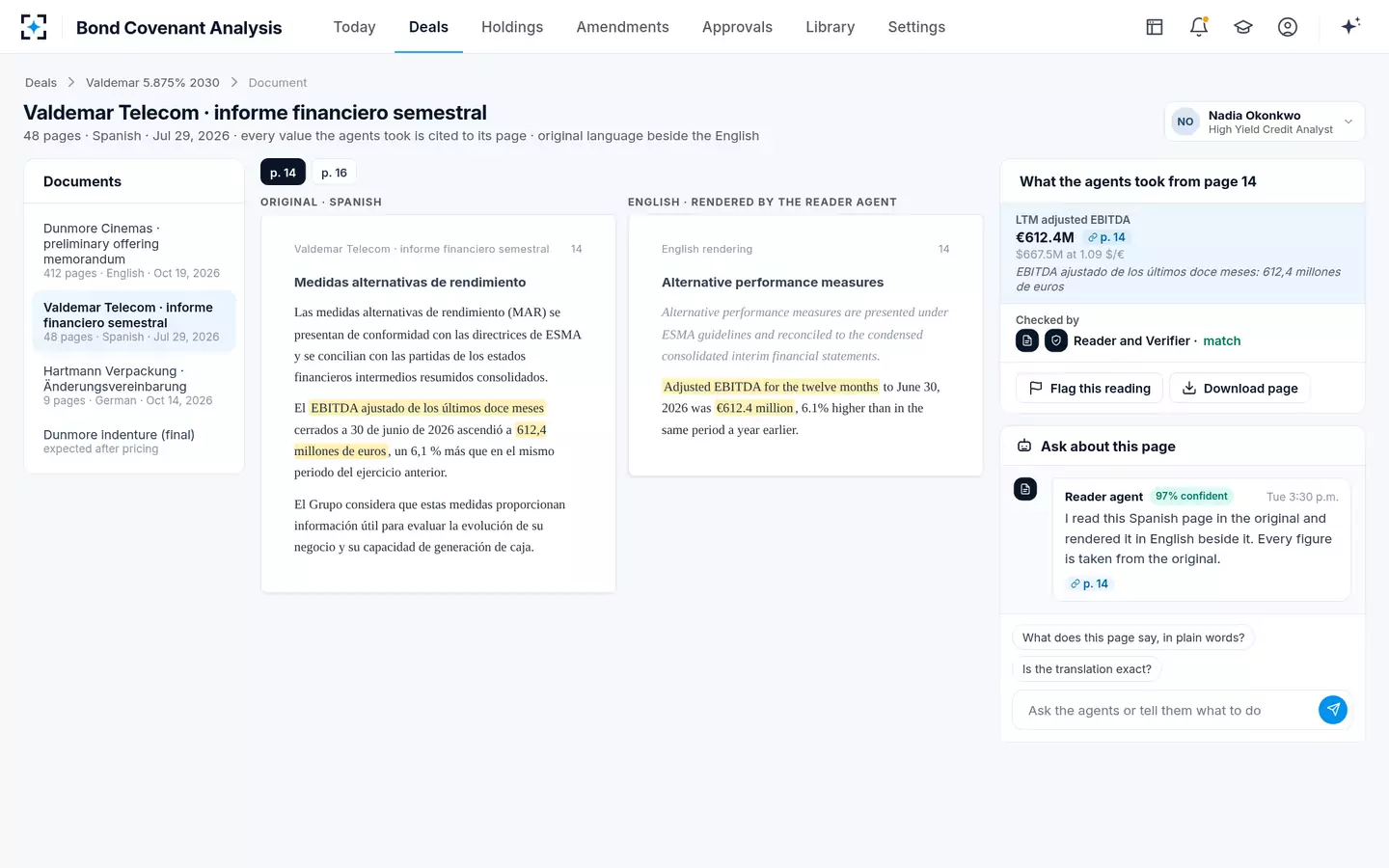
The inputs are often not in the indenture at all. Twelve-month EBITDA comes from the latest offering memorandum or the issuer's own quarterly report, sometimes in its own language. In the sample desk, a Spanish half-year report supplied Valdemar Telecom's €612.4M of twelve-month adjusted EBITDA from page 14, read in the original beside an English rendering and checked by two agents. The restricted payments guide works one basket line by line, and the agents guide explains why the calculator is never the checker.
Bond Covenant Analysis: a figure taken from a Spanish filing, original beside English
What is the best AI for legal documents? The one that matches the question
There is no single best AI for legal documents; there is a best fit for each question. For finding and organising clauses across many commercial contracts, clause-extraction tools are built for the job. For drafting or summarising, a general model with careful review may be enough. For questions whose answer is a dollar amount produced by several clauses together — covenant capacity, leakage routes, a vote threshold — the tool has to compute, chain and check, and has to say when two readings differ.
Bond Covenant Analysis is in the last group, and it is not a general contract tool. It reads indentures, offering memoranda, credit agreements and their amendments for credit teams; it does not manage a firm's commercial contracts, and it does not give legal opinions. Its readings feed a score that an analyst submits and a senior analyst approves, with counsel deciding disputed clauses.
Where clause extraction still earns its place on a credit desk
Clause extraction remains useful to a credit team wherever the job is finding rather than computing: locating every change of control definition across a portfolio, listing which held bonds have a given blocker, or pulling notice provisions before a consent deadline. It is also the first step of every covenant reading, because a basket that is not found cannot be sized.
The mistake is to stop there. A list of extracted baskets, each one correct, can still miss a $212.0M route, because the route lives in the combination. When evaluating a shortlist, ask each vendor which of the five questions above its product answers with cited working and which it leaves to the analyst; the honest answers will differ by question, and the buyer's job is to decide which questions the desk most needs answered under time pressure.
How to test contract AI on financial documents before you buy
Test any tool on documents your team has already analysed, with answers it trusts, and score more than correctness: whether each answer is cited, whether the arithmetic shows its working, and whether the tool says when it cannot answer.
A two-week test of AI contract analysis software on your own indentures
- Choose ten indentures you have already scored
Include one with a route your team found, one with a disputed clause and one with unreadable pages.
- Ask the same five questions of each
Quote a basket; size it in dollars; can it fund an investment; how much can leave; what vote changes a covenant.
- Score four outcomes, not two
Correct and cited; correct but uncited; wrong; declined. An uncited correct answer cannot be relied on in a trade.
- Check the arithmetic line by line
Every input should name its document and page; recompute three baskets yourself.
- Look for chaining, unprompted
Does the tool find that a dividend basket can fund investments without being told where to look?
- Plant an ambiguity
A good tool shows two readings and stops; a weak one picks one quietly.
- Ask for the logs and versions
Which model, prompt and document version produced each answer. A tool that cannot tell you cannot be supervised.
Two weeks on ten documents is enough to see the shape of a tool's errors, which matters more than its average score. A tool that is wrong in a way the reviewer can see — an uncited figure, a flagged ambiguity — is safer than one that is right more often but wrong silently. What to bring to a pilot covers the documents and rubric that make such a test meaningful.
Questions people ask
What is clause extraction?
Clause extraction is finding and labelling the passages of a contract that belong to a defined category — a governing law clause, a change of control clause, a cap on liability — so a reviewer can see them without reading the whole document. Benchmarks such as CUAD, with 41 label categories across 510 contracts, measure it. It is the first step of covenant analysis, not the whole of it.
Can a general chatbot read an indenture?
It can summarise one and answer simple questions, but the preregistered study cited above found general-purpose chatbots hallucinated more often than the retrieval-based legal tools, which themselves hallucinated 17% to 33% of the time. For covenant capacity, where a wrong total looks exactly like a right one, a chatbot's answer needs an independent check and cited working before anyone relies on it.
Is AI contract analysis software accurate enough for bond indentures?
Public benchmarks do not cover high yield indentures, so the honest answer is to measure it on your own documents. Score cited answers separately from uncited ones, recompute the dollar figures, and include clauses your team has disputed. A tool that declines or flags when unsure is easier to trust than one that always answers.
Does covenant analysis software replace legal review?
No. In Bond Covenant Analysis the agents read, compute and draft, but a disputed reading goes to legal counsel, the analyst submits the score and a senior analyst approves it. Counsel reviews the clauses that can honestly be read two ways; the agents make sure she sees them.
How long does a pilot of contract AI take?
Two weeks on about ten documents your team already knows is enough to see how a tool fails, if the questions include arithmetic, chaining and an ambiguous clause. A longer side-by-side run on live new issues shows whether it holds up under time pressure.